The SaaSpocalypse Isn't the Death of SaaS: How AI Is Disrupting the Traditional SaaS Business Model
- 1 The SaaSpocalypse Isn't the Death of SaaS: How AI Is Disrupting the Traditional SaaS Business Model
- 1.1 Key Takeaways
- 1.2 What Is the SaaSpocalypse?
- 1.3 Why Is Everyone Talking About the SaaS Apocalypse?
- 1.4 Is SaaS Actually Dying?
- 1.5 How AI Is Disrupting the Traditional SaaS Business Model
- 1.6 The New SaaS Business Model: From Features to Outcomes
- 1.7 Service-as-Software: When AI Agents Get Priced Like a Service, Not a Seat
- 1.8 What Happens to Traditional SaaS Companies?
- 1.9 SaaS Apocalypse vs SaaS Evolution
- 1.10 Is This Actually Happening? The Evidence Behind the SaaSpocalypse
- 1.11 How SaaS Companies Can Survive the AI Disruption
- 1.12 What Should Businesses Do About the SaaSpocalypse?
- 1.13 The Opportunity Behind the SaaSpocalypse
- 1.14 How Inno Panda Can Help Businesses Adapt
- 1.15 Quick Glossary
- 1.16 Frequently Asked Questions About the SaaSpocalypse
- 1.16.1 What Is the SaaSpocalypse?
- 1.16.2 Is SaaS Dead in 2026?
- 1.16.3 Is AI Killing SaaS?
- 1.16.4 Will AI Agents Replace SaaS?
- 1.16.5 How Are AI Agents Changing SaaS?
- 1.16.6 Why Is SaaS Pricing Changing?
- 1.16.7 Is Per-Seat SaaS Pricing Becoming Obsolete?
- 1.16.8 What Is Service-as-Software (SaS)?
- 1.16.9 How Is Service-as-Software Different From Traditional SaaS?
- 1.16.10 What Is Agentic SaaS?
- 1.16.11 What Is an Agentic Workflow?
- 1.16.12 What Is the Future of SaaS?
- 1.16.13 How Can SaaS Companies Survive AI Disruption?
- 1.16.14 Which Companies Have Already Changed Their Pricing Because of AI?
- 1.17 SaaS Isn't Dead. The Old SaaS Model Is Being Rewritten.
- 1.18 Related Reading from Inno Panda
- 1.19 Ready to Rethink Your Digital Strategy?
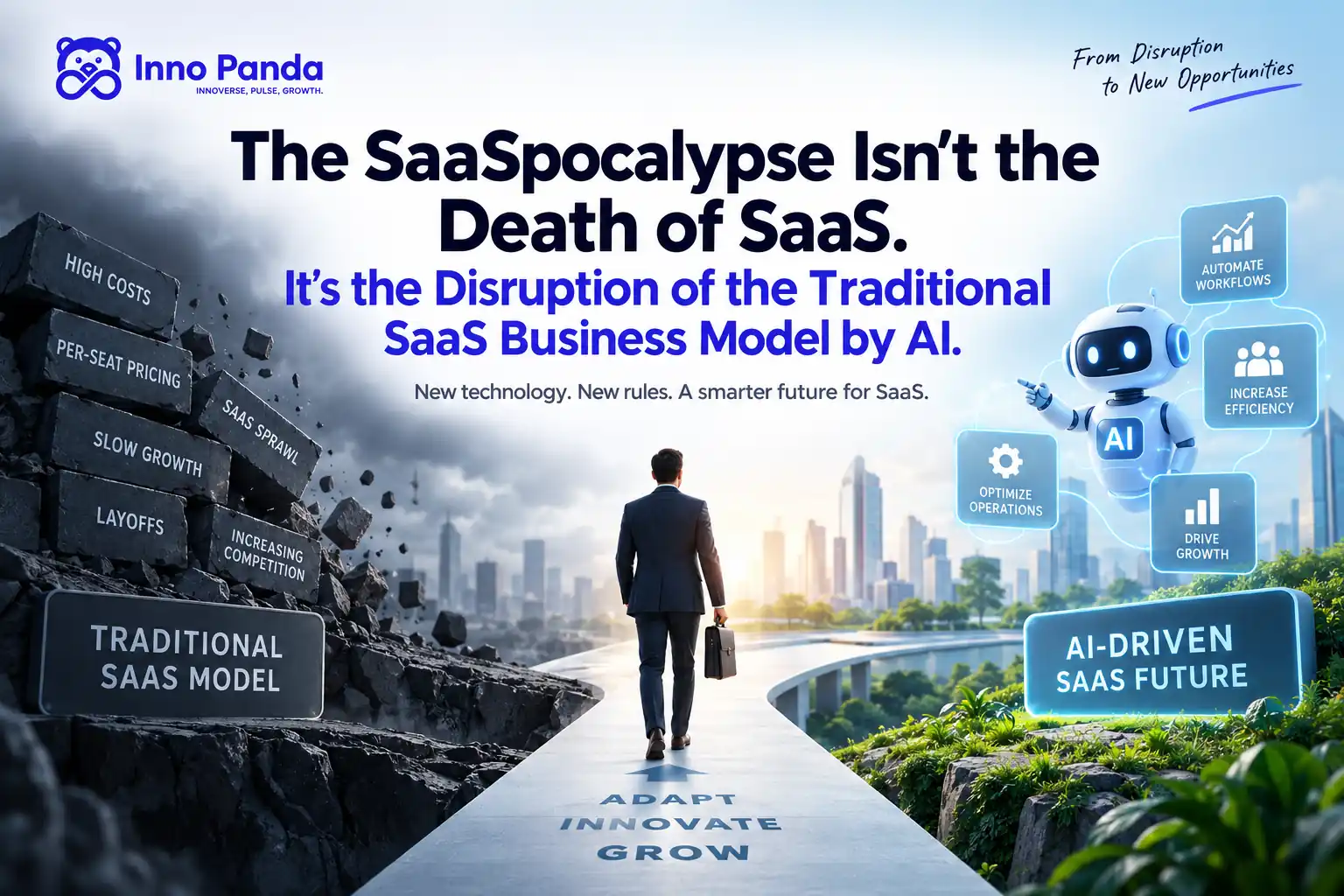
AI isn't just another SaaS feature. It's challenging the assumptions that made traditional SaaS work in the first place: humans logging into applications, paying per seat, and buying yet another point solution to bridge the gaps. This guide explains what the SaaSpocalypse actually means, why AI agents are accelerating it, how "Service-as-Software" pricing fits in, and what SaaS companies and businesses should do next.
Key Takeaways
- The SaaSpocalypse describes SaaS business models being disrupted, not SaaS itself disappearing.
- The traditional SaaS model, built on human logins and per-seat pricing, is what's under pressure, not software as a category.
- Software still runs on SaaS infrastructure, but AI agents are increasingly the ones operating it on a human's behalf.
- SaaS pricing is shifting from per-seat toward usage-based, consumption-based, and outcome-based models.
- A new category, "Service-as-Software," prices AI agents for completed work rather than software access, and it's already live at companies like Intercom, Salesforce, and Zendesk.
- Data, workflows, and integrations are becoming stronger competitive moats than feature lists alone.
- Choosing how to respond matters as much as the disruption itself: build AI in, rethink pricing, and reduce SaaS sprawl.
AI isn't simply adding another feature to SaaS. It's challenging the assumptions that made traditional SaaS successful in the first place: humans logging into applications, companies paying per user or seat, businesses buying multiple point solutions to stitch workflows together, software acting as the primary interface for getting work done, and SaaS companies monetizing access rather than outcomes.
This guide covers what the SaaSpocalypse actually means, why AI agents are accelerating the shift, why SaaS pricing is changing, the new "Service-as-Software" category that's emerging around it, whether SaaS is genuinely dying, and what SaaS companies and businesses should do about it. If pricing specifically is what you're trying to get your head around, our deeper breakdown of SaaS pricing in 2026 covers the full cost picture businesses are dealing with today.
What Is the SaaSpocalypse?
SaaSpocalypse: the disruption of traditional SaaS business models as AI, particularly AI agents, changes how software is built, purchased, used, priced, and monetized.
The term picked up momentum as AI tools got noticeably better at reading, reasoning, and acting on data, not just generating text. The conversation intensified specifically around AI agents, since an agent that can log into a system and complete a task on a person's behalf changes the economics of software in a way a chatbot never did. That's the real reason SaaS economics are being questioned right now: not because AI is a flashy new feature, but because it changes who, or what, actually uses the software. "Apocalypse" is a dramatic word, but it doesn't mean extinction here. It means the end of a particular era of SaaS, not the end of software.
Why Is Everyone Talking About the SaaS Apocalypse?
AI Is Changing How Software Is Used
The traditional pattern looks like this: human, then SaaS application, then workflow, then result. The emerging pattern looks different: human, then AI agent, then multiple applications working together, then result. The agent becomes the thing doing the clicking, the switching between tools, and the assembling of the final output.
AI Is Changing How Software Is Built
AI-assisted coding has made software cheaper and faster to build. That means more competition, faster product development, and easier creation of niche tools that would once have taken a full team months to ship. The barrier to building a competent SaaS alternative has genuinely dropped.
Companies Are Questioning SaaS Spend
SaaS sprawl, overlapping tools, and unclear ROI have pushed many companies toward consolidation. Finance and operations teams are increasingly asking which subscriptions are actually earning their keep, and cutting the ones that aren't.
Investors Are Demanding More Than Growth
The old formula, growth at all costs, has given way to a demand for efficiency and profitability alongside growth. SaaS companies burning cash to add seats without a clear path to sustainable margins face a much tougher market than they did a few years ago.
Is SaaS Actually Dying?
No. SaaS isn't disappearing. The traditional SaaS model is being forced to evolve.
It helps to separate two things that get conflated constantly: SaaS as a software delivery method, and SaaS as a business model. The delivery method, cloud-hosted software accessed over the internet, isn't going anywhere. The business model built around it is what's under real pressure.
SaaS Isn't Going Away
Enterprise software, cloud infrastructure, data systems, security, compliance, collaboration tools, and core business applications remain essential. None of that disappears because AI agents exist. If anything, agents need reliable systems to act on, which keeps this infrastructure relevant.
But Traditional SaaS Economics Are Under Pressure
Per-seat pricing, workflows designed around a human clicking through screens, differentiation based purely on feature lists, and a sprawl of disconnected point solutions are exactly the parts of the old model that don't hold up well once AI agents enter the picture.
How AI Is Disrupting the Traditional SaaS Business Model
From Software Applications to AI Agents
In the traditional model, a human interacts directly with an application. In the AI-native model, an AI agent interacts with applications on the human's behalf, working across tools, completing tasks, and responding to natural-language instructions rather than menu clicks. This is what people mean by agentic workflows: not a single AI feature, but AI doing the operating. Our guide to AI agents in SaaS goes deeper into how this is showing up inside actual business platforms today.
Agentic Workflows Are Changing the Software Stack
Picture the old path: a user moves data between a CRM, a spreadsheet, an email tool, and an analytics dashboard, then compiles a report by hand. The emerging path collapses that: a user asks an AI agent for the outcome, and the agent moves across the CRM, the spreadsheet, the email tool, and the analytics dashboard to deliver it.
That's a real shift in where value sits. If an agent can operate ten different tools to reach an outcome, the specific interface each tool offers matters less than whether it can be reached and operated at all.
Why AI Agents Challenge Per-Seat SaaS Pricing
Traditional SaaS pricing assumes more employees means more seats means more revenue. In an AI-native environment, fewer human interactions can still mean more work getting done, just automated instead of manual, which breaks that simple equation. That's pushing pricing toward usage-based, consumption-based, and outcome-based models instead of a flat per-seat fee.
| Traditional SaaS | AI-Native SaaS |
|---|---|
| Per-seat pricing | Usage-based pricing |
| Human users | Human + AI agents |
| Application-centric | Workflow-centric |
| Feature value | Outcome value |
| Manual workflows | Automated workflows |
AI Is Changing the Build-vs-Buy Decision
With AI-assisted development lowering the cost of building software, more companies are asking whether they actually need another SaaS subscription or whether AI can build or automate the same thing internally. That said, build vs buy isn't automatically shifting toward build. Enterprise-grade SaaS still offers security, compliance, reliability, integrations, support, governance, and scalability that an internally-built tool often can't match without significant, ongoing investment. The honest answer is that both paths remain valid, and the right one depends on the specific problem.
The New SaaS Business Model: From Features to Outcomes
Traditional SaaS sells access: "here's our software, log in and use it." Emerging AI-native software increasingly sells completion: "we finish this business task for you." That shift shows up in pricing models built around outcomes, usage, and consumption rather than a flat monthly fee per user.
Service-as-Software: When AI Agents Get Priced Like a Service, Not a Seat
The outcome-based pricing shift described above has a name now. Industry analysts increasingly use the term "Service-as-Software" (sometimes shortened to SaS) to describe AI-powered platforms that carry out a task a human employee or an outsourced service used to do, and charge for the result delivered rather than for access to a tool. It's a meaningful distinction from ordinary outcome-based pricing on a SaaS product, because the software isn't just helping a person do the work anymore, it's doing the work itself, end to end.
This isn't a future concept sitting in a pitch deck somewhere. It's already priced and live at some of the largest names in SaaS:
Intercom Fin
Charges per successfully resolved customer conversation. No resolution, no charge, which shifts the performance risk onto the vendor rather than the customer.
Salesforce Agentforce
Prices AI-handled customer service conversations per interaction, alongside a separate per-action credit model, rather than charging by user seat.
Zendesk
Bills for each support ticket its AI agent resolves without human help, confirmed after a set window of customer inactivity, with a lower committed rate and a higher pay-as-you-go rate.
Newer AI-Native Vendors
Several younger customer-support AI companies have built their entire pricing model around this idea from day one, charging purely for resolved outcomes rather than any form of seat or licence.
The mechanics vary by vendor, some charge per resolved case, others per "action" or unit of AI work, but the underlying logic is consistent: the customer is buying a completed piece of work, priced closer to how a business would pay an outsourced service provider than how it would pay for a software licence. That has real implications for anyone building or buying SaaS. For vendors, it means the product has to reliably finish the job, not just offer a helpful interface. For buyers, it means comparing quotes on cost-per-outcome rather than cost-per-seat, and asking hard questions about how an "outcome" is actually defined and measured before signing anything, since disputes over what counts as a successful resolution are one of the more common friction points as this model matures.
Figures and examples above reflect publicly reported 2026 pricing structures from the vendors named; specific rates change over time and should be confirmed directly with each vendor.
What Happens to Traditional SaaS Companies?
Feature-Based SaaS
Risk: features get commoditized as AI can replicate functionality, and switching costs fall.
Point Solutions
Risk: AI agents can connect multiple systems directly, making standalone tools easier to consolidate away.
Workflow-Critical Platforms
Strength: proprietary data, deep integrations, compliance requirements, and embedded workflows raise switching costs.
Data-Rich SaaS
Strength: data, workflow, context, and distribution together form a moat that's genuinely hard for AI to replicate on its own.
There's a related pattern worth watching here too: narrow, industry-specific platforms are generally holding up better against this disruption than broad, horizontal tools, largely because their depth in one workflow is harder for a general-purpose AI agent to shortcut. Our comparison of vertical SaaS vs horizontal SaaS looks at why that specificity is becoming a genuine competitive advantage in 2026, not just a niche positioning choice.
SaaS Apocalypse vs SaaS Evolution
| SaaS Apocalypse Narrative | SaaS Evolution Reality |
|---|---|
| SaaS is dying | Traditional SaaS is changing |
| AI replaces software | AI changes how software is accessed |
| SaaS subscriptions disappear | Pricing models evolve |
| Apps become irrelevant | Applications become infrastructure |
| Humans use every tool | Agents increasingly execute workflows |
| Features drive value | Outcomes increasingly drive value |
Is This Actually Happening? The Evidence Behind the SaaSpocalypse
It's easy to treat "the SaaSpocalypse" as a catchy label without checking whether the underlying shift is real. It is, and it's showing up in actual pricing decisions, not just conference talks.
The company-level evidence backs this up too. In the first few months of 2026 alone, HubSpot introduced outcome-based pricing for its Breeze AI agents, SAP announced a shift toward AI consumption pricing, and Anthropic leaned further into usage-based billing for Claude while lowering its enterprise seat prices. These aren't small startups experimenting on the margins. They're established SaaS and AI companies actively rewriting how they charge, in public, this year.
The pattern shows up in growth numbers too. Vendors that price by consumption have been growing revenue well above the median for public SaaS companies, and usage-based or hybrid pricing models carry a meaningful net revenue retention advantage over pure seat-based models, according to recent B2B SaaS and AI-native benchmarking research. None of this proves SaaS is disappearing. It proves the pricing and packaging assumptions behind traditional SaaS are already being rewritten by the companies with the most to lose if they get it wrong.
Figures referenced above are drawn from public 2026 industry research on B2B SaaS monetization, enterprise software spend, and SaaS management benchmarks; specific figures should be verified against the original research before being cited elsewhere.
How SaaS Companies Can Survive the AI Disruption
Build AI Into the Core Product
Not a bolted-on chatbot. AI woven into workflows, recommendations, automation, decision-making, and task execution itself.
Move From Features to Outcomes
Ask what business result the product actually delivers: leads generated, hours saved, revenue increased, costs reduced, tasks completed.
Prepare for Agentic Workflows
Make the product API-friendly, integration-ready, automation-ready, and genuinely interoperable with the tools an agent might need to reach.
Rethink Pricing
Evaluate seat-based, usage-based, consumption-based, outcome-based, and hybrid models against how the product is actually used now.
Strengthen the Data Moat
AI can commoditize features quickly. Proprietary data, customer context, workflows, integrations, and domain knowledge are harder to replicate.
Reduce SaaS Sprawl
Audit duplicate tools, unused subscriptions, overlapping functionality, manual processes, and disconnected systems, both in your own stack and your customers'.
What Should Businesses Do About the SaaSpocalypse?
For SaaS Founders
Rethink product strategy and pricing, integrate AI meaningfully, and protect proprietary data as a genuine differentiator.
For Enterprises
Audit your SaaS stack, identify automation opportunities, evaluate where AI agents genuinely help, and consolidate overlapping tools.
For Digital Teams
Optimise workflows, improve integrations, measure ROI honestly, and build infrastructure that can actually scale with demand.
The Opportunity Behind the SaaSpocalypse
Every technology disruption creates winners and losers, and this one is no different. The opportunity here isn't simply "cut SaaS spending." It's building a smarter digital operating system: AI, automation, data, integrations, and digital optimisation working together toward sustainable growth, rather than a pile of disconnected subscriptions that each do one small thing well.
How Inno Panda Can Help Businesses Adapt
The problems this article covers, SaaS sprawl, disconnected workflows, pricing questions, and where AI genuinely adds value, are ones we work through with clients regularly. A few areas where that shows up in practice:
Digital Strategy & Custom Systems
Identifying where your current tech stack has real gaps, and what's worth building versus buying.
Automation & AI
Finding the repetitive workflows across your existing tools that are genuinely worth automating.
Website & Infrastructure Optimisation
Improving the performance of the digital infrastructure everything else depends on.
SEO & Organic Growth
Building acquisition that compounds over time, rather than relying entirely on paid channels.
If AI and automation are the piece you're trying to figure out first, our AI Automation & Integration team can help map where it actually fits. If your infrastructure needs work before any of this makes sense, our Website Optimisation team can start there. And for organic growth that doesn't depend on chasing every new AI trend, our SEO Services team builds the kind of visibility that compounds.
Quick Glossary
- SaaSpocalypse
- The disruption of traditional SaaS business models as AI changes how software is built, purchased, used, priced, and monetized.
- Agentic Workflow
- A multi-step process where an AI agent, rather than a human, moves a task across tools and systems to reach a completed outcome.
- Service-as-Software (SaS)
- AI-powered platforms that carry out a task a human employee or outsourced service used to do, charging for the completed outcome rather than for software access or seats.
- Per-Seat Pricing
- A SaaS pricing model that charges based on the number of individual users with access, regardless of how much they actually use the product.
- Usage-Based Pricing
- A pricing model based on how much a product is actually used, rather than how many people have access to it.
- Outcome-Based Pricing
- A pricing model tied to the business result delivered, such as leads generated or hours saved, rather than access or usage alone.
- SaaS Sprawl
- The accumulation of overlapping, underused, or disconnected SaaS subscriptions across a business over time.
- Net Revenue Retention (NRR)
- A measure of how much recurring revenue a company keeps and grows from its existing customers over time, factoring in upgrades, downgrades, and cancellations.
Frequently Asked Questions About the SaaSpocalypse
What Is the SaaSpocalypse?
The SaaSpocalypse refers to the disruption of traditional SaaS business models as AI, particularly AI agents, changes how software is built, purchased, used, priced, and monetized. It's less about SaaS disappearing and more about the old rules no longer holding.
Is SaaS Dead in 2026?
No. SaaS as a delivery model, cloud infrastructure, data systems, and business applications remain essential. What's under pressure is the traditional SaaS business model built on per-seat pricing and manual, human-driven workflows.
Is AI Killing SaaS?
AI isn't killing SaaS itself, it's killing the assumptions that made the old SaaS model work: that humans log in and click through software, and that more users automatically means more revenue. Software still matters; how it's accessed and priced is what's changing.
Will AI Agents Replace SaaS?
Not entirely. AI agents are more likely to sit on top of existing SaaS applications, calling them through APIs to complete tasks, than to fully replace the underlying software, data, and infrastructure those applications provide.
How Are AI Agents Changing SaaS?
AI agents shift software from something a human clicks through to something an agent operates on a human's behalf, often across multiple tools at once. That changes what's valuable: completing the workflow, not just providing the interface.
Why Is SaaS Pricing Changing?
Per-seat pricing assumes more human users means more value delivered. When AI agents handle more of the work, that assumption breaks down, pushing SaaS companies toward usage-based, consumption-based, or outcome-based pricing instead.
Is Per-Seat SaaS Pricing Becoming Obsolete?
Not obsolete everywhere, but increasingly questioned for workflows where AI agents do more of the actual work than human users do. Usage-based and outcome-based models are gaining ground precisely because seat count stops reflecting real usage.
What Is Service-as-Software (SaS)?
Service-as-Software describes AI-powered platforms that autonomously carry out a task an outsourced service or a human employee used to do, and charge based on the outcome delivered rather than seats or software access. Customer support resolved by an AI agent, billed per resolution, is a common early example.
How Is Service-as-Software Different From Traditional SaaS?
Traditional SaaS sells access to a tool and leaves a human to do the work inside it. Service-as-Software sells the completed work itself, with an AI agent doing what a person or an outsourced service previously did, and pricing tied to results rather than logins or seats.
What Is Agentic SaaS?
Agentic SaaS describes software built to be operated by AI agents as much as by human users, designed to be API-friendly, integration-ready, and capable of completing multi-step tasks autonomously rather than waiting for manual input at every step.
What Is an Agentic Workflow?
An agentic workflow is a multi-step process where an AI agent, rather than a human, moves the task across different tools and systems to reach a completed outcome, only involving a person for approval or exceptions.
What Is the Future of SaaS?
The future of SaaS likely combines proprietary data, deep integrations, and measurable outcomes rather than feature lists alone. Software that plugs into agentic workflows and proves real business results is better positioned than software that simply adds an AI chatbot on top.
How Can SaaS Companies Survive AI Disruption?
By building AI into core workflows rather than bolting it on, shifting messaging from features to outcomes, making products agent-friendly through APIs, reconsidering pricing models, and strengthening the proprietary data and integrations that are harder for AI to commoditize.
Which Companies Have Already Changed Their Pricing Because of AI?
Several established SaaS and AI companies made pricing changes in early 2026, including HubSpot introducing outcome-based pricing for its Breeze AI agents, SAP shifting toward AI consumption pricing, and Anthropic leaning further into usage-based billing for Claude while lowering enterprise seat prices.
SaaS Isn't Dead. The Old SaaS Model Is Being Rewritten.
This isn't really a story about SaaS versus AI. It's a story about traditional SaaS becoming AI-native SaaS. The companies that come out ahead will likely be the ones that combine AI with proprietary data, real workflows, deep integrations, and measurable outcomes, rather than the ones that simply bolt AI onto an existing product and call it a feature.
If you're trying to work out where your own business or product sits in that shift, that's a conversation worth having sooner rather than later.
Ready to Rethink Your Digital Strategy?
Whether you're a SaaS company rethinking pricing and product, or a business trying to cut through SaaS sprawl and figure out where AI genuinely helps, let's talk through what actually fits your situation.