Vertical SaaS vs Horizontal SaaS: Why Industry-Specific Platforms Are Winning in 2026
- 1 Vertical SaaS vs Horizontal SaaS: Why Industry-Specific Platforms Are Winning in 2026
- 1.1 Key Takeaways
- 1.2 What Is Vertical SaaS vs Horizontal SaaS? Understanding the Basics
- 1.3 Vertical SaaS vs Horizontal SaaS Pros and Cons
- 1.4 Vertical SaaS vs Horizontal SaaS: How the Business Numbers Compare
- 1.5 Why Vertical SaaS Is Winning in 2026: The Shift Behind the Numbers
- 1.6 Micro SaaS vs Vertical SaaS: What's the Difference (and Why It Matters)
- 1.7 How to Pick the Right Vertical for Your SaaS Idea
- 1.8 Real Vertical SaaS Case Studies: What We've Actually Built
- 1.9 Vertical SaaS in Southeast Asia: The Opportunity Nobody's Talking About
- 1.10 How to Choose the Right SaaS Model for Your Business
- 1.11 How Inno Panda Builds Vertical SaaS Platforms for Singapore Businesses
- 1.12 Quick Glossary: Vertical SaaS Terms Explained
- 1.13 Frequently Asked Questions About Vertical SaaS vs Horizontal SaaS
- 1.14 Thinking About Building a Vertical SaaS Platform for Your Industry?
If you've ever asked "what is vertical SaaS" or wondered why your generic project management tool never quite fits how your industry actually works, you're not alone. In 2026, industry-specific software is quietly outgrowing the one-size-fits-all platforms that dominated the last decade. Here's what's actually changing, with real company examples, business metrics, and two vertical SaaS products we've built ourselves.
Key Takeaways
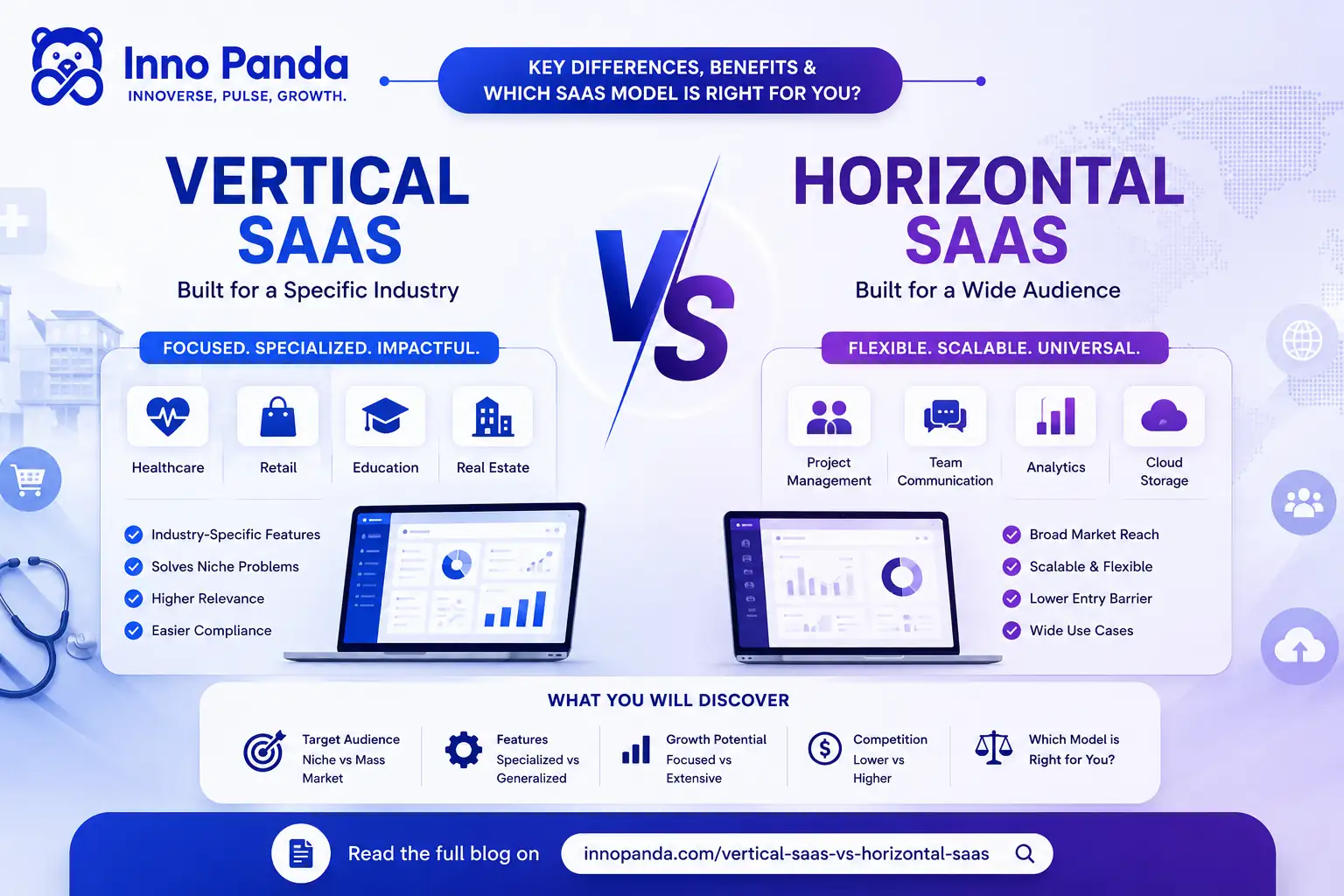
- Vertical SaaS is software built for one specific industry (e.g. construction, staff scheduling, ecommerce selling). Horizontal SaaS is general-purpose software (CRM, accounting, chat) built to serve any industry.
- Vertical SaaS is growing quickly, helped by cheaper AI-assisted development and buyer fatigue with generic software.
- Vertical SaaS usually wins on retention and lower acquisition cost; horizontal SaaS usually wins on total addressable market and scale.
- Southeast Asia is an under-served vertical SaaS market - many SME workflows here still run on tools built for Western markets.
- Inno Panda builds vertical SaaS directly: ReKloq for staff attendance tracking and SyncingAbout for multi-channel ecommerce selling.
What Is Vertical SaaS vs Horizontal SaaS? Understanding the Basics
Vertical SaaS is software built for one specific industry - think a booking system made only for gyms, or a compliance tool made only for clinics. Horizontal SaaS is the opposite: general-purpose software like a CRM or accounting tool that any business, in any industry, can use.
Neither model is "better" on its own. Horizontal SaaS wins on scale - a tool like a generic CRM or accounting platform can sell to almost any company on earth. Vertical SaaS wins on depth - it speaks your industry's language, handles your compliance headaches, and fits into your existing workflow without twenty workarounds. The question isn't which model is superior. It's which one actually solves your problem.
Vertical SaaS Examples Across Industries
| Industry | What Vertical SaaS Solves |
|---|---|
| Construction | Project timelines, permit tracking, on-site coordination |
| F&B / Restaurants | Table turnover, kitchen workflow, POS and inventory |
| Healthcare | Patient scheduling, records, and regulatory compliance |
| Fitness & Gyms | Class scheduling, membership billing, trainer management |
| Ecommerce (multi-channel) | Syncing inventory and orders across marketplaces |
| Workforce management | Attendance, shift tracking, and staff accountability |
Horizontal SaaS Examples You Already Use
Horizontal SaaS is the software running quietly in the background of almost every business: CRM platforms for tracking customer relationships, accounting software for invoicing, communication tools for team chat, and marketing platforms for email campaigns. These tools are built to be flexible enough for a bakery and a law firm to use the exact same product.
Vertical SaaS vs Horizontal SaaS: Real Company Examples
Abstract definitions only go so far. Here is how the split looks with actual products you may already know. Some of these companies sell into several segments, so treat the table as a simple guide.
| Model | Company | Who It Serves |
|---|---|---|
| Vertical | Toast | Restaurants: POS, kitchen and payments |
| Vertical | Procore | Construction project management |
| Vertical | Veeva | Life sciences and pharma compliance |
| Vertical | ServiceTitan | Home service trades such as plumbing and HVAC |
| Vertical | Mindbody | Gyms, studios and wellness businesses |
| Vertical (SEA) | StoreHub | Retail and F&B point of sale |
| Vertical (SEA) | Moka | Indonesian retail and F&B point of sale |
| Horizontal | Salesforce, HubSpot | CRM for any industry |
| Horizontal | Slack | Team chat for any company |
| Horizontal | QuickBooks, Xero | Accounting for any small business |
Notice the pattern. Each vertical product owns one workflow end to end. A restaurant owner does not need a CRM with a restaurant plugin. They need a till, a kitchen screen and a payment link that already work together.
These are general market patterns, not audited figures. Results vary by industry and product.
Vertical SaaS vs Horizontal SaaS Pros and Cons
Pros and Cons of Vertical SaaS
Pros and Cons of Horizontal SaaS
Vertical SaaS vs Horizontal SaaS: How the Business Numbers Compare
If you are building a product or backing one, the model you pick changes how the whole business behaves. This is the comparison founders and investors look at first.
| Metric | Vertical SaaS | Horizontal SaaS |
|---|---|---|
| Market size | Smaller, but clearly defined | Very large, but crowded |
| Customer acquisition cost | Often lower, because buyers cluster in one industry | Often higher, because you compete with many tools |
| Churn | Often lower, because the product runs daily operations | Often higher, because switching is easier |
| Revenue per customer | Can grow through add-ons such as payments and payroll | Mostly grows by adding seats |
| Sales cycle | Shorter once you know the industry's buyers | Longer, with more varied buyers |
| Main risk | Running out of room inside one niche | Being copied by a bigger rival |
These are general patterns, not guarantees. A badly chosen niche can still churn, and a well-run horizontal tool can still keep customers for years.
How Vertical SaaS Companies Make Money
Most vertical products start with a monthly subscription. The stronger ones then add revenue lines that fit the industry, such as payment processing, payroll, lending or a marketplace. Because the software already sits at the centre of daily work, adding these services feels natural to the customer. That is a big reason investors like the model.
Why Vertical SaaS Is Winning in 2026: The Shift Behind the Numbers
For years, the safest bet in software was building broad. A bigger addressable market meant a bigger potential payday, so most SaaS founders chased "every business" instead of "one industry." That playbook is losing steam. Businesses have gotten tired of paying for generic software and then spending months customising it to fit how they actually operate.
At the same time, agentic AI SaaS tools - software that doesn't just assist but actually completes tasks on its own - are making it far cheaper to build deeply specialised products. A small team can now bake industry-specific logic, compliance rules, and automation into a platform without the massive engineering budget that used to be required. That's a big reason niche SaaS ideas are multiplying so quickly this year: the cost of building "deep, not wide" has dropped.
The businesses buying software have changed too. Fewer teams want to stitch together five generic tools and a spreadsheet. They'd rather pay for one platform that already understands their industry, out of the box. Many platforms in highly specific niches are now adding AI agents to stay differentiated, which only strengthens the case for building deep rather than wide.
How AI Is Changing Vertical SaaS
AI helps vertical products more than horizontal ones, for a simple reason: it works best when it knows the context. A tool built only for clinics can learn clinic scheduling patterns. A tool built only for ecommerce sellers can learn how stock moves across marketplaces. A generic tool has to guess.
That gives vertical products a data advantage over time. Every customer in the same industry adds examples of the same workflow, which makes the automation better. It is also why smaller teams can now compete with larger ones.
Micro SaaS vs Vertical SaaS: What's the Difference (and Why It Matters)
These two terms get mixed up constantly, so let's clear it up. Micro SaaS describes the size and team behind a product - usually a small, often solo-founder tool solving one narrow problem, regardless of industry. Vertical SaaS describes who the product is for - one specific industry, regardless of company size. A tool can absolutely be both at once: a single founder building a booking app just for pet groomers is micro SaaS and vertical SaaS at the same time.
If you want the fuller picture on the "small and scrappy" side of this conversation, we've broken it down in more detail in What Is Micro SaaS? A Complete Guide for Entrepreneurs.
Signs Your Business Needs an Industry-Specific Software Solution
How to Pick the Right Vertical for Your SaaS Idea
If you are building your own product, the industry you choose matters more than the feature list. Before you write any code, test your idea against these five points.
How to Validate a SaaS Idea Before Building
Talk to ten people in the industry before you build. If at least three describe the same problem without being prompted, you have found something worth building around. Ask what they use today, what it costs them, and what they would pay to fix it.
Once you have a direction, our Build a SaaS Platform in 2026 guide walks through the build itself, and our Custom Software vs SaaS comparison helps you decide whether to build or buy.
Real Vertical SaaS Case Studies: What We've Actually Built
It's easy to write about vertical SaaS in the abstract. We'd rather show you what it looks like in practice, because we've built it ourselves - twice, in two very different niches.
ReKloq - Staff Attendance & Workforce Tracking
ReKloq is a vertical SaaS product built specifically for staff attendance, shift tracking, and workforce accountability - the kind of granular, day-to-day operational need that generic HR suites tend to treat as an afterthought.
Visit ReKloq →SyncingAbout - Multi-Channel Selling Software
SyncingAbout is built for one job: keeping inventory and orders in sync across multiple ecommerce marketplaces at once - a problem generic inventory tools built for single-channel Western retail were never designed to solve.
Visit SyncingAbout →Both products exist because the horizontal alternatives on the market left real, specific gaps unaddressed. That's the pattern worth noticing: the strongest vertical SaaS ideas rarely come from market research alone - they come from watching one industry struggle with software that wasn't built for it.
Vertical SaaS in Southeast Asia: The Opportunity Nobody's Talking About
Most vertical SaaS coverage is written from a US or European lens - healthcare in America, construction in the UK. Far less attention goes to Singapore, Malaysia, Indonesia, Vietnam, and the Philippines, even though these markets have some of the fastest-growing SME sectors in the world, and many are still running on generic, poorly-fitted software.
That gap is the opportunity. A multi-channel selling tool built specifically for Southeast Asian ecommerce sellers juggling Shopee, Lazada, and TikTok Shop solves a completely different problem than a generic inventory app built for the US market - which is exactly why SyncingAbout exists. The same logic applies to staff scheduling built around SEA labour regulations and shift patterns, which is the problem ReKloq was built to solve. Businesses here don't need less software - they need software actually built for how they operate.
Vertical SaaS Ideas for Southeast Asia
Whether you are looking at vertical SaaS in Singapore, Malaysia or Indonesia, the best ideas start with a daily pain that local SMEs still solve with spreadsheets or chat groups. Here are a few areas worth exploring.
How to Choose the Right SaaS Model for Your Business
Whether you're buying software or building your own product, the decision usually comes down to three questions: how specific is your problem, how much does compliance or industry nuance matter, and how much competition already exists in the generic space.
| Your Situation | Better Fit | Why |
|---|---|---|
| Generic need (accounting, chat, basic CRM) | Horizontal SaaS | Mature tools already solve this well and cheaply |
| Industry-specific workflow or compliance need | Vertical SaaS | Off-the-shelf tools force awkward workarounds |
| No existing tool fits your exact process | Custom / white-label SaaS | Built around your workflow, not the other way around |
| Multi-marketplace ecommerce selling | Vertical SaaS (e.g. SyncingAbout) | Purpose-built for marketplace-specific sync logic |
| Staff attendance & shift accountability | Vertical SaaS (e.g. ReKloq) | Built around real shift patterns, not generic HR fields |
When a White-Label SaaS Platform Beats Off-the-Shelf Tools
Sometimes even vertical SaaS options on the market don't quite fit - the pricing model is wrong, the integrations are missing, or you simply want to own the product rather than rent it. That's where custom SaaS development in Singapore comes in: building a platform shaped entirely around your business, or even white-labelling it as your own product to sell to others in your industry.
How Inno Panda Builds Vertical SaaS Platforms for Singapore Businesses
This isn't just theory for us - it's what we build. Inno Panda develops white-label and vertical SaaS products for real, specific niches, not generic templates repackaged with a new logo.
CashFlow SaaS (White Label)
A finance-specific SaaS platform built for cashflow visibility, ready to white-label for your own brand.
Learn more →Staff Tracking Software - ReKloq
Vertical workforce management built around how SEA teams actually schedule, clock in, and get paid.
Visit ReKloq →Multi-Channel Selling Software - SyncingAbout
Built specifically for Southeast Asian ecommerce sellers managing multiple marketplaces at once.
Visit SyncingAbout →If you're weighing up buying an existing SaaS tool versus building your own, our Custom Software vs SaaS guide and our Build a SaaS Platform in 2026 walkthrough are good next reads before you commit either way. And if none of the existing categories fit, our SAAS Development Services and Custom Development teams can scope a platform built specifically around your industry from day one.
Quick Glossary: Vertical SaaS Terms Explained
- Vertical SaaS
- Cloud software built specifically for one industry's workflows, compliance needs, and terminology.
- Horizontal SaaS
- Cloud software built to serve general business functions across any industry.
- Micro SaaS
- A small, often single-founder software product solving one narrow problem, regardless of industry.
- White-label SaaS
- A SaaS product built by one company that another business can rebrand and sell as its own.
- Agentic AI SaaS
- SaaS products where AI agents autonomously complete multi-step tasks rather than just assisting a human user.
Frequently Asked Questions About Vertical SaaS vs Horizontal SaaS
The questions people actually search before making a SaaS decision - answered straight, no fluff.
What is the difference between vertical SaaS and horizontal SaaS?
Vertical SaaS is software built for one specific industry, with workflows and compliance features designed around that niche. Horizontal SaaS is general-purpose software built to serve businesses across every industry. Vertical SaaS trades market size for depth; horizontal SaaS trades depth for scale.
Is vertical SaaS more profitable than horizontal SaaS?
Vertical SaaS companies often see stronger retention and lower acquisition costs because they solve specific, high-value problems with less direct competition. Horizontal SaaS can generate more total revenue thanks to a larger addressable market, but usually spends far more to win and keep each customer.
What are some examples of vertical SaaS companies?
Well-known examples include Toast for restaurants, Procore for construction, Veeva for life sciences, ServiceTitan for home services, and Mindbody for gyms. In Southeast Asia, examples include StoreHub and Moka for retail and F&B, plus purpose-built platforms like SyncingAbout for multi-channel ecommerce and ReKloq for staff attendance tracking.
Should a startup build vertical SaaS or horizontal SaaS?
Startups with deep knowledge of a specific industry's pain points and limited marketing budgets usually do better starting vertical, since competition is lower and word-of-mouth travels faster within a niche. Horizontal SaaS suits teams targeting a broad, well-understood problem with the resources to compete against established players.
How much does it cost to build a vertical SaaS platform in Singapore?
Costs vary based on complexity, but a focused MVP-stage platform typically starts from a few thousand dollars for core features, scaling with integrations, compliance needs, and workflow depth. A proper discovery call is the only reliable way to get an accurate figure for your specific idea.
Is micro SaaS the same as vertical SaaS?
No. Micro SaaS describes small, often solo-founder products solving one narrow problem, regardless of industry. Vertical SaaS describes software built specifically for one industry, which can be a large platform or a small micro SaaS product. A tool can be both at once.
Can a horizontal SaaS product become vertical over time?
Yes. Some horizontal platforms add industry-specific modules over time to compete with vertical challengers. Retrofitting deep industry logic onto a generic core is usually harder than building it in from day one, which is why purpose-built vertical SaaS often still wins on fit.
Is vertical SaaS a good fit for Southeast Asian businesses?
Yes. Many Southeast Asian SMEs are still running on generic software built for Western markets and workflows. Vertical SaaS designed specifically around SEA labour rules, marketplaces, and payment systems tends to fit day-to-day operations far better than adapted global tools.
Is a CRM vertical or horizontal SaaS?
A general CRM such as Salesforce or HubSpot is horizontal SaaS, because any industry can use it. A CRM built only for real estate agents or only for clinics would be vertical SaaS.
Is Slack horizontal SaaS?
Yes. Slack is horizontal SaaS because teams in any industry can use it for communication. It is not built around the workflows or compliance needs of one specific sector.
Is Shopify vertical or horizontal SaaS?
Shopify is usually described as vertical SaaS because it is built for one purpose: helping merchants sell online. It is broad within commerce, since it serves many product categories, so some people see it as horizontal inside that space. The key point is that it focuses on a single job rather than serving every business function.
Why is vertical SaaS growing faster than horizontal SaaS?
Buyers are tired of customising generic tools, and AI has made it cheaper to build deeply specialised products. Vertical tools also tend to keep customers longer, which makes growth easier to sustain.
Can a small business use vertical SaaS?
Yes. Vertical SaaS often suits small businesses best, because it works out of the box and needs less setup than a generic platform. Many vertical tools are priced for small teams, such as shops, clinics and gyms.
What is a white label SaaS platform and how does it work?
A white label SaaS platform is software built by one company that another business rebrands and sells as its own product. The builder handles hosting, updates and core features, while the reseller controls the branding, pricing and customer relationships. Our CashFlow SaaS is one example.
Further Reading
Thinking About Building a Vertical SaaS Platform for Your Industry?
Whether you want to white-label an existing product, build a custom platform from scratch, or just need help deciding if vertical SaaS is the right move at all, Inno Panda's development team can walk you through it - no jargon, no pressure, just a straight answer about what's realistic for your business and budget.