Multi-Channel E-Commerce Software in Malaysia: Automate Sales, Inventory & Orders
- 1 Multi-Channel E-Commerce Software in Malaysia: Automate Sales, Inventory & Orders
- 1.1 What Is Multi-Channel E-Commerce Software and Why Are More Malaysian Sellers Using It?
- 1.2 The Hidden Challenges of Managing Sales Across Multiple Platforms
- 1.3 How E-Commerce Automation Helps You Save Time and Reduce Errors
- 1.4 What Features Should You Look for in Multi-Channel E-Commerce Software in Malaysia?
- 1.5 Why Inventory Automation Matters More Than Most Sellers Realise
- 1.6 Manual Management vs Multi-Channel Automation: Which One Supports Growth Better?
- 1.7 How Inno Panda Helps Malaysian Businesses Simplify Multi-Channel Selling with SyncingAbout
- 1.8 How to Choose the Right Multi-Channel E-Commerce Software for Your Business
- 1.9 Ready to Automate Your E-Commerce Operations?
- 1.10 Frequently Asked Questions About Multi-Channel E-Commerce Software in Malaysia
- 1.11 Simplify Your Multi-Channel E-Commerce Operations
If you are selling on Shopee, Lazada, and TikTok Shop at the same time and still updating stock counts by hand, this guide is for you. Here is what multi-channel e-commerce software actually does — and why more Malaysian sellers are switching to automation in 2026.
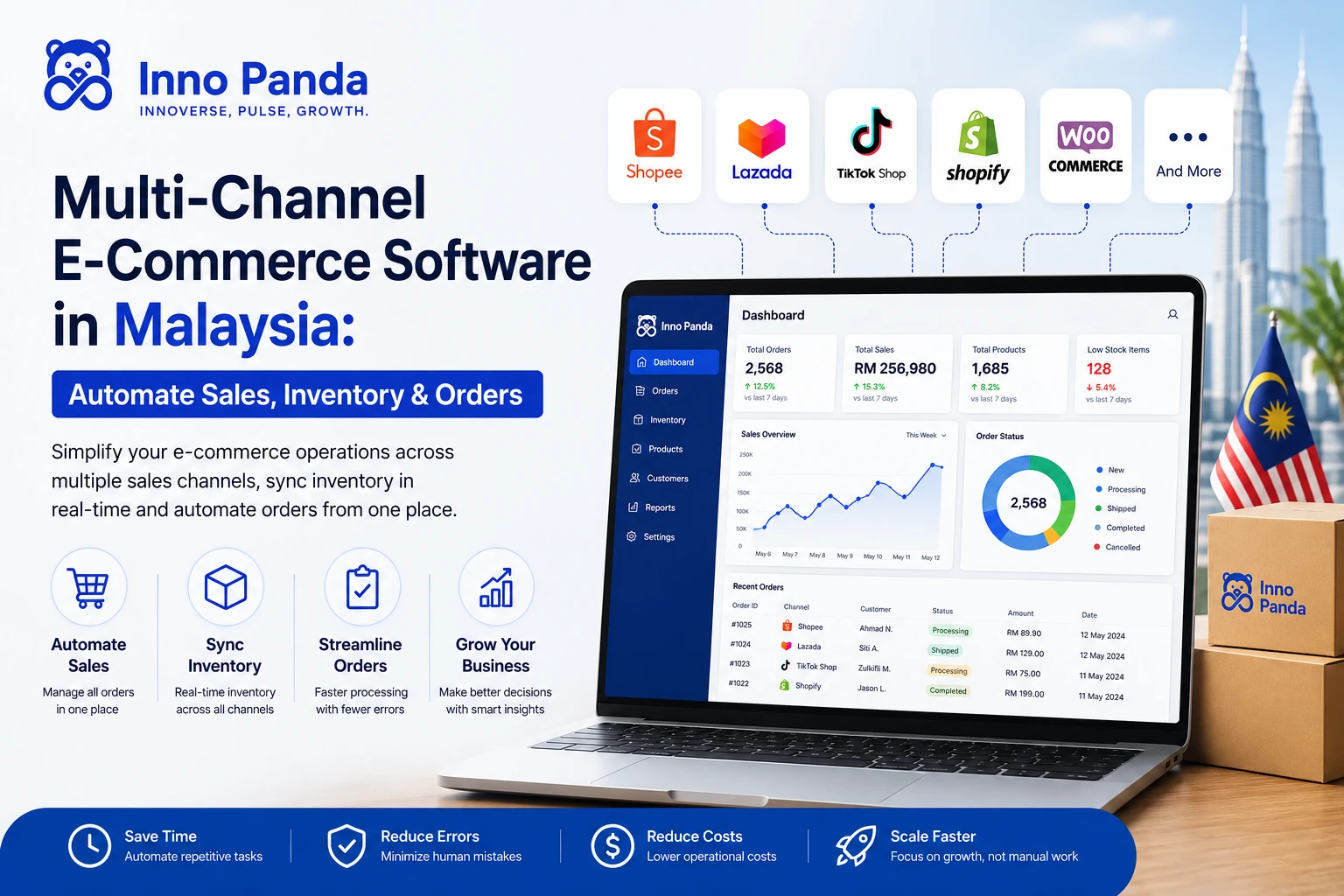
You started on one platform and it worked. Then you added a second, maybe a third. Now you are juggling Shopee, Lazada, TikTok Shop, and possibly your own website — and what used to take 30 minutes a day takes three hours. Inventory goes out of sync, orders slip through, and you spend more time firefighting than actually growing. Multi-channel e-commerce software in Malaysia is built for this exact moment — when manual operations stop scaling with your business.
Selling online in Malaysia is no longer about being on one platform and managing it well. Most serious sellers today are operating across at least two or three channels simultaneously — Shopee and Lazada being the dominant pair, with TikTok Shop growing fast enough that ignoring it is no longer a viable strategy. Each channel brings its own dashboard, its own order queue, its own inventory system. Managing all of them by hand is technically possible, but only up to a point.
Malaysia's e-commerce market is projected to reach USD 12 billion in 2026 — and over 97% of the businesses competing in it are SMEs, most running with small teams and limited capacity for repetitive operational work. The sellers who are scaling past that limitation are the ones using ecommerce automation software to handle the routine so their teams can focus on growth.
What Is Multi-Channel E-Commerce Software and Why Are More Malaysian Sellers Using It?
At its core, multi-channel e-commerce software is a system that pulls all your sales platforms into one connected dashboard. Instead of logging into Shopee to check orders, then Lazada, then TikTok Shop — everything is visible and manageable from one place. When a product sells anywhere, inventory updates everywhere. Orders from all channels land in one queue. Reports pull from all sources at once.
The software works through API integrations with each platform. You connect your channels once, define how stock and orders should be handled, and the system runs the operational layer automatically in the background. For sellers, the shift is significant: what used to require manual attention dozens of times a day becomes something you rarely think about at all.
The reason more Malaysian sellers are adopting ecommerce automation now is not because the technology is new — it is because the operational cost of not using it has finally become obvious. When you are running one store on one platform, manual is manageable. When you are running three or four channels during a 12.12 campaign, manual is a liability.
It means Shopee MY and Lazada MY as your volume channels, TikTok Shop for social discovery, your own Shopify or WooCommerce store for brand control and margin, and increasingly, cross-border channels for regional expansion. Managing that stack without automation is not just slow — it creates constant risk of overselling, missed orders, and inconsistent customer experience across channels.
If you have been selling on more than one platform for a while, you already feel this in your daily workflow. But it is worth being specific about the problems — because they tend to compound each other in ways that are easy to underestimate until you are already in the middle of a campaign spike.
Updating Inventory Manually Takes Time
Imagine receiving ten orders in an hour across Shopee, Lazada, and TikTok Shop simultaneously. Each one requires a manual stock update on every other platform. During a flash sale, that becomes unmanageable within the first thirty minutes. The lag between a sale and the inventory update is where overselling happens — and overselling in Malaysia's marketplace environment means cancelled orders, buyer disputes, and platform penalties that hit your store rating directly. Inventory management software eliminates this lag entirely by syncing stock in real time the moment a sale is recorded anywhere.
Orders Can Easily Get Missed
When your orders are distributed across five separate dashboards, something always gets buried. A Lazada order sitting under a stack of notifications, a TikTok Shop enquiry that arrives while you are processing Shopee orders — each missed or delayed fulfilment chips away at your store rating and erodes the buyer trust that takes months to build. Centralised ecommerce inventory management brings all orders into one queue so nothing gets lost regardless of which channel it came from.
Stock Errors Lead to Lost Sales
When inventory is not synced in real time across channels, the same unit can sell twice — once on Shopee, once on Lazada. Cancelling one of those orders means a refund request, a possible negative review, and a mark against your fulfilment score. Malaysian sellers managing Shopee and Lazada manually report overselling and fulfilment delays as their most consistent operational problem. It is not a question of whether it will happen — only when.
Managing Multiple Dashboards Creates Confusion
There is no honest picture of your business when your data lives in five different places. Revenue by channel, stock levels by SKU, best-performing products — assembling this information manually is not just time-consuming, it is structurally unreliable. Decisions made on fragmented data are rarely the right ones. A single unified view is not a luxury feature — it is a basic requirement for running a multi-channel business well.
How E-Commerce Automation Helps You Save Time and Reduce Errors
The shift from manual to automated operations is not just about saving a few hours a week. It changes the structural reality of how your business runs — and what your team is actually spending their time on.
Automatic stock updates across every channel
Every sale on any connected channel triggers an instant inventory update everywhere else. No lag, no manual input, no overselling — even during your heaviest campaign days. This single automation removes the most common operational failure point in multi-channel selling.
Faster order handling from one place
All orders from Shopee, Lazada, TikTok Shop, and your own website land in one centralised queue. Bulk label printing, courier assignment, and status updates all happen from a single screen. Your team stops context-switching between platforms and starts processing orders in a fraction of the time.
Reduced manual work across the entire operation
Low-stock alerts, reorder triggers, courier routing rules, status notifications — all of these fire automatically based on conditions you set once. The routine operational layer runs itself, and your team's attention goes to decisions that actually require a human.
More focus on actually growing the business
When operations run automatically, your bandwidth goes back to the things that move the needle: new product development, better listings, smarter campaigns, stronger customer relationships. Automate ecommerce business tasks first — then reinvest that time into growth.
What Features Should You Look for in Multi-Channel E-Commerce Software in Malaysia?
Not all ecommerce order management software is built for the Malaysian market — and feature lists can be misleading. Here is what actually matters for local sellers, written as practical advice rather than a checklist of buzzwords.
Real-Time Inventory Sync
The most important feature — and the one most frequently oversold. "Real-time" means seconds, not minutes. For Malaysian sellers running simultaneous promotions on Shopee and Lazada, a two-minute sync delay is long enough to create overselling problems during high-traffic moments. When evaluating any platform, ask specifically: how frequently does inventory sync? The answer should be continuous and event-driven, not scheduled.
Centralised Order Management
All orders from all channels should appear in one unified queue — with the ability to process, label, assign couriers, and update tracking without switching between platforms. Good best multi-channel ecommerce software makes this feel seamless. Weak implementations force you to handle exceptions manually, which defeats the purpose.
Marketplace and Store Integrations
For Malaysian sellers specifically, the non-negotiables are native connections with Shopee MY, Lazada MY, and TikTok Shop. If those integrations are slow, patchy, or require manual workarounds, the entire system is unreliable when you need it most. Bonus if it also connects your Shopify or WooCommerce store and local courier partners (J&T, Ninja Van, Poslaju).
Automated Workflows
Beyond inventory sync, the ability to set rules that run automatically — order routing by weight or destination, low-stock reorder alerts, courier selection logic — is what separates a powerful system from a basic dashboard. Ecommerce automation software should remove common decisions from your team's daily queue, not just display information in a prettier way.
Business Insights and Reports
Unified reporting across all channels is what makes a multi-channel operation manageable. Revenue by channel, stock turnover by SKU, fulfilment accuracy, best-seller trends — all visible in one place, without exporting five separate spreadsheets and trying to merge them manually.
Real-Time Inventory Sync
Instant stock updates across Shopee, Lazada, TikTok Shop, and your own store the moment any sale is recorded. No delays, no overselling, no manual corrections after the fact.
Centralised Order Queue
All orders from all channels in one place. Bulk label printing, courier assignment, and fulfilment tracking — no platform-switching required during your busiest periods.
Automated Workflow Rules
Set courier routing rules, low-stock thresholds, and reorder triggers once — and let the system run them automatically every time the condition is met.
Local Platform Integrations
Native connections with Shopee MY, Lazada MY, TikTok Shop, and Malaysian courier partners including J&T, Ninja Van, and Poslaju. Built for this market, not retrofitted for it.
Unified Business Reports
Revenue, stock movement, channel performance, and top SKU data — across all channels in one dashboard, not five separate exports you have to stitch together yourself.
Scalable Architecture
The right system grows with your business. Whether you are processing 200 orders a month or 20,000, it should not become your bottleneck as volume increases.
Why Inventory Automation Matters More Than Most Sellers Realise
Most sellers think about inventory sync software as a convenience — something that saves time. It is actually something more critical than that. Inventory accuracy is the foundation your entire multi-channel operation sits on, and when it breaks, everything downstream breaks with it.
The compounding cost of manual inventory errors: One oversell leads to a cancelled order. A cancelled order leads to a buyer dispute. A dispute leads to a platform warning. A platform warning leads to lower visibility in search rankings. Lower rankings lead to fewer sales. The downstream effects of a single inventory error are far larger than they appear at the moment it happens.
Manual Management vs Multi-Channel Automation: Which One Supports Growth Better?
The comparison is worth making explicitly, because a lot of Malaysian sellers treat automation as something to think about "once the business is bigger." The problem is that waiting until the business is bigger often means dealing with a crisis first — usually a fulfilment breakdown during a campaign that was supposed to be a growth moment.
| Area | Manual Operations | Multi-Channel Automation |
|---|---|---|
| Inventory Updates | Manual per platform — slow, error-prone, dangerous during campaign spikes | Real-time sync the moment a sale is recorded, across every connected channel |
| Order Processing | Log in to each platform separately — high risk of missed or delayed fulfilment | All orders in one centralised queue with bulk processing and courier automation |
| Overselling Risk | High — especially during 9.9, 11.11, and 12.12 campaign periods | Eliminated — stock accuracy is maintained automatically across all channels |
| Team Scalability | More orders = more manual hours = more staff needed to keep up | Same team handles significantly higher volume without adding headcount |
| Business Insights | Fragmented — requires manually exporting and merging data from multiple platforms | Unified dashboard with real-time cross-channel reporting always available |
| Growth Ceiling | Low — manual operations create a hard limit on how far you can scale | High — the system absorbs operational complexity as you expand channels and volume |
The honest reality is that manual operations are not free. They cost time, generate errors, and create a ceiling on growth that tightens exactly when your business is trying to accelerate. Omnichannel ecommerce Malaysia at any meaningful scale requires systems, not spreadsheets.
How Inno Panda Helps Malaysian Businesses Simplify Multi-Channel Selling with SyncingAbout
If your business is growing across multiple sales channels and the operational side is starting to feel unmanageable, SyncingAbout by Inno Panda is built for exactly this problem. It is a dedicated multi-channel ecommerce solution Malaysia — connecting your sales channels, inventory, and order workflows into one unified system designed for the Southeast Asian market.
Scale Without Adding More Manual Tasks
The most important thing the right ecommerce automation services Malaysia solution does is absorb growth rather than resist it. As your order volume increases and you add new channels, SyncingAbout handles the additional complexity — your team does not. This is how Malaysian SMEs move from managing hundreds of orders a month to thousands without doubling their operational headcount. The system grows with the business instead of becoming its constraint.
How to Choose the Right Multi-Channel E-Commerce Software for Your Business
With a growing number of options available — from global platforms to locally-built solutions — the decision can feel overwhelming. Here is a practical checklist built around what actually matters for Malaysian sellers, not just feature marketing.
Ready to Automate Your E-Commerce Operations?
Managing multiple channels manually is not sustainable — and for most Malaysian sellers, the real question is not whether to automate, but when. The longer you wait, the more operational overhead accumulates, and the harder it becomes to build proper systems while the business is already running at full capacity.
The right ecommerce management software Malaysia connects to your existing channels, syncs inventory from day one, and starts freeing up your team's time immediately. It is not a months-long implementation project — it is a workflow change that starts paying back quickly and compounds over time.
Take an honest look at your current operations: how many hours per week does your team spend on manual stock updates, processing orders from separate dashboards, and reconciling data from multiple platforms? That is the number that changes when you switch to automation. And that time does not disappear — it goes back into growing your business.
Frequently Asked Questions About Multi-Channel E-Commerce Software in Malaysia
What is multi-channel e-commerce software?
Multi-channel e-commerce software is a system that connects all your sales platforms — Shopee, Lazada, TikTok Shop, your own website — into one dashboard. It automatically syncs inventory across every connected channel, consolidates all orders into a single queue, and gives you unified reporting across your entire operation.
For Malaysian sellers, the practical value is this: instead of logging into five different platforms to check orders and manually update stock after every sale, everything is visible and manageable from one place. When a product sells anywhere, inventory updates everywhere — instantly, without any manual input required.
Can inventory be updated automatically across multiple platforms?
Yes — real-time inventory sync is the core function of any good multi-channel system. When a sale happens on any connected channel, the stock count is automatically deducted and the updated level is pushed to all other platforms immediately. No manual step, no delay, no risk of the same unit selling twice.
For Malaysian sellers running simultaneous promotions on Shopee and Lazada, this is not a convenience feature — it is essential protection against the overselling penalties that marketplace platforms impose when orders are cancelled due to stock errors. Real-time sync is what makes multi-channel operations structurally safe at high volume.
Is multi-channel e-commerce software suitable for wholesalers in Malaysia?
Yes. Wholesalers managing large SKU catalogues across multiple buyers, distribution channels, and marketplaces benefit significantly from the same core capabilities that help retail sellers — centralised inventory, bulk order processing, and automated fulfilment workflows. For wholesalers specifically, features like multi-warehouse support, SKU-level stock tracking, and low-stock threshold alerts are particularly valuable.
If you are looking at ecommerce software for wholesalers Malaysia, also check for LHDN MyInvois e-invoicing compliance support, which is now mandatory for higher-turnover businesses and non-negotiable for any serious wholesale operation in 2026.
How does automation improve order management for Malaysian sellers?
Automation consolidates all incoming orders from every platform into one centralised queue. From there, rules you define handle the rest: assigning orders to the correct courier based on weight or destination, generating shipping labels in bulk, updating tracking information, and notifying buyers — all automatically.
During high-volume periods like 9.9, 11.11, or Hari Raya campaigns, this is the difference between a managed fulfilment operation and a crisis. Manual order management at campaign-level volume is not scalable without a much larger team than most Malaysian SMEs can afford. Automation removes that constraint entirely.
What should Malaysian sellers look for before choosing multi-channel e-commerce software?
Five things matter most for Malaysian sellers specifically: native integration with Shopee MY, Lazada MY, and TikTok Shop (not just global platforms); genuine real-time inventory sync — verify this with a specific question about sync frequency, not just the marketing copy; an interface simple enough for a small team to run without technical help; pricing that makes sense at your current and projected order volume; and support for LHDN MyInvois e-invoicing compliance.
Beyond that, look for local or regional support availability, integration with Malaysian courier partners, and ideally a free trial or demo period so you can test the integration quality with your actual channels before committing. Integration quality with Shopee and Lazada varies significantly between platforms — testing it yourself is the only reliable way to evaluate it.
Simplify Your Multi-Channel E-Commerce Operations
Stop juggling five dashboards and start managing your entire e-commerce business from one place. SyncingAbout by Inno Panda connects your Shopee, Lazada, TikTok Shop, and web store into a single automated workflow — so your team spends less time on operations and more time on growth. Request a demo and see what your business looks like when the operational layer runs itself.