Why E-Commerce Automation Software Is Essential for Sellers in Indonesia in 2026
- 1 Why E-Commerce Automation Software Is Essential for Sellers in Indonesia in 2026
- 1.1 What Is E-commerce Automation Software?
- 1.2 Why E-commerce Automation Is Becoming Essential for Sellers in Indonesia in 2026
- 1.3 The Biggest Operational Challenges Ecommerce Sellers Face Without Automation
- 1.4 How Multi-Channel Ecommerce Software Helps Indonesian Sellers Scale Efficiently
- 1.5 Why Ecommerce Inventory Software Is Critical for Accuracy and Business Growth in Indonesia
- 1.6 How Ecommerce Order Management Software Improves Fulfilment Performance
- 1.7 How Inno Panda Helps Ecommerce Sellers Build Automated and Scalable Operations in Indonesia
- 1.8 How SyncingAbout Supports Inventory Synchronisation and Multi-Channel Management for Indonesian Sellers
- 1.9 Key Features Sellers Should Look for in Ecommerce Automation Software in Indonesia
- 1.10 Manual Management vs Ecommerce Automation: A Direct Comparison for Indonesian Sellers
- 1.11 Common Challenges When Implementing Ecommerce Automation and How to Overcome Them
- 1.12 The Future of Ecommerce Automation for Sellers in Indonesia Beyond 2026
- 1.13 Frequently Asked Questions About Ecommerce Automation Software in Indonesia
- 1.14 Conclusion: Why Indonesian Ecommerce Sellers Cannot Afford to Wait on Automation
- 1.15 Ready to Simplify Your Ecommerce Operations and Scale Faster?
If you are selling on Shopee, Tokopedia, and TikTok Shop simultaneously and still managing stock updates by hand, this guide is for you. Here is why Indonesian sellers are switching to ecommerce automation in 2026 — and what it actually changes about how your business runs.
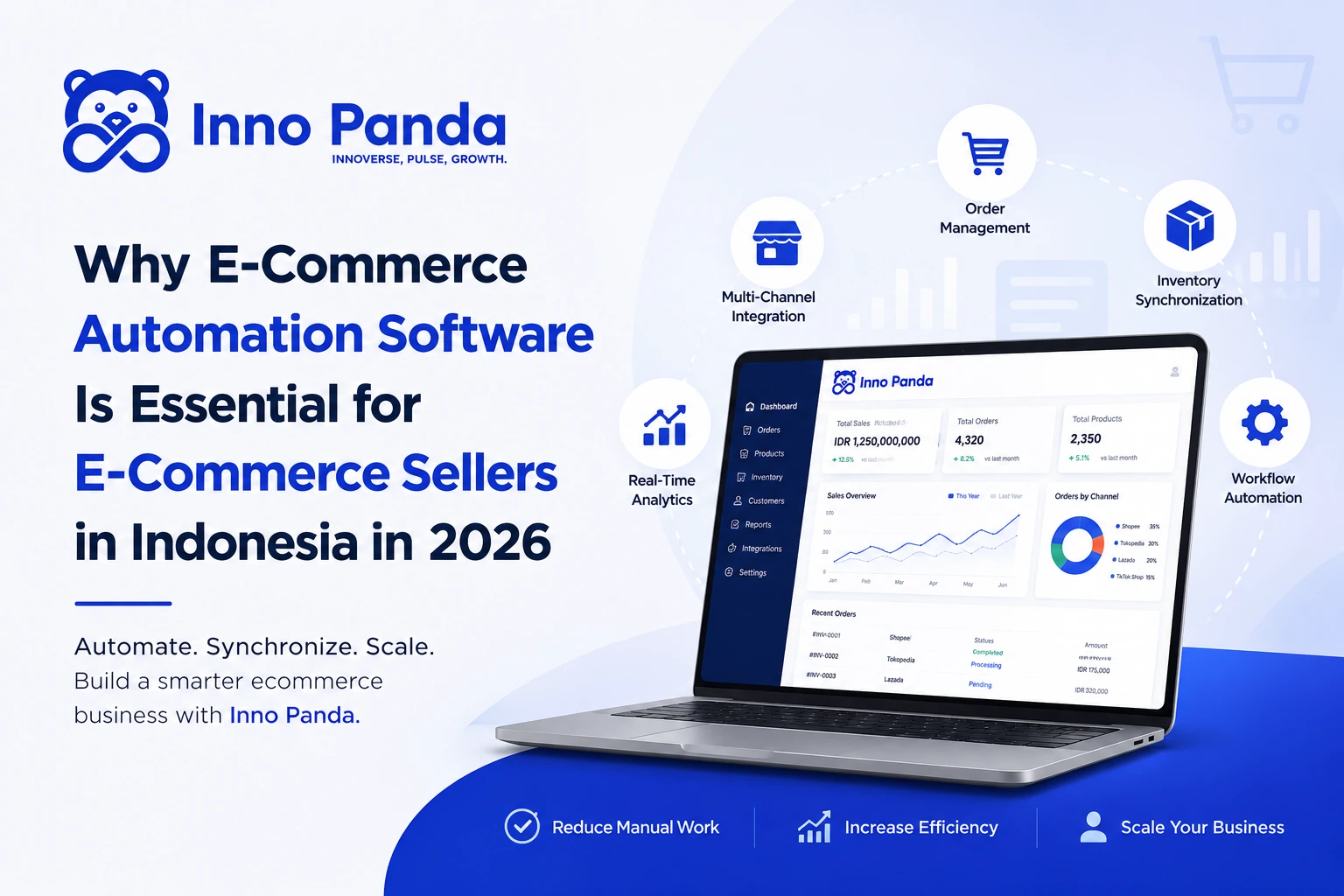
Indonesia is one of Southeast Asia's most competitive ecommerce environments. With Shopee, TikTok-Tokopedia, Lazada, and Blibli collectively holding over 80% of market share, sellers today are not just competing on price — they are competing on speed, stock accuracy, and fulfilment reliability. Managing all of that manually is possible at low volume. At scale, it becomes a structural liability.
Indonesia's ecommerce market is on track to grow from USD 39.23 billion in 2024 to approximately USD 61.61 billion by 2029, expanding at a 9.2% CAGR. The sellers who capture that growth will not be the ones working harder on manual processes — they will be the ones who replaced those processes with ecommerce automation software early enough to scale without a proportional increase in operational overhead.
What Is E-commerce Automation Software?
Understanding E-commerce Automation
Ecommerce automation software is a system that connects all your sales channels — Shopee, Tokopedia, Lazada, TikTok Shop, your own website — into one centralised dashboard and handles the routine operational layer automatically. Instead of logging into each platform separately to check orders, update stock, and track fulfilment, everything runs from a single connected system. When a product sells anywhere, inventory updates everywhere. Orders land in one queue. Reports pull from all channels at once.
The system works through API integrations with each marketplace. You connect your channels once, configure how inventory and orders should be handled, and the automation runs in the background continuously — not scheduled every few minutes, but event-driven and immediate. For sellers, the impact is significant: dozens of manual actions per day become things you simply do not have to think about.
Manual Operations vs Automated E-commerce Processes
Manual is manageable when you run one store on one platform. The moment you add a second channel — let alone Shopee, Tokopedia, Lazada, and TikTok Shop together — manual becomes a bottleneck. Not eventually. Immediately. The tab-switching, the duplicate stock updates, the missed order from the platform you checked last — these are not inconveniences. They are structural limits on how far your business can grow.
Time efficiency: Automated stock updates, order consolidation, and shipping workflows eliminate the hours your team currently spends on repetitive operational tasks every day. That time does not disappear — it goes back into growing the business.
Error reduction: Manual processes create a reliable stream of errors — overselling during flash sales, missed orders during campaign spikes, inconsistent stock counts across platforms. Automation eliminates the manual step where those errors happen.
Operational scalability: With automation, adding a new channel does not add operational complexity. The system absorbs it. Your team stays the same size while your business handles significantly higher volume.
Core E-commerce Processes Sellers Can Automate
Inventory Management
Real-time stock synchronisation across all channels the moment a sale is recorded. No manual updates, no sync delays, no overselling — even during your heaviest Harbolnas campaigns.
Order Processing
All orders from every channel in one centralised queue. Bulk label printing, courier assignment, and fulfilment tracking handled automatically without switching between marketplace dashboards.
Customer Communication
Automated order confirmation, shipping notifications, and tracking updates sent to buyers across channels without manual input — keeping customers informed at every stage.
Workflow Automation
Set courier routing rules, low-stock threshold alerts, and reorder triggers once. The system runs them automatically every time the condition is met — no manual monitoring required.
Reporting & Analytics
Unified cross-channel reporting that shows revenue by channel, top-performing SKUs, stock movement, and fulfilment accuracy — all in one dashboard, not five separate platform exports.
Inventory Forecasting
Data-driven restocking insights based on actual sales velocity across channels — so you are never caught understocked before a campaign or overstocked after one.
Why E-commerce Automation Is Becoming Essential for Sellers in Indonesia in 2026
Rapid Ecommerce Growth Creates Operational Pressure
Indonesia's ecommerce landscape has changed structurally since TikTok's acquisition of a majority stake in Tokopedia's ecommerce unit, which enabled TikTok Shop to resume operations under domestic compliance structures and created a powerful new social-commerce channel with 110 million monthly users. Shopee has deployed over 200 micro-fulfilment centres across provincial cities with a USD 120 million investment aimed at faster delivery times. Competition is no longer concentrated in Java — it is intensifying across the entire archipelago.
For sellers, this means more channels to manage, faster fulfilment expectations to meet, and more campaign cycles to navigate — all simultaneously. The operational load of competing in this market in 2026 is substantially higher than it was two years ago. Ecommerce business automation in Indonesia is the practical response to this pressure, not a premium feature reserved for large enterprises.
Customers Expect Faster Fulfilment and Better Experiences
Indonesian buyers in 2026 have been trained by platform competition to expect fast shipping, accurate stock information, and immediate order confirmation. When a buyer sees a product in stock on Tokopedia and orders it — only to receive a cancellation notice because your Shopee stock update had not propagated — they do not come back. Platform algorithms also penalise cancellation rates and delayed fulfilment with lower search visibility, which compounds the damage beyond the single lost order.
Ecommerce operations automation closes the gap between what customers expect and what manual processes can reliably deliver. Real-time inventory sync means stock accuracy is not something you have to maintain manually — it is guaranteed by the system.
Manual Processes Limit Business Expansion
Every Indonesian seller who has tried to scale a manual operation past a certain order volume has hit the same wall. More orders means more manual work. More manual work means more errors. More errors means more operational firefighting. At some point, the team is spending most of its time managing the consequences of the previous day's manual mistakes rather than building toward tomorrow's growth.
Multi-channel ecommerce software Indonesia sellers need is not the kind that just displays information in a prettier interface — it is the kind that removes the manual work at the source, so the growth ceiling disappears rather than just moving up slightly.
Sellers Need Scalable Systems to Compete
With entry barriers rising due to compliance costs and fulfilment requirements, and platform rivalry intensifying around delivery speed and seller tools, the operational advantage now belongs to sellers who have systematised their backend. A seller running automated inventory sync, centralised order management, and workflow-driven fulfilment can process twice the order volume of a manual competitor with the same team size. In a margin-compressed market, that efficiency is a genuine competitive edge.
The Biggest Operational Challenges Ecommerce Sellers Face Without Automation
Inventory Errors and Overselling
This is the most common and most costly problem for Indonesian multi-channel sellers. When inventory is not synced in real time across Shopee, Tokopedia, Lazada, and TikTok Shop, the same unit can sell on two platforms simultaneously. The downstream effects compound fast: a cancelled order creates a refund request, a negative review, a platform penalty, and lower search ranking. During a 12.12 Harbolnas flash sale, a single inventory sync failure can generate dozens of overselling incidents in under an hour.
Ecommerce inventory management software eliminates this entirely by making real-time sync the default rather than a manual task. Stock accuracy is maintained automatically, regardless of which channel generates the sale and how fast orders are coming in.
Delayed Order Fulfilment
Manual order management across multiple platforms means orders get buried. A Tokopedia order sitting under a stack of notifications, a TikTok Shop purchase that arrives while you are processing Shopee orders — each delayed fulfilment chips away at your store rating, your seller score, and the customer trust that takes months to build. Indonesian marketplace platforms are increasingly aggressive about penalising slow fulfilment with reduced visibility, making delays a direct revenue problem, not just an operational inconvenience.
Managing Multiple Sales Channels Manually
The tab-switching reality of manual multi-channel selling in Indonesia is something every seller in this position knows well. Shopee Seller Centre, Tokopedia dashboard, Lazada Seller Center, TikTok Shop backend — each one is a separate system, a separate login, a separate order queue, and a separate inventory system. Managing all of them by hand is not just slow; it creates constant structural risk that something will be missed, especially during high-volume periods when the operational pace is fastest and the margin for error is smallest.
Data Fragmentation Across Platforms
When your business data lives in five separate dashboards, you do not actually have a picture of your business — you have five partial pictures that never quite align. Revenue by channel, best-selling SKUs, stock turnover rates, fulfilment accuracy — assembling this information manually by exporting and merging spreadsheets from every platform is both time-consuming and structurally unreliable. Decisions made on fragmented data are rarely the right ones.
Increasing Operational Costs
Manual operations scale linearly with order volume. More orders require more staff, more hours, more oversight. For most Indonesian SMEs, this creates a situation where growth directly increases costs without proportionally increasing margins. Ecommerce stock management Indonesia automation breaks that linear relationship — the same operational infrastructure can handle significantly higher volume without adding headcount, which is what real scalability looks like.
How Multi-Channel Ecommerce Software Helps Indonesian Sellers Scale Efficiently
Centralised Product Management
Multi-channel ecommerce software Indonesia sellers use typically provides a single product catalogue that pushes listings across all connected platforms simultaneously. Update a price, add a product variation, or adjust a description once — and the change propagates to Shopee, Tokopedia, Lazada, and TikTok Shop automatically. This removes hours of repetitive listing work every week and eliminates the inconsistencies that come from updating platforms separately.
Inventory Synchronisation Across Channels
Real-time inventory synchronisation is the core function that makes multi-channel selling operationally safe. Every sale on any connected platform triggers an instant stock update across all other channels — not scheduled, not delayed, but immediate and event-driven. For Indonesian sellers running flash sales across multiple platforms simultaneously, this is not a convenience. It is the difference between a campaign that converts and a campaign that generates cancellations and platform penalties.
Unified Customer Experience
When orders, tracking, and communication all flow through one system, buyers get a consistent experience regardless of which platform they purchased on. Automated order confirmations, shipping notifications, and status updates go out immediately without manual input. Omnichannel ecommerce software Indonesia platforms make this level of customer communication sustainable at scale — you cannot manually send timely updates across four channels during a high-volume campaign.
Improved Business Visibility
Unified reporting across all channels gives Indonesian sellers something manual operations cannot: an accurate, real-time picture of the business as a whole. Revenue by channel, stock movement by SKU, fulfilment performance, top sellers — all visible in one dashboard, without any spreadsheet merging. This is the data layer that makes growth decisions informed rather than instinctive.
Why Ecommerce Inventory Software Is Critical for Accuracy and Business Growth in Indonesia
Real-Time Inventory Tracking
Ecommerce inventory software Indonesia sellers rely on provides a live, accurate view of stock levels across every connected channel and warehouse at all times. This is not the same as a dashboard that refreshes periodically — it is a continuous, event-driven system where every sale, return, or manual adjustment is reflected immediately across all platforms. For Indonesian sellers managing hundreds or thousands of SKUs across multiple channels, this single source of truth is what makes accurate stock management possible at scale.
Prevent Overselling and Stock Conflicts
Overselling is structurally inevitable in manual multi-channel operations — it is only a question of when it happens and how damaging the incident is. Ecommerce inventory tracking software prevents it entirely by ensuring that the moment a unit sells on any channel, that quantity is immediately deducted and updated everywhere else. The risk of a stock conflict — the same unit selling on two platforms simultaneously — is removed at the system level rather than managed through manual vigilance.
Forecast Inventory Demand More Accurately
Good inventory management software Indonesia sellers use does more than track what you have — it helps you anticipate what you will need. By analysing sales velocity across channels, identifying seasonal patterns, and flagging which SKUs are approaching low-stock thresholds, the system gives you the lead time to restock before you run out. For Indonesian sellers navigating the Harbolnas campaign calendar, this forecasting layer is particularly valuable: being understocked during 11.11 or 12.12 is a growth opportunity missed, not just a temporary stock problem.
Improve Inventory Efficiency Across Channels
Beyond preventing errors, effective inventory automation improves efficiency across the entire operation. Automated low-stock alerts eliminate the need for manual stock checks. Reorder triggers ensure restocking happens at the right time without someone having to remember to check. Multi-warehouse support means inventory can be allocated intelligently across locations. The cumulative effect is an operation where stock is always where it needs to be, in the right quantities, without constant manual intervention.
How Ecommerce Order Management Software Improves Fulfilment Performance
Automate Order Processing
Ecommerce order management software Indonesia sellers use consolidates all incoming orders from every connected channel — Shopee, Tokopedia, Lazada, TikTok Shop, and your own website — into a single unified queue. From there, automated rules handle the routing: which courier to assign based on weight, destination, or buyer preference; which warehouse to fulfil from; which label template to use. What used to require logging into five separate dashboards and making individual decisions becomes a single-screen workflow that processes in a fraction of the time.
Accelerate Fulfilment Workflows
Bulk label printing, batch courier assignments, and automated status updates all happen from one interface. The operational steps between a completed order and a shipped parcel are compressed dramatically. For Indonesian sellers processing hundreds of orders per day during campaign periods, this acceleration is not incremental — it changes whether the team can actually keep up with demand during peak hours without errors.
Improve Delivery Coordination
Automated courier routing ensures every order goes through the right logistics partner based on rules you define once. Shipping updates flow back to the buyer automatically as the parcel moves through the delivery network. Returns are tracked like new orders, with system updates handling the operational steps that would otherwise require manual tracking across multiple platforms.
Increase Customer Satisfaction
Fast, accurate fulfilment is the most direct path to high store ratings on Indonesian marketplaces. When ecommerce order management systems handle the operational layer automatically, buyers get their orders faster, with accurate tracking, and with less chance of an error requiring a cancellation or refund. The result is consistently higher fulfilment scores, better store visibility in platform search, and the repeat purchase rates that come from buyers who trust that their orders will arrive as expected.
How Inno Panda Helps Ecommerce Sellers Build Automated and Scalable Operations in Indonesia
Identifying Common Seller Bottlenecks
Most Indonesian ecommerce sellers face a predictable set of operational problems as they scale — inventory inconsistency across channels, multi-channel complexity that grows faster than the team can manage, and operational inefficiencies that are invisible until they create a crisis. Inno Panda starts by identifying exactly where these bottlenecks live in your current workflow, rather than proposing a generic automation solution that may not fit your actual operation.
Common patterns: stock counts that fall out of sync between Shopee and Tokopedia during campaign spikes; order queues that get backed up when volume increases faster than the team can process manually; reporting that requires manually pulling and merging data from four separate platform dashboards before any decision can be made. These are not unique problems — they are the predictable consequence of scaling a manual operation past its natural limit.
Inno Panda's Ecommerce Automation Approach
Inno Panda builds custom automation infrastructure tailored to how Indonesian ecommerce businesses actually operate — not retrofitted global software that treats Southeast Asian marketplaces as an afterthought. The approach covers process automation (removing manual steps from inventory, order, and reporting workflows), workflow optimisation (designing operational processes that scale without proportionally scaling headcount), system integration (connecting existing tools and platforms through a unified API layer), and scalable infrastructure (building systems that handle growth rather than constraining it).
Ecommerce automation services Indonesia sellers work with through Inno Panda are designed to deliver operational impact quickly — not months-long implementation projects, but workflow changes that start reducing manual work immediately and compound over time.
Business Outcomes Sellers Can Expect
How SyncingAbout Supports Inventory Synchronisation and Multi-Channel Management for Indonesian Sellers
If your business is growing across multiple sales channels and the operational side is starting to feel unmanageable, SyncingAbout by Inno Panda is built for exactly this problem. It is a dedicated multi-channel inventory and order management platform designed for Southeast Asian ecommerce sellers — connecting your channels, inventory, and order workflows into one unified system that runs automatically.
Reducing Operational Complexity as You Scale
The most important thing the right ecommerce operations automation Indonesia solution does is absorb growth rather than resist it. As your order volume increases and you add new channels, SyncingAbout handles the additional operational complexity — your team does not. This is how Indonesian sellers move from managing hundreds of orders per month to thousands without a proportional increase in headcount or manual work. The system grows with the business instead of becoming its constraint.
Centralised ecommerce management through SyncingAbout also gives sellers something manual operations structurally cannot: a single accurate view of the business at all times. Inventory levels, order status, channel performance, and fulfilment accuracy — all visible in one place, in real time, without any manual data assembly.
Key Features Sellers Should Look for in Ecommerce Automation Software in Indonesia
Not all ecommerce management platforms Indonesia sellers encounter are built for the local market. Feature marketing can be misleading. Here is what actually matters for Indonesian sellers, not what sounds impressive on a product page.
Inventory Automation
Real-time, event-driven inventory sync is the single most important feature. "Real-time" should mean seconds, not minutes. For Indonesian sellers running simultaneous flash sales on Shopee and Tokopedia during Harbolnas, a two-minute sync window is long enough to generate multiple overselling incidents. When evaluating any platform, ask specifically: is inventory sync event-driven or scheduled? The answer should be event-driven — meaning every sale triggers an immediate update, not a periodic batch process.
Multi-Channel Integration
For Indonesian sellers, the non-negotiable integrations are Shopee ID, Tokopedia, Lazada ID, and TikTok Shop (through the Tokopedia integration following the TikTok acquisition). If a platform lacks native, direct support for these four channels, it is not a viable solution for the Indonesian market regardless of its other capabilities. Bonus integrations: Shopify or WooCommerce for your own store, and local courier partners (JNE, J&T Express, SiCepat, AnterAja).
Order Automation
Beyond order consolidation, the ability to set rules that run automatically — courier routing by weight or destination, priority handling for specific product categories, automatic low-stock alerts triggering reorder workflows — is what separates genuinely useful ecommerce inventory management software Indonesia from a basic dashboard that still requires manual decisions throughout the day.
Analytics Dashboard
Unified cross-channel reporting that actually shows you the business as a whole: revenue by channel, SKU-level performance, stock turnover rates, fulfilment accuracy, campaign performance comparisons. The report should not require exporting CSVs from five different platforms and assembling them manually in a spreadsheet — that defeats the purpose of having a centralised system.
CRM Connectivity
As Indonesian sellers grow, customer data becomes a strategic asset. The right automation platform should be able to connect order and purchase history across channels to a unified customer record — giving your team the context to handle enquiries, returns, and repeat purchase opportunities intelligently, regardless of which platform the customer originally bought from.
Scalable Infrastructure
The system should handle your current volume and your projected volume. It should not become your bottleneck as your business scales. Indonesian ecommerce campaign peaks — Harbolnas, Ramadan, Lebaran — are not gradual volume increases. They are sudden spikes that can multiply daily order volume many times over. Your automation infrastructure needs to absorb those spikes without slowing down or requiring manual intervention.
Manual Management vs Ecommerce Automation: A Direct Comparison for Indonesian Sellers
The comparison is worth making explicitly, because many Indonesian sellers treat automation as something to consider once the business gets larger. The reality is that manual operations hit their ceiling long before most sellers expect — typically during a campaign they were hoping would accelerate growth, not expose operational limits.
| Area | Manual Operations | Ecommerce Automation |
|---|---|---|
| Inventory Updates | Manual per platform — slow, error-prone, and dangerous during Harbolnas campaign spikes | Real-time sync the moment a sale is recorded, across every connected channel instantly |
| Order Processing | Log in to each platform separately — high risk of missed or delayed fulfilment across channels | All orders in one centralised queue with bulk processing and automated courier routing |
| Overselling Risk | High — especially during 11.11 and 12.12 Harbolnas when volume spikes across all platforms simultaneously | Eliminated — stock accuracy is maintained automatically across all channels at all times |
| Team Scalability | More orders = more manual hours = more staff needed to keep pace with volume growth | Same team handles significantly higher volume without adding operational headcount |
| Business Insights | Fragmented — requires manually exporting and merging data from Shopee, Tokopedia, Lazada, TikTok Shop separately | Unified real-time dashboard across all channels — no manual assembly required |
| Store Rating Impact | Delayed fulfilment and cancellations directly lower marketplace ratings and reduce search visibility | Fast, accurate fulfilment protects ratings and improves platform search performance organically |
| Growth Ceiling | Low — manual operations create a hard operational limit that tightens exactly when growth accelerates | High — the system absorbs operational complexity as channel count and order volume both increase |
Common Challenges When Implementing Ecommerce Automation and How to Overcome Them
Initial Setup Investment
Getting an ecommerce automation software system up and running requires an upfront investment of time and money. Platform connections need to be configured, product catalogues need to be mapped, and workflow rules need to be set up correctly from the start. The honest answer to this challenge is that the investment is real — but it is typically recovered within weeks in the form of reduced manual hours, fewer error-related losses, and avoided platform penalties. Sellers who delay automation to avoid the setup cost usually end up paying more in operational losses than the setup would have cost.
Team Adoption
Switching from five familiar platform dashboards to one centralised system requires a change in how your team works day-to-day. This is a genuine transition, not just a software installation. The most effective approach is choosing a platform with a genuinely simple interface — one your operations team can learn quickly without technical assistance — and running a structured onboarding period with clear documentation of the new workflow before going fully live.
Platform Integration Quality
Not all Shopee and Tokopedia integrations are equal. Some platforms advertise marketplace connectivity that is technically functional but practically unreliable — slow API responses, incomplete order data, or sync delays that reintroduce the exact problems you were trying to eliminate. The only reliable way to evaluate integration quality is to test it with your actual channels before committing. Any reputable provider should offer a demo or trial period that allows you to verify this.
Data Migration and Training
Migrating existing product data, SKU structures, and historical order information into a new system requires careful planning. Rushing this step creates inconsistencies that take longer to untangle than the migration itself would have taken if done properly. Allocate dedicated time for data validation before going live, and ensure your team understands how the new system maps to your existing product catalogue and channel structure.
The Future of Ecommerce Automation for Sellers in Indonesia Beyond 2026
AI-Driven Commerce Operations
The next evolution of ecommerce business automation Indonesia sellers will encounter is AI being embedded directly into operational workflows. Intelligent pricing recommendations, automated customer segment responses, fraud detection in real time, and AI-assisted listing optimisation — these capabilities are moving from enterprise-level features to accessible tools for Indonesian SME sellers. The sellers building solid automation infrastructure now will be better positioned to layer AI capabilities on top of it.
Predictive Inventory Management
Beyond real-time sync and low-stock alerts, the next generation of inventory tools for Indonesian sellers will incorporate predictive restocking based on sales velocity trends, platform algorithm signals, and upcoming campaign schedules. Rather than reacting to low stock, the system will prompt reordering before the shortage materialises — accounting for supplier lead times and campaign demand patterns simultaneously.
Omnichannel Selling Expansion
Indonesia's ecommerce market is converging with offline retail — Tokopedia-GoTo has strengthened linkages with Gojek delivery, Shopee has partnered with Indomaret for O2O fulfilment, and social commerce through TikTok Shop is blurring the line between content discovery and purchase. Indonesian sellers who want to compete across this expanding landscape will need ecommerce automation Indonesia 2026 infrastructure that handles omnichannel complexity as seamlessly as it currently handles multi-marketplace complexity.
Personalised Customer Experiences at Scale
As Indonesian buyers become more sophisticated — and platforms provide more data on purchase behaviour — personalisation will become a competitive axis. Automation platforms that connect order history, browsing behaviour, and channel preference data will allow sellers to deliver targeted promotions, personalised product recommendations, and loyalty communications at scale — capabilities that require the unified customer data layer that only centralised ecommerce management provides.
Frequently Asked Questions About Ecommerce Automation Software in Indonesia
What is ecommerce automation software?
Ecommerce automation software is a system that connects all your sales channels — Shopee, Tokopedia, Lazada, TikTok Shop, and your own website — into one centralised dashboard. It automatically syncs inventory across every connected platform, consolidates all orders into a single queue, and delivers unified reporting across your entire operation.
For Indonesian sellers, the practical value is straightforward: instead of logging into four or five separate marketplace dashboards to check orders and manually update stock counts after every sale, everything is visible and manageable from one place. When a product sells anywhere, inventory updates everywhere — instantly, without any manual input.
Why is ecommerce automation important for sellers in Indonesia in 2026?
Indonesia's ecommerce market is growing rapidly — projected to reach over USD 61 billion by 2029 — with Shopee, TikTok-Tokopedia, and Lazada collectively holding more than 80% of market share. Serious sellers today are operating across multiple platforms simultaneously, and the operational complexity of managing that manually is no longer sustainable beyond a certain order volume.
Beyond market scale, platform competition is intensifying around fulfilment speed and seller performance scores. Manual operations create consistent errors — overselling during campaign spikes, delayed fulfilment, missed orders — that directly damage your store rating and reduce your search visibility across Indonesian marketplaces. Automation removes those failure points at the system level.
How does ecommerce inventory software improve operations for Indonesian sellers?
Ecommerce inventory software provides real-time stock synchronisation across every connected channel. When a product sells on Shopee, the updated stock count is immediately pushed to Tokopedia, Lazada, TikTok Shop, and your own website — without any manual update required. This prevents overselling, eliminates the manual stock-update workflow your team currently performs multiple times per day, and gives you a single accurate view of your inventory at all times.
Good inventory software also adds a forecasting layer — analysing sales velocity to flag which SKUs are approaching low-stock levels and when to restock, so you are never caught understocked before a Harbolnas campaign or overstocked after one.
What is multi-channel ecommerce software?
Multi-channel ecommerce software is a platform that connects all your marketplace and store channels — Shopee, Tokopedia, Lazada, TikTok Shop, Shopify, WooCommerce — into one unified system. It syncs inventory automatically across every connected channel, manages all orders from a single dashboard, and provides cross-channel reporting so you never have to manage each platform separately.
For Indonesian sellers, the practical difference from managing channels manually is significant. During a 12.12 Harbolnas flash sale, multi-channel software maintains stock accuracy across all platforms simultaneously while your team processes orders from a single queue — rather than toggling between four dashboards and manually updating stock on each one after every sale.
How does ecommerce order management software work?
Ecommerce order management software collects all incoming orders from every connected sales channel into one centralised queue. From there, automated rules handle the operational steps: assigning the order to the appropriate courier based on weight, destination, or delivery preference; generating shipping labels in bulk; updating tracking status across platforms; and notifying the buyer automatically as the order moves through fulfilment.
For Indonesian sellers navigating peak periods like Harbolnas 11.11 and 12.12, this consolidation is the difference between a manageable fulfilment operation and a crisis. Manual order management across multiple platform dashboards during a campaign spike is where missed orders and delayed fulfilment happen — and where platform penalties accumulate fastest.
How can Indonesian sellers reduce inventory synchronisation issues across platforms?
The most reliable solution is real-time inventory synchronisation through dedicated multi-channel ecommerce software. When all channels are connected through one system, every sale triggers an instant stock update across all platforms simultaneously — eliminating sync delays and preventing the same unit from selling twice across different channels.
For Indonesian sellers specifically, it is important to verify that any platform you evaluate uses event-driven sync (triggered by each sale) rather than scheduled sync (updating every 15 or 30 minutes). During a flash sale on Shopee and Tokopedia simultaneously, a 15-minute sync window is long enough to generate significant overselling. Event-driven sync is the only architecture that genuinely prevents the problem rather than just reducing its frequency.
How does Inno Panda help ecommerce sellers in Indonesia?
Inno Panda helps Indonesian ecommerce sellers build automated, scalable operations through custom software development, system integration, workflow optimisation, and SyncingAbout — a dedicated multi-channel inventory and order management platform built for Southeast Asian sellers.
The approach starts by identifying where operational bottlenecks actually live in your current workflow — whether that is inventory inconsistency across channels, order management complexity, or fragmented reporting — and then building the automation infrastructure needed to remove those bottlenecks. The goal is operational leverage: the same team handling significantly higher order volume with fewer manual steps and fewer errors.
How does SyncingAbout support multi-channel operations for Indonesian sellers?
SyncingAbout by Inno Panda connects Shopee, Tokopedia, Lazada, TikTok Shop, Shopify, WooCommerce, and Amazon into one unified dashboard. It provides real-time inventory synchronisation across all connected channels, centralised order management with automated courier routing and label generation, and cross-channel reporting that gives sellers an accurate view of their entire operation in one place.
Built specifically for Southeast Asian ecommerce sellers, SyncingAbout is designed to handle the operational complexity of the Indonesian marketplace environment — including campaign-period volume spikes, multi-channel inventory management, and the fulfilment speed requirements of platforms like Shopee and Tokopedia. It is a system that grows with your business rather than becoming its constraint as volume increases.
Conclusion: Why Indonesian Ecommerce Sellers Cannot Afford to Wait on Automation
Indonesia's ecommerce market is not slowing down. With platforms investing hundreds of millions in logistics infrastructure, competition intensifying across every category, and buyer expectations for speed and accuracy rising steadily, the operational demands on Indonesian sellers in 2026 are genuinely higher than they were two years ago.
Ecommerce automation software is not a tool for large enterprises — it is the infrastructure that allows Indonesian SME sellers to compete at scale without a proportional increase in headcount or manual work. Real-time inventory sync prevents the overselling that erodes store ratings. Centralised order management prevents the missed fulfilment that costs you both the order and the customer relationship. Unified reporting gives you the accurate business picture you need to make growth decisions that are informed rather than instinctive.
The sellers who are scaling past the manual operations ceiling are the ones who automated the routine layer of their business early — freeing their teams to focus on what actually moves the needle. Multi-channel ecommerce software Indonesia sellers need is available now. The question is not whether to automate, but how long to wait before the cost of not automating becomes obvious in a campaign that was supposed to be a growth moment.
Ecommerce inventory software Indonesia sellers can rely on — and the order management infrastructure to match it — is what SyncingAbout by Inno Panda provides. Built for Southeast Asia, designed for Indonesian marketplace realities, and structured to grow with your business rather than constrain it.
Ready to Simplify Your Ecommerce Operations and Scale Faster?
Stop managing stock manually across Shopee, Tokopedia, Lazada, and TikTok Shop. SyncingAbout by Inno Panda connects all your channels into one automated workflow — real-time inventory sync, centralised order management, and unified reporting from day one. The longer you delay automation, the more operational complexity accumulates. Talk to our team and see what your operation looks like when the manual layer runs itself.