Agentic Commerce Is Here: How to Get Your Products Found by AI Shopping Agents in 2026
- 1 Agentic Commerce Is Here: How to Get Your Products Found by AI Shopping Agents in 2026
- 1.1 Key Takeaways
- 1.2 What Is Agentic Commerce?
- 1.3 How AI Shopping Agents Find and Recommend Products
- 1.3.1 ChatGPT Shopping
- 1.3.2 Google AI Mode
- 1.3.3 Gemini & Perplexity
- 1.3.4 Key Ranking Factors for AI Shopping Agents
- 1.3.5 Optimize Product Pages for AI Product Discovery
- 1.3.6 Product Schema and Structured Data for AI Commerce
- 1.3.7 How GEO Improves Product Visibility
- 1.3.8 Building Brand Authority and Entity SEO for AI Search
- 1.3.9 Optimizing Product Images, Reviews, and Content for AI Shopping
- 1.3.10 Merchant Center, Product Feeds, and Technical SEO Best Practices
- 1.3.11 How AI Agents Actually Complete a Purchase: Agentic Checkout Protocols
- 1.3.12 Common Mistakes That Prevent Products from Appearing in AI Shopping Results
- 1.3.13 Agentic Commerce Optimization Checklist for E-commerce Stores
- 1.4 Why Businesses Choose Inno Panda for AI Commerce Optimization
- 1.5 Frequently Asked Questions
- 1.6 Get Your Products Discovered by AI Shopping Agents
- 1.7 Related Reading
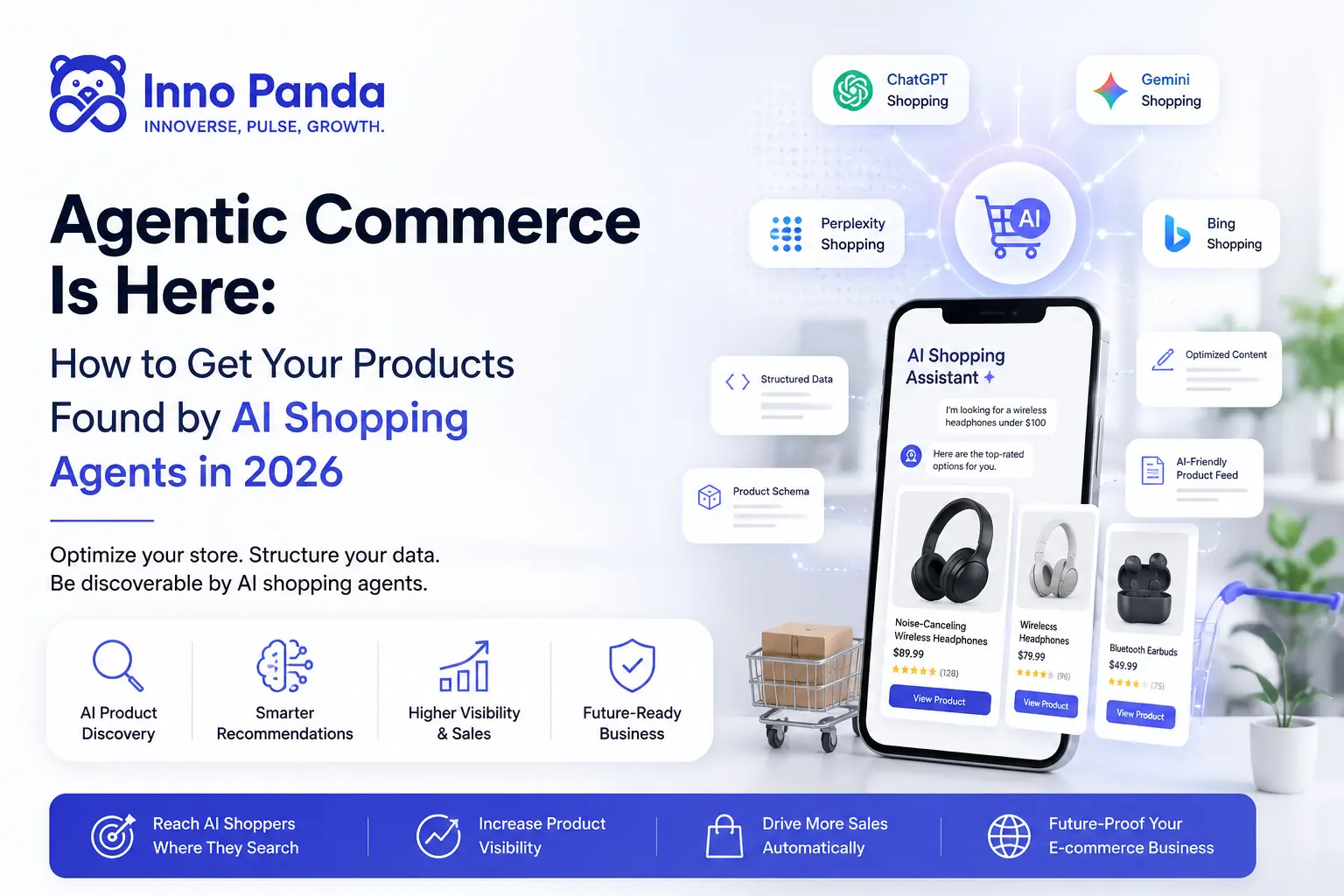
Your next customer might not be a person. It could be an AI agent, shopping on someone's behalf, comparing your product against five others in seconds. Here's how to make sure it picks yours.
Key Takeaways
- Agentic commerce means AI agents research, compare, and sometimes buy products for a shopper. There's no manual search-and-click journey.
- AI shopping agents rank products using clean, structured data. Design and clever copy matter less here.
- Product schema, accurate product feeds, and a healthy Merchant Center account now matter as much as your Google rankings.
- GEO (Generative Engine Optimisation) and entity SEO work alongside technical SEO to build AI shopping visibility.
- Shopify and WooCommerce stores each need specific fixes to show up in ChatGPT Shopping, Google AI Mode, and Perplexity Shopping.
- Discovery and checkout are separate layers now. Being recommended doesn't guarantee the agent can complete the sale, your store also needs to support protocols like ACP, UCP, or Agent Pay.
What Is Agentic Commerce?
Quick answer: Agentic commerce is when an AI agent does the shopping for you: researching, comparing, and often completing the purchase itself, with no manual search-and-click journey.
A shopper simply says what they need. For example: "find me a reliable standing desk under SGD 400 that ships to Singapore this week." The agent takes it from there, pulling live product data, comparing specs and reviews, then returning a shortlist, or sometimes a finished order.
This goes further than a chatbot that just talks you through a purchase. In agentic commerce, the AI agent acts on its own. Online shopping is no longer only a human-driven journey. More of it is becoming machine-led.
Why Agentic Commerce Is the Future of Online Shopping
This isn't a small trend for tech-heavy markets only. It's growing fast because it solves a real problem. Shoppers are tired of too many tabs, tired of reading endless reviews and comparing near-identical listings by hand. An AI agent does that comparison in seconds.
For retailers, this is part of a bigger shift in AI retail. Platforms like Google AI Mode and ChatGPT are becoming shopping destinations on their own, not just research tools that send people elsewhere. Smart shopping features now sit inside these assistants directly, so discovery, comparison, and checkout can all happen in one conversation.
How AI Shopping Agents Are Changing Product Discovery
The old way worked like this: a shopper searches, scans a page of results, and clicks a few links to compare. AI product discovery skips most of that. The agent does the comparing itself, reading specs, prices, delivery times, and review sentiment across several stores in the time it takes a person to open one tab.
This makes AI shopping agents the new gatekeepers of visibility. If your product data is missing or outdated, the agent skips it, even if a human browsing your site would have loved the product. Stores with clean data now benefit from AI-powered product recommendations that place them ahead of competitors who haven't fixed their data yet.
AI Shopping Agents vs Traditional Search Engines
It helps to see what's actually different, because the playbook changes with it.
| Traditional Search Engines | AI Shopping Agents |
|---|---|
| Ranks pages using links, keywords, and authority | Ranks products using structured data, accuracy, and trust signals |
| Shopper reads and compares by hand | Agent compares products automatically across sources |
| Crawls HTML pages directly | Uses feeds, schema, and APIs an agent can query directly |
| Relies on semantic search to match keywords to intent | Extracts intent, then filters and ranks candidate products |
| Success means a high rank on the results page | Success means being included in the agent's shortlist or answer |
Why Businesses Should Prepare for Agentic Commerce in 2026
The honest answer is simple: start now. It isn't a weekend job. It takes work on your product data, schema markup, and feeds together. Wait too long, and competitors with clean, machine-readable stores will already own the recommendations in your category.
We're already seeing this play out. Brands that treated structured data as an afterthought are losing visibility, even while their normal Google rankings stay stable. The AI agent simply never considers them.
Benefits of Agentic Commerce for E-commerce Brands
Done right, this shift isn't a threat. It's a chance to get recommended without fighting for every click.
How AI Shopping Agents Find and Recommend Products
Most systems don't crawl your website the way Googlebot does. Instead, they query structured sources: product feeds, schema markup, and sometimes direct APIs.
ChatGPT Shopping
Leans on indexed product data and connected merchant feeds. If your catalogue isn't indexed or marked up, it stays invisible, no matter how good the product is.
Google AI Mode
Pulls from your Merchant Center feed and structured data, blended with your organic content. Google Shopping fundamentals still apply, but the bar for accuracy is higher now.
Gemini & Perplexity
Favour sources with strong outside validation: reviews, comparison mentions, and consistent product details across the web.
Key Ranking Factors for AI Shopping Agents
There's no single ranking algorithm, but the same patterns show up again and again across every agent we've tested.
Optimize Product Pages for AI Product Discovery
Your product page still matters, but its job has changed. It's no longer just there to persuade a human, it now feeds an agent the facts it needs to decide on someone else's behalf. Write specs in full, plain sentences instead of only short bullet fragments. Keep your product metadata, titles, descriptions, categories, consistent with your feed. Treat this as an ongoing task, not something you finish once at launch.
Product Schema and Structured Data for AI Commerce
This is the single biggest technical lever you have. Structured data tells an agent exactly what's on a page, so it doesn't have to guess.
- Product Schema
- Structured markup (schema.org/Product) that lists name, price, stock status, brand, and reviews in a format agents can read directly.
- Offer Schema
- Sits inside Product schema. States price, currency, and stock status, the exact fields an agent checks before it recommends a purchase.
- Product Schema Implementation
- The technical work of adding this markup across every product page, then checking it renders without errors.
Getting this right isn't a one-time job. Prices change, stock runs out, and your schema needs to reflect that almost in real time. Recommend a product you can't actually deliver, and an agent stops trusting your feed fast.
How GEO Improves Product Visibility
Generative Engine Optimisation is the practice of shaping your content and data so AI systems can find, understand, and cite it correctly. For product pages, that means writing the way you'd explain a product to a smart colleague: direct comparisons, honest limitations, clear use cases, no pure marketing language.
GEO works alongside semantic product search. Agents match shopper intent to product meaning, not just exact keywords, which is why specific, descriptive content beats generic copy every time.
Agents don't just check your site, they check what the rest of the internet says about you too. Entity SEO means keeping your brand, products, and claims consistent everywhere: your site, review platforms, marketplaces, and press mentions. A strong presence in Google's knowledge graph helps here, as does a product knowledge graph that links your catalogue to recognised categories and attributes.
Optimizing Product Images, Reviews, and Content for AI Shopping
Product reviews are one of the strongest trust signals an agent can use, since they come from independent people. Encourage genuine reviews, reply to them, and make sure your review markup is set up correctly so agents can actually read your rating. Alt text and structured image data help an agent confirm a product matches what a shopper asked for, especially for visual details like colour or style.
Merchant Center, Product Feeds, and Technical SEO Best Practices
Your Merchant Center feed is your most direct line to AI shopping agents. A clean, complete, frequently updated product feed beats a beautiful website with no feed at all.
Audit Your Catalog
Look for missing product IDs, gaps in attributes, and prices that don't match.
Fix Feed Errors First
Clear disapprovals or warnings in Merchant Center. Errors here block visibility completely.
Optimise the Feed
Improve titles, categories, and descriptions for machine parsing, not just human eyes.
Confirm Technical SEO
Fast load times, clean indexing, and crawlable product pages are the foundation everything else sits on.
How AI Agents Actually Complete a Purchase: Agentic Checkout Protocols
Quick answer: Discovery and checkout are now two separate technical layers. Getting recommended by an agent doesn't automatically mean it can complete the purchase, your store also needs to support the payment protocol the agent uses.
In 2026, the agent isn't just suggesting a product for a human to buy. In many flows, it builds the cart, passes payment credentials, and completes the transaction directly. A handful of named protocols now make this possible, and knowing which ones your store supports is becoming as important as your product feed.
| Protocol | Who's Behind It | What It Does |
|---|---|---|
| ACP (Agentic Commerce Protocol) | OpenAI & Stripe | Powers ChatGPT Shopping checkout. Open-sourced so any store can plug in. |
| UCP (Universal Commerce Protocol) | Google & Shopify | Powers checkout inside Google AI Mode and Gemini, built with Walmart, Target, Etsy, and Wayfair. |
| Trusted Agent Protocol | Visa | Verifies that a purchase request genuinely comes from an authorised agent acting for a real cardholder. |
| Agent Pay | Mastercard | Issues a tokenised card credential scoped to one agent, one merchant, and one spending policy, so the agent never holds the raw card number. |
This isn't theoretical for Singapore merchants. Mastercard has already run live agentic transactions in Singapore alongside South Korea and other Asia-Pacific markets, and Visa's Trusted Agent Protocol has moved from sandbox testing into commercial rollout. The practical takeaway: a store that's perfectly optimised for AI product discovery can still lose the sale at checkout if it hasn't connected to any of these payment layers. Talk to your payment provider or agency about ACP and UCP support alongside your schema and feed work, not after it.
We saw this with one of our retail clients: their product feed and schema were clean, and agents were recommending their products consistently. But their checkout still required a human to finish the purchase manually on-site, so agent-referred sessions were converting far below their organic sessions. Connecting ACP support closed most of that gap within one release cycle.
Common Mistakes That Prevent Products from Appearing in AI Shopping Results
Treating this as a content problem. It's usually a data problem instead. A well-written product page with a broken feed still won't get recommended.
No product schema, or schema with errors that fail silently.
Feed and on-page data mismatches, like a different price or stock status.
Thin product descriptions that give an agent too little to work with, even where good semantic matching could otherwise help.
Ignoring reviews completely, leaving agents with no outside trust signal.
Agentic Commerce Optimization Checklist for E-commerce Stores
Why Businesses Choose Inno Panda for AI Commerce Optimization
We're a Singapore-based agency. We build the technical and content groundwork this shift actually needs, not just the theory behind it. Our team pairs AI Development Services with hands-on SEO Services work, because agentic commerce readiness sits right at that overlap.
Our Agentic Commerce Optimization Process
Every project starts with ecommerce consulting: we review your current catalogue, feed health, and schema coverage first. We don't recommend a single change until we know what's actually broken. From there, our strategy targets the highest-impact fixes first, usually feed errors and missing schema, before we move on to content and entity work.
AI Shopping Optimization for Shopify, WooCommerce, and Custom E-commerce Stores
The platform you're on changes what's already handled and what needs custom work.
| Platform | What's Usually Missing |
|---|---|
| Shopify Development | Feed apps often need setup work. Theme-level schema usually needs manual fixes. |
| WooCommerce Development | Schema plugins vary a lot in quality. Feed generation needs a dedicated extension and careful checking. |
| Custom Software Development | Nothing is automatic. Schema, feeds, and API integration for merchant platforms all need to be built from the ground up. |
Whatever platform you're on, this work sits alongside broader e-commerce development and technical SEO foundations. A slow or poorly indexed store can undermine even perfect schema.
Success Metrics: Measuring AI Shopping Visibility
Normal rank tracking doesn't capture this well. Instead, track how often your products show up in AI Overviews and AI Mode shopping panels for your target searches, whether your brand gets named directly in ChatGPT or Perplexity answers, your Merchant Center feed health score, and referral traffic from AI platforms tagged separately in your analytics. This is still a new metric category, so combining a few signals gives a more honest picture than any single number can.
A measurement gap to plan for: when an agent completes a purchase inside its own interface through ACP or UCP, the sale may never register as a standard on-site session. Ask your analytics or payment provider how agent-completed orders get tagged, otherwise this revenue can quietly disappear from your normal reporting.
Future Trends in Agentic Commerce Beyond 2026
Expect this to grow, not level off. Conversational commerce is moving from a pilot feature to a mainstream one. So is full autonomous shopping, where an agent handles routine repurchases without asking each time. Generative commerce is the next layer on top of this, where product listings could be summarised, or even generated, for each shopper's exact context. Businesses that build strong data foundations now won't need to rebuild when the next feature ships.
Frequently Asked Questions
What is agentic commerce?
Agentic commerce is when an AI agent researches, compares, and sometimes completes a purchase for a shopper. The shopper doesn't need to search or click through websites themselves.
How do AI shopping agents find products?
They mainly use structured data. That includes product schema markup, Merchant Center feeds, and indexed content, rather than crawling a website the way traditional search engines do.
How does ChatGPT recommend products to shoppers?
ChatGPT relies on indexed, well-structured product data and connected merchant feeds. It favours listings with complete, accurate, and consistent details across sources.
What's the difference between GEO and traditional SEO?
Traditional SEO ranks pages using keywords and links. GEO is different. It focuses on being understood and cited correctly by AI systems. Structured data and brand consistency matter more here.
Do I need product schema markup for AI shopping agents to find my store?
Yes. Without product schema, most AI shopping agents can't confirm your price, stock, or specs reliably. That usually means they leave your store out entirely.
How do I know if my products are visible to AI shopping agents?
Test your target searches directly in ChatGPT, Google AI Mode, and Perplexity. Check your Merchant Center feed health. Then watch for AI-referred traffic in your analytics.
What's the difference between AI shopping discovery and agentic checkout?
Discovery is being recommended by an agent. Checkout is the agent actually completing the purchase, which requires your store to support a payment protocol like ACP, UCP, Visa's Trusted Agent Protocol, or Mastercard Agent Pay. A store can be great at one and missing the other.
How long does it take to become visible to AI shopping agents?
Fixing feed errors and adding basic product schema can show results within a couple of weeks. Building full entity authority, reviews, and consistent brand presence across the web is an ongoing process that typically takes a few months to compound.
Get Your Products Discovered by AI Shopping Agents
We help Singapore and Southeast Asia e-commerce brands build the schema, feeds, and content foundation agentic commerce actually runs on.