AEO vs SEO vs GEO: What Every Business Needs to Know in 2026
- 1 AEO vs SEO vs GEO: What Every Business Needs to Know in 2026
- 1.1 Why the Modern World of Search Has Changed More in Two Years Than in the Previous Decade
- 1.2 What Is SEO (Search Engine Optimization) — and Why It Is Still the Foundation in 2026
- 1.2.1 SEO: Search Engine Optimization
- 1.2.2 The Three Pillars of Search Engine Optimization Every Business Needs to Get Right
- 1.2.3 On-Page SEO: What You Control on Your Own Website
- 1.2.4 Off-Page SEO: The Authority You Build Across the Web
- 1.2.5 Technical SEO: The Infrastructure That Makes Everything Else Work
- 1.3 What Is AEO (Answer Engine Optimization) — Winning the Answer Box, Not Just the Ranking
- 1.4 What Is GEO (Generative Engine Optimization) — Getting Cited by AI, Not Just Ranked by Google
- 1.5 AEO vs SEO vs GEO: The Complete Side-by-Side Comparison for 2026
- 1.6 How SEO, AEO, and GEO Are Reshaping Digital Visibility in the Modern World
- 1.7 Building an Integrated SEO + AEO + GEO Strategy That Compounds Over Time
- 1.8 Frequently Asked Questions: SEO, AEO, GEO, and AI Search in 2026
- 1.9 The Businesses Building All Three Layers Now Will Dominate Search in 2027 and Beyond
- 1.10 Ready to Build a Search Strategy That Works Across SEO, AEO, and GEO?
Search has quietly split into three different games — and most businesses are still only playing one of them. If your entire digital strategy is built around Google rankings, you are already invisible in places your customers are increasingly looking. This guide breaks down SEO, AEO, and GEO in plain language, shows you exactly how they differ, and gives you a real strategy to win across all three.

Why the Modern World of Search Has Changed More in Two Years Than in the Previous Decade
Let us be honest about something. A lot of the content you will find online about "the future of search" reads like it was written to sound impressive rather than to actually help you understand what is happening. So here is the clearest version of the truth we can give you.
The way people find information has fractured. In 2022, if you wanted to find the best SEO agency in Singapore, you typed it into Google, scanned ten blue links, and clicked the most promising one. In 2026, a growing number of people are doing that same query inside ChatGPT, asking Google and getting an AI-written summary instead of links, or telling Siri to find them something. Each of those environments works completely differently — and each one needs a different type of optimisation to appear in.
None of this means traditional search is dead. Google still processes over 8.5 billion searches per day. But it does mean that a business whose entire online visibility strategy is built around traditional Google rankings is increasingly exposed. You need to be present where people are actually looking — and in 2026, that means three places at once.
What Is SEO (Search Engine Optimization) — and Why It Is Still the Foundation in 2026
SEO: Search Engine Optimization
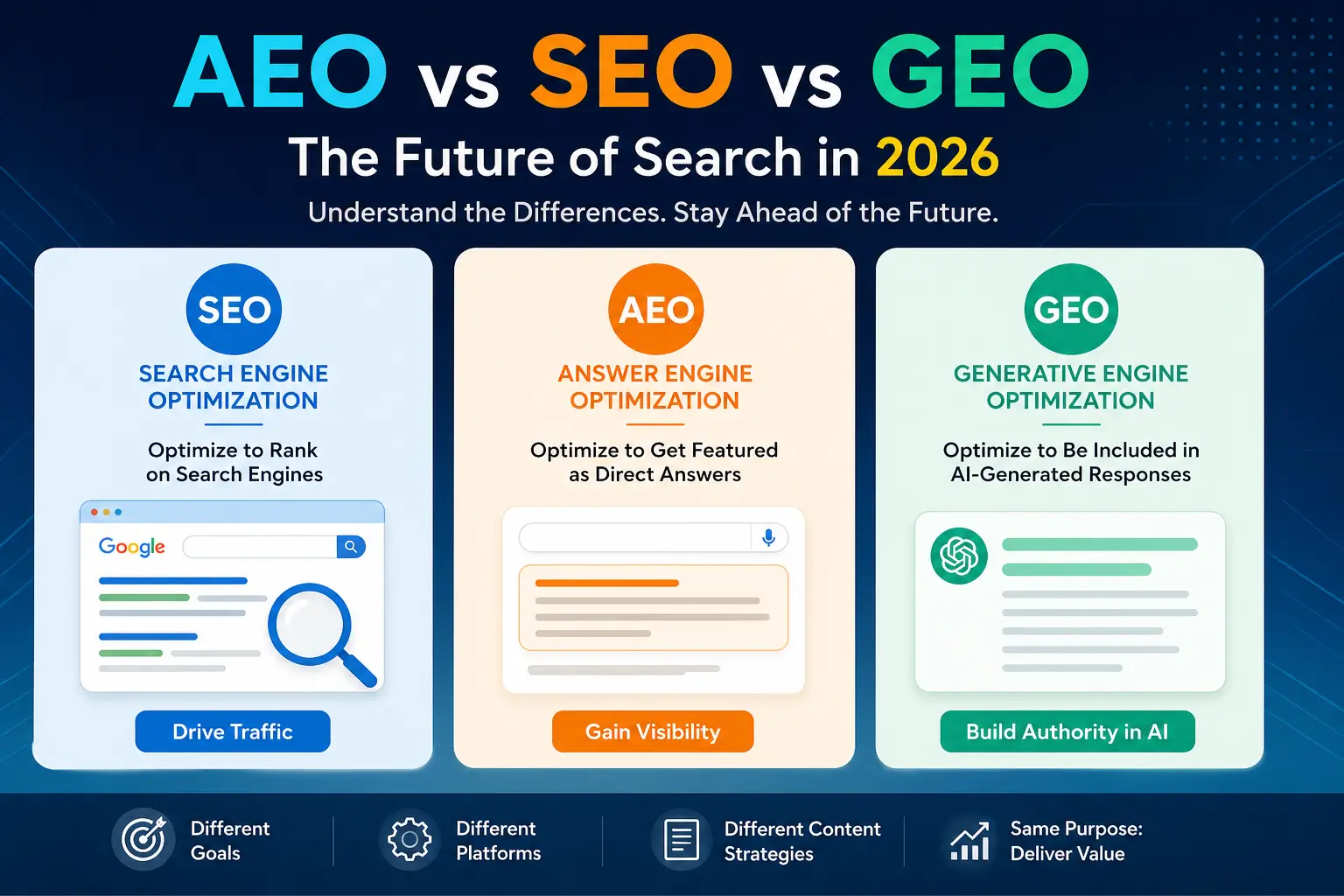
SEO is the practice of improving your website and content so that search engines — primarily Google and Bing — rank your pages higher in their organic results. When a user types a query and clicks a blue link, SEO is the discipline responsible for getting your page into that list in the first place. It is the oldest, most established, and still the highest-volume discipline in the search visibility ecosystem.
Here is something that surprises a lot of people when they first encounter AEO and GEO: both of those newer disciplines are built directly on top of SEO. You cannot win featured snippets without first ranking in the top positions. You cannot get cited by Google AI Overviews without pages that already rank well organically. SEO is not being replaced — it is being extended. That makes understanding it properly more important than ever, not less.
The Three Pillars of Search Engine Optimization Every Business Needs to Get Right
Modern SEO is not a single tactic — it is a system built on three interconnected pillars that all need to work together.
On-Page SEO: What You Control on Your Own Website
On-page SEO covers your content, keywords, heading structure (H1, H2, H3), meta titles, meta descriptions, internal linking, and URL structure. The goal is to make it unmistakably clear to both search engines and readers exactly what each page is about and why it is the most useful answer to a specific question. In 2026, on-page SEO also means writing for EEAT — structuring your content to demonstrate Experience, Expertise, Authoritativeness, and Trustworthiness, because Google's quality raters evaluate these signals explicitly when assessing whether to rank your content.
Off-Page SEO: The Authority You Build Across the Web
Off-page SEO is primarily about backlinks — links from other websites pointing to yours. They work as credibility votes: a link from a respected industry publication tells Google that real experts consider your content trustworthy. The quality of those backlinks matters far more than the quantity. One link from a major news site outweighs a hundred low-quality directory submissions. Off-page authority also includes brand mentions, press coverage, and third-party citations — all signals that are increasingly important for GEO as well, because they are exactly what AI systems look at when deciding which brands to cite in generated answers.
Technical SEO: The Infrastructure That Makes Everything Else Work
Technical SEO covers site speed, mobile-friendliness, Core Web Vitals (LCP, INP, CLS), crawlability, schema markup, XML sitemaps, and URL canonicalisation. It is the layer most businesses underinvest in — and the one that most often explains why strong content simply does not rank. If search engine bots cannot efficiently crawl your site, or if your pages fail Core Web Vitals benchmarks, even the best content will underperform. Our technical SEO service conducts a full infrastructure audit before any content or off-page work begins — because fixing the foundation always produces the fastest results.
What Is AEO (Answer Engine Optimization) — Winning the Answer Box, Not Just the Ranking
AEO: Answer Engine Optimization
AEO is the practice of structuring your content so that AI-powered answer platforms — including Google's AI Overviews, Siri, Alexa, and voice search assistants — can extract and present your content as a direct answer to a user's question. AEO targets the answer box itself: the response shown at the top of a search results page that the user reads without ever clicking a link.
You have been seeing AEO results for years without knowing the name for them. Featured snippets — the highlighted paragraph, list, or table that appears above all other organic results — are an AEO win. People Also Ask boxes are AEO territory. The answer Siri reads aloud when you ask your phone a question is almost always pulled from a page optimised for AEO. And in 2026, Google's AI Overviews — which appear on an estimated 40% of all searches — are the biggest AEO battlefield of all.
How Answer Engine Optimization Actually Works: The Techniques That Win Featured Snippets
Getting your content selected as the direct answer is not random. There is a specific set of content and structural practices that consistently produce results — and they are simpler than most people expect.
Check your Google Search Console for queries where you rank in positions 2 through 5 but another page owns the featured snippet. These are your highest-priority AEO wins — you are already ranking well enough to be eligible, you just need to reformat the answer to beat whoever currently holds the snippet position. Our SEO services include featured snippet gap analysis as part of every engagement.
What Is GEO (Generative Engine Optimization) — Getting Cited by AI, Not Just Ranked by Google
GEO: Generative Engine Optimization
GEO is the practice of optimising your content and online presence so that generative AI platforms — ChatGPT, Perplexity, Google Gemini, and Microsoft Copilot — are more likely to cite, reference, or recommend your brand when generating responses. GEO targets the AI conversation itself: the user asks a question, the AI generates an answer, and your brand either appears in that answer or it does not — regardless of whether a search engine was ever involved.
This is the newest of the three disciplines, and also the one that is growing fastest. ChatGPT processes 2.5 billion prompts per day in 2026, with 65% qualifying as search-style queries. Perplexity has become the default research tool for a significant slice of professional users. Google's Gemini is increasingly integrated into how businesses in Singapore, Malaysia, and across Southeast Asia discover and evaluate vendors.
Here is the part that should get your attention: only about 50% of Google's number-one organic rankings overlap with AI citations. That means ranking first on Google does not automatically make your brand appear in AI-generated answers. GEO requires a distinct set of signals — and the businesses building those signals now are accumulating an advantage that their slower-moving competitors will struggle to close.
Why GEO Matters for Businesses in Southeast Asia's Modern Search Landscape
GEO is not just a concern for global brands or tech companies. Any business in Singapore, Malaysia, Indonesia, the Philippines, or Vietnam that wants to be discoverable in 2026 and beyond needs to be thinking about it — because the growth of AI-driven queries in Southeast Asia is tracking ahead of global averages, particularly among younger, digitally-native professional audiences.
How to Build GEO Authority: A Practical Starting Point
Build your brand entity consistently
AI systems recognise brands that appear consistently across authoritative platforms: Google Business Profile, LinkedIn, Wikidata, industry directories, and press mentions. Inconsistent information across these sources actively reduces citation likelihood.
Create genuinely citable content
Original research, proprietary data, expert opinions, and detailed how-to guides are the content types that earn citations from both humans and AI models. Ask of every piece you publish: is this specific and valuable enough that another credible source would reference it?
Implement schema markup comprehensively
Schema is the clearest signal you can give AI systems about what your content means and why it should be trusted. FAQ, Article, Organisation, and HowTo schema all contribute directly to GEO authority — and they benefit traditional SEO and AEO simultaneously.
Earn mentions on high-authority sources
LLM training data heavily weights authoritative publications, industry forums, and credible news sources. A single editorial mention from a respected outlet does more for GEO than a hundred low-quality links. This requires real PR and thought leadership investment.
Keep content fresh and current
AI retrieval systems — particularly Perplexity and Google AI Overviews — strongly prefer recently updated content. A guide last updated in 2022 consistently loses to an equivalent guide updated in 2026. Build content refresh cadences into your editorial calendar.
Ensure AI crawlers can access your content
Check your robots.txt for AI crawler access. Many sites accidentally block GPTBot, PerplexityBot, and Google-Extended without realising it. Avoid client-side-only rendering — AI crawlers read server-returned HTML, not what JavaScript renders after the fact.
AEO vs SEO vs GEO: The Complete Side-by-Side Comparison for 2026
Here is the most useful single reference for understanding all three disciplines. Keep this table bookmarked — it is the clearest way to explain the differences to a colleague, a client, or a sceptical leadership team that still thinks "SEO is enough."
| Factor | SEO — Search Engine Optimization | AEO — Answer Engine Optimization | GEO — Generative Engine Optimization |
|---|---|---|---|
| Target Platform | Google & Bing organic results | Featured snippets, AI Overviews, voice assistants | ChatGPT, Perplexity, Gemini, Copilot responses |
| User Journey | Search → click blue link → read your page | Search → answer shown on results page → may not click at all | Ask AI → AI generates answer → may cite your brand or not |
| Success Metric | Rankings, organic traffic, CTR | Featured snippet wins, voice answer appearances, zero-click visibility | Brand citation frequency in AI outputs, AI-assisted discovery |
| Content Format | Comprehensive, keyword-optimised long-form pages | Concise direct answers, FAQ sections, numbered lists | Authoritative, data-rich, citable — consistent across the web |
| Schema Markup | Helpful — supports rich results | Very important — FAQPage and HowTo schema improve snippet eligibility | Important — helps AI parse content structure and trust it |
| Backlinks | Critical ranking signal | Indirectly important — page must rank to be eligible for snippets | Important — high-authority citations influence LLM training and retrieval |
| Technical Foundation | Critical — speed, crawlability, Core Web Vitals | Important — underlying page must load fast and rank well | Moderately important — crawler access and structured HTML matter |
| Entity / Brand Signals | Helpful — EEAT and brand authority | Helpful — author credentials improve content trust | Critical — AI systems cite brands they recognise as established entities |
| Content Freshness | Important for time-sensitive topics | Important — outdated snippets lose position to fresher content | Very important — retrieval AI systems strongly prefer recently updated pages |
| Time to Results | 3–12 months — long-term compounding growth | Weeks to months — faster than traditional ranking gains | 3–12 months — builds with brand authority and entity recognition over time |
| Builds on SEO? | Is the foundation | Yes — must rank first before winning snippets | Partially — off-page authority and technical signals both matter |
The most important thing this comparison makes visible is that these are not competing strategies — they are complementary layers. SEO is the foundation. AEO is the layer that captures zero-click and voice search users. GEO is the layer that positions your brand inside the AI conversations that are increasingly replacing traditional search for a growing share of queries. A business that understands all three and builds for all three simultaneously is in an entirely different competitive position from one that only thinks about traditional rankings.
How SEO, AEO, and GEO Are Reshaping Digital Visibility in the Modern World
The real-world impact of this three-layer shift is becoming visible in analytics dashboards across industries. Businesses that relied on top Google rankings for 90% of their organic traffic are watching that traffic plateau or decline — not because their rankings have dropped, but because a growing share of users are getting their answers before they ever click a link.
The businesses gaining ground are the ones whose content appears across all three environments. They rank traditionally on Google. They win featured snippets and People Also Ask boxes. And when someone asks ChatGPT or Gemini about their industry, their brand name appears in the answer. That kind of multi-environment visibility compounds in ways that any single-channel approach simply cannot match.
The practical implication for 2026: The three-layer approach — SEO for traditional rankings, AEO for answer box visibility, and GEO for AI citations — is not a premium add-on for large enterprises. It is the baseline for any business that wants to maintain compounding organic visibility as search behaviour continues to shift. Our SEO packages now include AEO content structuring and GEO readiness as standard components — because treating them as separate is no longer a realistic option.
Building an Integrated SEO + AEO + GEO Strategy That Compounds Over Time
The question we get asked most often after explaining all three disciplines is: "This sounds like a lot — how do we actually do it without tripling our workload?" The answer is that when these three disciplines are built as an integrated system, they are largely doing the same work in different ways. Fast, technically clean websites. High-quality, well-structured content. Genuine authority signals from credible sources. These are not three separate buckets of effort — they are the same fundamentals, applied with all three environments in mind from the start.
Here is what the integrated system looks like across the services we build at Inno Panda:
The technical layer — covered by our technical SEO service and website optimisation service — serves all three disciplines simultaneously. Schema markup, fast page speed, clean crawlability, and AI crawler access all benefit SEO rankings, AEO snippet eligibility, and GEO citation likelihood in one set of implementations.
The content layer — built through our SEO packages — produces content that is authoritative enough to rank, structured enough to win featured snippets, and citable enough to appear in AI-generated answers. These are not three different articles — they are one article written with all three standards in mind from the brief stage.
The authority layer — backlinks, brand mentions, PR, and third-party citations — builds the off-page credibility that all three disciplines depend on. Our SEO packages include off-page work as a standard component, not an optional extra. And the conversion layer — ensuring the visibility generated across all three disciplines actually turns into leads and revenue — is handled through our CRO service, landing page design, and lead generation funnels. Visibility that does not convert is a vanity metric.
Frequently Asked Questions: SEO, AEO, GEO, and AI Search in 2026
These are the questions real business owners and marketing teams are asking in 2026 — answered directly, without filler.
What does AEO stand for in SEO?
AEO stands for Answer Engine Optimization. It is the practice of structuring your content so that AI-powered answer platforms — including Google's AI Overviews, Siri, Alexa, and voice search assistants — can extract and present your content as a direct answer to a user's question, without requiring a click.
AEO is distinct from traditional SEO in that SEO targets a ranked link in organic results, while AEO targets the answer box itself — the response shown at the top of the page that users increasingly read instead of clicking any result. Winning People Also Ask boxes, featured snippets, and voice search answers all fall under AEO. It is built on top of traditional SEO — you generally need to rank in the top five positions before Google will consider your content for featured snippet selection.
What is GEO in digital marketing?
GEO stands for Generative Engine Optimization. It is the practice of structuring your content and digital presence so that AI generative platforms — ChatGPT, Perplexity, Google Gemini, and Microsoft Copilot — cite, reference, or recommend your brand when generating answers to user queries.
Unlike SEO, which earns you a ranked link, GEO earns you a citation inside an AI-generated response — in a conversation where the user may never have opened a search engine at all. GEO is built on entity authority (consistent brand information across authoritative platforms), structured content with comprehensive schema markup, genuine backlinks from credible sources, and regularly updated content that AI retrieval systems can find and trust.
What is the difference between SEO, AEO, and GEO?
The three disciplines target different search environments and different user journeys. SEO earns you a ranked link in Google or Bing results — the user clicks through to your site. AEO earns you the answer box at the top of the results page — the user gets the answer without necessarily clicking anything. GEO earns you a citation inside a ChatGPT, Gemini, or Perplexity response — the user may not have used a search engine at all.
All three share the same foundation — authoritative, well-structured, technically sound content — but they optimise for different endpoints. In 2026, a complete search visibility strategy addresses all three simultaneously, because each environment is growing and each has a distinct user base. Our SEO packages are built to serve all three disciplines within a single integrated system.
Is SEO still relevant in 2026 with the rise of AI search?
Yes — traditional SEO remains the single most important foundation for digital search visibility in 2026. Google AI Overviews predominantly cite pages that already rank well in traditional organic results. Featured snippets come from pages in top organic positions. ChatGPT's browsing feature draws from Bing's index. You cannot succeed at AEO or GEO without a strong underlying SEO foundation.
What has changed is that SEO alone is no longer sufficient. A business that only optimises for traditional rankings is invisible in AI Overviews, voice search, and generative AI conversations — all of which are growing. The answer is not to choose between SEO and AI search optimization. The answer is to build all three into one integrated strategy, which is exactly how we structure every engagement at Inno Panda.
Does schema markup help AI citations and GEO?
Yes — schema markup is one of the most direct and controllable signals you can send to AI systems about what your content means, who produced it, and why it should be trusted. FAQPage schema, Article schema, Organisation schema, and HowTo schema all improve the probability that AI retrieval systems can accurately extract and cite your content in generated responses.
Implementing comprehensive schema markup is a standard component of GEO optimisation — and the same implementation also benefits traditional SEO (through rich results) and AEO (through featured snippet eligibility) simultaneously. It is one of the highest-return technical investments available to any business in 2026. Our technical SEO team deploys schema markup across every engagement as standard.
How do I rank in AI search results in 2026?
Ranking in AI search results requires six practices applied consistently: (1) Structure every page so the direct answer to the query appears in the first one or two sentences — not in paragraph five. (2) Use question-phrased H2 and H3 headings that match how real people query these topics. (3) Implement FAQPage, Article, Organisation, and HowTo schema markup on all key pages. (4) Build genuine EEAT signals — named authors with credentials, accurate and consistent business information, real customer reviews. (5) Earn backlinks and citations from credible, authoritative external sources. (6) Keep content updated regularly — AI retrieval systems strongly favour current information over outdated pages.
For platforms like Google AI Overviews specifically, strong traditional organic rankings are a prerequisite. For ChatGPT and Perplexity, Bing optimisation and broader brand entity authority across the web matter most. Our SEO packages address both simultaneously.
What is the best content format for answer engine optimization?
The most effective AEO content formats are: FAQ sections with question-phrased H2 or H3 headings (which directly match query phrasing in search and voice); concise paragraph answers of 40 to 60 words that state the answer before expanding; numbered lists for step-by-step or procedural content; comparison tables for X vs Y queries; and definition-first opening paragraphs for "what is" queries.
All of these formats should be accompanied by appropriate schema markup — FAQPage schema for FAQ sections and HowTo schema for process content. The goal is to make your content as easy as possible for Google's extraction algorithm to identify, pull, and present as a direct answer. Our SEO content service builds these formats into every article we produce as standard.
How long does it take to see results from GEO optimization?
GEO results typically build over 3 to 12 months depending on your existing domain authority and the quality of your brand entity signals. Schema markup improvements can begin showing in Google AI Overviews within 2 to 4 weeks for pages with strong existing authority. Building broader AI citation authority through third-party mentions, consistent entity signals, and Bing ranking improvements compounds over 6 to 12 months.
GEO is a long-term compounding investment — not a quick fix. But the businesses that start building it now will hold citation authority that later entrants will find very difficult to displace, because AI systems develop preferences for established, consistently present brands over time. Starting now has compounding value that waiting does not.
The Businesses Building All Three Layers Now Will Dominate Search in 2027 and Beyond
AEO, SEO, and GEO are not three separate strategies that require three separate teams, three separate budgets, and three times the work. They are three layers of a single, coherent approach to search visibility — each one reinforcing the others when built on the same foundation of quality content, technical excellence, and genuine authority.
The search landscape will keep evolving. New AI platforms will emerge. Google will continue updating how AI Overviews work. The specifics will change — but the fundamentals will not. Authoritative content. Technical foundations that let AI systems access and trust your pages. Consistent brand signals across every platform where your audience might find you. Build for those fundamentals and you build for whatever comes next.
At Inno Panda, we are building these integrated three-layer systems for businesses across Singapore, Malaysia, Indonesia, the Philippines, and Vietnam — from technical SEO foundations and page speed optimisation through to AEO-ready content strategy and GEO entity building. We also ensure that the visibility generated actually converts — through CRO, landing page design, and lead generation funnels built to turn search visitors into revenue. See what that looks like in practice — then let us build it for you.
Ready to Build a Search Strategy That Works Across SEO, AEO, and GEO?
Whether you are starting from zero, auditing an underperforming strategy, or ready to add AEO and GEO layers to an existing SEO foundation — the Inno Panda team designs and executes search visibility systems that compound across all three environments. Traditional Google rankings, AI answer boxes, and generative AI citations: all working together, built around your business goals. No guesswork. No single-channel blind spots. Just a strategy built for how search actually works in 2026.