

SEO Southeast Asia: Complete 2026 Guide to Rank Higher & Drive More Traffic
- 1 SEO Southeast Asia: Complete 2026 Guide to Rank Higher & Drive More Traffic
- 1.1 Key Takeaways
- 1.2 Why Southeast Asia Is a Different SEO Market in 2026
- 1.3 Southeast Asia SEO Market Overview: Singapore vs Malaysia vs Philippines vs Indonesia vs Vietnam
- 1.4 🇸🇬SEO Singapore: Complete 2026 Strategy
- 1.5 🇲🇾SEO Malaysia: Complete 2026 Strategy
- 1.6 🇵🇭SEO Philippines: Complete 2026 Strategy
- 1.7 🇮🇩SEO Indonesia: Complete 2026 Strategy
- 1.8 🇻🇳SEO Vietnam: Complete 2026 Strategy
- 1.9 Technical SEO Strategy for Southeast Asia
- 1.10 On-Page SEO Strategy for Southeast Asia
- 1.11 Off-Page SEO Strategy for Southeast Asia
- 1.12 Google's 2026 Spam Updates: What They Mean for Southeast Asia SEO
- 1.13 Local SEO Strategy for Southeast Asia
- 1.14 How to Plan an SEO Strategy for a Southeast Asia Website
- 1.15 SEO Strategy for Startups in Southeast Asia
- 1.16 SEO Strategy for Small Businesses and SMEs
- 1.17 AI Search, AEO and GEO in Southeast Asia in 2026
- 1.18 SEO for SaaS Companies in Southeast Asia
- 1.19 Ecommerce SEO in Southeast Asia
- 1.20 How to Measure SEO Performance Across Southeast Asia
- 1.21 Common Southeast Asia SEO Mistakes
- 1.22 Southeast Asia SEO Cost and Timeline Benchmarks for 2026
- 1.23 Southeast Asia SEO Checklist for 2026
- 1.24 Frequently Asked Questions About SEO in Southeast Asia
- 1.24.1 What is SEO in Southeast Asia?
- 1.24.2 Why is SEO different across Southeast Asian countries?
- 1.24.3 Which countries should I target with Southeast Asia SEO?
- 1.24.4 Is English SEO enough for Southeast Asia?
- 1.24.5 Do I need separate websites for Singapore, Malaysia, Indonesia, Philippines and Vietnam?
- 1.24.6 What is the best URL structure for international SEO?
- 1.24.7 Do I need hreflang for Southeast Asia SEO?
- 1.24.8 How does local SEO work in Southeast Asia?
- 1.24.9 How long does SEO take in Southeast Asia?
- 1.24.10 How much does SEO cost in Southeast Asia?
- 1.24.11 Is SEO different for startups and established businesses?
- 1.24.12 How can AI search affect SEO in Southeast Asia?
- 1.24.13 Does Google's 2026 spam update affect Southeast Asia SEO content?
- 1.24.14 Is TikTok Shop SEO different from regular ecommerce SEO in Southeast Asia?
- 1.25 Final Thoughts: Build One SEO Foundation, Localise for Every Market
- 1.26 Ready to Build an SEO Strategy That Actually Works Across Southeast Asia?
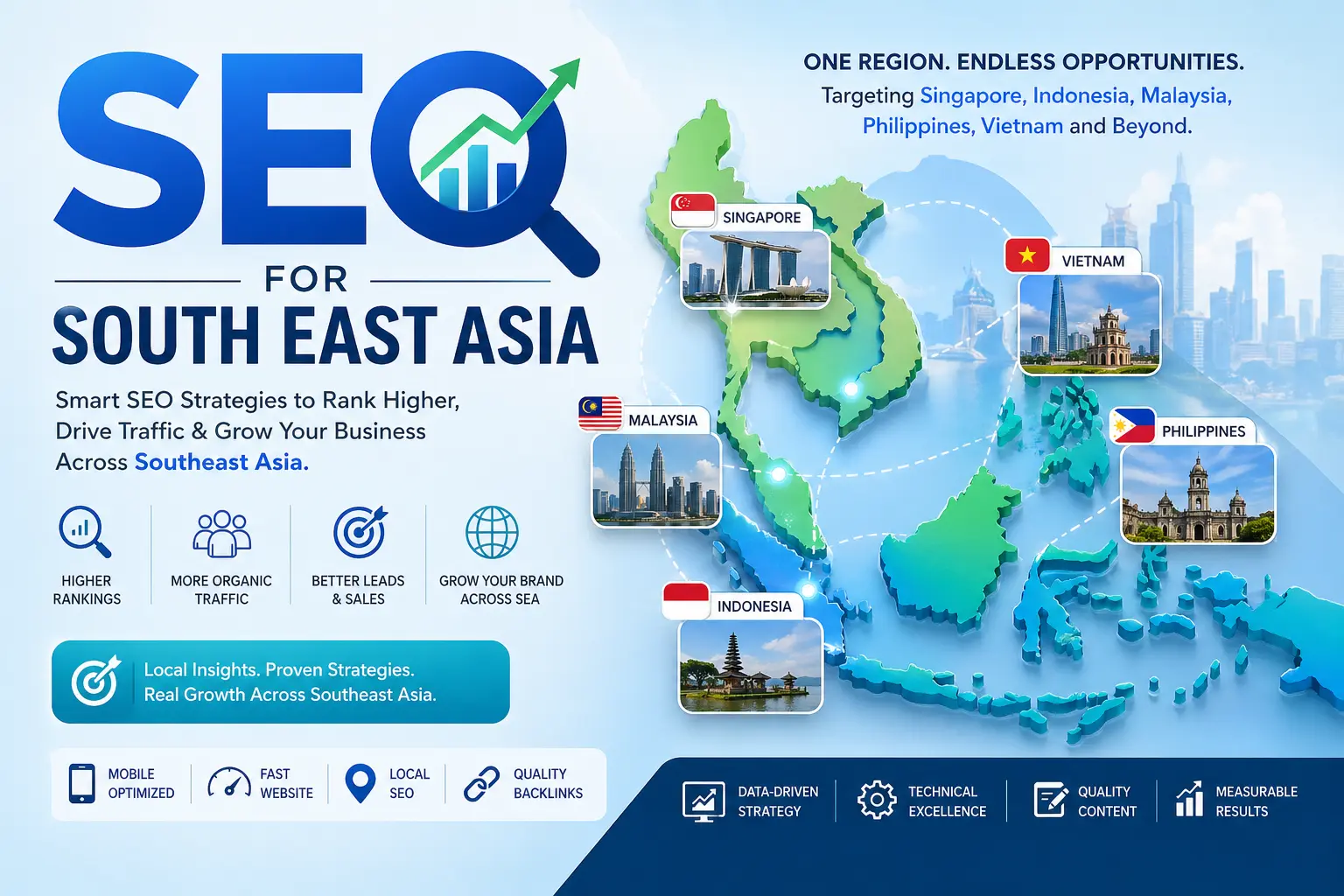
Ranking in Southeast Asia isn't a matter of translating one website into five languages and targeting the same keywords everywhere. Singapore, Malaysia, Indonesia, the Philippines and Vietnam each search differently, compete differently and convert differently. This guide walks through a Southeast Asia SEO strategy that actually accounts for that, market by market.
Key Takeaways
- Southeast Asia isn't one SEO market. Singapore, Malaysia, Indonesia, the Philippines and Vietnam differ in language, search intent, competition and mobile behaviour.
- Translating keywords isn't the same as localising them. Real keyword research has to happen separately in each market's own language and terminology.
- A scalable technical foundation (clean architecture, hreflang, canonicals) paired with country-specific content tends to outperform five near-identical country pages.
- Local SEO, Google Business Profile and genuine reviews matter differently in each market, and city-level SEO (Singapore, Kuala Lumpur, Jakarta, Manila, Ho Chi Minh City) is often where local businesses win.
- AI search and AI Overviews are changing how people find answers across the region, but they sit on top of solid SEO. They don't replace it.
- Measure performance by country, not as one blended regional number, or you'll miss which market is actually working.
- Five near-identical, translated-not-localised country pages risk being read as scaled content abuse under Google's current spam policies.
Why Southeast Asia Is a Different SEO Market in 2026
Ranking in Southeast Asia is not simply a matter of translating one website into five languages and targeting the same keywords across every country. Singapore, Malaysia, Indonesia, the Philippines and Vietnam have different languages, search behaviours, competitive environments, local intent and digital ecosystems. Treat them as one market and you'll end up with content that technically exists in five places but genuinely speaks to none of them.
This guide covers what a real Southeast Asia SEO strategy looks like in 2026: how each of the five markets differs, what to prioritise country by country, and the technical, on-page, off-page and local SEO fundamentals that tie it all together. It also covers where AI search and generative engines fit in, and how to measure whether any of it is actually working. Before going further, it helps to be clear on four terms people often blur together.
Regional SEO
Optimising for a whole region, such as Southeast Asia, often with one strategy spanning several related countries.
International SEO
The technical and structural side of targeting more than one country or language with a single website.
Local SEO
Optimising visibility for a specific city or area, like Singapore or Kuala Lumpur, usually through Google Business Profile and maps.
Multilingual SEO
Optimising content in more than one language, which may or may not line up with country boundaries, such as English and Bahasa Malaysia in Malaysia.
Southeast Asia Is Not One Search Market
Languages, search terminology, search intent, local competitors, digital adoption, mobile behaviour and ecommerce habits all shift from one country to the next. A strategy built only around Singapore's English-language, B2B-heavy search environment will miss most of how people actually search in Jakarta or Hanoi.
Translation Isn't the Same as SEO Localisation
This is one of the most common mistakes we see. A business translates its English keywords into Bahasa Indonesia or Vietnamese and assumes the SEO work is done. It isn't. Translation changes the words; localisation changes the strategy behind them.
A direct translation might be grammatically correct and still be a phrase nobody actually types into Google. Real keyword research has to happen independently in each market, using local search data and local terminology, not a translated spreadsheet.
Search Intent Can Change by Country
The same product or service can be searched for differently depending on the market: an English commercial query in Singapore, a Bahasa Indonesia equivalent in Indonesia, a Bahasa Malaysia variant in Malaysia, a Vietnamese phrase in Vietnam, and a mixed Filipino-English query in the Philippines. None of these are simple word-for-word swaps of each other.
Local competition changes the SERP
Local agencies, directories, marketplaces and review platforms crowd results differently in each market.
Mobile changes SEO priorities
Page speed, Core Web Vitals and mobile navigation matter more in mobile-first markets like Indonesia, Vietnam and the Philippines.
Local search works differently
Google Business Profile, Maps visibility, reviews and citations each carry different weight depending on the market's directory habits.
Southeast Asia SEO Market Overview: Singapore vs Malaysia vs Philippines vs Indonesia vs Vietnam
| Market | Language focus | SEO opportunity | Key SEO consideration |
|---|---|---|---|
| Singapore | English, plus multilingual pockets | B2B, SaaS, professional services | High competition, high search sophistication |
| Malaysia | English + Bahasa Malaysia | Local and regional commercial search | Genuinely multilingual search behaviour |
| Philippines | English + Filipino | Services, ecommerce, outsourcing | Strong local intent despite high English use |
| Indonesia | Bahasa Indonesia | Large consumer market, ecommerce | Deep localisation, not translation |
| Vietnam | Vietnamese | Ecommerce, services | Vietnamese-first search and content |
Singapore runs on English-first commercial search with real competition from established local and international brands, which suits B2B, SaaS and local business intent well. Malaysia genuinely mixes English and Bahasa Malaysia, so content and keyword research both need to account for the switch, often within the same searcher's journey. The Philippines has strong English-language search volume, but local Filipino terminology and mobile-first habits still shape a meaningful share of queries. Indonesia is overwhelmingly Bahasa Indonesia, spans a huge and geographically spread population, and rewards businesses that invest in proper localisation rather than translation. Vietnam is largely Vietnamese-first, with its own search patterns and a fast-growing ecommerce and services sector behind it.
Which Market Should Your Business Target First?
There's no universally "best" country to start with. The right first market depends on a handful of practical factors, not a ranking.
- Where your existing customers already are
- Where measurable search demand exists for what you sell
- The revenue potential of that market for your business
- How much competition you'd realistically face
- Whether your product or service is actually available there
- Whether you have the language resources to localise properly
A SaaS company with existing Singapore customers usually starts there. An ecommerce brand with strong demand signals in Indonesia might reasonably start there instead, even without an existing presence.
🇸🇬SEO Singapore: Complete 2026 Strategy
Singapore is the most competitive of the five SEA markets for commercial search, with an English-first business environment, mature B2B and SaaS demand, and well-established local brands defending their rankings.
Why Singapore SEO Is Different
Singapore's search environment is unusually competitive for its size. English-language business search is dense with established agencies, SaaS products and professional services, so ranking for broad commercial terms like "SEO services Singapore" takes real, sustained work. Google Maps and local intent still matter heavily for brick-and-mortar and service businesses, even in a market this digitally mature.
Technical SEO for Singapore Websites
The fundamentals are the same ones that matter everywhere: crawlability, clean indexing, an accurate XML sitemap, a sensible robots.txt, correct canonical tags, strong Core Web Vitals, mobile SEO, structured data, sound site architecture, HTTPS and properly rendered JavaScript. The Singapore-specific wrinkle is usually structural: businesses expanding across SEA from a Singapore base need to think through international URL structure (covered in detail further down) before they start duplicating content market by market. Our technical SEO services in Singapore cover this foundation directly.
On-Page SEO Singapore
Singapore keyword research, search intent mapping, title tags, meta descriptions, heading structure, Singapore-specific content and internal linking between service pages all matter here, same as anywhere, but the bar for quality is higher given the competition. A simple keyword mapping structure helps keep service pages organised rather than overlapping each other:
This kind of structure is exactly what sits behind our own SEO services in Singapore, local SEO services and SEO packages pages, each targeting a distinct, non-overlapping intent.
Off-Page SEO Singapore
Singapore business directories, industry websites, local publications, digital PR, local partnerships and genuinely relevant backlinks and brand mentions all build authority here. Volume matters far less than relevance: a handful of links from Singapore-relevant, topically related sites outperforms a large batch of generic ones.
Local SEO Singapore
Google Business Profile, a Singapore address, NAP consistency across directories, local citations, genuine reviews, Google Maps visibility and LocalBusiness schema all feed into local SEO here. For a service business with a physical presence or service area, this is often the fastest-moving part of the strategy. Our local SEO Singapore service is built specifically around this.
SEO Planning for a Singapore Website
- Foundation. Technical audit, keyword research and competitor analysis.
- Optimisation. Service pages, core content and internal linking.
- Authority. Digital PR, backlinks and local citations.
- Growth. Content clusters, CTR optimisation and conversion optimisation.
SEO by Business Type in Singapore
Startups
Low-competition commercial keywords, product-led SEO, founder expertise and long-tail queries before chasing broad terms.
SMEs
Local SEO, strong service pages, an optimised Google Business Profile, commercial keywords and genuine reviews.
SaaS companies
Feature pages, use-case pages, integration pages, comparison pages and problem-based content, covered further down.
Ecommerce
Category pages, product pages, product schema and transactional keywords, also covered further down.
Common Singapore SEO Mistakes
- Chasing broad commercial keywords before the site has any topical authority
- Treating Google Maps and local SEO as an afterthought for a B2B-looking business
- Publishing thin service pages with little real differentiation from competitors
- Building links from irrelevant, non-Singapore sources purely for volume
🇲🇾SEO Malaysia: Complete 2026 Strategy
Malaysia's search behaviour genuinely mixes English and Bahasa Malaysia, often within the same customer journey, which makes bilingual keyword research the main thing that separates Malaysia SEO from Singapore SEO.
Why Malaysia SEO Is Different
Malaysia's audience moves between English and Bahasa Malaysia depending on the query, the region and even the device, which means a single-language keyword strategy leaves real search volume on the table. Local terminology and regional differences between, say, Kuala Lumpur and Penang also shape which content actually ranks.
Malaysia SEO at a glance
- Technical: clean site architecture, solid crawlability and indexing, mobile SEO, Core Web Vitals, correct canonicalisation and hreflang where English and Bahasa Malaysia versions coexist
- On-page: separate English and Bahasa Malaysia keyword research, intent-matched content, localised titles and genuine internal linking between language versions
- Off-page: Malaysian publications, local directories, industry sites, digital PR and backlinks that are actually relevant to a Malaysian audience
- Local: Google Business Profile, Maps visibility, reviews, NAP consistency, local citations and city-level pages for hubs like Kuala Lumpur
SEO Planning and Business-Type Notes for Malaysia
The same four-phase planning roadmap used for Singapore, foundation, optimisation, authority, growth, applies here too, just with bilingual keyword clusters built in from the start. Malaysian startups generally do best focusing on specific, lower-competition commercial terms in both languages before competing broadly; SMEs tend to see the fastest wins from local SEO and a properly bilingual Google Business Profile; ecommerce businesses need Bahasa Malaysia product and category content alongside English, since many shoppers research in one language and buy in another; and SaaS companies targeting Malaysia often succeed by pairing English feature pages with Bahasa Malaysia landing pages for the same product.
Common Malaysia SEO Mistakes
- Publishing only in English and assuming it covers the whole market
- Machine-translating English content into Bahasa Malaysia without a local review
- Ignoring regional differences between Kuala Lumpur, Penang and other hubs
🇵🇭SEO Philippines: Complete 2026 Strategy
The Philippines has unusually high English-language search proficiency for the region, but genuine Filipino and local terminology, plus heavy mobile usage, still shape a meaningful share of how people actually search.
Why Philippines SEO Is Different
English-language search works well here, more reliably than in Indonesia or Vietnam, but treating the Philippines as "just English SEO" misses local Filipino and Taglish terminology, and the real difference between Metro Manila-focused searches and regional, provincial search behaviour. Ecommerce and service-based search are both strong growth areas.
Philippines SEO at a glance
- Technical and on-page: English keyword research as a base, supplemented with local terminology, search-intent mapping and content that genuinely reflects how Filipino audiences phrase things, not a direct US or UK English equivalent
- Off-page: Philippine publications, local directories, industry websites and digital PR with real relevance to the market
- Local: Google Business Profile, Maps, reviews and NAP consistency, with a clear distinction between Metro Manila targeting and regional or provincial targeting
SEO Planning and Business-Type Notes for the Philippines
Philippine startups tend to do well building around specific service or product pages first, since English search volume makes long-tail, high-intent terms genuinely reachable early. SMEs benefit heavily from local SEO given how much day-to-day search happens on mobile. Ecommerce businesses should plan for mobile-first product and category pages, since mobile commerce is a significant share of traffic here. SaaS companies targeting the Philippines often find a receptive, English-fluent B2B audience, provided content speaks to local business context rather than reading as generic international copy.
Common Philippines SEO Mistakes
- Assuming English SEO alone covers all local search intent
- Ignoring the difference between Metro Manila and provincial targeting
- Underinvesting in mobile page speed in a heavily mobile-first market
🇮🇩SEO Indonesia: Complete 2026 Strategy
Indonesia is overwhelmingly a Bahasa Indonesia search market, spread across a huge and geographically dispersed population, where genuine localisation matters more than almost anywhere else in the region.
Why Indonesia SEO Is Different
Indonesia's scale and geography set it apart: a large population spread well beyond Jakarta, strong ecommerce competition, and search behaviour that runs almost entirely through Bahasa Indonesia. Direct translation tends to fail here more visibly than in Malaysia or the Philippines, simply because so little of the market's search volume happens in English.
Bahasa Indonesia Keyword Research
Direct translation of English keywords routinely misses the actual local terminology Indonesian searchers use. Commercial terms like jasa SEO (SEO services), layanan SEO (SEO service/offering), optimasi website (website optimisation) and SEO lokal (local SEO) are the kind of native-language terms that real keyword research in Indonesia surfaces, and a literal translation of an English keyword list would likely miss entirely. Informational and transactional queries both need this same native-language research, not a translated version of an English keyword list.
Indonesia SEO at a glance
- Technical and on-page: Bahasa Indonesia-first architecture and content, with Jakarta-specific and regional targeting handled separately where relevant
- Off-page: Indonesian publications and directories, with genuine relevance over sheer volume
- Local: Google Business Profile, Maps and location-specific content for Jakarta and other major cities
SEO Planning and Business-Type Notes for Indonesia
Startups entering Indonesia generally need Bahasa Indonesia content from day one, not as a later addition, given how little commercial search happens in English. SMEs benefit from local SEO adapted to Indonesia's directory and review habits. Ecommerce is one of the strongest opportunities in the region here, given the sheer size of the market, but demands proper Bahasa Indonesia product and category content rather than translated copy. SaaS companies targeting Indonesia should expect to localise pricing, use cases and support language, not just marketing copy.
Common Indonesia SEO Mistakes
- Relying on direct translation instead of native Bahasa Indonesia keyword research
- Treating Jakarta search behaviour as representative of the whole country
- Underestimating how large and fragmented the ecommerce competition already is
🇻🇳SEO Vietnam: Complete 2026 Strategy
Vietnam is a largely Vietnamese-first search market with its own terminology and strong mobile usage, and a fast-growing ecommerce and services sector behind the demand.
Why Vietnam SEO Is Different
Vietnamese-language search dominates here, with local terminology, strong local competition and heavily mobile-first search behaviour. Regional search intent, between Hanoi and Ho Chi Minh City in particular, can also shift what actually ranks well.
Vietnamese Keyword Research
As with Indonesia, native-language research matters more than translation. Vietnamese keyword research needs to cover both commercial and informational intent in Vietnamese itself, accounting for local terminology and phrasing that a translated English list simply won't surface.
Vietnam SEO at a glance
- Technical and on-page: Vietnamese-first content and architecture, built around genuine local search intent rather than translated English pages
- Off-page: relevant Vietnamese publications, directories and partnerships
- Local: Google Business Profile, Maps and city-level content for Hanoi, Ho Chi Minh City and other hubs
SEO Planning and Business-Type Notes for Vietnam
Vietnamese startups and SMEs both benefit from the same pattern seen elsewhere in the region: local SEO and strong service pages first, broader competitive terms later. Ecommerce is a particularly strong growth area in Vietnam, and mobile-first product pages matter even more here than in most other SEA markets. SaaS companies entering Vietnam should expect longer sales education cycles and plan content that builds genuine category understanding, not just product comparison pages.
Common Vietnam SEO Mistakes
- Publishing English-only content for a market that searches mostly in Vietnamese
- Ignoring regional differences between Hanoi and Ho Chi Minh City
- Underinvesting in mobile performance in a heavily mobile-first market
Technical SEO Strategy for Southeast Asia
Once the country-specific strategy is clear, the technical layer underneath it needs to scale across markets without creating duplicate content or confusing search engines about which page serves which audience.
Build a Scalable International Website Architecture
Country-code subfolders are the most practical structure for most SEA-focused businesses:
Subfolders keep one domain's authority working across every market, which matters most for smaller and mid-sized businesses still building overall authority. Subdomains or separate country-specific domains can make sense for larger operations with dedicated local teams and budgets, but they split authority and generally take longer to establish.
Implement Hreflang Correctly
Hreflang tags tell search engines which language and country version of a page to serve to which audience: en-SG for English content aimed at Singapore, en-MY for English aimed at Malaysia, id-ID for Bahasa Indonesia aimed at Indonesia, vi-VN for Vietnamese aimed at Vietnam, and en-PH for English aimed at the Philippines. Missing or incorrect hreflang is one of the most common technical issues we see in multi-country SEA sites.
Each country version should canonicalise to itself, not to a single "master" version, or search engines will drop the local pages from results.
Prevent duplicate country content
Thin location pages, copy-paste country pages and machine-translated content without local review all tend to get filtered out of rankings.
Crawlability and indexing
A clean XML sitemap, sensible robots.txt and properly rendered JavaScript keep every country folder actually discoverable.
Core Web Vitals
Loading speed and stability matter more in mobile-heavy markets like Indonesia and Vietnam, where connection quality varies more than in Singapore.
Mobile SEO
Mobile-first indexing means the mobile version of every country page is what Google actually evaluates.
Structured data
Organisation, LocalBusiness and Article schema, applied consistently per country page, help search engines and AI systems understand what each page is for.
If your current site wasn't built with this kind of structure in mind, our technical SEO team can audit and rebuild the architecture before the content and link-building work goes further.
On-Page SEO Strategy for Southeast Asia
On-page SEO across SEA follows the same core workflow in every market: country-specific keyword research, clear intent mapping, genuine localisation, and content structured for both readers and search engines.
Country-Specific Keyword Research
The workflow that holds up across every market: seed keywords, competitor research, local terminology, search volume, intent, then keyword mapping into the site structure. Skipping the "local terminology" step is where most translated SEA sites go wrong.
Search Intent Mapping
| Intent type | What the searcher wants |
|---|---|
| Informational | An answer or explanation, not necessarily a purchase |
| Navigational | A specific website or brand they already have in mind |
| Commercial | Comparing options before a decision |
| Transactional | Ready to buy, sign up or enquire now |
| Local | A business or service near a specific location |
Content Localisation
The real workflow is translation, then localisation, then search-intent adaptation, not translation alone. A page can be grammatically perfect in Bahasa Indonesia or Vietnamese and still fail to match what people actually search for, because the structure and examples weren't adapted to local intent.
Titles and meta descriptions
Written for the local market's phrasing, not a direct translation of the English version.
Heading structure
Clear H1/H2/H3 hierarchy per page, matched to the keyword mapping for that country.
Internal linking
Country-level internal link architecture that keeps each market's pages connected to each other, not just back to a single global homepage.
Image SEO
Localised alt text and file names, since image search behaviour also varies by market.
Entity optimisation
Clear, consistent naming of your brand, products and locations so search engines and AI systems can map them correctly.
E-E-A-T and first-hand experience
Genuine local expertise, real case examples and clear authorship build more trust than generic, unattributed content.
Off-Page SEO Strategy for Southeast Asia
A Singapore website shouldn't rely exclusively on unrelated international backlinks. Country-relevant links, digital PR and partnerships build authority that actually matches the markets you're targeting.
Digital PR
Genuine stories or data that local publications in your target market would actually want to cover.
Local publications
Industry and business media specific to Singapore, Malaysia, Indonesia, the Philippines or Vietnam.
Industry websites
Niche-relevant sites your actual customers already read.
Business directories
Reputable, market-specific directories rather than generic global listings.
Partnerships
Genuine relationships with complementary local businesses, often a natural source of relevant links.
Brand mentions
Even unlinked mentions in the right local context build real-world relevance signals.
Link Relevance vs Link Quantity
A handful of genuinely relevant, market-specific links consistently outperforms a large batch of generic ones. This matters even more across SEA, where it's easy to accumulate links that are technically "from the region" but have no real topical or geographic relevance to your actual audience.
Backlink Tactics to Avoid
- Spam directories with no real editorial standard
- Private blog networks built purely to pass links
- Irrelevant guest posts on unrelated sites
- Automated or bulk link-building services
- Paid links designed specifically to manipulate rankings
These tactics carry real risk under Google's current spam guidelines, and the short-term gain rarely outweighs the long-term exposure if the pattern gets flagged.
Google's 2026 Spam Updates: What They Mean for Southeast Asia SEO
Google's recent spam guidance targets exactly the shortcuts a rushed Southeast Asia rollout tempts people into: scaled, low-effort content, repurposed domains, and sites that rent out their authority. Knowing the three patterns helps you avoid tripping them by accident.
A lot of multi-country SEO work genuinely risks these policies without anyone intending to break them. It's worth naming the three patterns plainly, since "follow Google's guidelines" on its own doesn't tell you what to actually change.
Scaled Content Abuse and the Five-Country Trap
Scaled content abuse is Google's term for publishing a large volume of pages, often with little human oversight, mainly to manipulate rankings rather than to genuinely help anyone. The most common way a Southeast Asia rollout walks straight into this: five country pages that are the same template with the country name swapped in, or five machine-translated versions of one English page with no local review. Even with good intentions, that pattern reads as scaled, low-value content at the site level. The fix is the one running through this whole guide: genuine localisation per market, written or reviewed by someone who actually knows that market, not a translation pass.
Site Reputation Abuse
This covers third-party content hosted on a site mainly to borrow that site's existing authority and rank for topics unrelated to what the site is actually known for. It matters for SEA expansion when a business considers "renting" space on an established local site, through sponsored sections, syndicated content hubs or similar arrangements, to shortcut building its own authority in a new market. It's safer, and more durable, to build that authority on your own domain through the digital PR and partnership approach covered earlier.
Expired Domain Abuse
Buying an old, previously authoritative domain in a target country and repurposing it for unrelated content is another flagged pattern. If you're acquiring a local domain as part of a Southeast Asia expansion, the safe approach is using it for content genuinely continuous with what it was already known for, not a wholesale pivot to a different business entirely.
What This Means in Practice
- Have a real person fluent in the local language review every piece of localised content before it publishes
- Give each country page a genuine reason to exist, not just a swapped country name on shared template text
- Avoid content partnerships that exist mainly to borrow a site's authority rather than add real value to its readers
- Treat AI-assisted drafting as a starting point for a human editor, not a finished, publish-ready page
- When in doubt, ask whether the page would still be worth publishing if no search engine ever saw it
Local SEO Strategy for Southeast Asia
Local SEO across SEA runs on the same core components everywhere, Google Business Profile, Maps, citations, reviews, but the directory landscape and review culture shift from market to market.
Google Business Profile
Accurate category, hours, description and regular updates, localised per market.
Google Maps SEO
Visibility in the map pack, which often drives more local clicks than the organic results below it.
Local keyword research
City and neighbourhood-level terms, researched natively per market.
Location pages
Genuinely useful, non-duplicate pages for each city or service area you cover.
NAP consistency
The same name, address and phone number everywhere your business is listed.
Local citations
Listings on reputable, market-relevant directories.
Reviews and reputation
Genuine customer reviews, responded to consistently, never incentivised in ways that breach platform guidelines.
LocalBusiness schema
Structured data that confirms your business details directly to search engines.
City-Level SEO Across Southeast Asia
For businesses operating across more than one SEA market, city-level SEO is often where local competition really plays out: Singapore, Kuala Lumpur, Jakarta, Manila and Ho Chi Minh City each have their own local search patterns, directory ecosystems and review habits worth optimising for individually rather than lumping into one generic "Southeast Asia" location page.
How to Plan an SEO Strategy for a Southeast Asia Website
A Southeast Asia SEO rollout works best as a clear, staged plan rather than trying to launch every market and every tactic at once.
- Define your target market. Weigh revenue opportunity, existing customers, search demand, competition and product availability.
- Run country-specific competitor analysis. Look at ranking pages, keywords, content gaps, backlinks, local presence and SERP features for each market separately.
- Build country-specific keyword clusters. Separate primary, secondary, long-tail, local, commercial and informational keywords per market.
- Build the website architecture. Decide on subfolders, hreflang and canonical structure before content scales.
- Fix technical SEO. Crawlability, indexing, speed and mobile performance, covered in the technical section above.
- Build core commercial pages. Service, product or feature pages for each priority market.
- Create topical content. Supporting content clusters that build authority around your core pages.
- Build local authority. Country-relevant backlinks, digital PR and citations.
- Optimise Google Business Profile. For every location or service area you actually serve.
- Measure performance. By country, not as one blended number, covered in detail further down.
SEO Strategy for Startups in Southeast Asia
- Start with high-intent, low-competition keywords rather than broad terms you can't realistically rank for yet.
- Build product and service pages before publishing hundreds of blog posts. Commercial pages convert; thin blog volume rarely does on its own.
- Use founder and team expertise as a genuine E-E-A-T signal, not generic, unattributed copy.
- Build topic clusters around your actual product, not around every tangentially related keyword you can find.
- Build early authority through digital PR and partnerships rather than waiting for links to accumulate passively.
- Track leads, not just rankings, since a page one ranking that converts nobody isn't actually working.
If you're earlier in this process, our 2026 SEO strategies guide and SEO packages are built with exactly this staged approach in mind.
SEO Strategy for Small Businesses and SMEs
- Prioritise local SEO over broad national or regional competition first.
- Build service and location pages for every area you genuinely serve.
- Optimise Google Business Profile thoroughly, not just a one-time setup.
- Collect genuine customer reviews consistently, not in occasional bursts.
- Create locally relevant content that reflects your actual market, not generic industry advice.
- Build local backlinks from genuinely relevant community and industry sources.
- Track calls, leads and enquiries, which usually matter more to an SME than raw traffic.
Our affordable SEO services and local SEO offerings are built around exactly this kind of SME-focused approach.
AI Search, AEO and GEO in Southeast Asia in 2026
AI Overviews and generative search are changing how people find answers across Southeast Asia, but they sit on top of solid SEO fundamentals rather than replacing them.
How AI Is Changing Search Behaviour
More searches across the region now surface an AI-generated summary before the traditional blue links, often pulling from a handful of sources Google or another AI system judges most directly useful. Google's AI Overviews and AI Mode, and Gemini's growing multilingual capability, all affect how content gets surfaced across English, Bahasa Malaysia, Bahasa Indonesia, Vietnamese and Filipino queries alike.
What Is Answer Engine Optimisation (AEO)?
AEO is the practice of structuring content so it can be pulled directly into a featured snippet or AI-generated answer, typically through clear, direct answers near the top of a section, rather than burying the answer in several paragraphs of lead-up.
What Is Generative Engine Optimisation (GEO)?
GEO is the broader practice of making content more likely to be cited or referenced by generative AI systems themselves, not just traditional featured snippets, through clear structure, credible sourcing and genuine expertise that an AI model can confidently draw from.
SEO vs AEO vs GEO
| Approach | Primary focus | Example |
|---|---|---|
| SEO | Search rankings | Google organic results |
| AEO | Direct answers | Featured snippets and AI-generated answers |
| GEO | Generative search visibility | Being cited inside AI-generated responses |
How to Make Southeast Asia Content More Useful to AI Search
- Lead sections with a direct, plain-language answer
- Use clear, consistent heading structure throughout
- Include genuine first-hand information and examples
- Back claims with original research or data where you have it
- Attribute content to a named author or team with real expertise
- Support claims with clear, verifiable evidence
- Use structured data so machines can parse the page correctly
- Keep entity names (brand, product, location) clear and consistent
- Add genuine country-specific context rather than generic global claims
Why AI Search Does Not Replace Traditional SEO
AI Overviews and generative answers still draw heavily on well-structured, technically sound, genuinely authoritative web content, the same qualities traditional SEO has always rewarded. A page with no technical foundation, no real expertise and no local relevance is no more likely to be cited by an AI system than it is to rank organically. AEO and GEO sit on top of SEO. They don't substitute for it.
SEO for SaaS Companies in Southeast Asia
SaaS SEO across SEA works best when it's product-led: pages built around specific features, use cases and comparisons, rather than generic company content.
Feature pages
One page per core feature, written around the specific problem it solves.
Use-case pages
Content built around a specific job the product does for a specific kind of customer.
Industry pages
Pages addressing how the product fits a particular industry's workflow.
Integration pages
One page per major integration, targeting people searching for that specific combination.
Comparison pages
Honest, fair comparisons against alternatives people are already evaluating.
Country-specific landing pages
Localised pages per market when pricing, compliance or use case genuinely differs.
If you're deciding whether a SaaS product needs this kind of country-specific structure at all, our explainer on what SaaS actually means and our SaaS development page cover the product side of this question.
Ecommerce SEO in Southeast Asia
Ecommerce SEO across SEA has to account for mobile-first shopping, strong marketplace competition and genuine language differences in product and category content.
Category pages
Clear, non-duplicate category structure with genuinely useful on-page content.
Product pages
Localised, non-templated product descriptions rather than manufacturer copy pasted as-is.
Ecommerce keyword research
Transactional, country-specific terms researched natively per market.
Product schema
Structured data covering price, availability and reviews for rich results.
Filtering that doesn't quietly generate thousands of duplicate, indexable URLs.
Mobile ecommerce SEO
Fast, mobile-optimised checkout and browsing, especially in mobile-first markets like Indonesia and Vietnam.
Marketplaces like Shopee and Lazada often compete directly with a brand's own Google rankings across SEA, so it's worth treating marketplace presence and owned-site SEO as two connected channels rather than separate projects, each needing country-specific content rather than one generic regional product catalogue. If you sell across several marketplaces and your own site, our ecommerce automation platform keeps inventory and listings in sync while your SEO work builds owned-site visibility alongside it.
TikTok Shop has become a genuine third channel alongside Google and the big marketplaces across several SEA markets, especially Indonesia, Vietnam and the Philippines. It isn't traditional SEO, since TikTok's own in-app search and recommendation system decides what surfaces, but the two channels feed each other in practice: product names, descriptions and reviews that are consistent across your own site, Shopee, Lazada and TikTok Shop reinforce the same entity signals search engines use to understand what you actually sell. Treat social commerce content as part of the same keyword and entity strategy as your Google-facing pages, not a separate, disconnected workstream.
How to Measure SEO Performance Across Southeast Asia
Measure Southeast Asia SEO by country, not as one blended regional number, or you'll miss which market is actually driving results and which one is quietly underperforming.
| Metric | What it tells you |
|---|---|
| Organic traffic by country | Which markets are actually gaining visibility |
| Keywords by country | Where you're ranking, and for what, market by market |
| Search impressions | How often your pages are being shown, even before clicks |
| CTR | Whether your titles and descriptions are actually earning the click |
| Organic leads | Enquiries and form fills attributable to organic search |
| Conversions and revenue | The business outcome that ultimately matters |
| Desktop vs mobile | Whether mobile performance is dragging down results in mobile-first markets |
Segmenting Google Search Console and GA4
In Search Console, segment by country, then query, then page, then device, so you can see exactly where a market is winning or stalling rather than reading one blended trend line. In GA4, segment by country, then landing page, then conversion, which keeps the data tied to actual business outcomes rather than traffic alone.
Common Southeast Asia SEO Mistakes
- Treating Southeast Asia as one market instead of five genuinely different ones.
- Translating instead of localising keywords and content.
- Using the same keywords across every country regardless of actual local search behaviour.
- Creating five nearly identical country pages that read as duplicate content to search engines and to real visitors.
- Ignoring local search intent in favour of a single global content strategy.
- Ignoring mobile performance in markets where most search happens on a phone.
- Building irrelevant backlinks purely for volume rather than relevance.
- Publishing mass AI-generated content without genuine local review or expertise behind it.
- Ignoring local competitors in favour of only benchmarking against international brands.
- Measuring regional traffic without country-level data, which hides exactly which market is working.
- Focusing only on rankings instead of business outcomes like leads, enquiries and revenue.
Southeast Asia SEO Cost and Timeline Benchmarks for 2026
Cost and timeline are the two questions every business actually wants answered before they commit, so it's worth being direct about realistic ranges rather than leaving it to a final sales call.
| Market | Typical monthly retainer | What usually drives the range |
|---|---|---|
| Singapore | Roughly SGD 500 to SGD 5,000+ | Competition level, scope and whether technical SEO is included |
| Malaysia | Roughly USD 300 to USD 2,000 | Bilingual content needs and local competition |
| Indonesia | Roughly USD 300 to USD 2,000 | Depth of Bahasa Indonesia localisation and market size targeted |
| Philippines | Roughly USD 300 to USD 2,000 | Local vs provincial targeting and content volume |
| Vietnam | Roughly USD 300 to USD 2,000 | Vietnamese content depth and ecommerce complexity |
These are retainer ranges, not fixed prices, and provider quality varies widely within every one of them, a very cheap quote in any market is worth questioning as much as an expensive one. As a rough shape for what a Southeast Asia rollout costs over time: the first three to four months lean heavily into technical foundation, architecture and keyword research, months four to six add content and local SEO across priority markets, and from month six onward spend typically shifts toward content clusters, digital PR and refining whichever markets are showing traction. Our own SEO cost guide for Singapore breaks this down tier by tier if you want the full pricing detail for that specific market.
Should You Hire a Regional Agency or Build an In-House Team?
Neither is automatically right. An in-house hire makes sense once you have enough ongoing content and local market knowledge to keep one person genuinely busy in a single market. A regional agency tends to make more sense earlier, or across several markets at once, since bilingual and multilingual SEO specialists for five different SEA languages are expensive and hard to hire one at a time. Many of our clients land on a hybrid: an in-house marketing lead who owns strategy and brand voice, paired with an agency that handles the technical, multilingual and local SEO execution across markets.
Southeast Asia SEO Checklist for 2026
Technical SEO
- Mobile-friendly website across every country version
- Core Web Vitals optimised
- Crawlability checked for each market's pages
- Indexing checked in Search Console per country
- XML sitemap covering all markets
- Robots.txt reviewed
- Canonical tags set correctly per country page
- Hreflang implemented and verified
- Structured data in place
Keyword Research
- Country-specific keywords researched natively
- Local terminology captured, not translated
- Search intent mapped per keyword
- Competitor keywords reviewed per market
- Long-tail keywords included
Content
- Content genuinely localised, not just translated
- Original information included where possible
- First-hand expertise reflected in the writing
- Clear E-E-A-T signals (authorship, sourcing, expertise)
- Internal linking connects related pages within each market
- Country-specific examples used throughout
Off-Page
- Backlinks genuinely relevant to the target market
- Local citations built per country
- Digital PR targeted at local publications
- Brand mentions tracked, even unlinked ones
- Links from recognised industry publications
Local SEO
- Google Business Profile set up and maintained per location
- Google Maps visibility checked
- Genuine reviews actively collected
- NAP consistency verified across directories
- Local landing pages built for each city or service area
Measurement
- Google Search Console segmented by country
- GA4 segmented by country and landing page
- Country-level traffic tracked, not just blended totals
- Rankings monitored per market
- CTR reviewed and titles adjusted where it's low
- Leads tracked back to organic search
- Revenue attribution reviewed regularly
Frequently Asked Questions About SEO in Southeast Asia
What is SEO in Southeast Asia?
SEO in Southeast Asia is the practice of improving a website's visibility in search results across markets like Singapore, Malaysia, Indonesia, the Philippines and Vietnam. It covers the same technical, on-page and off-page fundamentals as SEO anywhere, but needs country-specific keyword research and localisation because each market searches differently.
Why is SEO different across Southeast Asian countries?
Language, search terminology, competition, mobile usage and local search habits all vary by country. A keyword that works in Singapore often doesn't translate directly to Indonesia or Vietnam, and the competitors you're up against change from one market to the next.
Which countries should I target with Southeast Asia SEO?
It depends on where your existing customers are, where search demand for your product exists, how much competition you'd face, and whether you can support the language needed. Singapore, Malaysia, Indonesia, the Philippines and Vietnam each suit different kinds of businesses.
Is English SEO enough for Southeast Asia?
English alone can work well in Singapore and, to a large extent, the Philippines, since both have high English search volume. It's usually not enough in Indonesia or Vietnam, where most commercial search happens in Bahasa Indonesia or Vietnamese, and only partly enough in Malaysia, which searches in a mix of English and Bahasa Malaysia.
Do I need separate websites for Singapore, Malaysia, Indonesia, Philippines and Vietnam?
Not necessarily. Many businesses succeed with one website using country-specific folders or subdirectories, clear hreflang tags and localised content for each market, rather than maintaining five separate domains.
What is the best URL structure for international SEO?
Country-code subfolders, such as example.com/sg/ and example.com/id/, are usually the most practical option for most small and mid-sized businesses, since they keep one domain's authority working for every market. Subdomains or separate country domains can make sense for larger operations with dedicated local teams.
Do I need hreflang for Southeast Asia SEO?
Yes, if you have content in more than one language or targeting more than one country. Hreflang tags tell search engines which version of a page to show to which audience, such as en-SG for English content aimed at Singapore and id-ID for Bahasa Indonesia content aimed at Indonesia.
How does local SEO work in Southeast Asia?
Local SEO in Southeast Asia centres on an optimised Google Business Profile, consistent business name, address and phone number across directories, genuine customer reviews and location-specific content, adapted to how each market's directories and review culture actually work.
How long does SEO take in Southeast Asia?
Most businesses see early movement within three to four months and more meaningful results from six months onward, similar to SEO timelines elsewhere. Less competitive markets and long-tail local keywords tend to show results faster than highly competitive commercial terms in Singapore.
How much does SEO cost in Southeast Asia?
Costs vary a lot by market and scope. Singapore tends to sit at the higher end given its competitive market, while Malaysia, Indonesia, the Philippines and Vietnam often have lower monthly retainers, though quality and execution vary widely between providers regardless of country.
Is SEO different for startups and established businesses?
Yes. Startups usually do better focusing on low-competition, high-intent keywords and strong product or service pages first, while established businesses with existing authority can take on more competitive keywords and invest more in content clusters and digital PR.
How can AI search affect SEO in Southeast Asia?
AI Overviews and AI-powered search are changing how people find answers, often summarising information directly in the search results. This makes clear structure, direct answers and genuine first-hand expertise more important, but it doesn't replace the need for solid technical, on-page and local SEO underneath it.
Does Google's 2026 spam update affect Southeast Asia SEO content?
Yes, particularly for multi-country rollouts. Publishing five near-identical country pages, or machine-translated content with no local review, can be treated as scaled content abuse under Google's current spam policies. Genuine localisation, reviewed by someone who actually knows the market, is the safest path.
Is TikTok Shop SEO different from regular ecommerce SEO in Southeast Asia?
TikTok Shop runs on its own in-app search and recommendation system rather than Google, so it isn't traditional SEO. But keeping product names, descriptions and reviews consistent across your own site, Shopee, Lazada and TikTok Shop reinforces the same entity signals search engines use, so the two are worth planning together rather than separately.
Final Thoughts: Build One SEO Foundation, Localise for Every Market
Southeast Asia SEO works best when businesses combine a scalable technical foundation with country-specific keyword research, genuinely localised content, local SEO, relevant authority building and continuous performance analysis. In practice, that means one regional framework, five localised strategies, country-specific search intent respected in each one, technical consistency underneath it all, content that's actually localised rather than translated, and authority built from sources genuinely relevant to each market. Get that combination right, and the five-market complexity stops being a burden and starts being a genuine advantage over competitors still treating Southeast Asia as one undifferentiated block.
Ready to Build an SEO Strategy That Actually Works Across Southeast Asia?
Tell us which markets you're targeting and where you are today, and we'll show you exactly where the biggest opportunity sits, country by country, rather than a generic regional plan.