When spreadsheets and off-the-shelf tools stop keeping up, custom software can save time, connect your systems and give you room to grow. Here's how it works for small businesses and startups in Singapore.
Most small businesses start with spreadsheets, a few subscription tools and a lot of manual effort. That works until orders pile up, the team grows and people spend more time moving data between systems than serving customers. This is usually the moment custom software solutions start to make sense.
Ready-made tools are built for the average business. They force you to work their way, rarely connect neatly to each other, and charge per user as you grow. When your process is different from the average, you end up with workarounds, and workarounds become hidden costs.
Singapore businesses are already highly digital. IMDA reports that 95.1% of SMEs had adopted at least one digital area by 2024, and SME use of AI rose from 14.5% in 2024 to 23.4% in 2025. When most competitors have the basics, the advantage comes from software that fits how you work.
Custom software solutions are applications built for one business, around its own processes, customers and tools. That could be an internal system for managing orders, a customer portal, a booking platform or a mobile app. The idea is simple: instead of changing how you work to suit the software, the software is designed to suit you.
Ready-made software is built once for many customers. You get it quickly and cheaply, but you adapt to it. Custom-built software is designed for you, so it takes longer and costs more upfront, but it fits your workflow and can change as you do. Our guide on why every business needs different software solutions goes deeper on this.
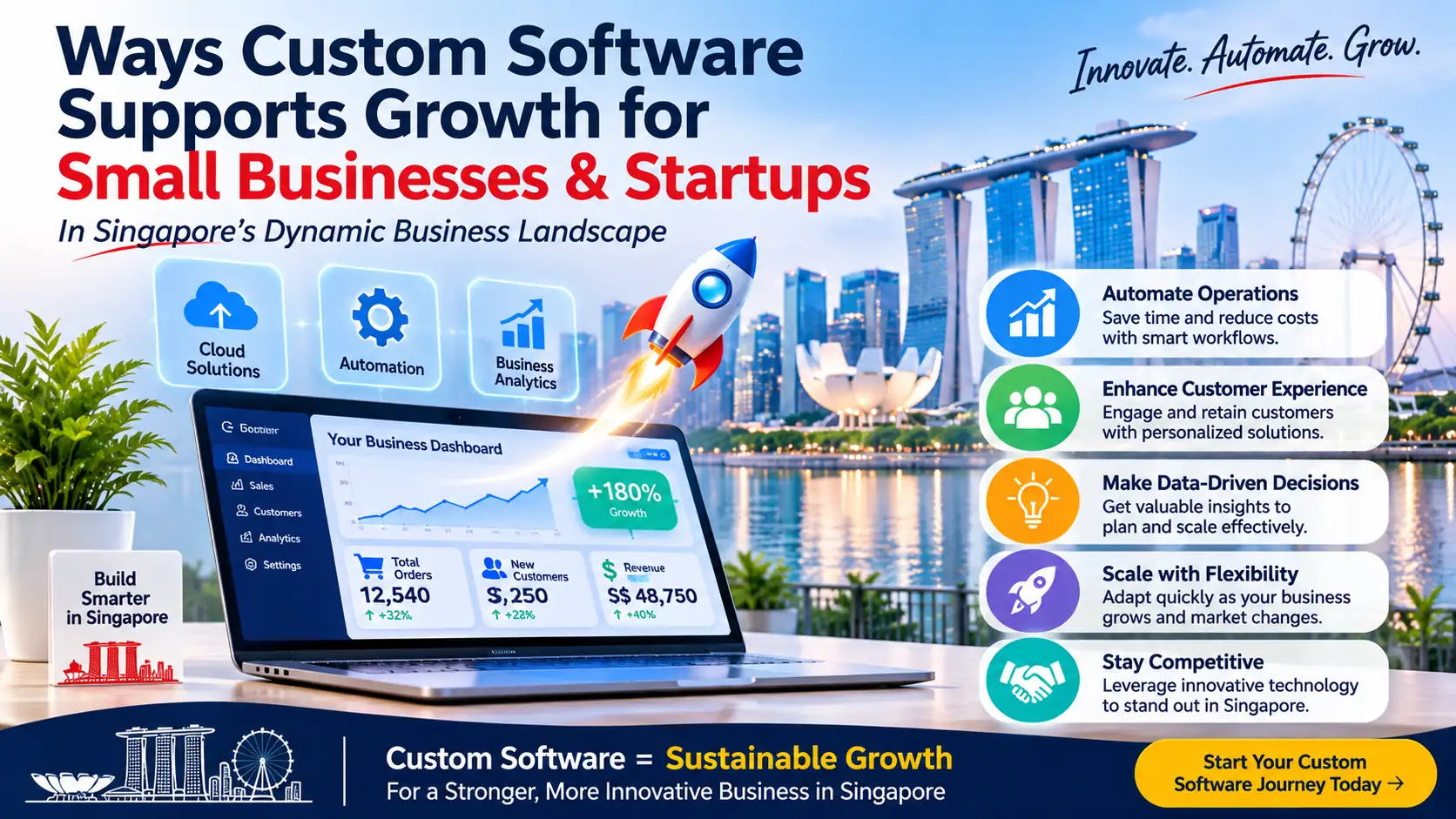
Order entry, approvals, reminders and reports can be handled by the software. Business process automation turns repeated tasks into steps your team no longer has to touch.
When systems are built around your workflow, people spend less time searching, retyping and checking. Small teams get more done without working longer hours.
Less manual work means fewer errors and less time lost. Over time you may also avoid per-user fees that grow with the team, depending on how you build and host.
Self-service booking, order tracking, quick quotes and accurate delivery times are things customers notice. A custom portal or app lets a small team serve like a much bigger one.
Instead of data scattered across files and tools, you get one reliable source. That makes reporting faster and decisions better informed.
Software can be designed to handle more users, orders and locations, and extended in stages, so growth doesn't force a rebuild.
Role-based access, audit trails and proper data handling reduce the risk that comes with sensitive information living in shared spreadsheets and chat threads.
| Off-the-shelf software | Custom software | |
|---|---|---|
| Flexibility | Limited to vendor features | Changes as your business changes |
| Pricing | Low upfront, recurring per-user fees | Higher upfront, no per-seat licences in many cases |
| Integrations | Limited to what the vendor supports | Designed around your systems |
| Scalability | Fine until you outgrow the plan | Built to grow in stages |
| Ownership | You rent access | Often you own the code, depending on the contract |
| Time to start | Days or weeks | Months, depending on scope |
Cost depends on features, integrations, design depth, security needs and who builds it. The smartest way to control it is to phase the build: start with the one feature that saves the most time or earns the most, prove it, then add the next. Remember to budget for hosting, support and updates. See our web application development cost guide for what drives the price.
A practical rule: buy for standard jobs, build for the parts that make your business different.
These are the kinds of software small businesses and startups most often have built or ask about.
A custom CRM tracks leads, customers and follow-ups in the way your sales process actually works, and can connect to your email, quotes and billing. See our CRM automation service.
An ERP joins finance, inventory, purchasing and operations in one system. A custom or modular version avoids paying for modules you never use.
Accurate stock across locations and channels is one of the most common pain points. Good inventory software updates counts automatically so you don't oversell or run out unexpectedly.
Sellers on several marketplaces lose hours updating stock, prices and orders in each one. E-commerce automation software centralises these jobs. SyncingAbout is one example, covered below.
Approvals, notifications, document creation and report generation can all be automated, often with system integration that links the tools you already use.
Customer portals, booking platforms and member apps give customers a direct way to deal with you. Our custom development, SaaS development and mobile app development teams build these.
Gyms juggle memberships, classes, trainers, workout programmes and member progress. Gym management software puts them in one place, with different views for owners, trainers and members.
Teams, especially remote and hybrid ones, need clear records of attendance, working hours and productivity. Workforce management software and employee management software centralise this, and can include time tracking and analytics. Where employee performance management software is used, be transparent with staff and follow your PDPA obligations. Our staff tracking software is one option.
You don't need custom software on day one. Look for these signs that it's time.
If you're still testing an idea, start with a lean MVP. Our guide on how to build a B2B SaaS product covers that path.
The partner you pick matters as much as the idea itself. Look for these four qualities, and watch for the warning signs that follow.
Have they worked with businesses like yours? Ask for examples and what changed for those clients.
Look for solid web, mobile and integration skills, and a team that explains trade-offs plainly.
Ask how they design software to handle growth, and how they'd add features later without a rebuild.
Software needs updates and fixes after launch. Check what support and maintenance they offer.
At Inno Panda, we build software around business requirements, not the other way round. Here's what that means in practice.
Our expert team has designed and built software that helps businesses grow faster and run more smoothly. Each product started with a real business problem, from running a gym to selling across several marketplaces to managing remote teams, and each is built to cut manual work, save time and give owners a clearer view of their business.
Memberships, classes, trainers and member progress in one platform.
Stock, orders and listings across marketplaces and stores from one dashboard.
Time, attendance and productivity tracking for remote, hybrid and office teams.
Marketplace integrations depend on your region and account.
Custom software isn't for every small business, and it shouldn't be your first move. But when manual work is slowing you down, your tools don't connect, or your process is your edge, software built around your business can free up time, improve service and give you room to grow. Start small, prove the value, then expand.
If you're not sure whether custom software is the right step, tell us how your team works. We'll give you an honest view of what to build first and what to leave out.
It can be, if you start small. A focused first version that solves your biggest bottleneck costs far less than a full platform. Phasing the build, reusing proven components and choosing the right partner keep the investment manageable, and the savings from automation help it pay back over time. Our web application cost guide shows what drives price.
Because your product or process is what sets you apart. Custom software lets you build exactly what you need, test it with a lean MVP, change direction as you learn, and own the code as you scale, instead of waiting on a vendor's roadmap.
A focused first version often takes a few months, depending on scope, integrations and how quickly decisions are made. Smaller internal tools can be faster, while larger platforms take longer. Building in stages lets you start using the software early.
Neither is better in every case. Ready-made software is cheaper and faster for standard needs like accounting. Custom software gives a better fit, easier integration and more flexibility. Many businesses use both.
Yes, if it's designed that way. A well-planned system can handle more users, orders and locations, and be extended in stages, so you aren't forced to replace it every time you grow.
Businesses with processes that off-the-shelf tools handle poorly: ecommerce sellers on several marketplaces, gyms and fitness studios, logistics firms, clinics, service businesses with remote teams, and startups building their own product.
Yes, if it stores personal data such as customer or employee details. Plan for consent, access control, secure storage and the ability to correct or remove records. Tools that monitor employees should be used transparently, with clear policies.
Possibly. The Enterprise Development Grant has supported custom projects, and Enterprise Singapore has said its grants are being merged into a new EDGE scheme. Check current rules with Enterprise Singapore or GoBusiness, and apply before you sign a contract.
It depends on your contract, so agree on it before you start. Many businesses require that they own the source code and intellectual property once the project is paid for. Get ownership, handover and documentation in writing.
Wondering whether custom software would pay off for your business? Describe your workflow and we'll tell you where to start.
Tell us where your team loses time, or what product you want to launch. We'll help you scope a realistic first version, recommend the right approach and give you a clear estimate in SGD, with no obligation.
Book a Free Consultation Explore Custom Development