A practical, step-by-step guide for founders and product teams in Singapore: how to validate the idea, scope an MVP, choose pricing and architecture, and get your first customers.
Whether you're trying to understand B2B SaaS, looking at examples and top B2B SaaS companies, or planning a platform of your own, this guide covers it in one place. Start with the basics, then follow the path to launch. One pattern shows up again and again: most B2B SaaS products don't fail because the code was bad. They fail because the team built something nobody was ready to pay for, or launched without a plan to reach buyers. This guide walks through the whole journey, from testing your idea to launch day, with the decisions that matter at each stage and what's different when you're building from Singapore.
B2B SaaS means business-to-business software as a service. A company builds software, hosts it online and lets other businesses subscribe to it. Customers don't install anything or run servers. They log in, use it and pay a recurring fee, usually monthly or yearly.
It works differently from consumer software. Sales cycles are longer, several people usually sit in the buying decision, contracts are bigger, and buyers expect security, integrations and proper support. That's why the build and the launch both need more planning than a typical app.
Why it matters: SaaS is a business model as much as a product. Pricing, onboarding, support and renewals matter as much as features, so plan them alongside the build.
For most companies, software isn't a one-off purchase any more. B2B SaaS has become the default way to get it, and the reasons are practical.
You pay a subscription instead of buying licences and servers, which keeps cash free for the rest of the business.
Most products can be set up in days or weeks, not months, so teams see value sooner.
Add users, upgrade a plan or switch off features as the team and its needs change.
The vendor handles updates, security patches and backups, so your team doesn't have to.
A browser is enough, which suits hybrid teams and companies working across several countries.
APIs let your CRM, accounting and other tools share data instead of living in silos.
The trade-off: you depend on the vendor. Before you commit, check where your data is stored, what the contract says about price changes and how you can export your data if you leave.
| Factor | B2B SaaS | Traditional on-premise software |
|---|---|---|
| Cost model | Recurring subscription | Large upfront licence, plus maintenance fees |
| Setup | Hosted by the vendor, often live within days | Needs servers, installation and IT time |
| Updates | Delivered automatically | Manual upgrades that take planning |
| Scaling | Change your plan or add seats | Buy more hardware or licences |
| Access | Any device with a browser | Specific machines or your own network |
| Customisation | Configuration and integrations | Deeper changes, usually at higher cost |
| Data control | Vendor hosts it, so check the location | You hold everything in-house |
Traditional software still makes sense in some highly regulated or very specialised situations. For most day-to-day business needs, though, SaaS has become the practical choice.
The appeal isn't only on the buyer's side. The model itself has real advantages for the company building the product.
It isn't easy. Sales cycles are long, churn can quietly eat growth, and buyers expect strong security and support. That's why the rest of this guide focuses on doing it carefully, step by step.
The easiest way to understand B2B SaaS is to look at what companies actually use. Most products fit a category where a business has a repeated, painful job to do.
| Category | Problem it solves | Well-known examples |
|---|---|---|
| CRM and sales | Tracking leads, deals and customers | Salesforce, HubSpot |
| Team collaboration | Planning work and sharing knowledge | Atlassian (Jira, Confluence), Asana |
| HR and payroll | Hiring, payroll and people management | Workday, Rippling, BambooHR |
| Accounting and finance | Invoicing, expenses and reporting | Intuit, Xero, NetSuite |
| IT and security | Managing IT requests and protecting systems | ServiceNow, CrowdStrike, Okta |
| Communication | Meetings and team messaging | Zoom, Slack |
| Data and monitoring | Storing, analysing and watching systems | Snowflake, Datadog |
Look at what these have in common: each solves one expensive, recurring problem, fits into the tools a business already uses, and gets more valuable the longer a team uses it. That's a useful test for your own idea.
"Top" depends on what you measure. Revenue, valuation and growth each give a different list, and rankings change often. This is a snapshot of widely recognised names, not a ranking.
| Company | Category | Known for |
|---|---|---|
| Microsoft | Productivity and cloud | Microsoft 365 and cloud services used by businesses of every size |
| Salesforce | CRM | The reference point for customer relationship management |
| Oracle and SAP | Enterprise applications | ERP and business systems for large organisations |
| Adobe | Creative and marketing software | Tools for design, documents and marketing teams |
| Intuit | Finance | Accounting and finance tools for small businesses |
| ServiceNow | Workflow automation | IT service management and enterprise workflows |
| Workday | HR and finance | Cloud HR and finance systems for larger employers |
| Atlassian | Team collaboration | Jira, Confluence and a large app marketplace |
| HubSpot | CRM and marketing | Easier-to-adopt CRM for growing companies |
| Datadog | Monitoring | Visibility into applications and infrastructure |
| CrowdStrike | Security | Cloud-based endpoint and threat protection |
If you're building from Singapore, the global names above aren't your only competition, and they're not your only inspiration either. Regional B2B SaaS companies tend to win in a few specific ways.
Singapore is a small home market. Many successful local products plan for Malaysia, Indonesia, the Philippines and beyond early, with multiple languages and currencies.
Global tools can be strong but generic. Support for PayNow, local accounting practices, regional compliance and support in your customers' time zone are real advantages.
Finance, logistics, HR, property and construction all have specific workflows that broad tools handle poorly. A focused niche is easier to enter and defend.
Expect buyers to compare you with global brands. They'll ask about security, data hosting and integrations, so be ready with clear answers.
Before you build, check whether existing B2B SaaS software already solves the problem. This question comes up from both sides: buyers choosing tools for their company, and founders deciding whether a gap is real.
Fastest and cheapest when your process is standard and a product covers most of what you need.
Sensible when a ready-made tool fits most needs but you need specific fields, reports or integrations.
Makes sense when the software is your product, your workflow is genuinely different, or nothing on the market does the job.
For a deeper look at the buy-or-build decision, read our guide on why every business needs different software solutions. If you've decided to build, the next section walks through how.
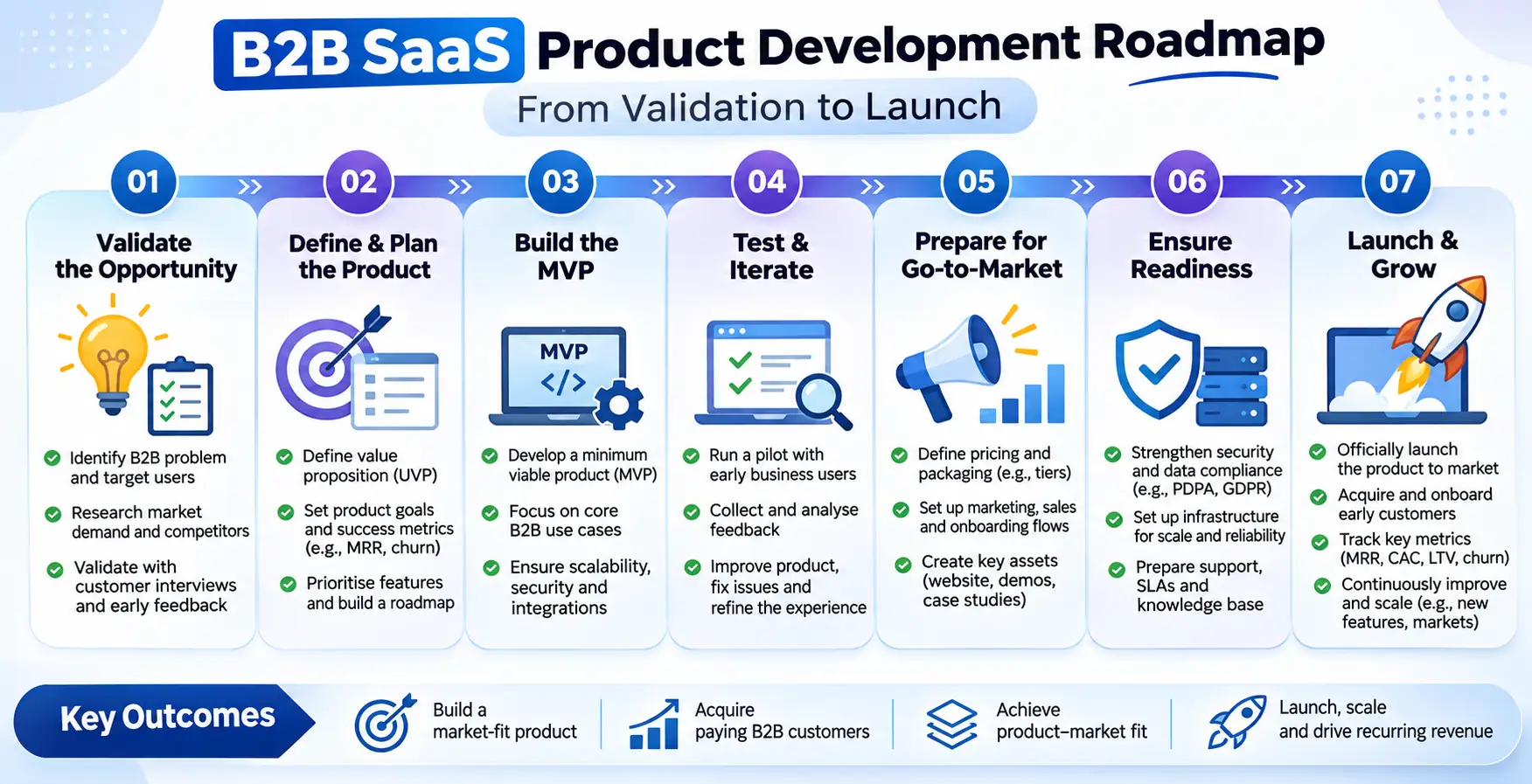
Work through these in order. Each step reduces a specific risk before you spend more money on the next one.
Talk to at least a handful of people who would buy or use the product. Ask how they handle the problem today, what it costs them in time or money, and what they've tried already. You're listening for pain that's frequent, expensive and currently solved with spreadsheets or workarounds. Positive feedback alone proves little. A pilot agreement, a deposit or a named champion at a company proves much more.
B2B products succeed by being clearly for someone. Decide which industry, company size and role you're serving, and write one sentence about the outcome you deliver. "Workflow software for everyone" is hard to sell. "Approval tracking for Singapore construction subcontractors" is easy to explain.
List every feature you can think of, then cut it down to the smallest set that solves the core problem end to end. Everything else goes on a later list. A good MVP feels slightly too small to you and still useful to a customer.
Decide how you'll charge before you build billing. Per user, tiered plans, usage-based and flat pricing each suit different products, covered in the table below. Early pricing is a hypothesis, so build the product so plans and limits can change without a rewrite.
Pick mainstream, well-supported tools your team or partner knows well. Design for multi-tenancy (many customers on one system with separated data), role-based access, an API and room to add integrations. These are expensive to bolt on later.
B2B users put up with a lot, but they still abandon confusing onboarding. Map the first-time journey, from sign-up to the first useful result, and prototype it with real users before development starts.
Work in sprints of one to two weeks, with a working demo at the end of each. Regular releases to a small group of testers keep the product honest and surface problems while they're cheap to fix.
Customers will ask where their data lives and who can see it. Cover access control, encryption, backups, audit logs and your PDPA responsibilities early, because enterprise buyers often send security questionnaires before they sign.
Release to a small group of friendly customers, ideally paying or committed ones. Watch what they actually do, not only what they say. Use their feedback to fix onboarding and decide what to build next, and ask permission to turn the results into a case study.
Go to market with a clear offer, a demo people can see in minutes and a way to buy or book a call. Combine direct outreach, content, partnerships and demos, and track results from week one.
You don't need all of these in your MVP, but you do need to make sure the foundation can support them later.
Many customer companies share one system, with their data kept separate. Getting this wrong is the most expensive mistake to fix later.
Admins, managers and standard users need different access. Larger customers will insist on this.
Encryption, audit logs and single sign-on are common requests from larger buyers.
B2B software rarely lives alone. Connections to accounting, CRM and payment tools often decide whether a deal closes.
Plans, invoices, upgrades and renewals. Check the GST treatment of your subscriptions with an accountant.
Track who signs up, who gets to value and who leaves. You can't improve what you can't see.
| Model | How it works | Works best when | Watch out for |
|---|---|---|---|
| Per user | Customers pay for each seat | Value grows with the number of users | Customers may limit seats to save money |
| Tiered plans | Fixed packages with different features and limits | You serve different customer sizes | Too many tiers confuse buyers |
| Usage-based | Customers pay for what they use | Value tracks a measurable unit, like transactions | Revenue and customer budgets are harder to predict |
| Flat rate | One price for everything | The product is simple and the customer base is uniform | Large customers may be undercharged |
| Hybrid | A base fee plus usage or seats | You want predictable income plus growth | Can be harder to explain |
Whatever you choose, test it with early customers and be ready to change it.
There's no universally right answer. It depends on your budget, your timeline and who will own technical decisions after launch.
Full control and deep product knowledge. Hiring takes time, and good engineers are expensive in Singapore.
Flexible and lower cost for defined tasks. Harder to manage for a full product, and continuity is a risk if someone leaves.
A ready team covering design, development, testing and security. You pay more per hour, but you move faster and share the risk.
If you're considering a partner, look for one that has built SaaS before, explains trade-offs honestly and stays involved after launch. Our SaaS development and custom development teams work with Singapore founders and businesses on exactly this.
Cost depends on scope, integrations, security requirements and who builds it. As a rough guide, an MVP is usually the lowest-cost stage and each stage after it costs more.
| Stage | What you're building | What drives cost |
|---|---|---|
| Validation | Research, prototypes, pilot agreements | Time spent with customers, design depth |
| MVP | Core workflow, accounts, basic billing | Number of features, integrations, roles |
| Version 1 | Fuller product, admin tools, more integrations | Security reviews, reporting, onboarding |
| Scale | Performance, new modules, new markets | Infrastructure, support, compliance |
Don't forget running costs: hosting, third-party services, support and ongoing development. For typical ranges, see our guide to web application development cost in Singapore.
Share what you learned during validation, build a short list of target companies, and prepare a demo, a one-page offer and a simple pricing page.
Offer a clear demo, a free trial or a pilot, and one obvious next step. Reach out directly to the people you've already spoken to.
Review activation, support questions and churn weekly. Turn happy customers into case studies, and fix onboarding before chasing more leads.
For long-term growth, plan content and search visibility early. Buyers research software online before they speak to anyone, so guides, comparison pages and case studies bring in leads while you sleep. Our SEO packages help SaaS companies build that pipeline.
| Metric | What it tells you |
|---|---|
| Activation rate | How many new sign-ups reach their first useful result |
| MRR / ARR | Your monthly or annual recurring revenue |
| Churn | How many customers or how much revenue you lose over time |
| CAC | What it costs to win a customer |
| LTV | What a customer is worth over their time with you |
| CAC payback | How long it takes to earn back what you spent to win a customer |
Pick two or three to watch closely at first. Activation and churn tell you whether the product works. CAC and payback tell you whether the business does.
A B2B SaaS product is software that businesses subscribe to and use over the internet, instead of buying and installing it. Examples include CRM, accounting, HR and workflow tools. You sell to companies, and customers pay a recurring fee.
Because it lowers the upfront cost of software, gets teams started quickly, scales as the company grows and removes the burden of maintaining servers and updates. It also makes it easier to connect tools and let teams work from different locations.
Well-known examples include Salesforce and HubSpot for customer relationship management, Atlassian's Jira and Confluence for team collaboration, Workday and Rippling for HR, ServiceNow for IT workflows, Datadog for monitoring and CrowdStrike for security. In each case, a business pays a subscription to use software that helps it run part of its operations.
It depends on how you measure it, because revenue, valuation and growth give different rankings. Names that regularly appear include Microsoft, Salesforce, Oracle, SAP, Adobe, Intuit, ServiceNow, Workday, Atlassian, HubSpot, Datadog and CrowdStrike. Treat any list as a snapshot, since rankings change.
B2B SaaS sells to companies, so sales cycles are longer, several people influence the decision, contracts are larger and buyers expect security, integrations and support. B2C SaaS sells to individuals, usually with simpler sign-up and lower prices.
A focused MVP often takes around three to six months, depending on scope, team size and how quickly decisions get made. A fuller first version with more integrations and admin features takes longer. Launching is the start of the work, not the end.
It depends on scope, integrations, security needs and who builds it. A SaaS MVP is often one of the larger web application projects, and costs rise with multi-user accounts, billing and compliance. Our web application cost guide for Singapore shows typical ranges.
A minimum viable product is the smallest version that solves one real problem well enough for customers to use and pay for. It's meant to test demand and gather feedback before you build everything on your wish list.
Talk to potential customers before writing code. Ask how they handle the problem today, what it costs them and what they'd pay to fix it. Pre-sales, signed pilot agreements or a waiting list with real company names are stronger signals than positive opinions.
Common models are per user, tiered plans, usage-based pricing, flat rate and hybrids. Choose the one that matches how customers get value, and test it with early customers. Expect to adjust pricing as you learn.
Not necessarily. Many founders work with a development partner, especially for the first version. You do need someone who can own technical decisions, whether that's a co-founder, a senior hire or a trusted partner who stays involved after launch.
There's no single best stack. Choose mainstream, well-supported tools your team or partner knows well, and design for multi-tenancy, security and integrations from the start. Hiring ease and long-term maintenance matter as much as technical fashion.
Possibly. Enterprise Singapore has supported custom projects through the Enterprise Development Grant, and has said its grants are being merged into a new EDGE scheme. Check current eligibility with Enterprise Singapore or GoBusiness before you commit, and apply before you sign contracts.
Start with the people you spoke to during validation. Offer pilots at a discount in exchange for feedback and a case study, then add outbound outreach, content, partnerships and demos. Early customers matter more for learning than for revenue.
Building a B2B SaaS product comes down to a few disciplined habits: test the problem before building, keep the first version small, get the foundations right, and launch with a plan to reach buyers. The teams that win usually aren't the ones with the longest feature list. They're the ones who learn fastest from real customers.
If you're planning a SaaS product in Singapore, Inno Panda can help with scoping, design, development and integrations, and we'll tell you honestly what to build first and what to leave for later. You can also read how software needs differ between businesses in our guide on why every business needs different software solutions.
Have a SaaS idea you want to pressure-test? Tell us about it and we'll help you scope a realistic MVP.
Tell us what you want to build and who it's for. We'll help you scope a focused MVP, choose the right architecture and plan the road to launch, with a clear estimate in SGD and no obligation.
Book a Free Consultation Explore SaaS Development