AI Agents vs. Traditional Automation: What SMEs in Singapore Actually Need in 2026
- 1 AI Agents vs. Traditional Automation: What SMEs in Singapore Actually Need in 2026
- 1.1 Key Takeaways
- 1.2 What's the Real Difference Between AI Agents and Traditional Automation?
- 1.3 How Traditional Automation Actually Works
- 1.4 What Makes AI Agents Genuinely Different
- 1.5 AI Agents vs. Traditional Automation: Side by Side
- 1.6 Where Each One Actually Wins for a Singapore SME
- 1.7 What This Actually Looks Like Inside an SME
- 1.8 The Hybrid Approach: Why Most SMEs Don't Need to Choose
- 1.9 AI Agents vs. Traditional Automation: What Do They Actually Cost an SME?
- 1.10 Governance and Risk: What to Check Before You Deploy an AI Agent
- 1.11 Common Mistakes SMEs Make Choosing Between AI Agents and Traditional Automation
- 1.12 How to Decide What Your Business Actually Needs
- 1.13 The Bottom Line for Singapore SMEs
- 1.14 Quick Glossary
- 1.15 Frequently Asked Questions
- 1.16 Related Reading from Inno Panda
- 1.17 Not Sure Whether You Need Automation, an AI Agent, or Both?
Every automation vendor now wants to sell you an "AI agent." Some of you genuinely need one. Most of you need something simpler, running properly, before you touch agents at all. Here's how to tell the difference without the sales pitch.
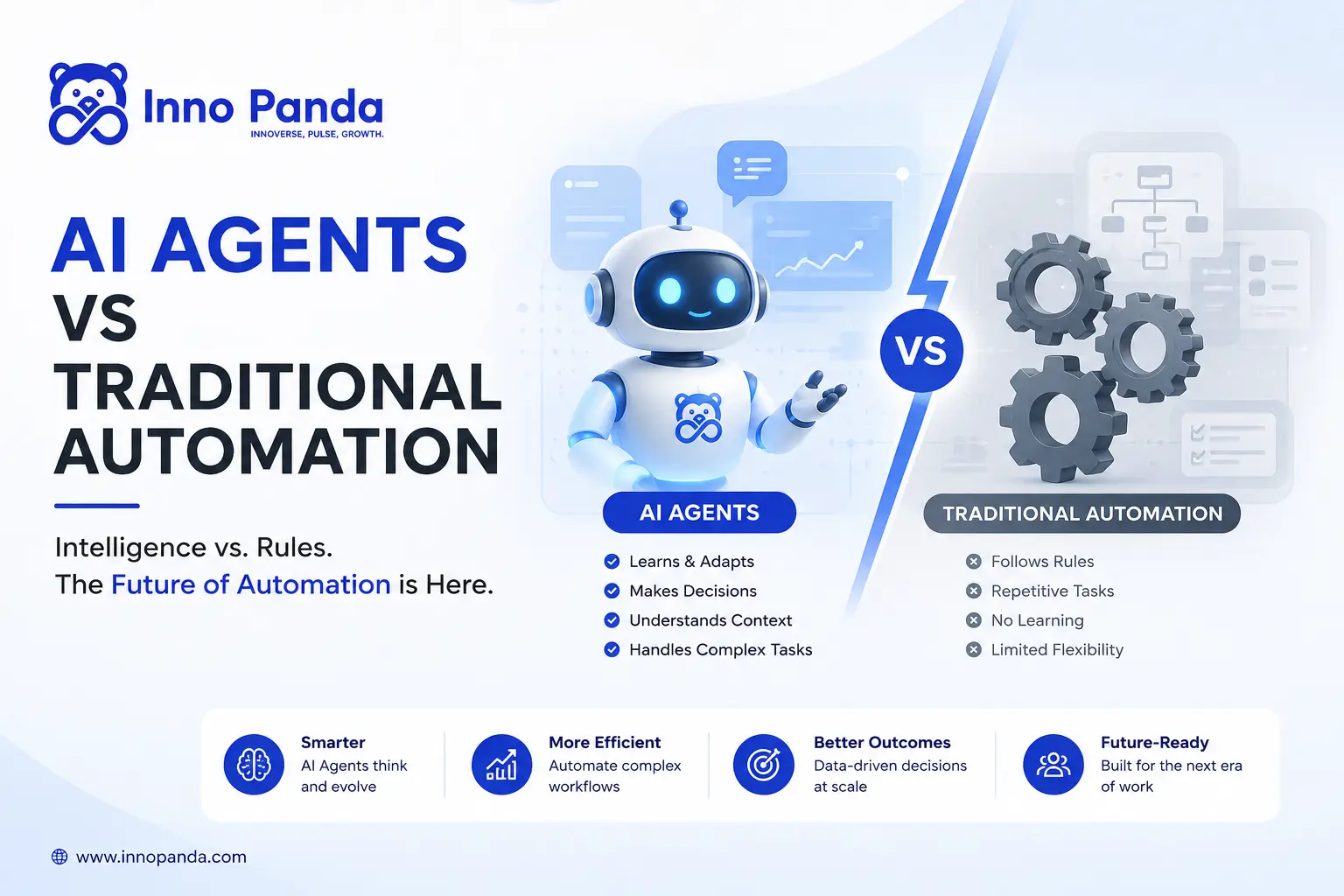
Quick answer: Traditional automation follows fixed rules and does the same thing every time, ideal for structured, high-volume tasks like invoicing or stock updates. AI agents use an LLM to reason through a goal, so they can handle messy, varied inputs like customer emails or documents with no fixed format, but they need more monitoring. Most Singapore SMEs don't need to pick one, they need traditional automation running well first, then AI agents layered on top for the specific tasks that actually involve judgment.
Key Takeaways
- Traditional automation is deterministic (same input, same output). AI agents are probabilistic, they reason and adapt, which means more flexibility but less predictability.
- Gartner expects 40% of enterprise applications to embed task-specific AI agents by the end of 2026, up from under 5% in 2025, but that doesn't mean every SME workflow needs one.
- The right question isn't "agents or automation," it's which tool fits which task.
- AI agents need ongoing oversight: monitoring outputs, checking for drift, and staying on top of data privacy obligations under Singapore's PDPA.
- Most businesses get the best results running both side by side, not replacing one with the other.
What's the Real Difference Between AI Agents and Traditional Automation?
Traditional automation, think RPA (robotic process automation) or a rule-based workflow tool, follows fixed logic. If this happens, do that. Give it the same input a thousand times, and you get the exact same output a thousand times. That's the whole appeal: total consistency, cheap to run, easy to audit.
AI agents work differently. They're built on large language models, which means they can read messy, unstructured information, weigh a few options, and decide on an action that fits the specific situation, even one nobody explicitly programmed for. The tradeoff is that the output can vary slightly each time, because the agent is reasoning, not just executing a script.
Why This Distinction Matters More in 2026
This isn't a small technical footnote anymore. Analysts expect a huge jump in how many business applications embed some kind of task-specific AI agent by the end of this year, and the AI agent market itself has grown fast in a short window. That means the vendors selling you automation are increasingly calling everything an "agent," whether it actually reasons or just follows a slightly fancier script.
For a Singapore SME specifically, this matters because the decision isn't abstract, it's usually about a real bottleneck: a support inbox that's grown past what one person can triage, a finance team re-keying data from supplier invoices that never arrive in the same format twice, or a sales team that can't keep up with follow-ups across WhatsApp, email, and calls at once. Getting the label right, agent or automation, changes what you should actually buy or build.
How Traditional Automation Actually Works
Traditional automation runs on explicit logic trees. There's no interpretation layer, the system checks a condition and executes a predefined outcome. That makes it excellent for stable, repetitive, structured work: invoice processing, payroll, stock updates, sending the same confirmation email every time an order comes through.
Once it's built and tested, it rarely needs to change unless your business rules change. For a small team without in-house AI expertise, that's a real strength, not a limitation. A bit of rigidity is exactly what you want when consistency and compliance matter more than flexibility.
What Makes AI Agents Genuinely Different
An AI agent is given a goal, not a script, and figures out the steps itself. It reads unstructured input (a support ticket, a supplier email, a scanned invoice in a format you've never seen before), reasons about what it means, and decides what to do next, sometimes using other tools or systems along the way.
This is genuinely useful where traditional automation falls apart: a support ticket that doesn't match any keyword rule, an invoice from a new vendor with a different layout, a customer asking something in a way your script never anticipated. The agent adapts. The rule-based system just fails or waits for someone to rewrite it.
The catch: AI agents need ongoing supervision. Models drift, prompts need the occasional adjustment, and costs scale with usage in a way that flat-fee automation tools don't. That's a genuine ongoing commitment, not a one-time setup. Vendors selling agents rarely lead with this, because "set it and forget it" is a much easier pitch than "keep watching it."
AI Agents vs. Traditional Automation: Side by Side
| Factor | Traditional Automation | AI Agents |
|---|---|---|
| How it decides | Fixed rules, if-this-then-that | Reasons toward a goal using an LLM |
| Best for | Structured, repetitive, high-volume tasks | Varied inputs, judgment calls, unstructured data |
| Consistency | Identical output every time | Output can vary slightly, reasoned not random |
| Setup effort | Map every decision branch upfront | Define the goal and guardrails, less branch-mapping |
| Ongoing maintenance | Low, stable once tested | Needs monitoring for drift and edge cases |
| Cost pattern | Mostly flat, upfront build cost | Scales with usage and complexity |
Where Each One Actually Wins for a Singapore SME
What This Actually Looks Like Inside an SME
Two quick, realistic examples make this less abstract than a feature comparison table.
Example 1: A Multichannel Retailer's Support Inbox
Order status questions, all near-identical, get handled fine by a rule-based system: match a keyword, pull the order number, send the tracking link. But a message like "the second item arrived damaged and I need a partial refund, not a replacement" doesn't fit a keyword rule cleanly. An agent reads the full message, understands the actual request, and either resolves it directly against your order data or routes it to a person with the context already attached, instead of dropping it into a generic queue.
Example 2: A Finance Team Processing Supplier Invoices
If every supplier sends invoices in the same template, a rule-based extraction tool works fine and costs less to run. The moment you're dealing with a dozen suppliers, each with their own layout, a rule-based tool breaks constantly and needs new rules for every new format. An agent reads the invoice regardless of layout, pulls the right fields, and flags anything it's not confident about for a human to check, rather than silently misreading a number.
The Hybrid Approach: Why Most SMEs Don't Need to Choose
Here's the part most vendor content skips, because it doesn't sell a single product. The businesses getting real value out of this shift aren't the ones who ripped out their automation and replaced it with agents. They're running both, deliberately, side by side.
Traditional automation handles the high-volume, stable core, the stuff you never want to behave unpredictably. AI agents get layered on top for the specific tasks that involve judgment, variation, or unstructured input. That's not a compromise, it's the setup that actually matches how most SME operations are structured: mostly routine, with a handful of genuinely messy workflows mixed in.
Our AI automation integration service is built around exactly this mix, connecting your existing systems with rule-based automation where it belongs, and layering AI where it adds real value, rather than defaulting to whichever is trendier.
In practice, this usually means keeping your existing rule-based workflows for the stable 80% of a process, and inserting an agent at the one or two decision points that genuinely need judgment. That's a far smaller, cheaper project than replacing an entire system, and it's also far easier to explain to a team that's understandably cautious about handing over control to something less predictable.
AI Agents vs. Traditional Automation: What Do They Actually Cost an SME?
Cost is where a lot of SME decisions actually get made, so it's worth being direct about the pattern rather than a single number, since it depends heavily on scope.
On accuracy specifically, this is where the tradeoff gets interesting rather than purely a cost question. Independent research on document processing has found AI agents outperforming rule-based extraction by a wide margin once documents stop following one fixed layout, a gap that closes completely, and can reverse, once you're back to a single, stable format that a cheaper rule-based tool handles just as well.
Governance and Risk: What to Check Before You Deploy an AI Agent
This part matters and gets skipped a lot, mostly because it's less exciting than the capability itself. Because agents make probabilistic decisions rather than following a fixed script, they can behave in ways nobody explicitly tested for, especially early on. That's not a reason to avoid them, it's a reason to deploy them deliberately. Before handing a workflow to an agent, especially one touching customer data, work through this short list.
Common Mistakes SMEs Make Choosing Between AI Agents and Traditional Automation
Most of the regret we see afterward traces back to one of these, not to the technology itself failing.
Treating "AI Agent" as a Marketing Label, Not a Capability
Plenty of tools now call themselves agents while still running on fixed rules underneath. Ask what happens with an input the system has never seen. If the answer is "it fails or needs a new rule," it's automation with a new name, not reasoning.
Deploying an Agent on a Task That Never Needed One
If a process is stable and the inputs never really vary, an agent adds cost and unpredictability with no real upside. This is the single most common overspend we see.
Skipping Human Review Because the Demo Looked Flawless
Demos use clean, cherry-picked examples. Real traffic is messier. Give any new agent a genuine review period before trusting it unsupervised.
Ignoring the Running Cost Until the First Busy Month
Usage-based pricing feels invisible at low volume and then arrives all at once during a promotion or peak period. Budget for the busy month, not the average one.
How to Decide What Your Business Actually Needs
Don't start by picking a technology. Start by picking a task.
Phase 1: Audit
List your most repetitive tasks. For each, ask: does the input ever vary, or is it always the same shape?
Phase 2: Fix the Basics
Get traditional automation running well on the stable, high-volume tasks first. It's cheaper and it's the foundation everything else sits on.
Phase 3: Add an Agent
Pick one task involving real judgment or varied input, deploy an agent there, and keep a person reviewing outputs while it's new.
Our business process automation service covers the foundational layer, and our AI automation integration team can help you identify exactly where an agent would earn its keep instead of adding complexity for its own sake.
The Bottom Line for Singapore SMEs
Neither technology makes the other obsolete, and treating this as a single either-or decision is how businesses end up either over-investing in an agent for a task that never needed one, or under-investing in the basic automation that would have solved 80% of the problem for a fraction of the cost. Get the boring, stable, high-volume stuff automated properly first. Then bring in an agent for the specific spots where judgment genuinely matters, and keep a person watching it while it's new.
Quick Glossary
- RPA (Robotic Process Automation)
- Software that follows fixed, rule-based scripts to complete repetitive digital tasks, the same way every time.
- AI agent
- A system that uses an LLM to reason toward a goal, adapting its approach based on the specific input it receives.
- Deterministic vs. probabilistic
- Deterministic systems always produce the same output for the same input. Probabilistic systems, like AI agents, can produce slightly different but still reasoned outputs.
- Model drift
- When an AI system's outputs gradually change or degrade over time, often requiring prompt or configuration adjustments to correct.
Frequently Asked Questions
What is the difference between AI agents and traditional automation?
Traditional automation follows fixed rules, the same input always gives the same output. AI agents reason through a goal using an LLM, adapt to context, and can handle situations they weren't explicitly programmed for, though their output can vary slightly each time.
Do small businesses actually need AI agents, or is traditional automation enough?
Most SMEs need both, for different jobs. Traditional automation still wins for high-volume, structured tasks like invoicing or stock updates. AI agents make more sense where inputs vary, like customer messages, emails, or documents that don't follow one format.
Is AI agent automation expensive to set up for a small business?
It depends on scope. A single, well-defined AI agent handling one workflow can be built and running within a few weeks, often more affordably than businesses expect, especially compared to hiring for the same task.
Can AI agents replace RPA (robotic process automation)?
Not entirely, and usually not immediately. RPA still handles stable, rule-based processes reliably and cheaply. Most businesses run AI agents alongside RPA rather than ripping it out, using each for what it's actually good at.
What are the risks of using AI agents in a business?
The main risks are unpredictable output on edge cases, ongoing monitoring needs as models and prompts change, and data privacy obligations under Singapore's PDPA when agents handle customer information. None of these rule out using agents, they just require guardrails.
How do I know if my business is ready for AI agents?
You're ready if you have a specific, recurring task involving judgment or varied inputs, like sorting support tickets or reading documents in different formats, and someone on your team is willing to review outputs while the agent is new.
What's the biggest mistake SMEs make when choosing AI agents vs traditional automation?
Deploying an AI agent on a task that never actually needed one. If a process is stable and inputs never really vary, traditional automation does the job more cheaply and more predictably, an agent just adds cost and unpredictability with no real benefit.
Is Singapore's PDPA relevant when using AI agents?
Yes, if an AI agent touches customer data. Businesses should check any AI deployment against PDPA obligations directly, rather than relying on a vendor's compliance claims, and IMDA's Model AI Governance Framework is a useful practical checklist to work through first.
Not Sure Whether You Need Automation, an AI Agent, or Both?
Tell us about the task that's actually slowing your team down. We'll give you a straight answer on whether it needs traditional automation, an AI agent, or a mix of both, no pressure either way.