Wearable-Integrated Apps for Singapore Businesses: Health, Fitness & Insurance Guide
- 1 Wearable-Integrated Apps for Singapore Businesses: Health, Fitness & Insurance Guide
- 1.1 Key Takeaways
- 1.2 What Wearable-Integrated App Development Actually Means
- 1.3 Why Singapore Businesses Are Investing in This Right Now
- 1.4 Comparing the Major Wearable Platforms in 2026
- 1.5 Build vs Buy: Direct Integration or a Wearable Data Aggregator?
- 1.6 RepAgain: Our Own Wearable-Integrated Fitness App
- 1.7 Common Mistakes Singapore Businesses Make With Wearable Integration
- 1.8 How a Wearable-Integrated App Actually Gets Built
- 1.9 What to Look for in a Wearable App Development Partner
- 1.10 Cost and Timeline Considerations
- 1.11 Quick Glossary
- 1.12 Frequently Asked Questions
- 1.13 Related Reading from Inno Panda
- 1.14 Ready to Build a Wearable-Integrated App That Actually Works?
Wearables are not new. What is new is how many Singapore businesses in health, fitness, and insurance are realising that syncing with a smartwatch or fitness band is the difference between an app people delete after a week and an app that becomes part of someone's daily routine.
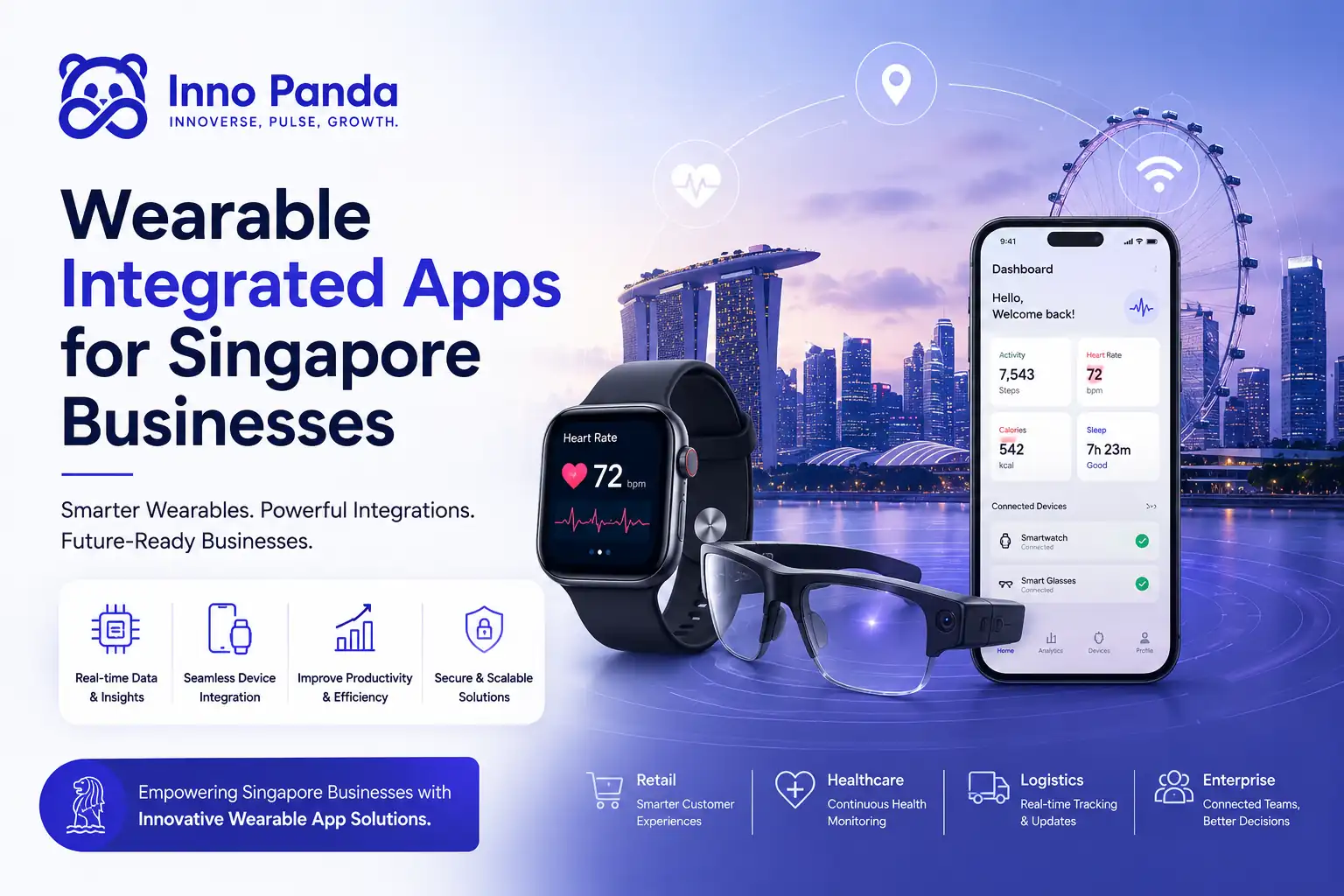
Quick answer: A wearable-integrated app connects to a platform layer, not the watch itself. On iOS that's Apple HealthKit. On Android it's Health Connect, which is now replacing the older Google Fit APIs. Google is retiring those through 2026. You can build these integrations directly, or use an aggregator API like Terra or Vital to cover many device brands through one connection. In Singapore, health, fitness, and insurance businesses are moving fastest on this. PDPA compliance gets built in as an architecture decision from day one, not bolted on after launch.
Key Takeaways
- Wearable integration means connecting your app to a platform layer, Apple HealthKit, Health Connect, or Samsung Health, not the watch directly, and each one behaves differently.
- Google Fit is being retired through 2026. New Android builds should target Health Connect, not the old Google Fit APIs.
- You can build direct integrations yourself, or use an aggregator API like Terra, Vital, or Spike to cover many devices through one connection. Each approach has real trade-offs.
- Health, fitness, and insurance businesses in Singapore are adopting this fastest. AIA Vitality is a live example of wearable data driving real premium discounts.
- The most expensive mistake is treating wearable sync as something you bolt on at the end instead of designing for it from sprint one.
- PDPA applies to wearable health data from day one. This needs to be an architecture decision, not a policy afterthought.
What Wearable-Integrated App Development Actually Means
Wearable integration is the process of connecting a mobile app to data generated by a smartwatch, fitness band, or health sensor, so information like heart rate, steps, sleep, or blood oxygen flows automatically into your app without the user typing anything in.
Your app does not talk directly to an Apple Watch or a Galaxy Watch. It talks to a platform sitting in between, Apple HealthKit on iOS, or Health Connect on Android. These platforms collect data from whichever wearable the user owns, standardise it, and hand it to your app through an API. This middle layer is the reason a well-built wearable app can support several watch brands without a separate integration for each one.
How the Data Actually Moves
Here is the simplified version. First, the wearable device records raw sensor data. Second, that data syncs to a platform layer on the phone. Third, your app requests permission to read specific data types, such as heart rate or step count. Fourth, once permission is granted, your app pulls the data on a schedule or in real time, depending on how it is built. Samsung devices can route through either Samsung Health or Health Connect, and Huawei devices use their own separate health platform entirely, worth knowing if any part of your target market leans Huawei, which is common across parts of Southeast Asia.
Important 2026 update: Google stopped accepting new developer sign-ups for the Google Fit APIs back in May 2024, and the Fit REST API and Android APIs are being fully shut down by the end of this year. If a developer or agency quotes you a build using Google Fit as the Android integration point in 2026, that is out of date advice. The correct target for new Android builds is Health Connect.
Why Singapore Businesses Are Investing in This Right Now
Singapore has one of the highest smartphone and wearable adoption rates in Asia, and three sectors in particular are moving fastest.
A Real Example: How AIA Vitality Uses Wearable Data in Singapore
AIA Vitality is a live, running example of usage-based insurance in Singapore, and it shows what wearable integration looks like once it becomes the core of a business model rather than a side feature. Members earn status tiers based on verified activity and health screenings, and that status feeds directly into a real premium discount on eligible AIA plans, alongside weekly rewards redeemable through partner brands. None of this works on self-reported numbers. It only works because the activity data is pulled from a connected device or phone sensor and verified automatically. This is the pattern any Singapore insurer or healthtech business exploring a usage-based model should study closely.
Comparing the Major Wearable Platforms in 2026
Before choosing which platforms to support, it helps to know how they actually differ, since this shapes your development scope and timeline more than most businesses expect.
| Platform | Primary Devices | Common Data Types | 2026 Status |
|---|---|---|---|
| Apple HealthKit | iPhone, Apple Watch | Heart rate, steps, sleep, workouts, blood oxygen | Active, current standard for iOS |
| Health Connect | Android phones, most Android wearables | Steps, activity type, heart rate, sleep, on-device storage | Active, Google's current Android standard |
| Google Fit APIs | Legacy Android integrations | Steps, activity, heart rate | Being retired through end of 2026, do not build new on this |
| Samsung Health | Samsung Galaxy phones and watches | Heart rate, sleep, stress, blood oxygen, body composition | Active, also feeds into Health Connect |
| Fitbit Web API | Fitbit devices, account-based | Steps, sleep, heart rate, workouts | Active, separate from Google Fit's retirement |
| Huawei Health | Huawei phones and wearables | Steps, heart rate, sleep, workouts | Active, especially relevant across SEA markets |
Build vs Buy: Direct Integration or a Wearable Data Aggregator?
This is the decision most businesses do not realise they need to make until halfway through scoping. You can build direct integrations with each platform yourself, or use a wearable data aggregator API, such as Terra, Vital, Spike, or ROOK, that connects to hundreds of devices through a single integration and hands you normalised data.
When an Aggregator API Makes Sense
Aggregators earn their cost when you need to launch quickly across many device brands and your product can tolerate a per-user or per-credit fee that grows alongside your user base. They handle OAuth flows, data normalisation, and webhook delivery, so a task that could take one engineer several months across five device families can be live in days instead.
When Direct Integration Makes Sense
Direct integration is worth the extra build time when data quality is core to your product, when you have scaled past the point where aggregator fees exceed your own development and maintenance cost, or when you operate in a regulated healthcare context where owning the full data path matters for compliance and audit purposes. It also means you are not exposed when an aggregator's upstream vendor relationship changes and their incident quietly becomes your incident.
| Approach | Speed to Launch | Ongoing Cost | Best Fit |
|---|---|---|---|
| Direct integration (HealthKit, Health Connect) | Slower, weeks of dedicated engineering | One-time build cost, lower long-term | Products where data quality and compliance ownership matter most |
| Aggregator API (Terra, Vital, Spike, ROOK) | Fast, days to a few weeks | Per-user or per-credit, grows with scale | Startups launching across many device brands quickly |
A practical rule of thumb: if you need to support two platforms, Apple Health and Health Connect, direct integration is usually the better long-term investment. If you need to support ten or more device brands from day one, an aggregator will likely get you to market faster.
RepAgain: Our Own Wearable-Integrated Fitness App
The Challenge
Fitness apps live or die on whether users trust the numbers and whether logging feels effortless. Manual entry is one of the top reasons fitness app users stop opening an app within the first two weeks. When we built RepAgain, our AI-powered fitness and workout tracking app, we needed workout data, heart rate, and calorie burn to appear automatically, pulled from whatever device the user already owned, without asking them to switch brands or buy new hardware.
The Approach
We built RepAgain to read from both Apple Health and Android's health data layer from day one, since together they cover the overwhelming majority of smartphone users in Singapore regardless of whether someone carries an iPhone or an Android device. Rather than a single rigid data pipeline, we designed a modular sync layer, so adding support for an additional platform later would not mean rebuilding the app. We also treated permissions and data handling as a design problem, not just a technical one. Users are shown clearly what data RepAgain reads, why, and how it improves their experience, rather than a wall of legal text at first launch.
The Result
RepAgain functions as a genuine AI-powered training companion, not just a workout logbook, because the data it works with is accurate and current the moment a user opens the app. That accuracy is what allows the AI layer to make useful recommendations instead of guesses based on incomplete manual entries. The same rule applies to any AI-powered feature built on top of user data. The AI is only as good as the data feeding it. That's why we treat the sync layer as the foundation, not an afterthought. It is also why we designed the sync layer to be modular from the start, so migrating any single data source later, as we are doing across the industry with Google Fit's retirement, does not mean touching the rest of the app.
Common Mistakes Singapore Businesses Make With Wearable Integration
Treating Wearable Sync as a Bolt-On Feature
The most common and most expensive mistake. Teams build the entire app first, then try to add HealthKit or Health Connect integration in the final sprint. Data permissions, sync frequency, and offline handling affect your database structure from the start. Retrofitting wearable sync into an app not designed for it usually means rebuilding core parts of the backend, not just adding a new screen.
Building on Google Fit Instead of Health Connect
Some teams still scope Android wearable work around the old Google Fit APIs, either from outdated documentation or a developer who has not kept up with the migration. Since Google Fit is being retired through 2026, any new build on it is dead on arrival and will need re-work almost immediately after launch.
Ignoring PDPA and Health Data Compliance
Health and fitness data is some of the most sensitive personal data your app will ever handle. In Singapore, PDPA obligations apply from day one, not after a data breach. Businesses that treat compliance as a legal afterthought instead of an architectural requirement almost always end up paying for expensive rework, or worse, a real incident.
Building for One Platform Only
Apps built to support Apple Health and nothing else immediately exclude a large share of the Android-using population, which in Singapore and the wider region is significant. A wearable strategy that only covers iPhone users is not really a wearable strategy, it is half of one.
Underestimating Sync Reliability Issues
Wearable data does not always sync instantly, and connections drop. Bluetooth range, battery-saving modes on Android, and background app restrictions on iOS can all interrupt data flow. Businesses that assume sync will simply work every time end up with support tickets asking why yesterday's workout never showed up. Good wearable apps are built with retry logic and clear fallback messaging, not silent failure.
No Clear Business Model for the Data
Some businesses integrate wearable data because it is trendy, without a plan for what to do with it. Are you personalising recommendations, offering premium pricing tiers, or feeding an insurance discount model like AIA Vitality does? If you cannot answer that before development starts, the integration ends up as a feature nobody uses rather than a genuine business advantage.
How a Wearable-Integrated App Actually Gets Built
Foundation, Platform Selection & Build-vs-Buy
Identify which platforms your users actually carry, decide between direct integration and an aggregator API, and design the data model and permission flow around that choice from the start.
Core Integration & Compliance Build
Build the sync layer, permission requests, and background data handling, with PDPA-aligned consent and retention rules built into the architecture, not added afterward.
Testing, Launch & Monitoring
Test sync reliability across real devices and connection conditions, then monitor for platform changes after launch, since Apple, Google, and Samsung all update permission models and data schemas over time.
What to Look for in a Wearable App Development Partner
If you are evaluating agencies for a wearable-integrated build, a few questions separate the teams who have actually done this from the teams learning on your budget.
Technical Depth Across Platforms
Ask directly whether the team has shipped apps integrating both Apple HealthKit and Health Connect, not just one, and whether they can explain why Google Fit is not the right target for a new 2026 build. Ask how they would approach an aggregator API like Terra or Vital if your timeline needed broader device coverage fast.
Compliance-First Architecture
Ask how PDPA compliance is built into the data architecture, not just the privacy policy. This should be a specific, detailed answer, not a vague assurance. It's the same standard we hold our own custom software development work to. Compliance built in at the architecture level is far cheaper than compliance bolted on later. Especially once a regulator starts asking questions.
Post-Launch Support
Wearable platforms update their APIs regularly, and Google Fit's own retirement is proof of how fast this can move. A partner who disappears after launch leaves you exposed the next time a platform update breaks your sync layer.
Cost and Timeline Considerations
Wearable integration adds real engineering time to a mobile app build, mainly because of permission handling, background sync logic, and testing across multiple device types. For a typical mid-complexity app, direct wearable sync can extend a build timeline by several weeks beyond a standard app without this feature, while an aggregator API can shorten development time in exchange for an ongoing per-user cost. The exact cost depends heavily on how many platforms you need to support, whether you build direct or buy through an aggregator, and how central wearable data is to your core feature set, so a proper technical scoping conversation before committing to a number is worth far more than a rough online estimate.
Quick Glossary
- Wearable Integration
- Connecting a mobile app to data generated by a smartwatch or fitness band, via a platform layer rather than the device directly.
- Apple HealthKit
- Apple's platform layer that standardises health and fitness data from the iPhone and Apple Watch for use by third-party apps.
- Health Connect
- Google's current on-device health data platform for Android, replacing the retired Google Fit APIs, storing data locally with per-data-type permissions.
- Samsung Health
- Samsung's own health data platform, used by Galaxy phones and watches, which also feeds into Health Connect.
- Wearable Data Aggregator
- A third-party API, such as Terra, Vital, Spike, or ROOK, that connects to many wearable brands at once and delivers normalised data through a single integration.
- PDPA
- Singapore's Personal Data Protection Act, which governs how businesses collect, use, and store personal data, including wearable-sourced health data.
- Usage-Based Insurance (UBI)
- An insurance pricing model where premiums adjust based on verified activity or behaviour data, often sourced directly from wearables, as seen in programmes like AIA Vitality.
Frequently Asked Questions
Is Google Fit shutting down in 2026?
Yes. Google stopped accepting new developer sign-ups for the Google Fit APIs in May 2024, and the Fit REST API and Android APIs are being fully retired by the end of 2026. New Android builds should integrate with Health Connect instead, since that is now Google's supported health data layer.
What is Health Connect and how is it different from Google Fit?
Health Connect is Google's current on-device health data platform for Android, replacing the older Google Fit APIs. It stores data locally on the device with granular per-data-type permissions, and it can pull from multiple sources, including Samsung Health and Fitbit, rather than acting as its own single silo the way Google Fit did.
Should I build my own wearable integration or use an aggregator API like Terra or Vital?
Aggregator APIs make sense when you need to launch quickly across many device brands and can accept per-user pricing that scales with your growth. Direct integration makes sense when data quality is core to your product, when you are past the user count where aggregator fees exceed in-house development cost, or when you are in a regulated healthcare context where owning the full data path matters.
Do I need to support both Apple Health and Health Connect?
If your user base includes both iPhone and Android users, which is almost always the case in Singapore, yes. Supporting only Apple Health cuts out a large share of your potential audience on Android.
Is wearable data covered under PDPA in Singapore?
Yes. Health and fitness data collected through your app falls under Singapore's PDPA obligations, and businesses need to build consent and data handling practices around that from the start of development, not after launch.
How long does it take to build a wearable-integrated app?
It depends on complexity, but wearable sync typically adds a few extra weeks to a standard mobile app timeline because of permission handling, background sync, and cross-platform testing. Using an aggregator API can shorten this, at the cost of an ongoing per-user fee.
Does Fitbit still work with third-party apps in 2026?
Yes. The Fitbit Web API remains separately available even as Google Fit is retired, since Fitbit data is tied to the user's Fitbit account rather than the Android device. Apps that need Fitbit data specifically should integrate with the Fitbit Web API directly or through an aggregator that already supports it.
How does usage-based insurance with wearables work in Singapore?
Programmes like AIA Vitality track verified activity data from a connected wearable or phone and translate it into a wellness status tier, which then adjusts the policyholder's premium discount for that year. The discount depends on real, synced data rather than anything the user can self-report.
Ready to Build a Wearable-Integrated App That Actually Works?
Wearable integration only pays off when it is planned from the first sprint, and built on the right platform, not the one that is being retired. Our team built RepAgain with exactly this kind of architecture, and we bring the same approach to healthtech, fitness, and insurance-focused mobile apps for Singapore businesses.