Top 12 SEO Mistakes Businesses Make in 2026
- 1 Top 12 SEO Mistakes Businesses Make in 2026
- 1.1 Key Takeaways
- 1.2 How SEO Mistakes Quietly Cost Businesses Rankings and Revenue in 2026
- 1.3 Technical and Foundational SEO Mistakes
- 1.4 On-Page SEO Mistakes Businesses Make in 2026
- 1.5 Content and Authority Mistakes
- 1.6 E-commerce SEO Mistakes After Google's 2026 Updates
- 1.7 International SEO Mistakes When Expanding Into New Markets
- 1.8 Local, Conversion & Tracking Mistakes
- 1.9 How These Mistakes Actually Hurt Your Ranking and Visibility
- 1.10 How Inno Panda Fixes These Problems
- 1.11 Quick Glossary
- 1.12 Frequently Asked Questions
- 1.13 Ready to Fix Your SEO and Start Ranking Where You Belong?
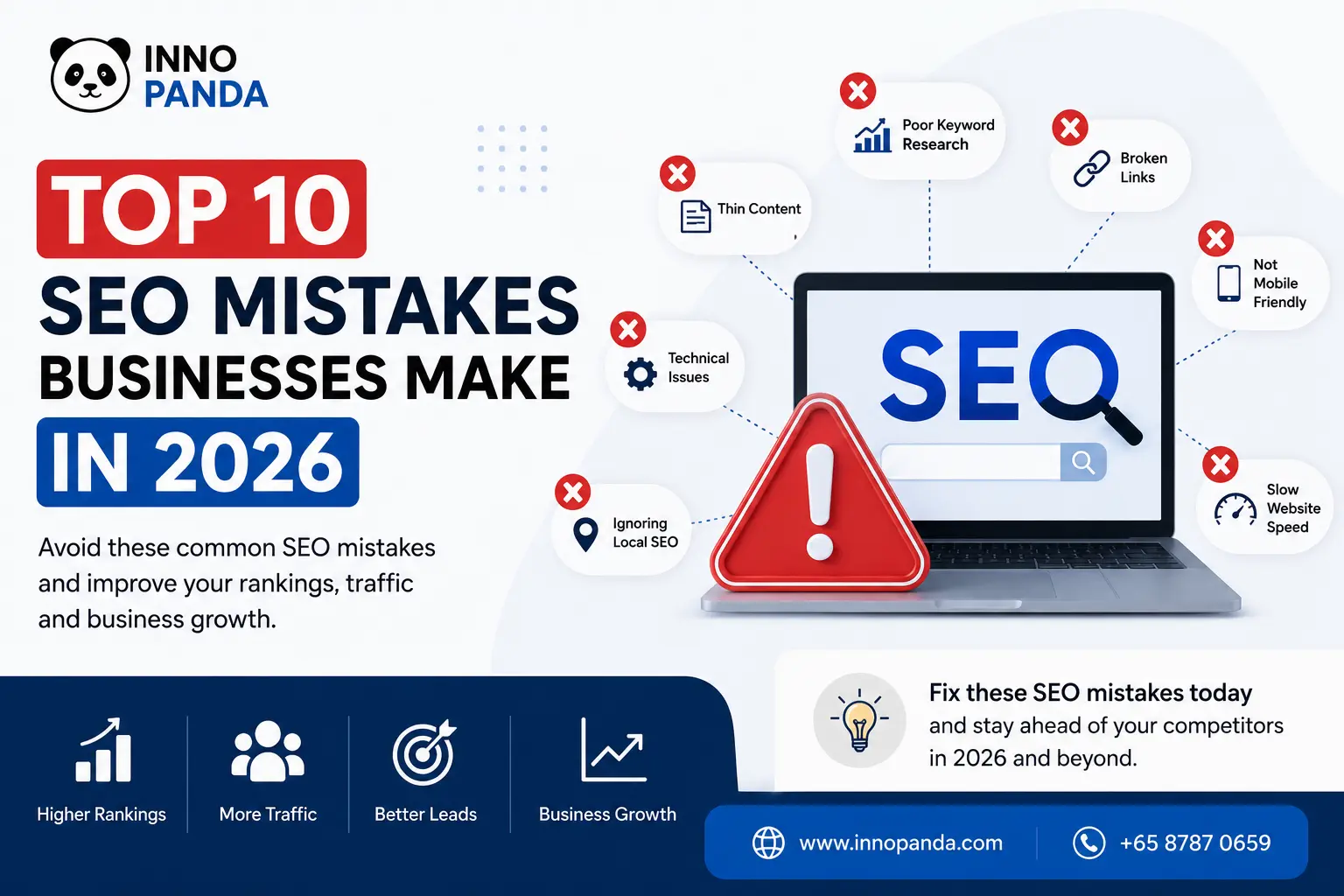
Your website could be generating leads right now. If you're making any of these mistakes, Google is quietly ranking your competitors above you instead. This guide covers the on-page, e-commerce, technical, local, and international SEO mistakes we see most often, worldwide, drawn from real audit work including our own Singapore client base. Real fixes, for each one.
Key Takeaways
- Technical SEO, weak keyword research, and thin content are still the three costliest mistakes in 2026.
- On-page, e-commerce, and international SEO mistakes each need their own checklist. A generic 10-item list misses the specifics, which is why this guide covers 12.
- Local SEO matters everywhere your business has a physical presence, not just in your home market. Our Singapore work makes that especially clear.
- AI content isn't the problem. Unedited, generic AI content with no real expertise behind it is.
- None of these mistakes need a big budget to fix. They need a clear plan and someone to execute it.
How SEO Mistakes Quietly Cost Businesses Rankings and Revenue in 2026
Most business websites aren't failing because of a bad product. They're failing because of small SEO mistakes that add up over time. Most owners never notice, until a rival shows up above them on every search their customers make.
This happens to businesses everywhere, not just in one market. The gap between page one and invisible usually comes down to the same handful of mistakes. They repeat across thousands of sites worldwide. A few of them, like on-page and international SEO errors, get far less attention than they deserve.
Technical and Foundational SEO Mistakes
These are the mistakes that quietly cap every page on your site. It doesn't matter how good the content is.
Ignoring Technical SEO
Technical SEO is the foundation everything else sits on. If Google can't crawl and index your pages properly, nothing you publish gets seen. Slow load times, broken robots.txt files, missing sitemaps, and Core Web Vitals failures are the most common culprits in 2026 audits. These issues rarely show up as an obvious error. They just quietly cap how high a page can ever rank.
Quick fix: Check Google Search Console's Coverage report and run PageSpeed Insights. Both are free and take minutes to reveal your biggest issues.
Weak Keyword Research and Search Intent Mismatch
Ranking for a keyword nobody searches is worse than not ranking at all. So is ranking for one that attracts people who'll never buy. In 2026, Google is far better at spotting when a page doesn't actually match what someone was searching for. A generic head term like "SEO mistakes" is brutally competitive. A specific one like "ecommerce SEO mistakes after a Google update" is far easier to win, and far more likely to match real buyer intent.
Skipping Core Web Vitals and Mobile-First Optimisation
Google ranks your mobile experience first, not your desktop one. Worldwide, most search traffic now comes from mobile, and in several fast-growing markets like Indonesia and the Philippines it's well over 90%. A slow, clunky mobile site turns away most of your audience before they read a single word.
Quick fix: Test at search.google.com/test/mobile-friendly, and fix LCP and CLS failures first. They carry the most ranking weight.
On-Page SEO Mistakes Businesses Make in 2026
On-page fixes are some of the fastest wins available. No developer needed, just a careful pass through your existing pages.
A page titled "Home | Company Name" tells Google almost nothing. Duplicate titles across several pages tell Google even less, and can cause your own pages to compete against each other. Every indexable page needs its own clear, keyword-led title.
Quick fix: Pull a full title tag export from Search Console or Screaming Frog, and flag anything duplicated or under 30 characters.
Poor Header Structure and Missing Answer-Ready Content
A page with no clear H2s and H3s is hard for Google, and for AI Overviews, to break into digestible pieces. Question-format headings that answer a real search, like "what are the most common on-page SEO mistakes," help both classic search and generative answers pull your content correctly.
Weak Internal Linking
Every internal link helps Google understand your site's structure. It also passes authority from strong pages to weaker ones. A page connected only by your top menu, with no other links pointing to it, signals weak topical authority.
Quick fix: Find your highest-traffic pages in Google Analytics, then add relevant links from those pages to your key service pages.
This is where AI has changed the game the most, for better and worse.
Publishing Thin or Unedited AI Content Without E-E-A-T
The problem in 2026 isn't a shortage of words. It's a shortage of real insight. AI makes it easy to produce plausible-sounding articles that add nothing new to a topic. Google's Helpful Content system is built to catch this, and it quietly demotes content like this, even when it looks polished on the surface.
Note: AI writing tools aren't the problem. Publishing unedited AI content with no human expertise layered on top is.
E-commerce SEO Mistakes After Google's 2026 Updates
Online stores carry their own set of mistakes, on top of everything above.
Duplicate Product Descriptions and Missing Product Schema
Copying a manufacturer's product description onto your store is one of the most damaging e-commerce mistakes in 2026. It gives Google nothing unique to rank. It also skips product schema, which AI shopping tools now use to read your price and stock correctly.
Quick fix: Start with your top 20 revenue products. Fix descriptions and schema there first, then work outward.
International SEO Mistakes When Expanding Into New Markets
Expanding into a new country takes more than a translated page. Each market needs its own signals, whether that's the US, Europe, or Southeast Asia, where our own client base sits.
Using one page to target several countries at once is a common mistake. Google can't tell which country the page is for. So it often shows the wrong version. Sometimes it shows none at all. Each market needs its own signals: local currency, local examples, and correct hreflang tags.
Quick fix: Check your hreflang setup with Google Search Console's International Targeting report. Many sites have none set up at all.
Local, Conversion & Tracking Mistakes
These mistakes cost businesses real leads everywhere, local and international alike, not just rankings.
Neglecting Local SEO Wherever You Do Business
If you serve customers in any specific city or country, local SEO is a main focus, not a side task. An incomplete Google Business Profile is one common mistake. Mismatched business details across directories is another. So is having no content about your local area at all. In our own audits across Singapore, KL, Jakarta, and Manila, these are consistently the costliest local SEO mistakes we find, and the pattern holds in every market we've checked. Learn more in our Local SEO guide.
Key stat: "Near me" searches have grown sharply over the past three years, worldwide. In many markets, including Singapore, KL, Jakarta, and Manila, the local pack now matters more than a standard first-page result.
No Conversion Strategy on High-Traffic Pages
Ranking on page one means nothing if visitors land and immediately leave. SEO drives traffic. Your conversion setup decides whether that traffic becomes revenue. Missing CTAs are one common failure. No trust signals, like reviews or client logos, is another.
Not Tracking SEO Performance
This mistake makes every other one worse. Without tracking, you can't tell which pages are slipping, or which keywords actually bring in leads. Google Search Console and Analytics 4 are both free, and together they cover almost everything you need.
Quick fix: If Search Console isn't set up, do it today. It takes 15 minutes at search.google.com/search-console.
How These Mistakes Actually Hurt Your Ranking and Visibility
Each mistake above doesn't just sit there quietly. It breaks a different stage of how Google finds, understands, and ranks your site. Knowing which stage is broken tells you which fix actually moves the needle.
| Mistake Type | What It Breaks | What You See |
|---|---|---|
| Technical SEO | Crawling and indexing. Google can't reach or read your pages properly. | Pages missing from search entirely, or stuck showing old versions |
| Weak keyword research | Relevance matching. Your page targets the wrong query, or none at all. | Low impressions, or impressions for terms nobody buys from |
| On-page mistakes | Google's understanding of what the page is about | Poor rankings even when the topic is right |
| Thin or AI-only content | Google's Helpful Content and E-E-A-T signals | Rankings that creep up, then quietly drop after a few weeks |
| Weak internal linking | How authority flows across your site | Some pages rank well, others near identical pages never do |
| Missing local SEO | Your eligibility for the Local Pack and "near me" results | You show up nationally or not at all, but never locally |
| Missing hreflang | Which country version Google shows a searcher | Wrong-market traffic, or your page competing against itself |
| No conversion setup | Nothing, technically. But it wastes every ranking gain you make. | Traffic that arrives and leaves without ever converting |
The pattern is always the same. A broken stage caps everything built on top of it. You can write the best content in the world, but if Google can't crawl the page, or doesn't trust it as local, it never gets the chance to prove that. This is why fixing mistakes in the wrong order rarely works. Content fixes on a page Google can't index change nothing. Local fixes on a page with no local relevance signal at all get ignored too.
Why this matters for your ranking specifically: Google doesn't rank a page once and leave it. It re-evaluates constantly. A single unresolved mistake, like a canonical mismatch or a missing feed, quietly caps a page's ceiling even while everything else about it improves.
How Inno Panda Fixes These Problems
Every mistake on this list is fixable, and none need an enterprise budget. What they need is a clear plan, matched to the right service, run consistently, not a one-off fix.
Technical SEO Audit & Fix
We check crawlability, indexing, Core Web Vitals, and canonical or schema errors first. Nothing else works until this stage is clean.
Explore Technical SEO →On-Page & Content Overhaul
We rewrite titles, headers, and thin pages with real expertise behind them, built around E-E-A-T, not just keyword density.
Explore SEO Services →Local SEO Setup
We fix your Google Business Profile, directory consistency, and local content gaps, wherever your customers are. Our deepest experience is across Singapore and Southeast Asia.
Explore Local SEO →E-commerce SEO & Schema
We rewrite duplicate product copy and add Product and Offer schema, so Google and AI shopping tools can read your store correctly.
Explore E-commerce Development →International SEO Setup
We set up correct hreflang tags and market-specific content, so each country you sell into gets its own signal, not one blended page.
Explore SEO Packages →Tracking & Reporting
We set up Search Console and Analytics 4 correctly, then report on the queries and pages that actually move, month over month.
Talk to Our Team →Our full SEO packages bundle these together as one connected system. Technical fixes first, then content and local SEO, then ongoing tracking, so gains at one stage don't get capped by a mistake at another.
Quick Glossary
- Technical SEO
- The backend work that lets Google crawl, index, and rank your site properly: speed, structure, and crawlability.
- E-E-A-T
- Experience, Expertise, Authoritativeness, Trustworthiness. Google's framework for judging content quality.
- hreflang
- An HTML tag that tells Google which country and language version of a page to show a searcher.
- Core Web Vitals
- Google's three key page-speed metrics: loading speed, interactivity, and visual stability.
- NAP consistency
- Keeping your business Name, Address, and Phone number identical across every online directory.
Frequently Asked Questions
How do SEO mistakes actually affect my Google ranking and visibility?
Each mistake breaks a different stage. Technical issues stop Google from crawling or indexing your pages. Weak keyword targeting causes mismatched relevance. Thin content weakens your E-E-A-T signals. A broken stage caps everything built on top of it, so rankings stay low even when other parts of the page improve.
How does Inno Panda fix these SEO mistakes?
We start with a technical SEO audit to fix crawling, indexing, and schema errors. Then we rebuild on-page content for E-E-A-T, set up local and international SEO wherever your customers are, add e-commerce schema where needed, and track results in Search Console and Analytics 4.
What are the most common on-page SEO mistakes businesses make in 2026?
The top ones: generic meta titles, missing header structure, thin content, weak internal linking, and duplicate title tags. Each is easy to check and fix, no developer needed.
What are common e-commerce SEO mistakes after Google's 2026 updates?
Duplicate product descriptions, missing product schema, thin category pages, and slow mobile load times top the list in 2026. Google's recent updates reward unique, well-structured product pages over templated ones.
What international SEO mistakes hurt businesses expanding into new countries?
The biggest mistakes are missing hreflang tags, word-for-word translation instead of real localisation, and one generic page trying to target several countries at once. Every market, whether that's Singapore, the US, or Europe, needs its own signals.
Why is my website not ranking on Google in 2026?
Common reasons: poor technical health, weak keyword targeting, thin content, few quality backlinks, a poor mobile experience, and missing local SEO. A technical audit is always the right first step.
Does AI-generated content hurt SEO rankings?
Not automatically. But generic, unedited AI content with no real expertise behind it performs poorly. Use AI as a starting point. Then add real insight, and review it before you publish.
How important is local SEO for businesses today?
Very important, wherever you're based. Fill out your Google Business Profile fully. Keep your details the same across every directory. Add content about your specific location. Our Singapore client work shows these are some of the best-return SEO tasks available to any local business.
Ready to Fix Your SEO and Start Ranking Where You Belong?
Need a full technical audit? A local SEO setup? Or just an honest answer for why your site isn't generating leads? Our team is ready to help, no obligation.