Top 10 Website Features Every Business Needs in 2026
- 1 Top 10 Website Features Every Business Needs in 2026
- 1.1 Key Takeaways
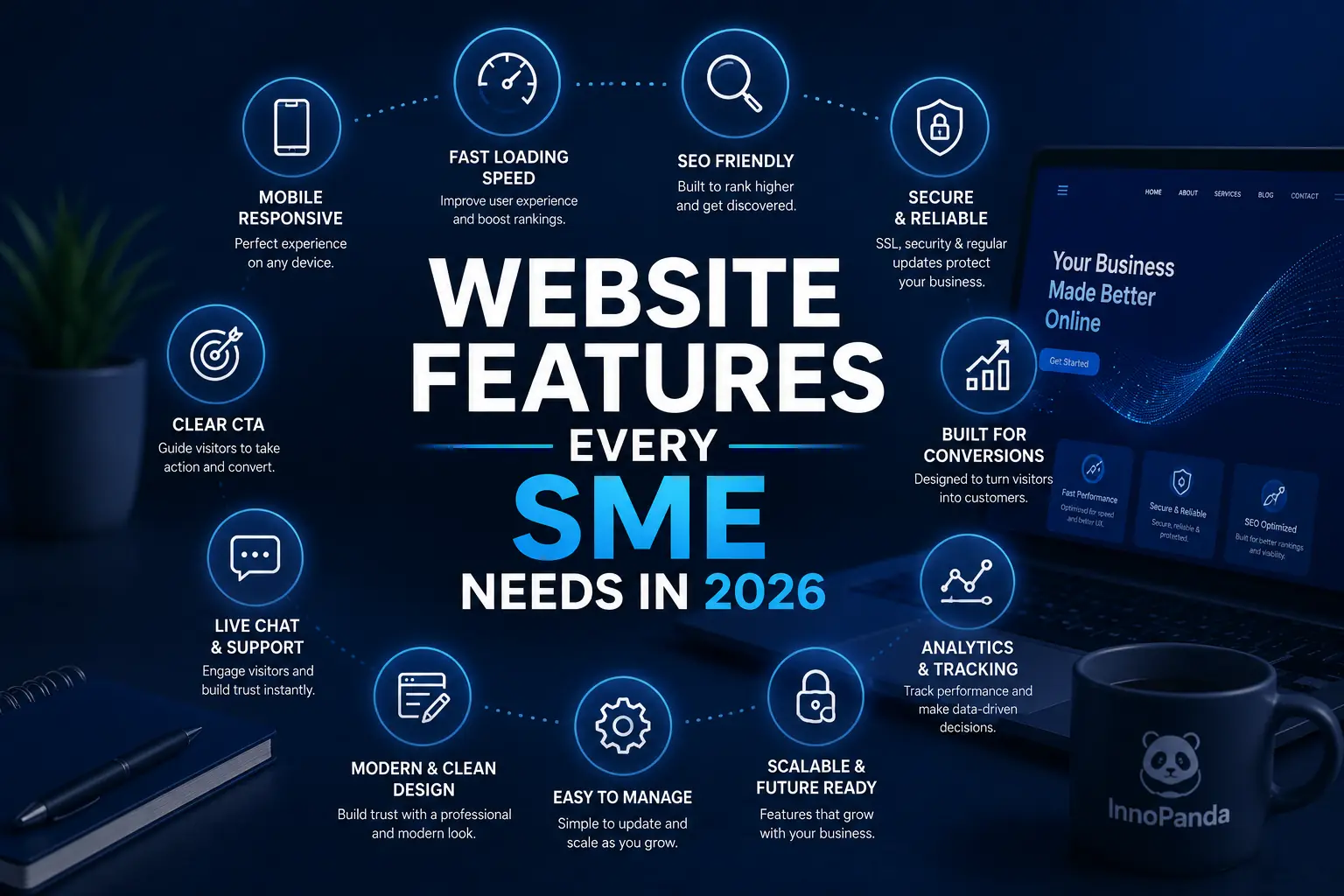
- 1.2 Why Website Features Matter More Than Website Design in 2026
- 1.3 The Top 10 Website Features Every Business Needs in 2026
- 1.3.1 Mobile-First Responsive Design
- 1.3.2 Core Web Vitals and Page Speed
- 1.3.3 On-Page and Technical SEO Foundations
- 1.3.4 AI Chatbot and Live Chat Support
- 1.3.5 AEO-Ready Content for AI Search
- 1.3.6 Website Security: SSL, Backups, Bot Protection
- 1.3.7 Clear Lead Generation and Call-to-Action Architecture
- 1.3.8 Online Booking or Appointment Scheduling
- 1.3.9 Analytics and Conversion Tracking
- 1.3.10 Accessible, Inclusive Design
- 1.3.11 Feature-by-Feature: Effort vs Impact
- 1.4 5 Mistakes Businesses Make When Upgrading Their Website Features
- 1.5 Which Features to Prioritise First
- 1.6 Quick Glossary
- 1.7 Frequently Asked Questions
- 1.8 Not Sure Which Features Your Site Is Missing?
- 1.9 Related Reading from Inno Panda
Most businesses don't lose customers because their website looks dated. They lose them because it's missing the features that actually turn a visit into an enquiry, or because it's invisible to the AI tools more people now ask before they ever open Google. Here are the ten that matter most in 2026, ranked by real impact, not trend.
Key Takeaways
- Mobile speed, clean SEO structure, and a clear path to enquiry still carry the most weight of any features on this list.
- AI search readiness (AEO) is the newest addition for 2026, and the one most businesses haven't touched yet.
- Security and analytics are invisible until they're missing, then they're the most expensive gap to have ignored.
- The most common mistake isn't skipping a feature. It's adding features in the wrong order, polish before foundations.
- You don't need all ten at once. Prioritise by what's actually costing you leads right now.
Why Website Features Matter More Than Website Design in 2026
A website used to be judged on how it looked. In 2026, it's judged on what it does. Visitors decide whether to trust you within seconds, AI tools decide whether to cite you based on how clearly your content is structured, and Google decides whether to rank you based on signals that have nothing to do with your colour palette. The businesses winning online right now aren't the ones with the prettiest sites. They're the ones whose sites are built to function.
That's the lens for this list. Every feature below exists because it measurably changes whether visitors convert, whether your pages rank, or whether your business shows up when someone, or something, is looking for exactly what you offer.
The Top 10 Website Features Every Business Needs in 2026
Mobile-First Responsive Design
The majority of your traffic arrives on a phone, so mobile isn't a secondary version of your site anymore, it's the primary one. Buttons need to be tappable without pinching, forms need to work cleanly on a phone keyboard, and pages need to feel fast on a mid-range connection, not just a fast office wifi network.
Core Web Vitals and Page Speed
Google uses Largest Contentful Paint, Cumulative Layout Shift, and Interaction to Next Paint as direct ranking signals. A site that fails these thresholds ranks below a slower-content competitor whose pages simply load faster, regardless of how good the writing is. Speed is no longer a nice-to-have; it's a ranking factor with a number attached.
On-Page and Technical SEO Foundations
Unique title tags, real meta descriptions, clean URL structure, and schema markup aren't optional extras bolted onto a finished site. They're what makes your pages findable at all. Most business websites we review have either missing or generic meta data on the majority of their pages, an easy fix with outsized impact.
AI Chatbot and Live Chat Support
A chatbot that handles the same five questions your team answers by phone every week, and passes on anything more complex, catches visitors at the exact moment they're deciding whether to reach out. Even a simple after-hours version that collects a name and question is worth having.
AEO-Ready Content for AI Search
This is the feature most 2026 checklists still miss. Answer Engine Optimisation means structuring your content, clear definitions, direct answers, well-marked FAQs, so AI tools like ChatGPT, Perplexity, and Google's AI Overviews can extract and cite it. A growing share of research now starts with an AI-generated summary before anyone opens a traditional search result, and a site that isn't structured for that is invisible at that first step, even if it still ranks normally underneath.
Website Security: SSL, Backups, Bot Protection
HTTPS is non-negotiable, and beyond that, daily automated backups and basic bot protection matter more for small businesses than most owners assume, precisely because small sites are targeted by automated attacks more often, not less. A breach costs you rankings and customer trust, both of which take months to rebuild.
Clear Lead Generation and Call-to-Action Architecture
Every page needs one obvious next step, not "click here," but something specific: "Get a Quote," "Book a Call." A short contact form with a confirmation message and an automatic notification to your team consistently outperforms a page with no clear direction at all.
Online Booking or Appointment Scheduling
If your business takes appointments, consultations, demos, inspections, integrated booking removes the phone-tag friction that quietly loses you customers outside office hours. It's one of the highest-ROI single features on this entire list for service businesses.
Analytics and Conversion Tracking
Traffic numbers without conversion tracking are vanity metrics. Google Analytics 4, Search Console, and goal tracking for forms, calls, and purchases take under a day to set up and are the difference between guessing what's working and actually knowing.
Accessible, Inclusive Design
Proper image alt text, keyboard navigation, and sufficient colour contrast make your site usable for more people and easier for both search engines and AI tools to parse correctly. It's good practice everywhere, and depending on your market, it may also be a compliance requirement, worth checking against your specific jurisdiction rather than assuming.
Figures are drawn from published industry research, not one single study, and vary by industry and traffic source.
Feature-by-Feature: Effort vs Impact
Not every feature on this list takes the same investment, and not every one pays back at the same speed. This is roughly how they compare, based on the projects we typically see.
| Feature | Typical effort | Typical impact |
|---|---|---|
| 1. Mobile-first design | Moderate–high | Very high |
| 2. Core Web Vitals | Low–moderate | High |
| 3. SEO foundations | Low | High |
| 4. AI chatbot | Low | Moderate |
| 5. AEO-ready content | Moderate | High, and growing |
| 6. Security | Low | High (risk reduction) |
| 7. Lead-gen & CTAs | Low | Very high |
| 8. Online booking | Moderate | High for service businesses |
| 9. Analytics & tracking | Low | High (decision quality) |
| 10. Accessibility | Low–moderate | Moderate, compounding |
The pattern worth noticing: several of the highest-impact items, SEO foundations, lead-gen architecture, security, and analytics, are also the lowest effort. They're not neglected because they're hard. They're neglected because they're invisible until someone goes looking for them.
5 Mistakes Businesses Make When Upgrading Their Website Features
Most website disappointments trace back to the order things were done in, not any one missing feature.
Adding polish before fixing foundations
A beautiful redesign on top of slow load times and broken SEO structure doesn't fix the underlying problem, it just makes it look more expensive. Foundations come first.
Assuming the developer "handled" analytics and tracking
This is one of the most common gaps we find in audits: nobody explicitly owns whether goals are actually tracking. Check yours directly rather than assuming.
Treating AI search readiness as optional
Businesses that skip AEO structure now aren't losing visibility today. They're losing it gradually as more research shifts to AI-generated summaries, and catching up later costs more than building it in from the start.
Adding every feature at once
Ten features rolled out simultaneously make it impossible to tell which one actually moved the needle. Prioritise, ship, measure, then move to the next one.
Ignoring the site after launch
Performance degrades naturally as pages, plugins, and images accumulate. A site that loaded in under two seconds at launch can be loading in four seconds a year later without anyone noticing until rankings slip.
Which Features to Prioritise First
You don't need all ten simultaneously. Prioritise based on what's actually costing you business right now.
Our website optimisation service starts every engagement with exactly this kind of audit, so fixes get prioritised by business impact, not guesswork. If you're weighing a full rebuild instead, our web development service covers that too.
What this looks like in practice: a Singapore-based clinic we audited had a decent-looking site getting steady traffic but almost no online bookings. The gaps weren't visual, meta descriptions were missing on every service page, there was no booking widget, and the contact form sat below three scrolls of text nobody was reading. We fixed SEO foundations and moved the booking CTA above the fold first, then added the widget itself two weeks later. Online bookings went from roughly two a week to twelve within the first month, without touching the site's design at all.
Quick Glossary
- Core Web Vitals
- Google's three page-experience metrics, LCP, CLS, and INP, used directly as ranking signals.
- AEO (Answer Engine Optimisation)
- Structuring content so AI tools like ChatGPT and AI Overviews can extract and cite it directly, rather than only optimising for traditional search rankings.
- Schema markup
- Structured data added to a page's code that tells search engines and AI tools exactly what the content means, not just what it says.
- Conversion tracking
- Recording specific visitor actions, form submissions, calls, purchases, as measurable goals inside analytics tools.
Frequently Asked Questions
What are the most important website features for a business in 2026?
The features with the biggest measurable impact are mobile-first responsive design, fast Core Web Vitals, solid on-page SEO, a clear lead-generation path, and content structured for both search engines and AI answer engines. Everything else, chat, booking, analytics, matters, but these five carry the most weight.
What is AEO and why does it matter for a business website in 2026?
AEO, or Answer Engine Optimisation, is structuring content so AI tools like ChatGPT, Perplexity, and Google's AI Overviews can extract and cite it directly. As more research starts with an AI-generated summary instead of a search results page, a website that isn't structured for this becomes invisible at that first stage, even if it still ranks normally in classic search.
Do I need an AI chatbot on my business website?
Not every business needs one, but it's one of the highest-ROI additions for businesses that get repeated, predictable questions. A simple chatbot that answers common questions and captures contact details after hours often pays for itself within the first few months.
How much does it cost to add these features to an existing website?
It depends heavily on your current platform and how many features are missing. Targeted fixes, like Core Web Vitals repair or analytics setup, typically cost far less than a full rebuild and can often be done in days rather than weeks.
Is website security really necessary for a small business site?
Yes. Small business websites are targeted by automated attacks specifically because they're statistically less likely to have proper security in place. SSL, daily backups, and basic bot protection are baseline requirements, not optional extras, regardless of company size.
What website feature has the biggest impact on conversions?
A clear, well-placed contact form or lead capture path paired with a fast-loading page consistently has the biggest measurable effect. Trust elements like testimonials strengthen it further, but visitors first need a fast page and an obvious next step before anything else can convert them.
Not Sure Which Features Your Site Is Missing?
Tell us your URL and we'll give you a straight, honest read on where your site stands against this list, and exactly what to fix first for the biggest impact. No lengthy proposals, no obligation.