SaaS as a Services 2026: What Actually Drives Growth
- 1 SaaS as a Services 2026: What Actually Drives Growth
- 1.1 Key Takeaways
- 1.2 What Is SaaS? A Simple Definition
- 1.3 B2B SaaS: Why It Plays by Different Rules
- 1.4 Subscription vs Usage-Based Pricing: Which Model Wins in 2026?
- 1.5 Customer Retention and Customer Experience: Where SaaS Growth Really Happens
- 1.6 Product-Led Growth and GTM Strategy for B2B SaaS
- 1.7 No-Code and Low-Code: How They're Changing SaaS Development
- 1.8 Customer Acquisition Strategies for SaaS Companies
- 1.9 SaaS Metrics That Actually Matter for Growth
- 1.10 Choosing the Right SaaS Development Company
- 1.11 Quick Glossary
- 1.12 Frequently Asked Questions
- 1.13 Ready to Build a SaaS Growth Strategy That Actually Scales?
SaaS growth in 2026 isn't about chasing more traffic. It's about retention, pricing, and using AI where it actually helps. This guide breaks down what SaaS really is, the strategies working right now, and what to skip.
Key Takeaways
- SaaS means renting software over the internet instead of buying it outright.
- Customer retention drives more SaaS growth than new signups do. A leaky bucket doesn't fill up.
- Usage-based pricing is replacing flat subscriptions in more SaaS categories every year.
- AI now personalises onboarding and predicts churn before it happens, not just answers support tickets.
- Vertical SaaS, built for one industry, often out-retains broad, general-purpose tools.
What Is SaaS? A Simple Definition
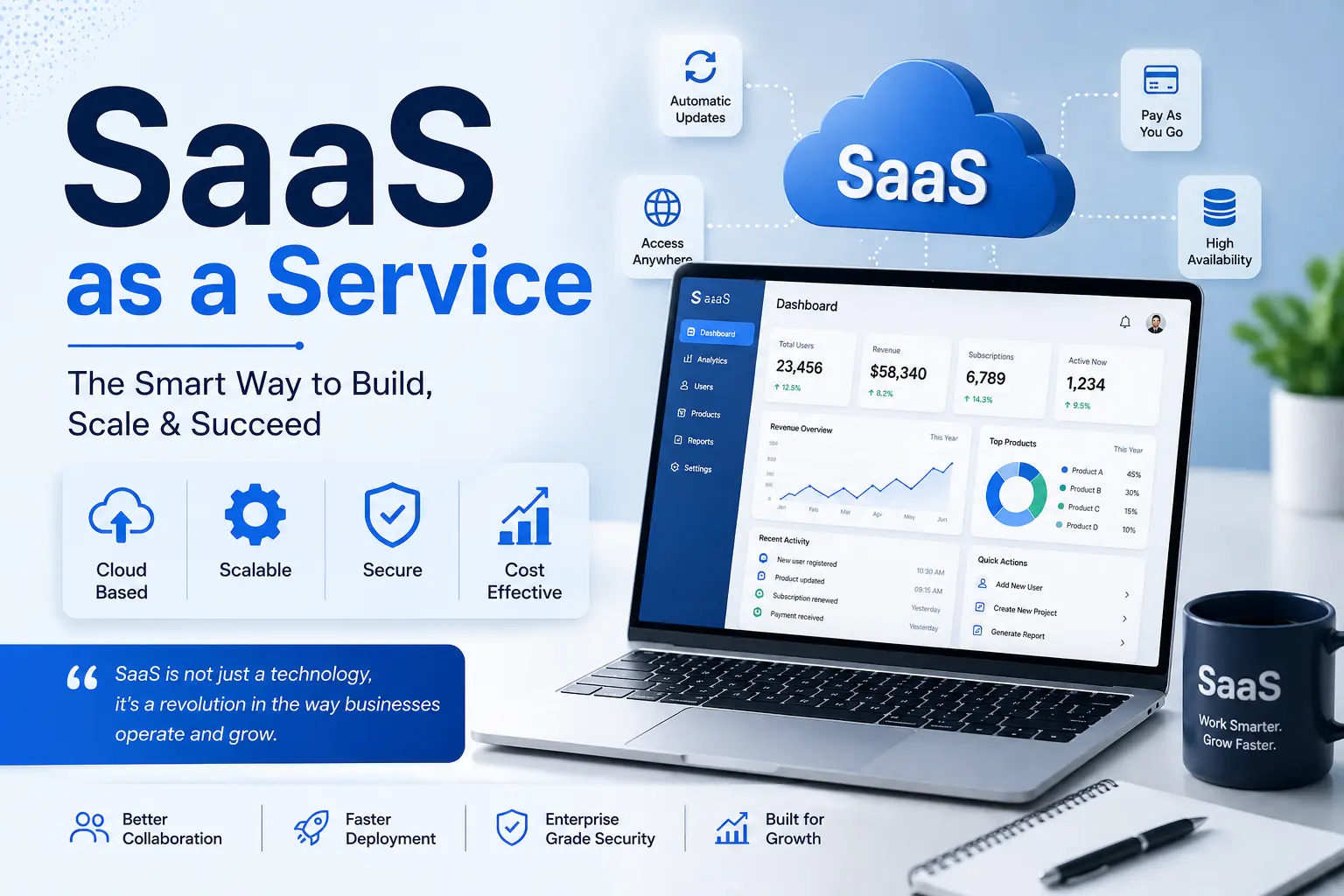
SaaS means Software-as-a-Service. You rent it, access it online, and pay monthly or yearly instead of buying it once.
Instead of installing software on your computer, you log in through a browser or app. The provider handles hosting, updates, and security. You just use it. That's the whole idea. It's why SaaS is now the default way new software gets built.
SaaS Examples You Already Use
You've used SaaS today, probably without thinking about it. Slack for messaging. Canva for design. Shopify for online stores. HubSpot for sales. Google Workspace for email and docs. Every one runs the same way. Online. Subscription-based. Updated automatically.
The SaaS Business Model, Explained Simply
A SaaS company doesn't sell you software once. It earns your subscription every month. That means it only wins long-term if you keep finding value in the product. That single fact shapes almost everything else in this guide.
B2B SaaS: Why It Plays by Different Rules
B2B SaaS means software sold to other businesses, not individual consumers. The buying process looks different. Deals take longer to close, more people are involved in the decision, and price points are usually much higher than a consumer app.
That changes how growth works. A B2B SaaS company can't rely on viral growth the way a consumer app might. It needs a mix of content that builds trust early, a product that proves value fast during a trial, and a sales team ready to step in once a buyer is close to deciding.
Subscription vs Usage-Based Pricing: Which Model Wins in 2026?
Pricing isn't just a business decision. It shapes who buys, how fast they grow, and how much they trust you from day one.
| Model | How It Works | Best For |
|---|---|---|
| Subscription pricing | Fixed fee per seat or plan | Predictable, simple products |
| Usage-based pricing | Pay for what you actually use | Infrastructure, AI, and API-first tools |
Usage-based pricing is growing fast because it removes risk for new customers. You pay for what you use, not what you might use. More SaaS companies shift this way every year. It's especially common now in AI and developer tools.
Customer Retention and Customer Experience: Where SaaS Growth Really Happens
Here's the truth most growth advice skips. Adding new customers barely matters if you lose old ones just as fast. Customer retention is the real growth engine in SaaS. Not signups.
Signs Your SaaS Has a Retention Problem
AI Trends Changing Customer Experience in SaaS
This is where AI is genuinely changing SaaS, not just adding a chatbot on top. AI now predicts which accounts are about to churn, based on real usage patterns, before the customer even complains. It personalises onboarding so two different users see two different first experiences, matched to what they actually need. It also plans ahead on the acquisition side, using predictive analytics to flag which leads are actually likely to convert, instead of treating every signup the same.
Our CRM automation and chatbot development services build exactly this kind of proactive customer experience system, one that catches problems before a customer has to raise them.
Product-Led Growth and GTM Strategy for B2B SaaS
Product-led growth means the product sells itself. It works through free trials, freemium plans, and features that spread through use. It works best paired with a light sales team. They step in once an account shows real expansion signals. For B2B SaaS, this hybrid model usually beats a pure self-serve or pure sales-led approach.
Your go-to-market strategy needs to match this. A strong GTM strategy for SaaS in 2026 mixes three things. Organic content that builds trust early. A frictionless trial experience. A sales motion that only steps in once a lead is actually ready.
Vertical SaaS: The Niche Growth Opportunity
Vertical SaaS means building for one specific industry, not everyone. A tool built only for dental clinics, or only for construction firms, solves problems a generic tool never will. It's a smaller market. But customers stay longer, and competition is thinner. Going narrow and deep often beats going broad and shallow.
No-Code and Low-Code: How They're Changing SaaS Development
No-code and low-code tools let non-developers build working software without writing much code, or any at all. This has opened SaaS development up to far more founders. For simple internal tools or early prototypes, no-code is genuinely useful. For a real product meant to scale, you'll usually outgrow it and need custom development.
Customer Acquisition Strategies for SaaS Companies
The SaaS companies with the lowest customer acquisition cost almost always invested in SEO and content years before it paid off. Organic search is the only channel that gets cheaper as your content library grows. Paid channels, like Google Ads, work best as an amplifier. Use them to boost a message already proven to convert organically, not as a replacement for it.
Once a visitor becomes a trial user, conversion rate optimisation across your signup and onboarding flow usually moves revenue more than doubling your traffic would, at a fraction of the cost.
SaaS Metrics That Actually Matter for Growth
Traffic and signups feel exciting, but they're vanity metrics on their own. What happens after someone signs up is where real SaaS growth lives.
Choosing the Right SaaS Development Company
If you're building or scaling a SaaS product, the partner you choose matters as much as the strategy itself. Look for a team that's shipped real SaaS products, not just marketing sites. Look for one that treats growth and development as connected, not two separate projects.
At Inno Panda, we build the full system: SEO for compounding traffic, landing pages built to convert, CRM automation for retention, and AI automation woven through all of it. Every channel reinforces the others instead of working in isolation.
Quick Glossary
- SaaS
- Software-as-a-Service. Software you access online and pay for on a subscription, instead of buying and installing it.
- Product-led growth
- A growth model where the product itself, through trials and free plans, drives acquisition and retention.
- Vertical SaaS
- Software built for one specific industry, rather than a broad, general audience.
- Usage-based pricing
- A pricing model where customers pay based on how much they actually use the product.
Frequently Asked Questions
What is SaaS in simple terms?
SaaS, short for Software-as-a-Service, is software you rent instead of buy. It runs in the cloud, you access it through a browser or app, and you pay a monthly or yearly fee instead of a one-time licence.
What are some well-known SaaS examples?
Common SaaS examples include Slack, Salesforce, Canva, Shopify, HubSpot, and Google Workspace. Each is accessed online, billed on a subscription, and updated automatically by the provider.
What is the difference between usage-based pricing and subscription pricing?
Subscription pricing charges a fixed fee per user or plan, regardless of how much the product is used. Usage-based pricing charges based on actual consumption, like API calls or data processed, which lowers the entry cost and scales with value delivered.
What is product-led growth in SaaS?
Product-led growth is when the product itself drives acquisition and retention, through free trials, freemium plans, and in-product referrals, rather than relying mainly on a sales team to close every deal.
What is vertical SaaS?
Vertical SaaS is software built for one specific industry, like healthcare or construction, instead of a broad, general audience. It often retains customers longer because it solves problems generic tools cannot.
How is AI changing customer experience in SaaS?
AI now personalises onboarding, predicts churn before it happens, and powers chatbots that resolve support tickets instantly. This shifts customer experience from reactive support to proactive, individual attention at scale.
What SaaS metrics actually matter for growth?
The metrics that matter most are customer retention rate, churn rate, customer acquisition cost, and expansion revenue from existing accounts. Traffic and signups matter less than what happens after someone becomes a customer.
Ready to Build a SaaS Growth Strategy That Actually Scales?
Whether you're launching a new SaaS product or trying to fix leaky retention, our team builds the SEO, automation, and conversion system behind it. No vanity metrics, just real growth.