OpenAI GPT-5.5 Explained, Smarter AI for Work, Coding and Automation
- 1 OpenAI GPT-5.5 Explained, Smarter AI for Work, Coding and Automation
- 1.1 What Is OpenAI GPT-5.5?
- 1.2 Why OpenAI GPT-5.5 Matters for SEO, Workflows and Productivity
- 1.3 GPT-5.5 Benchmark Performance
- 1.4 OpenAI GPT-5.5 for Business Automation
- 1.5 OpenAI GPT-5.5 for Developers and Codex
- 1.6 How GPT-5.5 Compares with Claude and Gemini
- 1.7 The Future of Work with OpenAI GPT-5.5
- 1.8 Final Thoughts on OpenAI GPT-5.5
OpenAI GPT-5.5 is OpenAI’s latest advanced model, designed to understand user intent faster, complete more complex tasks, and use fewer tokens while delivering stronger performance across coding, knowledge work, browsing, maths, cybersecurity and business workflows.
For readers who want the official release details, OpenAI has published its own GPT-5.5 announcement , covering availability across ChatGPT, Codex and the API.
OpenAI GPT-5.5 is not just another model update. It represents a major step toward AI systems that can understand messy, multi part requests and carry more of the work themselves. According to the official OpenAI announcement, GPT-5.5 is now available in ChatGPT, Codex and the API, with improvements across real work tasks such as writing code, debugging, researching online, analysing data, creating documents, producing spreadsheets and operating software across tools.
The most important change is practical usability. Earlier AI models often required users to carefully manage each step of the task. OpenAI GPT-5.5 is designed to reduce that effort. Instead of needing extremely detailed instructions, users can give broader goals and allow the model to plan, reason, check its work and continue through ambiguity with less hand holding.
This matters because businesses are no longer looking at AI only as a chatbot. They are looking at AI as a productivity layer that can support teams, reduce repetitive work and improve execution speed. For companies exploring AI automation and integration, GPT-5.5 points to a future where AI can become deeply embedded inside day to day workflows.
What Is OpenAI GPT-5.5?
OpenAI GPT-5.5 is a frontier AI model designed for advanced reasoning, coding, tool use and knowledge work. OpenAI describes it as its smartest and most intuitive model yet, built for a new way of getting work done on a computer. The model is designed to understand what a user wants faster and complete more of the process itself.
Compared with previous models, GPT-5.5 appears to focus strongly on agentic workflows. This means it is not only answering a question. It is increasingly capable of moving through a task, using tools, checking assumptions and producing a more complete result. This is highly relevant for businesses because many real world tasks are not single question tasks. They involve research, planning, execution, editing, validation and reporting.
Key takeaway
OpenAI GPT-5.5 is built for real work, not just simple conversation. Its biggest value is the ability to understand intent, use tools and complete longer tasks more efficiently.
Why OpenAI GPT-5.5 Matters for SEO, Workflows and Productivity
GPT-5.5 matters because it moves AI closer to becoming a true work assistant. For business users, this could mean faster content planning, stronger research support, better reporting, smarter customer service workflows and improved internal documentation. For technical teams, it could mean better code generation, debugging, test writing and software maintenance.
The efficiency side is also important. OpenAI says GPT-5.5 uses significantly fewer tokens to complete the same Codex tasks. In plain English, that means the model can often do more with less. For businesses using the API, token efficiency can affect cost, speed and scalability. A model that produces better results with fewer retries can reduce wasted usage and improve return on investment.
This is why OpenAI GPT-5.5 is likely to matter for companies of all sizes. Large enterprises may use it to improve internal productivity across departments. Small businesses may use it to automate marketing, customer support or operations. Software companies may use it to speed up product development and reduce bottlenecks.
GPT-5.5 Benchmark Performance
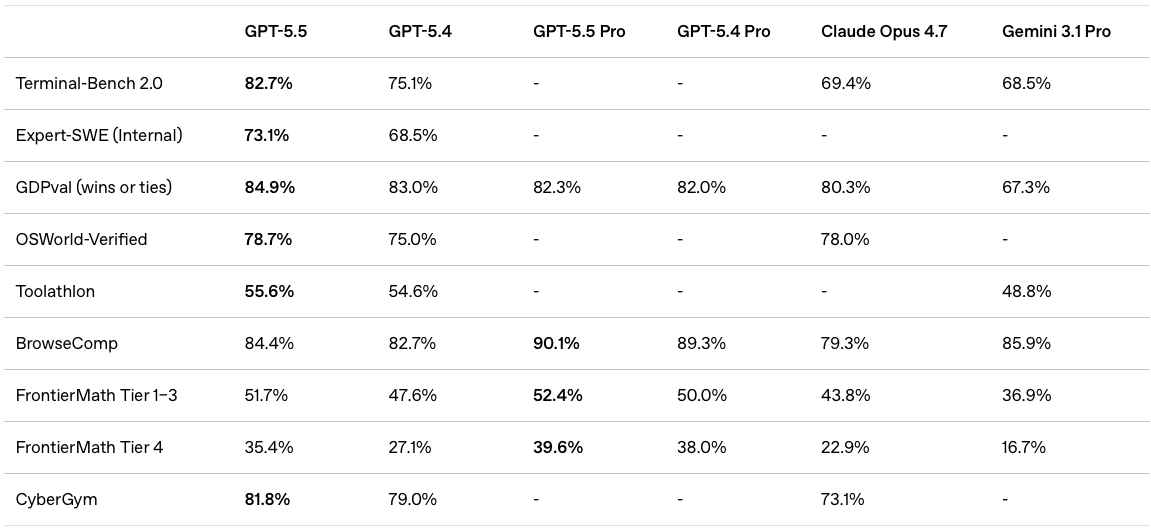
OpenAI’s published benchmark comparison shows GPT-5.5 performing strongly across several categories, including Terminal Bench 2.0, GDPval, OSWorld Verified, Toolathlon, BrowseComp, FrontierMath and CyberGym. These benchmarks cover areas such as agentic terminal use, knowledge work, computer use, browsing, advanced mathematics and cybersecurity capability.
The benchmark chart also compares GPT-5.5 with GPT-5.4, GPT-5.5 Pro, Claude Opus 4.7 and Gemini 3.1 Pro. While benchmarks should never be treated as the only measure of real world value, they do provide useful signals about model capability. The most important takeaway is that OpenAI GPT-5.5 appears especially strong in coding, computer use and complex knowledge tasks, which are exactly the areas where businesses want practical AI assistance.
For SEO and content teams, the lesson is wider than just model performance. AI tools are becoming better at analysing information, structuring content and improving workflows. This means companies need to think carefully about how they use AI to produce better content, not just more content. Helpful, original and well structured content will matter more as AI powered search and AI Overviews continue to evolve.
OpenAI GPT-5.5 for Business Automation
One of the clearest business use cases for GPT-5.5 is workflow automation. Many companies still rely on manual processes that take up valuable staff time. Examples include preparing reports, responding to common customer questions, summarising meetings, creating proposals, checking documents, analysing spreadsheets and updating internal knowledge bases.
With the right setup, GPT-5.5 can help automate parts of these workflows while still allowing humans to review important outputs. This is where AI becomes most useful. It does not need to replace people to create value. It can remove repetitive work, reduce delays and allow teams to focus on higher value decisions.
Businesses that already use CRMs, booking systems, e-commerce platforms or internal dashboards can benefit even more when AI is integrated properly. GPT-5.5 can support smarter workflows that connect data, users and actions. That is why AI adoption should not be treated as a random chatbot installation. It should be treated as a structured automation strategy.
OpenAI GPT-5.5 for Developers and Codex
OpenAI GPT-5.5 is also highly important for developers. OpenAI says GPT-5.5 is the default model in Codex, which shows how central it is becoming to software engineering workflows. Coding is one of the most valuable AI use cases because it directly affects how quickly products can be built, tested and improved.
Developers can use GPT-5.5 to write new code, review existing code, debug issues, generate tests, explain unfamiliar systems and support refactoring. This can reduce the time needed to move from idea to working product. Companies offering mobile app development services can also benefit from AI assisted workflows, especially when managing larger projects with many moving parts.
However, AI coding still needs human judgement. GPT-5.5 may be more capable, but software still requires architecture, security review, business understanding and quality assurance. The best results will come from teams that use AI as an accelerator while keeping experienced developers in control of final decisions.
How GPT-5.5 Compares with Claude and Gemini
GPT-5.5 enters a competitive market where Anthropic and Google are also pushing hard with Claude and Gemini. Each model family has its own strengths, and businesses should not choose tools based only on hype. The better question is which model fits the actual workflow.
Based on OpenAI’s published comparison, GPT-5.5 shows strong results across agentic coding, browsing, knowledge work and advanced reasoning. Claude remains widely respected for writing, analysis and safety focused workflows, while Gemini continues to benefit from Google’s search, workspace and ecosystem strengths. For businesses, this competition is positive because it pushes every provider to improve faster.
The practical takeaway is simple. AI models are becoming more capable, more specialised and more deeply integrated into business software. Companies that understand how to test and deploy these tools responsibly will gain an advantage over those that wait too long.
The Future of Work with OpenAI GPT-5.5
GPT-5.5 gives us a clearer picture of where work is heading. AI is moving from simple assistance to active task completion. This does not mean humans disappear from the workflow. It means human roles may shift toward direction, judgement, review, creativity and strategy.
Employees may spend less time producing first drafts, searching through information or repeating admin tasks. Instead, they may spend more time checking AI outputs, improving decisions and managing systems. Businesses that train their teams to work with AI effectively will likely see stronger productivity gains than those that simply add tools without changing workflows.
This is also why companies need strong governance. AI can improve speed, but poor implementation can create mistakes, security risks or low quality outputs. The future of work will not be defined by AI alone. It will be defined by how well businesses combine AI capability with human responsibility.
Final Thoughts on OpenAI GPT-5.5
OpenAI GPT-5.5 is a major release because it focuses on what businesses actually need from AI, stronger reasoning, better workflow execution, improved coding support and greater efficiency. It is not only about being smarter in a benchmark. It is about helping people get real work done faster and with less friction.
For businesses, GPT-5.5 should be viewed as a signal to take AI adoption seriously. The companies that benefit most will be those that build structured workflows, train their teams and connect AI with real operational problems. Whether the goal is automation, software development, research, reporting or customer support, GPT-5.5 shows that AI is becoming a practical business engine.
The next stage of AI will not be won by companies that simply use the newest model. It will be won by companies that understand how to apply the right model to the right workflow with the right human oversight.