
How to Use Meta Ad Library for Competitor Research: A Detailed Guide
- 1 How to Use Meta Ad Library for Competitor Research: A Detailed Guide
- 1.1 What Are the Key Takeaways?
- 1.2 What Is Meta Ad Library and How Does It Work?
- 1.3 What Is Meta Ads Competitive Analysis?
- 1.4 Why Is Competitor Ad Research Important for Businesses?
- 1.5 How Do You Use Meta Ad Library to Find Competitor Ads?
- 1.5.1 1What question should your research answer?
- 1.5.2 2Which market and category are you studying?
- 1.5.3 3Who belongs on your competitor list?
- 1.5.4 4How do you search for brands and relevant terms?
- 1.5.5 5How should you review each ad?
- 1.5.6 6Why should you compare several examples?
- 1.5.7 7How do you turn observations into hypotheses?
- 1.6 What Should You Analyse in Competitors' Facebook and Instagram Ads?
- 1.7 How Is AI Changing Competitor Advertising Research?
- 1.8 What Does the Meta Platforms Competitive Landscape Look Like for AI Advertising in 2026?
- 1.9 What Does Competitor Research Look Like for an eCommerce Business?
- 1.10 How Do You Turn Competitor Research Into a Better Advertising Strategy?
- 1.11 How Do You Build a Repeatable Competitor Research Workflow?
- 1.12 What Should Your Competitor Ad Research Checklist Include?
- 1.13 What Mistakes Should You Avoid When Analysing Competitor Ads?
- 1.14 Conclusion: How Can Competitor Research Lead to Smarter Advertising Decisions?
- 1.15 What Do People Ask About Meta Ad Library for Competitor Research?
- 1.16 Ready to Make Smarter Advertising Decisions?
A practical guide to researching Facebook and Instagram ads, understanding competitor messaging, applying AI responsibly, and turning observations into measurable marketing experiments.
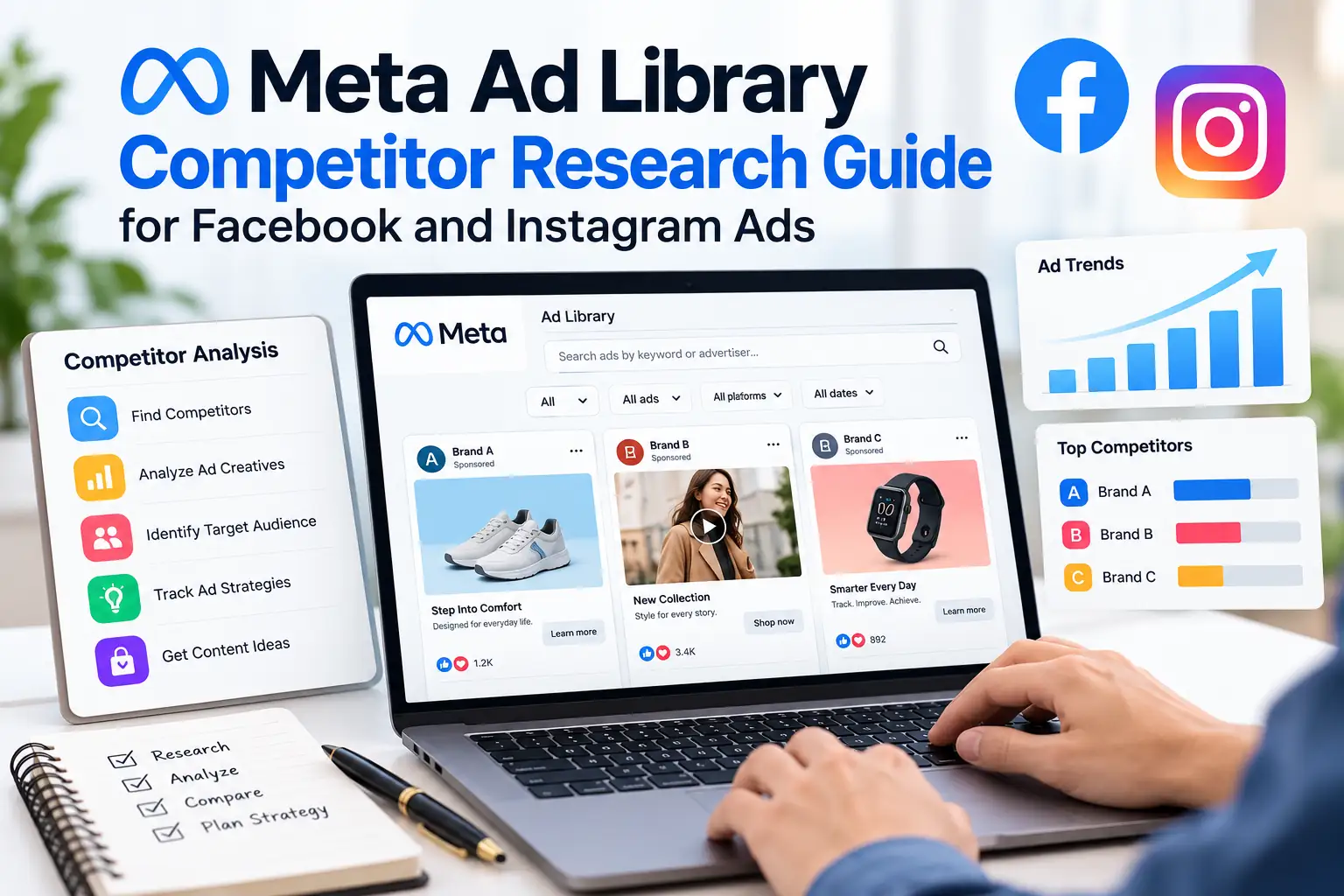
Digital advertising is more competitive than ever. Businesses across industries compete for attention, customer trust, clicks, leads, and sales across Facebook, Instagram, and other digital channels. Publishing an advertisement is only one part of the process. Businesses also need to understand the market they operate in, the messages customers are seeing, and the ways competing brands communicate their value.
This is where competitor research becomes useful. By examining publicly visible advertising, marketers can learn how other businesses present their products, explain benefits, structure offers, and guide audiences toward an action. Meta Ad Library provides a practical starting point for this research because it allows people to search for certain ads running across Meta technologies.
However, competitor research is not about copying another business or assuming that a visible advertisement is successful. It is about gathering observations, identifying potential opportunities, and developing hypotheses that can be tested using your own campaign data. When combined with careful analysis, customer understanding, and responsible use of AI tools, this process can help businesses make more informed advertising decisions.
What Are the Key Takeaways?
- Meta Ad Library shows what competitors say, not what works. For ordinary commercial ads it does not show spend, sales, CPA or ROAS.
- Keep three things apart: what you observe, what you infer, and what you test.
- Record the hook, offer, call to action and landing page for every ad, and date each review.
- Check whether the landing page keeps the promise the ad makes. A gap there is often your opening.
- AI can sort and compare ads for you, but it cannot see private results, so a person must check its output.
- Meta, Google and TikTok all sell AI that builds ad creative, so judge the offer and the promise, not the polish.
- Test one hypothesis at a time, choose the success metric before launch, and run a 30-minute weekly review.
What Is Meta Ad Library and How Does It Work?
Meta Ad Library is a public search resource for viewing certain advertisements across Meta platforms. Depending on the ad category, location, and available listing information, users can search for businesses or topics and inspect ads that are made available through the library. Marketers often use it to review visible creative, ad copy, calls to action, and other details that can inform competitive research.
For businesses, the library offers a way to observe advertising messages without needing access to a competitor's advertising account. It can help a marketing team understand how brands communicate offers and product benefits in the marketplace. The exact information shown can vary, and the interface and filters may change over time.
Visible in the library
- The page or advertiser associated with a visible ad
- The creative format and content, such as an image, video, carousel, headline, or body copy where provided
- The main message, offer, value proposition, and call to action
- The destination or landing page when a link is available
- Certain transparency information for some categories of ads, depending on the applicable rules and available data
Not a performance dashboard
For ordinary commercial ads, the library should not be treated as a complete performance dashboard. It generally does not reveal a competitor's full campaign spend, sales, conversion rate, return on ad spend (ROAS), customer acquisition cost (CPA), or all targeting decisions. A visible ad may be part of a test, a small campaign, a brand awareness effort, or a broader strategy that is not visible from the listing alone.
The most reliable approach: use Meta Ad Library to observe what a competitor is communicating. Do not claim that you know why the competitor is running the ad or how profitable it is.
What Is Meta Ads Competitive Analysis?
Meta Ads competitive analysis is the structured process of reviewing competitors' visible advertisements and marketing messages across Facebook and Instagram to understand their positioning, creative choices, offers, and customer journeys. It can include direct competitors, businesses offering alternative solutions, and brands in adjacent categories whose communication may provide useful lessons.
A good analysis separates three things: what you can directly observe, what you infer from those observations, and what you plan to test. Here is the same idea in practice, using a demonstration-led ad as the example.
What you can see
Several ads lead with a product demonstration.
What you think it means
Demonstrations may help reduce buyer uncertainty. This is an interpretation, not a fact.
What you do next
Create your own demonstration-led ad and measure its results.
Why Does This Distinction Matter?
Without this separation, marketers can mistake assumptions for facts. An ad may appear frequently because the advertiser is testing different variations, targeting different markets, or using a campaign objective that does not directly prioritise purchases. Research is useful when it informs questions and experiments rather than being treated as proof of competitor success.
Why Is Competitor Ad Research Important for Businesses?
Understand market positioning
Review how competing brands explain what makes their products or services useful. Some may emphasise price, while others focus on convenience, speed, expertise, customer support, quality, or a specialised use case. These patterns can help you find a credible point of differentiation instead of repeating generic claims.
Identify customer questions and content gaps
Ads reveal which customer problems advertisers choose to address. If several brands highlight a benefit but explain little, you may have room for clearer educational content or a more useful landing page. This is a question worth validating through customer feedback and campaign tests, not proof of an unmet need.
Generate creative ideas more efficiently
Studying a range of visible ads can help you build a creative idea bank. Common approaches include problem-solution storytelling, product demonstrations, testimonials, comparison messages, limited-time offers, and educational explainers. Use these as broad patterns, then create original executions.
Support better campaign planning
Competitor analysis can inform which messages to test, which objections to address, and what information should appear on a landing page. It can also help you plan a balanced creative portfolio instead of relying on one concept.
Improve marketing and sales collaboration
For businesses that generate leads, competitor research can highlight questions prospects ask before contacting a company. Marketing can use these to improve landing pages, lead forms, FAQs, and follow-up materials, and sales can confirm whether they address real concerns.
How Do You Use Meta Ad Library to Find Competitor Ads?
Work through these seven steps in order. Each one narrows the research so that the final output is a test you can actually run.
1What question should your research answer?
Begin with one question you want the research to answer. Examples include: How are competitors explaining a complex service? Which product benefits appear in their ads? What types of offers are visible in our market? How do their ads connect to landing pages? A focused objective helps you avoid collecting irrelevant examples.
2Which market and category are you studying?
Identify the country or countries relevant to your target audience, the language customers use, and the category that best matches your research. A global business should not assume that an ad strategy in one market will translate directly to another. Purchasing power, regulations, cultural context, seasonal events, and customer expectations can all affect the message.
3Who belongs on your competitor list?
Include direct competitors that sell similar products or services, indirect competitors that solve the same customer problem in another way, and a few brands known for clear communication in your sector. For example, a project-management software business might review other project-management products as well as tools positioned around team collaboration or workflow automation.
4How do you search for brands and relevant terms?
Use the available search options to look up competitor names or relevant terms. Search results can vary, so check that the advertiser and ad are relevant to the market you are studying. Record the date of your review because the available set of ads can change.
5How should you review each ad?
For each relevant ad, record its opening hook, primary benefit, creative format, offer, call to action, and destination when available. Note whether the ad is educational, promotional, product-focused, or designed to encourage a lead or another action. Avoid trying to infer private targeting settings from the creative alone.
6Why should you compare several examples?
A single ad rarely provides enough context to draw a conclusion. Review multiple ads from a competitor and compare them with ads from other businesses. Look for repeated messaging themes, different ways of presenting the same benefit, and potential gaps in how the customer problem is explained.
7How do you turn observations into hypotheses?
Summarise what you noticed and propose a test for your own business. The hypothesis should be specific enough to guide a campaign experiment.
Example hypothesis: "Competitors often explain the product feature but do not demonstrate the time saved. We will test a short workflow demonstration against our current creative."
What Should You Analyse in Competitors' Facebook and Instagram Ads?
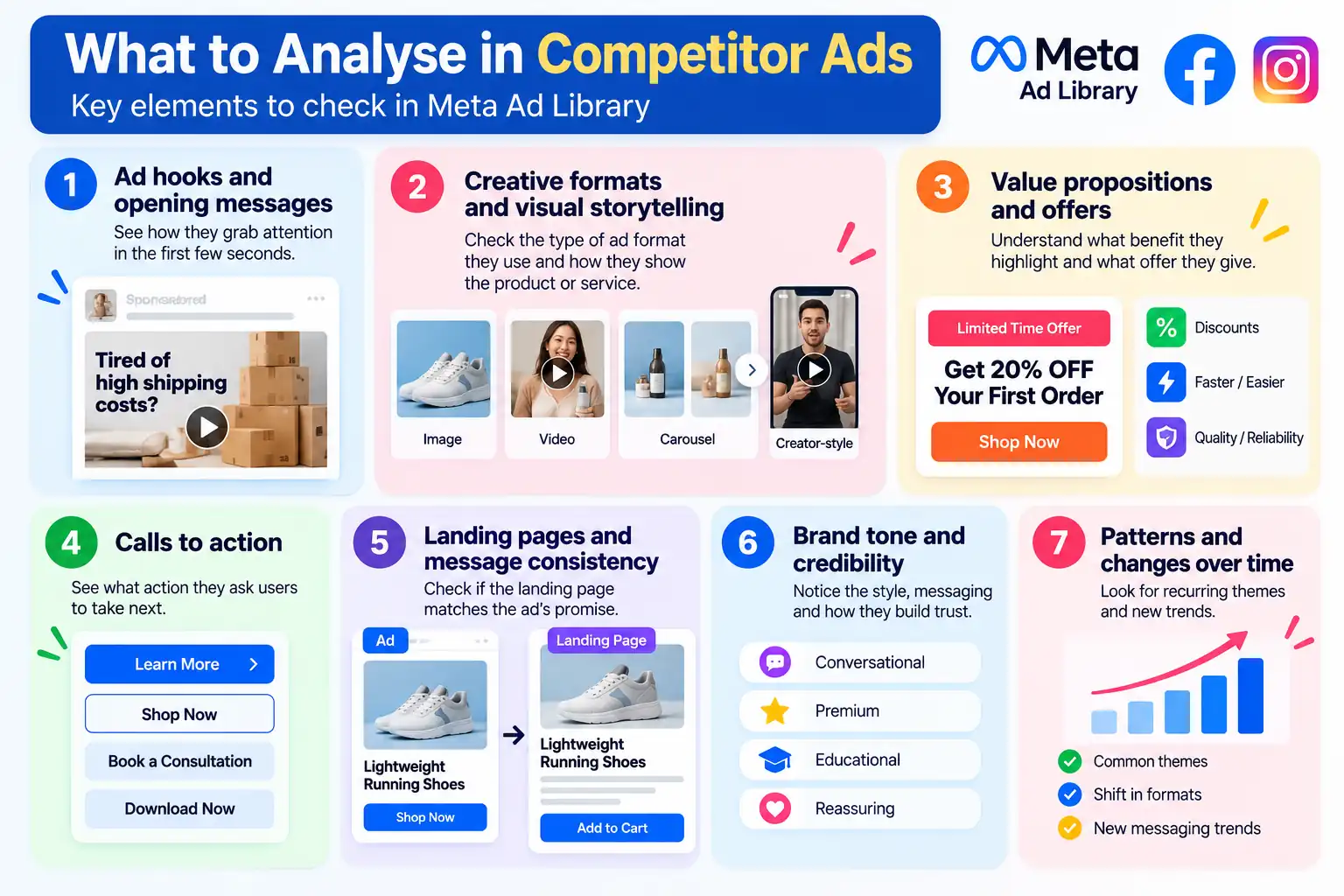
Use this table as a quick reference when you review each ad. The right-hand column shows what to look for in each element.
| Element | What to look for |
|---|---|
| Ad hooks and opening messages | The opening line or visual often establishes why a viewer should pay attention. Identify whether the ad begins with a customer problem, a question, a product demonstration, a benefit, a testimonial, or a comparison. Ask whether the hook is specific, understandable, and relevant to the audience. |
| Creative formats and visual storytelling | Record whether the ad uses a static image, short video, carousel, demonstration, creator-style content, or another format. Notice how quickly the message becomes clear and whether the creative shows the product in use. The most visually complex ad is not always the most effective; clarity and relevance matter too. |
| Value propositions and offers | A value proposition explains why the customer should care. It may focus on cost savings, convenience, expertise, reliability, speed, or another benefit. Record the offer if one is visible, but consider whether it suits your own margins, brand positioning, and audience. |
| Calls to action | Look at what the ad asks the user to do next, such as learn more, shop, book a consultation, download a resource, or request a quote. The CTA should fit the likely stage of the customer journey. A high-commitment action may be less appropriate for someone who is only beginning to learn about a problem. |
| Landing pages and message consistency | Check whether the page continues the same promise. Look for consistency in the headline, offer, visual style, product details, proof points, and next step. If an ad promotes a specific solution but the landing page is vague, that may be an opportunity for your own business to create a clearer journey. |
| Brand tone and credibility | Observe whether the advertiser sounds technical, conversational, premium, playful, reassuring, or educational. Consider how claims are supported. Clear demonstrations, relevant examples, transparent terms, and credible evidence may explain an offer more effectively than broad, unsupported superlatives. |
| Patterns and changes over time | Repeated observations can reveal themes, such as a shift from product features to customer outcomes, or from static images to more demonstrations. These are observations rather than proof of strategy or performance, so use them to guide questions and experiments. |
How Is AI Changing Competitor Advertising Research?
AI can support competitive research by helping marketers organise large amounts of information, summarise patterns, and generate new hypotheses. It can be useful when teams have collected a set of public ad examples and want to compare their messages consistently. However, AI analysis is only as reliable as the inputs and instructions provided, and it cannot infer private campaign results from public creative alone.
Classify messages and creative themes
Document the visible ad text and describe the creative, then ask an AI tool to group examples by customer problem, benefit, offer, format, or CTA. Review the output manually, especially when ads use humour, ambiguous wording, niche industry language, or visual cues that a text-only summary may miss.
Identify unanswered questions
After categorising ads, ask what customer questions receive little explanation. A category may focus heavily on features but rarely explain implementation, support, compatibility, or getting started. Treat these as possible content opportunities and validate them against customer feedback, sales conversations, and search demand.
Generate original creative directions
AI can help brainstorm ways to explain a genuine product benefit, create alternative hooks, or adapt a message to different stages of the customer journey. Give it your brand guidelines, verified product information, target audience, and prohibited claims. Ask for original concepts, not copies, and have a human review the final creative.
Is AI Research the Same as Meta's Advertising AI?
AI-assisted research and Meta's campaign automation are distinct. A general AI assistant can help categorise observations and draft ideas. Meta's own advertising systems use machine learning and automation in parts of ad delivery and campaign optimisation. Competitor research does not reveal the complete workings of those systems or the private data available to an advertiser inside its own account.
How Do You Use AI Responsibly in Research?
Use information you are permitted to process, avoid sharing confidential business or customer data with tools without appropriate safeguards, and check all factual claims before publication. AI can produce confident but incorrect summaries. Human oversight is essential for context, originality, privacy, brand consistency, and compliance.
What Does the Meta Platforms Competitive Landscape Look Like for AI Advertising in 2026?
Meta, Google and TikTok now all sell AI that writes, assembles and localises ads for the advertiser. That changes how you should read the Ad Library. Some of the ads you save come from a team with a clear brief, and some may be variants a tool produced in minutes. Each platform automates different parts of the work, so it helps to know who offers what before you draw conclusions. For the wider picture, read our guide to the Meta competitive landscape in 2026.
What Has Meta Announced for AI Advertising?
Muse for Small Business
Meta's Muse AI agent can now link to a business's Facebook Pages, Instagram professional account analytics and Meta ad accounts, alongside 15 third-party connectors such as Shopify, Stripe and Klaviyo. Meta says nothing publishes, sends or spends without the owner's approval. The business layer is for small businesses in the US and Canada and is free with usage limits. Meta has not said what Muse can change inside an ad account.
Automated ad creation
In June 2025 the Wall Street Journal reported that Meta aims to let a brand supply a product image and a budget goal, after which AI creates the ad, chooses who sees it and suggests a budget, with the tools expected by 2026. Treat this as a reported direction, not a feature list. Check your own Ads Manager to see which parts you actually have.
How Do Google and TikTok Compare on AI Advertising?
| Platform | AI tool | What it automates | What it means for your research |
|---|---|---|---|
| Meta | Advantage+ campaigns and the Muse agent | Parts of creative and delivery inside Ads Manager, plus account tasks that need the owner's approval | Visible ads may be variants of one brief, so compare the offer and landing page instead of the polish. |
| AI Max for Search campaigns (announced 6 May 2025) | Broader search matching, headlines and descriptions generated from your landing page, and final URL expansion | Search ad text may not be written by hand, so the landing page tells you more than the headline. Google reportedly delayed the automatic move from Dynamic Search Ads to AI Max to February 2027. | |
| TikTok | Symphony creative tools (expanded June 2026, as reported) | AI avatars, voiceovers, video localisation and creative variations | One video idea can appear in many languages and versions, so check whether a "new" ad is a local copy of an existing one. |
Each platform also has its own public ad transparency tool, and coverage differs, so do not expect the Meta Ad Library to show Google or TikTok ads.
What Should the AI Landscape Change in Your Research?
Five adjustments for 2026
- Judge the brief, not the polish. When a tool can turn a few product images into video, a polished ad says little about strategy. Look at the offer, the promise and the page it leads to.
- Count ideas, not variants. Ten near-identical ads may be one idea. Group them by the underlying message before you count.
- Look for original proof. As production gets cheaper, real demonstrations, customer footage and clear terms are harder for rivals to copy. Treat this as a hypothesis to test, not a rule.
- Compare across platforms. A message seen on Meta, TikTok and Google may be core positioning, while one seen on a single platform may be a test. Label it as a hypothesis.
- Keep a person in charge and check your account. Meta's own Muse wording leaves approval with the owner, and your process should too. Availability differs by account and country, so confirm in your own Ads Manager.
Sources and date check: the facts in this section were checked on 28 October 2026 against TechCrunch, PPC Land, Marketing Dive, Google and Impression Digital. Features change quickly, so recheck before you plan around them.
What Does Competitor Research Look Like for an eCommerce Business?
Imagine an online store selling reusable water bottles. The marketing team wants to improve its Facebook and Instagram campaigns but does not know which message to test next. It searches the Meta Ad Library for relevant brands and records visible ads in a simple spreadsheet.
What Does the Team Observe?
Patterns in the visible ads
- Several ads highlight product colours and appearance.
- Some ads focus on portability and everyday convenience.
- A number of creatives show the product, but few explain cleaning or care.
- Landing pages vary in how clearly they present product dimensions, materials, and delivery information.
How Does the Team Interpret What It Sees?
The team does not assume that the most common message is the most profitable. Instead, it identifies possible questions customers may have before buying. It checks customer reviews, support questions, and site analytics to determine whether care instructions and practical demonstrations are relevant concerns.
What Does the Team Test?
The business creates an original short video demonstrating how the bottle fits into a daily routine and how it is cleaned. It tests this creative against the current ad while keeping the audience, offer, and other conditions as consistent as practical. It defines the primary success metric in advance, such as purchase conversion rate or CPA, and monitors supporting metrics like CTR and landing-page engagement.
The role of competitor research: it helps the team form a useful hypothesis. The campaign's own results determine whether the new creative should be retained, revised, or discontinued.
How Do You Turn Competitor Research Into a Better Advertising Strategy?
Prioritise opportunities
Not every observation deserves a campaign test. Prioritise ideas by relevance to your audience, alignment with your product, feasibility, cost, and potential business value. A few well-designed tests teach more than many unrelated changes at once.
Match the message to the customer journey
New audiences may need education and problem clarification. People comparing options may need feature details or evidence. People close to purchase may need price, delivery, support, or next steps. Adapt what you learn to your own journey.
Connect ads to the landing page
An ad and its destination should work as one experience. Make sure the page repeats the central promise, answers likely questions, loads reliably, and makes the next action clear. For lead generation, review form length, trust signals, and privacy information.
Choose metrics that reflect business goals
Awareness campaigns may use reach and frequency. Traffic campaigns may use CTR and landing-page visits. Lead generation and sales may need qualified lead rate, conversion rate, CPA, revenue, and ROAS. Avoid using one metric as a substitute for overall performance.
Create a learning loop
Document the hypothesis, creative version, audience, offer, budget, dates, and results. Record what changed and what the team learned. Over time this builds a first-party knowledge base that is more useful than competitor observations alone.
How Do You Build a Repeatable Competitor Research Workflow?
A simple routine helps teams keep research useful without spending excessive time browsing. Adapt the schedule to the pace of your category and the size of your marketing team. Here is a 30-minute weekly review.
Set the focus
Revisit the research question and select the competitors or categories to review.
Review the ads
Review relevant visible ads and record new examples or notable changes.
Group observations
Group observations by hook, offer, creative format, CTA, and landing-page approach.
Pick one opportunity
Identify one opportunity that is relevant to your customers and business objectives.
Write the hypothesis
Write a test hypothesis, assign an owner, and decide which metric will indicate success.
The objective is not to track every competitor action. It is to maintain a manageable process that produces a small number of useful insights and supports better marketing experiments.
What Should Your Competitor Ad Research Checklist Include?
Use the following checklist when reviewing ads. Record what is visible, keep interpretations separate, and revisit the findings when the market or your campaign objectives change.
| Field | What to record |
|---|---|
| Competitor or page | Brand or page name and relevant market |
| Research date | Date the ad was reviewed |
| Ad format | Image, video, carousel or another visible format |
| Hook and headline | Opening message and central claim |
| Audience problem | The need or problem the ad appears to address |
| Value proposition | The main benefit communicated |
| Offer | Promotion, bundle, trial or other visible offer |
| Call to action | The action the viewer is encouraged to take |
| Destination | Landing page or destination, if available |
| Observed pattern | Themes repeated across the ads reviewed |
| Opportunity | A question, gap or differentiated angle to explore |
| Test hypothesis | The change you want to test and why |
| Success metric | CTR, conversion rate, CPA, qualified leads or ROAS as appropriate |
What Mistakes Should You Avoid When Analysing Competitor Ads?
- Copying rather than differentiating: Use competitor examples as research, not as creative assets to reproduce.
- Assuming visible ads are profitable: Public listings do not prove sales, conversions, or positive returns.
- Over-interpreting targeting: Creative content alone does not reveal all audience settings or delivery logic.
- Ignoring market differences: Language, regulations, seasonality, and customer expectations vary by region.
- Changing too many variables: Unfocused tests make it harder to identify what influenced performance.
- Relying on AI without review: Verify facts, claims, context, privacy, originality, and relevant platform policies.
- Collecting data without action: Research is most useful when it informs a specific decision or experiment.
Use observations to form hypotheses, then test them against your own business objectives.
Conclusion: How Can Competitor Research Lead to Smarter Advertising Decisions?
Meta Ad Library can help businesses understand the visible advertising environment around their products and services. By examining hooks, offers, creative formats, calls to action, and landing pages, marketers can develop a clearer view of how competitors communicate and identify questions worth exploring.
The most effective process combines structured observation with customer understanding, original creative development, responsible AI assistance, and measurement of your own campaign results. Public ads are useful research inputs, but they do not reveal a competitor's complete strategy or profitability. Avoid treating assumptions as facts.
For global businesses, repeat this process across relevant markets and account for differences in language, customer expectations, regulations, and buying behaviour. With a consistent workflow, competitor research can become a practical part of ongoing advertising planning rather than a one-time exercise.
Inno Panda helps businesses connect digital marketing strategy, campaign planning, and conversion-focused experiences to wider growth goals. By combining thoughtful research with measurable experimentation, businesses can make more informed advertising decisions and develop messaging that is both relevant to customers and distinct from competitors.
Want to turn competitor research into campaigns you can measure? We will help you plan the tests and connect them to your growth goals.
What Do People Ask About Meta Ad Library for Competitor Research?
Is Meta Ad Library free to use?
Meta Ad Library is publicly accessible for searching the ads it makes available. The information displayed depends on the ad category and the data Meta provides. Public access to an ad does not provide access to all of the advertiser's campaign analytics.
Can I see my competitors' Facebook and Instagram ads?
You can search for many publicly available ads associated with businesses on Meta platforms. Availability and displayed information can vary by market, category, and current library features. Use the ads to study visible creative and messaging choices.
Can Meta Ad Library reveal competitors' ad spend, conversions, or ROAS?
For ordinary commercial ads, do not expect a complete view of a competitor's spend, conversion rate, CPA, or ROAS. Some ad categories have additional transparency requirements, but these should not be confused with a full commercial performance report.
How often should businesses analyse competitor ads?
A weekly or fortnightly review is a reasonable starting point for many teams. Businesses in rapidly changing categories may review more frequently, while others may focus on research before launches or seasonal campaigns. Choose a cadence that produces useful learning without creating unnecessary monitoring work.
Can AI help with Meta Ads competitive analysis?
AI can help organise public observations, group creative themes, summarise messaging, and brainstorm original test ideas. Its output needs human verification, and AI cannot infer private campaign performance from public ads alone.
Should a business copy the ads that appear most often?
No. Repetition or visibility is not proof of profitability, and copying can weaken differentiation or create intellectual-property concerns. Identify the underlying communication pattern, consider whether it fits your audience, and develop an original idea to test.
Which Meta AI advertising tools should I know about in 2026?
Start with Advantage+ campaigns, which automate parts of creative and delivery inside Ads Manager. Meta also launched Muse for Small Business on 29 September 2026 for small businesses in the US and Canada, and the Wall Street Journal has reported that Meta aims to automate ad creation from a product image and a budget goal. Availability varies by account and country, so check your own Ads Manager.
How do Meta, Google and TikTok compare for AI advertising?
Each one automates different parts of the work. Meta offers Advantage+ campaigns and the Muse agent, Google offers AI Max for Search campaigns that broaden search matching and generate text from your landing page, and TikTok offers Symphony tools for AI avatars, voiceovers and video localisation. Research each platform with its own public ad tools and treat what you find as observations.
Ready to Make Smarter Advertising Decisions?
Tell us what you are trying to achieve. We will help you research your market, plan the right tests and measure what works.
Talk to Our TeamAbout Inno Panda