Custom Mobile App vs SaaS Platform: Which Is Better for Growing Singapore Businesses?
- 1 Custom Mobile App vs SaaS Platform: Which Is Better for Growing Singapore Businesses?
- 1.1 Custom Mobile App vs SaaS: Understanding the Core Difference
- 1.2 The Real Cost Comparison: Custom App vs SaaS Over 3 Years
- 1.3 When to Choose a Custom Mobile App vs When SaaS Is the Right Call
- 1.3.1 ✅ Choose a Custom Mobile App When...
- 1.3.2 ⚡ Choose SaaS When...
- 1.3.3 The Signs Your Singapore Business Has Outgrown SaaS
- 1.3.3.1 You are paying for features you do not use — and still missing features you need
- 1.3.3.2 Your customer-facing experience looks like a vendor's template, not your brand
- 1.3.3.3 Your team has built workarounds that no single person fully understands
- 1.3.3.4 You cannot demonstrate data control to enterprise clients or in regulated sectors
- 1.4 PDPA Compliance: Why Custom Apps Have a Structural Advantage for Singapore Businesses
- 1.5 Scalability and Southeast Asia Expansion: How Custom Apps Support Singapore Business Growth
- 1.6 Frequently Asked Questions: Custom Mobile App vs SaaS for Singapore Businesses
- 1.7 The Verdict: Custom App vs SaaS — What Growing Singapore Businesses Should Do in 2026
- 1.8 Not Sure Whether to Build Custom or Stay with SaaS? Let's Work It Out Together.
Both options work. Neither is always right. Here is the honest, side-by-side comparison Singapore business owners need to make a genuinely informed decision in 2026 — covering real costs, PDPA compliance, scalability, and the specific moment when each option makes sense.
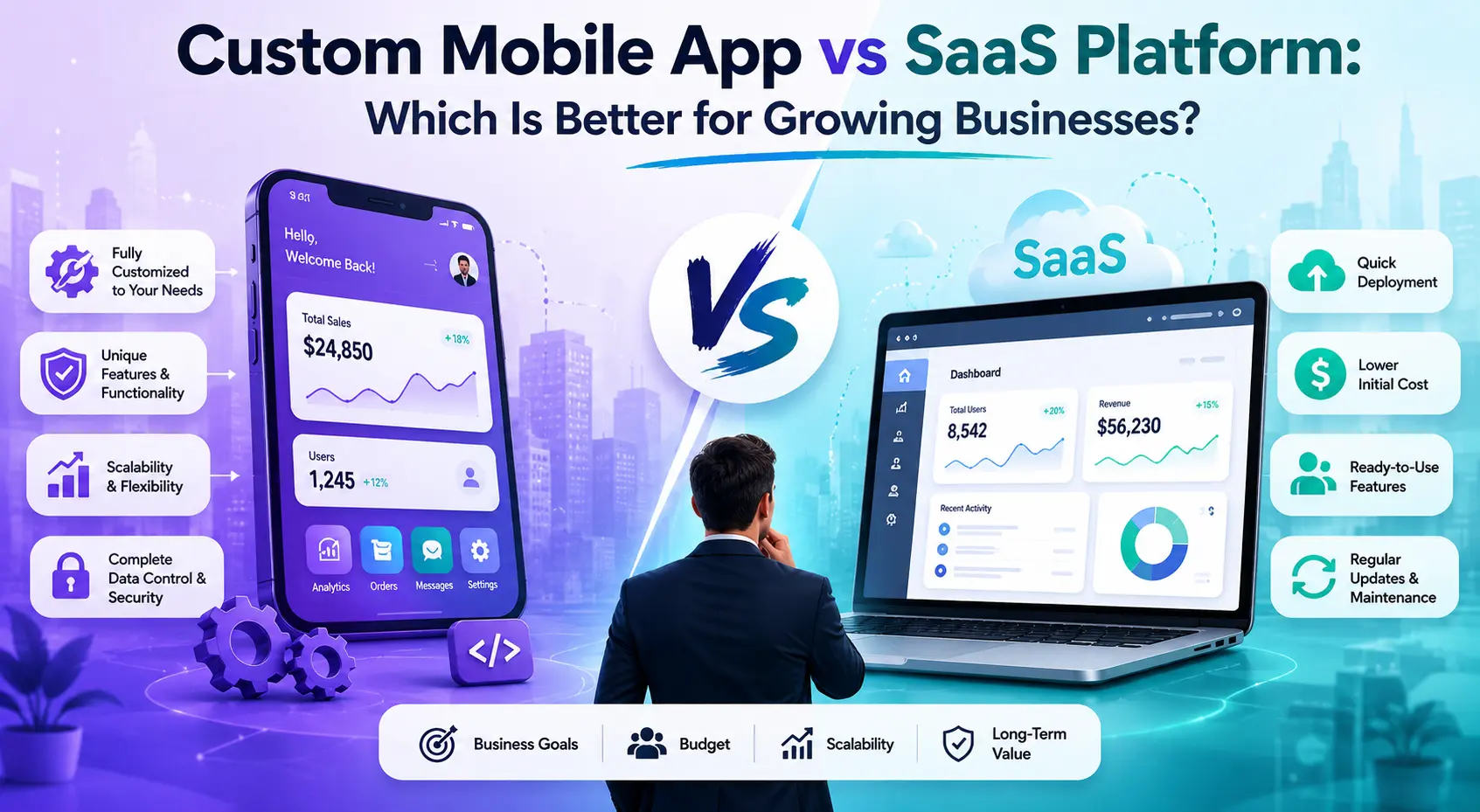
At some point in almost every growing Singapore business, the same conversation happens. You have been running on a SaaS platform — maybe it is your booking system, your CRM, your customer loyalty tool, or your operations dashboard. It worked fine when you were smaller. Now it does not quite fit. Features you need are missing or locked behind a higher tier. Data you want to access lives on a vendor's servers in another country. Your team has built a maze of workarounds that nobody fully understands. And a competitor just launched an app experience that makes yours look dated.
So the question becomes: do you stay with SaaS and keep patching things together, or do you invest in building something custom? It is not a small decision. It touches your technology budget, your team's time, your customer experience, and your long-term competitive position. And in Singapore in 2026 — with government grants available, cross-platform frameworks mature, and digital expectations higher than ever — the honest answer is more nuanced than most comparison guides let on.
This article gives you a proper framework to make that decision for your specific business. Not a blanket recommendation, but a clear, evidence-based comparison that helps you identify which path is actually right for where you are today and where you intend to go.
Custom Mobile App vs SaaS: Understanding the Core Difference
Before getting into the comparison, it is worth being precise about what these two options actually are — because the SaaS category in particular is often used loosely in ways that muddy the decision.
A SaaS (Software as a Service) platform is a subscription-based software product built by a vendor for the broadest possible market. You access it via a web browser or a vendor-branded app, pay a monthly or annual fee, and get whatever features the vendor has decided to build. You configure it within their system, but you do not own the code, and your data lives in the vendor's infrastructure — usually in data centres outside Singapore.
A custom mobile app is built from the ground up specifically for your business. Every screen, every workflow, every integration is designed around your requirements. You own the source code outright. Your data lives where you choose. And the app evolves according to your roadmap — not the vendor's.
SaaS asks your business to fit the software. A custom mobile app is built to fit your business — your workflows, your brand, your compliance requirements, and your growth trajectory.
The Full Comparison: Custom App vs SaaS for Singapore Businesses in 2026
| Factor | Custom Mobile App | SaaS Platform | Winner |
|---|---|---|---|
| Workflow fit | Built precisely around your operations | You adapt your operations to the platform | Custom |
| Time to deploy | 8 weeks (MVP) to 9 months (enterprise) | Days to weeks with a subscription | SaaS |
| Upfront investment | SGD $30K–$250K+ (EDG fundable up to 50%) | Low — monthly subscription from SGD $50–$500+/mo | SaaS |
| 3–5 year total cost | Lower — no licensing fees, asset value grows | Higher — compounds with team size and feature tiers | Custom |
| PDPA compliance (Singapore) | Data architecture built to your exact requirements | Data often on overseas servers; compliance gaps common | Custom |
| Data ownership | 100% — your code, your servers, your data | Vendor owns the platform; exit is complicated | Custom |
| Scalability across SEA | Architected for regional expansion from day one | Often limited by vendor's regional capabilities | Custom |
| AI & custom integrations | Full architectural freedom — build anything | Limited to vendor's marketplace and API choices | Custom |
| Ongoing maintenance | Requires a development partner or in-house team | Vendor handles infrastructure and updates | SaaS |
| Competitive advantage | Proprietary — competitors cannot replicate it | Anyone can subscribe to the same platform | Custom |
The Real Cost Comparison: Custom App vs SaaS Over 3 Years
The most common reason Singapore businesses stick with SaaS longer than they should is the upfront cost comparison. A SaaS subscription looks cheap at SGD $200 a month. A custom app costs SGD $80,000. The decision feels obvious — until you model what actually happens over three years.
3-Year Total Cost of Ownership Illustration (SGD) — Mid-Size Singapore Business
🟦 Custom Mobile App
🟡 SaaS Platform (Equivalent Capability)
At year three the numbers are already converging. By year four, custom development is typically more economical — and the gap widens every year after that, because the custom app's maintenance cost is relatively flat while the SaaS subscription scales with every new user, every feature tier upgrade, and every add-on you need. The business that builds a custom app in year one is making a decision that looks expensive today and smart in three years.
The EDG grant changes the maths significantly. For eligible Singapore SMEs, the Enterprise Development Grant can fund up to 50% of qualifying custom app development costs — reducing a SGD $90,000 project to an effective SGD $45,000 investment. At that number, custom development becomes competitive with SaaS from year one, not year three.
When to Choose a Custom Mobile App vs When SaaS Is the Right Call
Neither option is universally correct. The honest answer depends on where your business is today, how quickly you are growing, and how specific your operational and customer experience requirements actually are. Here is a practical decision framework.
✅ Choose a Custom Mobile App When...
- Your workflows are specific enough that generic software forces costly workarounds
- PDPA compliance requires full control over data architecture and storage location
- You are building toward regional expansion in Southeast Asia within three years
- Your customer experience is a genuine competitive differentiator — not just a utility
- You plan to be in business for five years or more and want a technology asset, not a liability
- You are in a regulated industry — fintech, healthcare, education — with specific compliance requirements
- You have been using SaaS for two or more years and are consistently hitting its ceiling
⚡ Choose SaaS When...
- You are at an early stage and need to validate your business model before investing in custom technology
- Your requirements are genuinely standard and a pre-built tool handles them well with no significant compromises
- Speed to market is critical and you cannot wait 8 to 14 weeks for an MVP build
- Your budget is limited and the EDG grant does not yet apply to your business
- You do not yet have the operational complexity that justifies a custom build
- You are testing a new product line or customer segment before committing to infrastructure
The Signs Your Singapore Business Has Outgrown SaaS
Most businesses do not make the switch to custom development proactively. They wait until the pain of staying with SaaS is greater than the perceived friction of building something new. Here is what that tipping point typically looks like.
You are paying for features you do not use — and still missing features you need
Generic platforms are built for the average user, not for your specific context. If you are paying for a higher tier to unlock one feature while ignoring 60% of the platform, and you still need to build manual workarounds for two other things, that is a clear signal the tool has stopped fitting your business.
Your customer-facing experience looks like a vendor's template, not your brand
SaaS platforms impose their UI conventions on your customers. The booking flow looks like every other business using the same platform. The loyalty app has the vendor's design language, not yours. In Singapore's competitive market, that is a real cost — not just an aesthetic one. Brand differentiation in digital channels is a conversion and retention driver, and generic templates undermine it.
Your team has built workarounds that no single person fully understands
This is the most overlooked sign. When three different team members have built three different Zapier automations to compensate for what the SaaS platform cannot do natively, you have hidden technical debt that is more expensive to maintain than a custom solution. The cognitive overhead alone is significant — and it compounds every time someone leaves the business.
You cannot demonstrate data control to enterprise clients or in regulated sectors
As soon as your Singapore business starts selling to enterprise clients, operating in a regulated sector, or handling sensitive personal data at scale, data governance becomes a commercial requirement. Enterprise procurement teams ask where data is stored. Healthcare regulators require specific controls. Financial sector clients need PDPA-aligned data handling. SaaS platforms often cannot provide the answers required — custom architecture can.
PDPA Compliance: Why Custom Apps Have a Structural Advantage for Singapore Businesses
Singapore's Personal Data Protection Act is not a checkbox — it is an ongoing operational requirement with real enforcement consequences. And it is one area where the custom vs SaaS comparison is less nuanced than the rest: custom development has a structural advantage that SaaS platforms cannot fully replicate.
Most SaaS platforms are not built with Singapore's PDPA as a primary design input. They are built for the US or European market first, with GDPR compliance as the dominant regulatory frame. PDPA has different requirements in specific areas — particularly around data transfer restrictions and notification timelines. A custom mobile app built by an experienced Singapore development partner can address those requirements precisely. A generic SaaS platform asks you to accept whatever compliance posture the vendor has decided to offer.
Scalability and Southeast Asia Expansion: How Custom Apps Support Singapore Business Growth
For many Singapore businesses, the decision between custom and SaaS is not just a technology question — it is a strategy question. If your three-year plan includes expanding into Malaysia, Indonesia, the Philippines, or Thailand, the platform you choose today needs to be able to support that journey without requiring a full rebuild at the point when you can least afford the distraction.
🌏 Multi-Market Architecture Custom Advantage
Custom apps are architected for multi-market deployment from day one — with multi-language support, multi-currency capabilities, region-specific regulatory compliance, and infrastructure that scales across Southeast Asia without requiring a complete redevelopment. SaaS platforms expand on the vendor's timeline, in the markets the vendor has prioritised, with the localisation the vendor has chosen to build.
⚙️ Integration Depth Custom Advantage
As your business grows, the number of systems you need your core platform to talk to grows with it. ERP, CRM, payment gateways, logistics APIs, HR platforms, and third-party data sources all need to connect cleanly. Custom apps can be built to integrate with any system via any API. SaaS platforms are limited to whatever integrations the vendor has decided to build and maintain.
👥 User & Data Scaling Custom Advantage
SaaS pricing models are almost universally tied to user count or data volume. As your team grows and your customer base scales, SaaS costs compound in ways that are difficult to model at the outset. Custom app infrastructure costs scale more predictably, and cloud architecture can be optimised for cost efficiency in ways that SaaS subscription models do not allow.
🚀 Feature Velocity Custom Advantage
When your business needs a new capability, a custom app development partner can build it on your timeline. SaaS vendors build features when those features serve their entire customer base — not when they serve your specific competitive need. The business that can ship customer-facing features faster than its competitors builds a compounding advantage that generic platforms simply cannot support.
Frequently Asked Questions: Custom Mobile App vs SaaS for Singapore Businesses
These are the questions Singapore founders and business owners ask most often when working through this decision for the first time.
What is the difference between a custom mobile app and a SaaS platform?
A SaaS platform is a subscription-based, ready-made software product built for the broadest possible market. You configure it within the vendor's system, pay a monthly fee, and work within whatever constraints the vendor has set. A custom mobile app is built from scratch specifically for your business — your workflows, your branding, your compliance requirements, and your customers. You own the code and the data outright, with no ongoing licensing dependency and no compromise on features.
The practical difference is who has control. With SaaS, the vendor does. With a custom app, you do.
Is a custom app cheaper than SaaS in the long run?
For most growing Singapore businesses with 15 or more users and specific operational requirements, yes — typically within two to three years. SaaS subscription costs compound with team size, feature tier upgrades, and add-on integrations. Custom app maintenance costs are relatively flat and predictable once the initial build is complete. The custom app also carries balance sheet asset value, which a SaaS subscription never does.
The EDG grant further changes this calculation. For eligible Singapore SMEs, funding up to 50% of development costs can make custom development cost-competitive with SaaS from year one rather than year three.
When should a Singapore business choose SaaS over a custom app?
SaaS is the right choice when your business is at an early stage and still validating its model, when your operational requirements are genuinely standard, when speed to market is critical and you cannot wait for a custom build, or when your budget does not yet support the upfront investment — even with grant assistance. The key question is not "which is better" but "which is right for where we are right now." Many successful Singapore businesses start with SaaS and migrate to custom development when they hit the natural ceiling of what generic tools can do for them.
Can Singapore SMEs get grants to build a custom app instead of buying SaaS?
Yes. The Enterprise Development Grant (EDG), administered by Enterprise Singapore, funds up to 50% of qualifying custom app development costs when the project is structured as a business transformation initiative. Applications are submitted through the Business Grants Portal (BGP) with decisions typically in 8 to 12 weeks.
It is worth noting that the PSG (Productivity Solutions Grant) covers pre-approved SaaS tools, not custom builds. The EDG is the correct grant route for custom development. An experienced development partner who has navigated EDG applications before can help structure your project scope to maximise funding eligibility.
Does a SaaS platform meet PDPA requirements for Singapore businesses?
Not consistently. Most SaaS platforms are built for the US or European regulatory environment, with GDPR as the primary compliance frame. Singapore's PDPA has different requirements in several areas — data transfer restrictions, notification timelines, and data subject rights obligations — that many SaaS vendors do not address specifically. Data stored on overseas servers also creates complications under PDPA's cross-border transfer rules.
A custom mobile app built by an experienced Singapore development team can be architected to meet PDPA requirements precisely — from data residency through consent management to breach notification workflows. That level of control is not available with most SaaS platforms.
How do I know if my Singapore business is ready to move from SaaS to a custom app?
The clearest signals are: you are consistently working around the limitations of your current platform; your customer-facing digital experience no longer reflects your brand properly; data governance requirements from enterprise clients or regulators are creating compliance gaps; your SaaS cost is scaling faster than the value you are getting from it; or you have a specific growth ambition — regional expansion, enterprise sales, regulated market entry — that your current platform cannot support without a significant rebuild anyway.
The most efficient thing to do if you are unsure is to book a discovery conversation with an experienced development partner who will give you an honest assessment — including telling you if SaaS is still the right answer for now — rather than trying to make that call in isolation.
The Verdict: Custom App vs SaaS — What Growing Singapore Businesses Should Do in 2026
There is no universal answer to this question. But there is a clear pattern in how the decision plays out for Singapore businesses that have thought it through carefully.
If you are early-stage, capital-constrained, and still validating your business model, SaaS is the right starting point. Move fast, learn quickly, and do not over-engineer the technology infrastructure for a business that is still finding its shape. The SaaS ecosystem has never been more capable, and for standard use cases it delivers genuine value with minimal friction.
But if you have been operating for two or more years, your requirements have evolved beyond what generic software handles cleanly, customer experience is a real differentiator in your market, and you are thinking about where the business needs to be in three to five years — the case for a custom mobile app is strong and getting stronger. With EDG grants reducing the upfront cost, cross-platform frameworks reducing the build time, and an experienced local partner reducing the execution risk, the barriers that used to make custom development feel out of reach for Singapore SMEs are lower than they have ever been.
The businesses pulling ahead in Singapore's digital economy in 2026 are not the ones with the best SaaS stack. They are the ones that invested in owning their digital infrastructure at the right moment — and used it to build customer experiences their competitors cannot replicate by clicking a subscribe button.
Not Sure Whether to Build Custom or Stay with SaaS? Let's Work It Out Together.
The Inno Panda team offers a free, no-commitment strategy consultation for Singapore businesses at exactly this decision point. We will look at your current setup honestly, assess whether custom development makes sense for your specific situation, walk you through realistic costs and timelines, and advise on EDG grant eligibility. If SaaS is still the right answer for you right now, we will tell you that too. Our goal is to help you make the right decision — not to sell you a project you do not need.