API Integration Services Singapore 2026: Connect Your Systems. Stop Doing It by Hand.
- 1 API Integration Services Singapore 2026: Connect Your Systems. Stop Doing It by Hand.
- 1.1 Key Takeaways
- 1.2 What Is API Integration? A Plain-English Explanation for Singapore Businesses
- 1.3 Why API Integration Is a Competitive Advantage, Not Just a Convenience
- 1.4 How Much Does API Integration Cost in Singapore?
- 1.5 Third-Party API Integration Singapore: The Types We Build
- 1.6 API Integration vs No-Code Tools vs Custom Development: Which Fits Your Business?
- 1.7 Is Your API Integration PDPA Compliant?
- 1.8 How to Get API Integration Right: Our Process From Scoping to Go-Live
- 1.9 Quick Glossary
- 1.10 Frequently Asked Questions About API Integration Services in Singapore
- 1.11 Get API Integration That Actually Works
- 1.12 Related Reading from Inno Panda
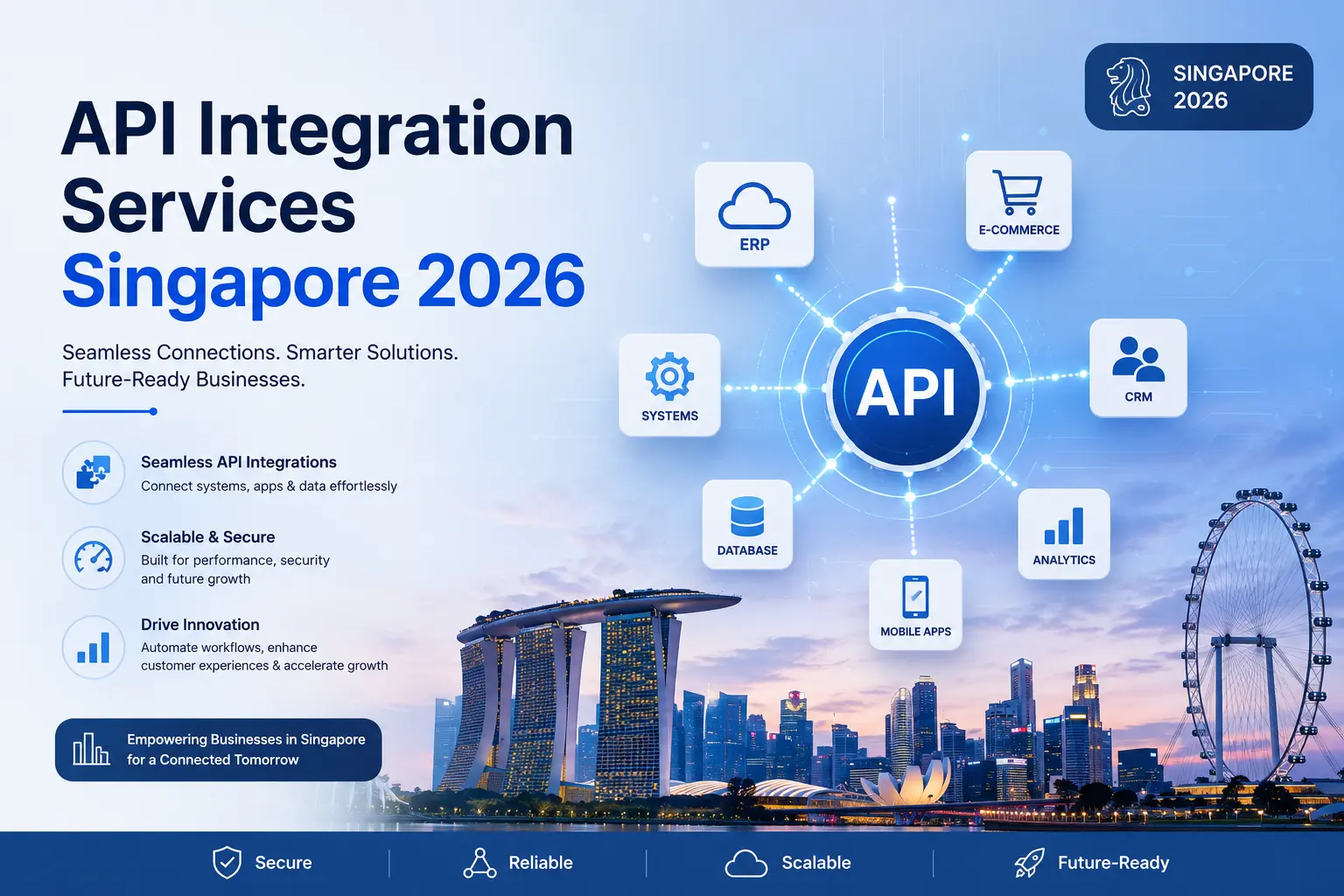
Every time your team copies data from one platform to another, your business is paying for a problem technology solved years ago. Inno Panda builds API integrations that connect your software, automate your workflows, and give your people back the hours they're losing to manual work.
Key Takeaways
- API integration connects the software you already run, like your CRM, ERP, store, and payment gateway, so data moves automatically instead of by hand.
- The real cost of skipping it isn't visible on a balance sheet. It's staff hours, data entry errors, and slower customer response times.
- Not every integration needs custom development. No-code tools, middleware, and custom builds each fit different volumes and budgets.
- A single integration typically takes 1 to 3 weeks. Multi-system projects run 4 to 12 weeks, priced as a fixed quote rather than open-ended billing.
- Reliable integration means error handling, retry logic, and documentation, not just two platforms wired together over a weekend.
What Is API Integration? A Plain-English Explanation for Singapore Businesses
API stands for Application Programming Interface. It sounds technical, but the idea is simple: an API is the standardised channel one software application uses to talk to another. When your online store sends a new order to your warehouse system automatically, that's an API. When a customer pays and the transaction instantly appears in your accounting software, that's an API too.
API integration is the process of building those connections. It means linking systems you already run so they share data automatically and trigger actions across platforms, removing the manual steps that currently fall on your team. Most Singapore businesses run four, five, or six different software tools, and most of those tools were never designed to talk to each other. That gap is where time gets lost, errors creep in, and growth gets bottlenecked.
The short version: API integration makes your software work together automatically, so your team spends time on decisions that need human judgement, not on copying data between platforms they already pay for.
Why API Integration Is a Competitive Advantage, Not Just a Convenience
Most business owners in Singapore already know their systems are disconnected. They've simply come to accept the manual work as unavoidable. It isn't, and the hidden cost of leaving it that way is usually bigger than the cost of fixing it.
Think about how many times a day someone exports a CSV from one platform and imports it into another, or manually re-enters an order, or chases a colleague for a status update an integrated system would show in real time. Multiply that by every working day of the year, add in the error rate that comes with manual entry, and that's what disconnected systems are quietly costing your business.
Figures are directional estimates from published operations and data-quality research plus patterns we see across client integration projects, not a single controlled study.
What this looks like in practice: a Singapore-based B2B distributor we worked with was running HubSpot, Xero, and a third-party logistics platform as three disconnected systems. Sales reps manually re-keyed every won deal into Xero for invoicing, then again into the logistics platform to schedule delivery, about 20 minutes per order, across roughly 15 orders a day. We built a phased integration connecting all three: HubSpot triggers the invoice in Xero automatically, and a confirmed invoice triggers the delivery booking. The rollout took just under four weeks, ran alongside their existing manual process until each step was verified, and cut re-keying time to zero without a single day of order processing downtime.
How Much Does API Integration Cost in Singapore?
This is usually the second question after "what is it," and it deserves a straight answer. Simple third-party integrations between two well-documented platforms typically run SGD 2,000 to SGD 8,000. Multi-system enterprise integrations involving custom development, several data sources, and thorough testing run SGD 10,000 to SGD 50,000 or more, depending on complexity.
| Project type | Typical cost (SGD) | Typical timeline |
|---|---|---|
| Single third-party integration | 2,000 – 8,000 | 1 – 3 weeks |
| Multi-system integration (CRM + ERP + payments) | 10,000 – 30,000 | 4 – 8 weeks |
| Custom API development with no existing endpoint | 20,000 – 50,000+ | 8 – 12 weeks |
The number that matters more than the quote itself is the comparison: what is the current manual workaround costing you every month in staff time and errors, against a one-time fixed price? For most Singapore SMEs, that break-even lands somewhere between two and four months. We provide a fixed-price quote after a free scoping session, so there's no open-ended billing to worry about.
Third-Party API Integration Singapore: The Types We Build
Different businesses need different integrations. The right ones for you depend on which systems you run today and where the manual work is costing the most. Here's what we build most often for Singapore businesses.
CRM Integration
Connecting Salesforce, HubSpot, Zoho, or Pipedrive to your website or store, so customer records stay accurate and your sales team works with live data.
Payment Gateway Integration
Integrating Stripe, PayNow, GrabPay, or Adyen, covering authentication, compliance, webhook handling, and reconciliation to your accounting software.
ERP Integration
Connecting SAP, Oracle, Microsoft Dynamics, or NetSuite to your operations tools, removing manual export-import cycles for finance and inventory.
E-commerce Integration
Connecting Shopify, WooCommerce, Lazada, or Shopee to inventory, warehouse, and logistics, so every order triggers the right downstream action automatically.
Logistics & Fulfilment APIs
Integrating DHL, SingPost, Ninjavan, or J&T Express, so shipping labels and tracking updates flow automatically without manual booking.
Custom REST API Development
When no public API exists, or your business logic is too specific for existing APIs, we build bespoke, documented APIs designed around your requirements.
| Integration type | Common platforms | Key outcome | Typical timeline |
|---|---|---|---|
| CRM integration | Salesforce, HubSpot, Zoho | Live customer data, faster sales cycles | 2–4 weeks |
| Payment gateway | Stripe, PayNow, GrabPay | Automated reconciliation, real-time status | 1–3 weeks |
| ERP connection | SAP, Oracle, NetSuite | No manual entry, live inventory accuracy | 4–10 weeks |
| E-commerce & marketplace | Shopify, Lazada, Shopee | Multi-channel inventory sync | 2–5 weeks |
| Logistics & fulfilment | DHL, SingPost, Ninjavan | Automated shipping, live tracking | 1–3 weeks |
| Custom REST API | Bespoke / no public API | Unlocks integration with no existing API | 4–12 weeks |
Platforms we regularly connect:
API Integration vs No-Code Tools vs Custom Development: Which Fits Your Business?
Singapore businesses have more ways than ever to connect their systems, but not every option suits every situation. Here's an honest comparison so you can decide before spending anything.
| Approach | Best for | Limitations | Typical cost (SGD) |
|---|---|---|---|
| Professional API integration | SMEs, e-commerce, multi-system needs, production reliability | Requires upfront scoping | 2,000 – 50,000+ project |
| No-code tools (Zapier, Make) | Simple two-platform connections, low volume, early testing | Breaks under load, limited logic, ongoing subscription cost | 100 – 500/month ongoing |
| Custom software development | Fully unique requirements with no existing API | Highest cost, longest timeline | 20,000 – 200,000+ project |
| Freelance API developer | Straightforward single integrations with a clear spec | Variable quality, little documentation | 1,000 – 5,000 project |
| In-house developer | Businesses with an existing technical team | High fixed cost, competes with other priorities | High fixed salary cost |
The honest answer on no-code tools: Zapier and Make are excellent for testing an integration concept before committing to a build. They're not production infrastructure. When they fail on a Sunday night, which they do, your data stops moving and nobody notices until Monday. For anything that matters to your operations, a properly built integration is the more reliable option.
Is Your API Integration PDPA Compliant?
If any integration you're planning touches customer names, contact details, payment records, or order history, it falls under Singapore's Personal Data Protection Act, and that's most integrations. This isn't optional small print. The Personal Data Protection Commission, which administers the PDPA, can fine organisations up to SGD 1 million or 10% of annual turnover for a breach, whichever is higher.
A poorly built integration is one of the more common ways personal data ends up exposed, since it's a connection point most teams never audit after launch. In practice, PDPA-aware integration work means a handful of concrete things:
This is a general summary, not legal advice. If PDPA compliance is a specific concern for your project, we'd recommend confirming your obligations with a qualified advisor alongside the technical build.
How to Get API Integration Right: Our Process From Scoping to Go-Live
There's a version of API integration that looks like wiring two platforms together over a weekend. It works until your business changes, a platform updates its API, or the connection breaks on a Friday evening with nobody sure why. That's not what we build. Every integration is documented, properly error-handled, and designed to grow with your business.
Discovery and requirements mapping
We map your systems and data flows, confirm which APIs are available and their limits, and document requirements before development starts.
Integration architecture design
Data flow, authentication, error handling, and monitoring get designed before a line of code is written. This is what separates integrations that hold up from ones that break under real conditions.
Development and staging tests
We build in a controlled staging environment and test every data flow and failure scenario against your actual requirements before anything touches live systems.
Deployment and live verification
We deploy, run live verification across every connected system, and stay available in the days after go-live to catch anything staging didn't surface.
Documentation, handover, and ongoing support
Every integration ships with documentation your team can use, plus ongoing maintenance, since APIs evolve and platforms release new versions. See our AI automation service to extend integrations further with intelligent workflow automation.
This same phased, zero-downtime approach is how we handle broken or outdated connections too. If your systems are already integrated but unreliable, that's a different starting point, covered in our guide to fixing legacy API integrations.
Quick Glossary
- API integration
- The process of connecting two or more software applications so they share data and trigger actions automatically.
- REST API
- The most common API standard, using standard HTTP requests to exchange data in JSON or XML format.
- Webhook
- An instant, event-driven notification pushed the moment something happens, instead of the receiving system having to ask for updates.
- OAuth 2.0
- The modern standard for API authentication, replacing static API keys with secure, revocable access tokens.
- Middleware / iPaaS
- A pre-built connector tool that links popular platforms without custom code, suited to standard workflows and moderate volume.
- PDPA
- Singapore's Personal Data Protection Act. It governs how personal data is collected, used, and disclosed, including when that data moves between systems through an API integration.
Frequently Asked Questions About API Integration Services in Singapore
What is API integration?
API integration is the process of connecting two or more software applications so they can share data and trigger actions automatically, without manual work. When an order placed on your website automatically appears in your inventory, CRM, and accounting software, that's API integration doing the work your team would otherwise do by hand.
How much does API integration cost in Singapore?
Simple third-party integrations typically range from SGD 2,000 to SGD 8,000. Multi-system enterprise integrations with custom development range from SGD 10,000 to SGD 50,000 or more, depending on complexity. We provide a fixed-price quote after a free scoping session, so there's no open-ended billing.
How long does API integration take?
Simple integrations between two platforms with existing APIs typically take 1 to 3 weeks. Multi-system integrations involving data mapping, custom development, and thorough testing take 4 to 12 weeks. A specific timeline is confirmed after reviewing your requirements.
What is the difference between API integration and custom software development?
API integration connects systems that already exist, such as linking your CRM to your ERP. Custom software development builds something entirely new. Most businesses need integration first because it uses tools they've already paid for; custom development becomes necessary only when no suitable API exists. See our custom software development service for projects that genuinely need a bespoke build.
Do I need a developer to integrate APIs?
For very simple, low-volume connections between two mainstream platforms, no-code tools like Zapier or Make can work as a starting point. For custom business logic, high data volumes, or multiple systems, a developer is necessary, since no-code tools fail in production more often than businesses expect.
What are the most common API integrations for Singapore businesses?
The most common projects are CRM integrations (Salesforce, HubSpot, Zoho), payment gateway integrations (Stripe, PayNow, GrabPay, Adyen), ERP integrations (SAP, Oracle, Microsoft Dynamics), e-commerce marketplace connections (Shopify, Lazada, Shopee), and logistics integrations (DHL, SingPost, Ninjavan).
What is REST API integration?
REST is the most widely used API standard in 2026. REST APIs use standard HTTP requests to exchange data in JSON or XML format. Most modern SaaS platforms, including Salesforce, Shopify, Stripe, and HubSpot, offer REST APIs, making it the default approach for most Singapore integration projects.
Is API integration covered by Singapore's PDPA?
If the integration moves personal data, such as names, contact details, or payment records, between systems, it falls under the PDPA. That means encrypting data in transit, limiting access to only the fields needed, and being able to show where data flows once it leaves your primary system. This is a general summary rather than legal advice; confirm specific obligations with a qualified advisor for your project.
Get API Integration That Actually Works
No generic implementations, no no-code tools dressed up as custom development, no integrations that break quietly in production. Just a clear architecture built for your systems, delivered with documentation and fixed-price clarity from the start.