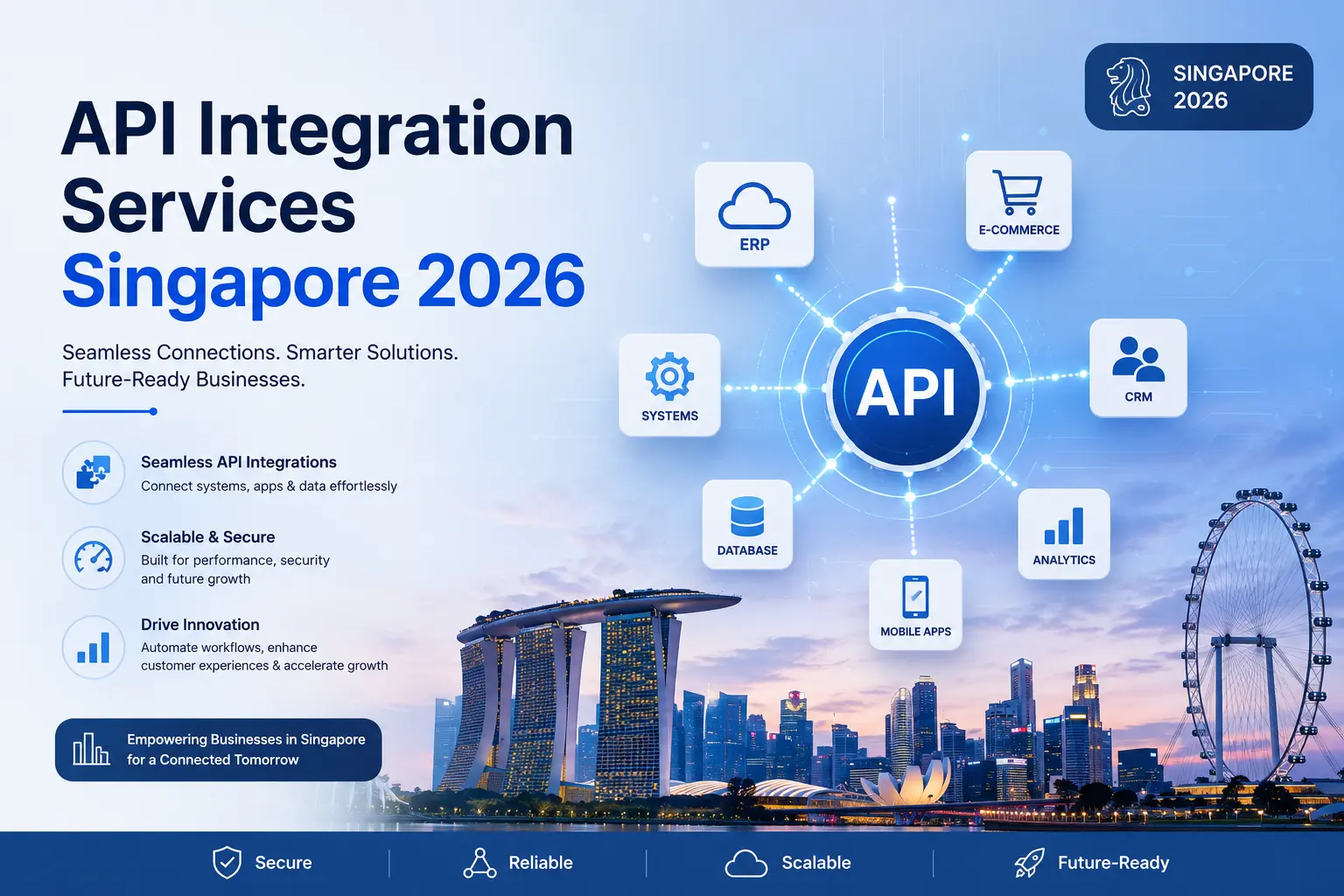
API Integration Services Singapore: How Small Businesses in Southeast Asia Can Automate and Scale in 2026
- 1 API Integration Services Singapore: How Small Businesses in Southeast Asia Can Automate and Scale in 2026
- 1.1 What Is API Integration? (And Why Small Businesses in Southeast Asia Should Care)
- 1.2 API Integration Singapore: What Businesses Here Are Automating Right Now
- 1.3 API Integration Across Southeast Asia: Singapore, Malaysia, Indonesia, and the Philippines
- 1.4 Real-World Use Cases: How Startups in Southeast Asia Are Using Business Automation
- 1.5 Software Integration Services Singapore: How to Choose the Right Approach
- 1.6 Business Automation Solutions for Startups Southeast Asia: When to Go Custom
- 1.7 How to Get Started with API Integration for Your Small Business: A Step-by-Step Framework
- 1.8 Inno Panda's API Integration and Business Automation Services Across Southeast Asia
- 1.9 Platforms and Systems We Integrate
- 1.10 Frequently Asked Questions About API Integration for Small Businesses in Southeast Asia
- 1.11 The Bottom Line: API Integration Is the Infrastructure That Lets Your Business Grow Without Breaking
- 1.12 Ready to Connect Your Systems and Automate the Manual Work Holding Your Business Back?
If your team is still manually copying data between systems, exporting CSVs, and reconciling spreadsheets every week — you are not just losing time. You are losing the capacity to grow. This guide is for small business owners, founders, and startup teams across Singapore, Malaysia, Indonesia, and the Philippines who are ready to change that.

At Inno Panda, we have built API integrations for businesses across Singapore, Malaysia, Indonesia, and the Philippines across e-commerce, logistics, fintech, healthcare, and professional services. We know what works, what does not, and where most small businesses are leaving the most value on the table. This guide shares all of it.
What Is API Integration? (And Why Small Businesses in Southeast Asia Should Care)
An API ( Application Programming Interface ) is the communication layer that lets two pieces of software talk to each other. When you use your phone to log into a website using Google, that is an API. When your Shopify store updates your inventory after a sale, that is an API. When your accounting software automatically pulls your Stripe payments, that is an API.
API integration is the process of deliberately connecting your business systems through these communication layers so data flows between them automatically, and the right actions happen at the right time without anyone manually triggering them.
For a small business or startup, this is transformative. Not because it is technically impressive, but because it directly eliminates the most expensive, error-prone, and time-consuming parts of running an operation the manual hand-offs between systems where data gets lost, delayed, duplicated, or corrupted.
What Happens Without API Integration
Most small businesses in Singapore and across Southeast Asia are running a version of the same painful pattern. They have multiple SaaS tools maybe a CRM, an accounting package, an e-commerce platform, a logistics system, and a customer support tool. Each of those tools is good at what it does. The problem is that they do not talk to each other. So someone on your team fills in that gap manually exporting, importing, copying, reconciling every single day.
The hidden cost of disconnected systems: The average SME in Southeast Asia loses between 8 and 15 hours of staff time per week maintaining manual data flows between unconnected software tools. At a loaded staff cost of SGD 25 per hour, that is SGD 10,000 to SGD 20,000 per year in pure manual overhead before accounting for the downstream cost of the errors that manual processes inevitably create.
Running disconnected systems and want to know what it is actually costing you? Our team will map your current data flows and quantify the operational cost no obligation.
Talk to Our Team →API Integration Singapore: What Businesses Here Are Automating Right Now
Singapore sits in a unique position. It is simultaneously one of the most digitally advanced business environments in Southeast Asia and one of the most expensive — which means operational efficiency is not a nice-to-have, it is a competitive necessity. The labour cost of manual processes in Singapore is higher than anywhere else in the region, which makes the ROI case for API integration services in Singapore particularly compelling.
Custom API Integration Company Singapore: What to Look For
The most common integrations we build for Singapore-based small businesses and startups connect systems that most businesses here already use but that were never designed to work together natively.
CRM and Payment Gateway Integration Singapore
Connecting Salesforce, HubSpot, or Zoho CRM to payment gateways like Stripe, PayNow, or eNETS so customer records update automatically when payments are received, subscriptions renew, or invoices are settled. Eliminates the daily reconciliation nightmare that finance teams dread.
E-Commerce to ERP Integration
Syncing Shopify, WooCommerce, or Lazada order data directly into inventory management and accounting systems in real time so stock levels are always accurate, fulfilment is triggered automatically, and financial records are updated without manual entry. Our Shopify development service handles this depth of connectivity.
Logistics API Connections
Connecting to NinjaVan, Lalamove, J&T, or Singpost APIs so that shipping labels are generated, tracking numbers are issued, and customer notifications fire automatically the moment an order is packed no manual booking, no copy-pasting tracking codes.
Accounting and Payroll Automation
Integrating Xero or QuickBooks with POS systems, payment processors, and payroll platforms so that transaction data flows in automatically, payroll calculations draw from real attendance data, and financial reports are always current.
AI-Powered Automation Layers
Building intelligent automation on top of your integrations using AI to categorise, prioritise, and route data as it flows between systems. Our AI automation service brings this capability to every integration we build.
Multi-Channel Inventory Sync
Connecting sales channels — Shopify, Lazada, Shopee, your own website to a single inventory source of truth through a custom integration layer, so stock levels update across all channels the moment any sale occurs. Our SyncingAbout platform is built exactly for this.
Business Automation Software Integration Singapore: The ROI Case
The economics of API integration services for small businesses in Singapore are often clearer than people expect. The question to ask is not "how much does this integration cost to build?" but "what is the cost of not building it?" When you add up the staff hours spent on manual data entry, the operational errors caused by disconnected systems, the customer experience failures that result from delayed or inaccurate data, and the management time spent chasing down reconciliation issues the ongoing cost of not integrating is almost always higher than the one-time cost of building the connection.
Looking for a custom API integration company in Singapore that understands your business, not just your code? We map your workflows first, then build the integration so what we deliver actually solves the right problem.
Explore Our API Services →API Integration Across Southeast Asia: Singapore, Malaysia, Indonesia, and the Philippines
The need for software integration is not unique to Singapore — it is a shared operational challenge across the region. But the specific platforms, payment methods, logistics providers, and compliance requirements vary significantly by country. Here is what API integration looks like on the ground across the four major markets where we work.
API Integration Singapore
Singapore businesses typically need integrations connecting to PayNow, eNETS, Stripe, Xero, Shopify, and government API systems like CorpPass and MyInfo. The priority is usually operational efficiency — eliminating manual overhead in high-cost labour environments and building integrations that meet the compliance standards of MAS-regulated industries. For software integration services in Singapore, reliability and security are non-negotiable.
API Integration Malaysia
Malaysian businesses often need connections to Maybank2u, FPX, GrabPay Malaysia, Lazada, and Shopee — alongside accounting tools like SQL Account and AutoCount. Custom API development in Malaysia frequently focuses on connecting e-commerce channels to offline retail systems, and on integrating SST compliance requirements into financial reporting automation. Business automation for startups in Malaysia increasingly centres on multi-channel order management and customer data unification.
API Integration Indonesia
Indonesia's digital ecosystem is driven by platforms like Tokopedia, Shopee, Bukalapak, and Gojek — alongside payment methods including GoPay, OVO, DANA, and virtual accounts. API integration in Indonesia often involves connecting multiple marketplace channels to fulfilment and inventory systems, building payment gateway aggregation layers, and automating customer communications across WhatsApp and messaging platforms. Business automation in Indonesia is accelerating rapidly as the startup ecosystem matures.
API Integration Philippines
The Philippines presents a distinctive integration landscape, with GCash, Maya, and bank transfer APIs sitting alongside Lazada and Shopee as primary commerce platforms. Software integration services in the Philippines frequently focus on automating order processing for social commerce businesses, connecting payment confirmation flows for GCash and Maya to order fulfilment, and building BPO-grade data processing pipelines that handle high transaction volumes with minimal manual intervention. Startup automation in the Philippines is particularly strong in fintech and logistics verticals.
A note on cross-border integrations: If your business operates across multiple Southeast Asian markets — selling in Singapore, fulfilling in Malaysia, and processing payments through Indonesian gateways — you almost certainly need a custom API development layer that normalises data across platforms and currencies. Off-the-shelf connectors are not built for this complexity. This is exactly where a custom API integration partner becomes invaluable.
Real-World Use Cases: How Startups in Southeast Asia Are Using Business Automation
The best way to understand what API integration can do for your business is to see what it has done for businesses like yours. Here are the most common automation scenarios we build for startups and SMEs across the region.
API Integration Solutions for Startups Singapore: Five Patterns That Deliver the Most Value
1. Order-to-Fulfilment Automation
An order placed on Shopify automatically triggers a stock deduction in the inventory system, generates a shipping label via the logistics API, sends a tracking notification to the customer via WhatsApp or email, and updates the sales record in Xero. The entire sequence happens in under 60 seconds with zero human involvement. For e-commerce businesses processing more than 50 orders per day, this single integration chain saves 2 to 4 hours of staff time daily.
2. Lead-to-CRM Automation
A form submission on your website, an enquiry via your Facebook page, or a WhatsApp message from a prospect automatically creates a contact record in HubSpot or Zoho CRM, assigns it to the right salesperson based on territory or product interest, sends an automatic acknowledgement to the lead, and schedules a follow-up task. No leads fall through the cracks. No manual data entry. Response time drops from hours to seconds.
3. Payment Reconciliation Automation
Payments received via PayNow, Stripe, GrabPay, or bank transfer are automatically matched to outstanding invoices in your accounting system, customer payment status is updated in your CRM, and a receipt is dispatched to the customer — all without your finance team touching a spreadsheet. For businesses processing 50 to 500 transactions per month, this eliminates an entire day of reconciliation work per week.
4. Multi-Channel Inventory Synchronisation
Stock levels are maintained in a single source of truth and pushed in real time to every sales channel — Shopify, Lazada, Shopee, your own website, and your physical store POS. When a product sells on any channel, every other channel updates immediately. Overselling becomes a historical problem. Our SyncingAbout platform is purpose-built for exactly this use case across Southeast Asian marketplaces.
5. Customer Support Data Integration
Your customer support platform (Zendesk, Freshdesk, or a custom system) is connected to your CRM and order management system — so support agents see the complete customer history, order status, and payment record the moment a ticket opens. No more "let me check with our operations team." No more customers repeating their order number three times. Resolution times drop. CSAT scores rise.
Ready to see which of these patterns would deliver the most value for your business? We build custom integrations for small businesses and startups across Singapore and Southeast Asia — from simple two-system connections to complex multi-platform automation pipelines.
See Our Work →Software Integration Services Singapore: How to Choose the Right Approach
Not all integration needs are the same, and not all integration approaches deliver the same result. Here is an honest comparison of the three most common approaches available to small businesses in Singapore and Southeast Asia.
| Factor | No-Code Tools (Zapier, Make) | Off-the-Shelf Connectors | Custom API Integration |
|---|---|---|---|
| Setup Time | Hours to days | Days to a week | Weeks to months |
| Upfront Cost | Low — subscription-based | Low to medium | Higher — development investment |
| Ongoing Cost | Compounds — per-task pricing | Moderate monthly fee | Low — maintenance only |
| Business Logic | Very limited — simple if/then rules | Standard logic only | Fully custom — any logic you need |
| Data Volume | Low — expensive and slow at scale | Moderate volumes supported | Handles any volume |
| SEA Platform Support | Limited — few SEA-specific apps | Patchy — depends on vendor | Any platform with an API |
| Error Handling | Basic alerts — often silent failures | Vendor-managed | Fully monitored and recoverable |
| Data Security | Data passes through third-party servers | Vendor's security policies apply | Full control — your infrastructure |
| Ownership | Dependent on Zapier/Make continuing | Vendor-dependent | You own the code entirely |
| Long-Term ROI | Good at small scale, degrades at volume | Moderate — constrained by features | Strongest — improves as you scale |
The pattern is consistent with what we see in practice. No-code tools like Zapier are excellent for simple, low-volume automations — they are the right starting point for businesses still figuring out which integrations they actually need. Off-the-shelf connectors work where the exact integration you need happens to exist. Custom API development delivers the most value for businesses with specific workflow requirements, significant data volumes, SEA-specific platform needs, or serious data security requirements.
Many of the businesses we work with started on Zapier, hit its limits, and came to us when they needed something their no-code tool simply could not handle. Understanding where that ceiling is for your specific situation is what our system integration service is designed to help you assess.
Business Automation Solutions for Startups Southeast Asia: When to Go Custom
Not every integration problem needs a custom solution. But some definitely do — and building a custom integration when no-code tools genuinely cannot handle the requirement is not overspending. It is making the right investment at the right time. Here is how to think about it.
✅ No-Code Tools Will Work If:
- You are connecting two mainstream SaaS tools with a simple trigger-action flow
- Volume is low — fewer than 1,000 automation tasks per month
- The integration logic is linear with no conditional branching
- You are validating whether a workflow automation is worth the investment
- Both tools you are connecting are well-supported by Zapier or Make
- The data involved is not sensitive or compliance-governed
🔧 You Need Custom API Development If:
- You are connecting to SEA-specific platforms not in Zapier's library
- Your workflow has complex conditional logic or multi-step branching
- Data volume is high — thousands of daily transactions or records
- You need real-time synchronisation, not batch processing
- Data security or regulatory compliance requires data to stay on your infrastructure
- You are building an integration that will be central to your product or service
Software Integration Services for SMEs Singapore: Starting Small, Scaling Smart
The best approach for most SMEs is not to try to automate everything at once — it is to identify the single highest-friction manual process in your operations, build a targeted custom integration to eliminate it, validate the ROI, and then expand from there. One well-built integration that saves your team 10 hours per week pays back within months. That proof of concept then makes the case for the next integration, and the one after that.
A practical starting point: Look at the process in your business that involves the most manual copy-pasting, the most spreadsheet reconciliation, or the most "we have to check both systems" moments. That is almost always the integration with the highest ROI. Our API development service starts every engagement by mapping this problem precisely before writing a single line of code.
How to Get Started with API Integration for Your Small Business: A Step-by-Step Framework
Whether you are a founder in Singapore evaluating your first automation investment or an operations lead in Jakarta trying to untangle a stack of disconnected tools — the process for getting started with API integration is the same. Here is exactly how to approach it.
Map every manual data flow in your business
Before you build anything, document every point in your operation where someone manually moves data from one system to another. Include the tool it comes from, the tool it goes to, how often it happens, and roughly how long it takes each time. This exercise almost always surfaces two or three integrations that would deliver a disproportionate return — and gives you a prioritised list rather than a wish list.
Quantify the cost of each manual process
For each manual data flow you have mapped, calculate the annual cost: (time per instance × frequency per year × loaded staff hourly rate) plus an estimate of error costs where relevant. This turns a vague operational frustration into a concrete financial number — and that number is what you compare against the cost of the integration to build. For most businesses, the top two or three manual flows account for the vast majority of the total cost.
Check whether your tools have usable APIs
Most modern SaaS tools have APIs — but not all of them are well-documented, stable, or capable of supporting the integration you need. Check whether the key systems you want to connect have API documentation, whether those APIs support the data operations required (read, write, webhooks), and whether there are known limitations or rate limits that would affect your use case. If a system does not have a native API, a custom development middleware layer may be needed to bridge the gap.
Define the business logic, not just the data flow
The most common cause of integration projects going wrong is scoping the technical data flow without defining the business logic. "When an order is placed, update the inventory" sounds simple — but what happens when the payment fails? What if the item is out of stock? What if the same customer exists in both systems under slightly different names? Defining the expected behaviour for edge cases before development starts is what separates integrations that work reliably from integrations that break silently and corrupt your data.
Build, test, and monitor — not just build
An integration that is built but not properly tested is a liability. An integration that is built and tested but not monitored is a time bomb. The build phase should include comprehensive testing with real data scenarios — including all the edge cases you defined in step four. And once deployed, the integration needs active monitoring — alerts when data volumes fall outside expected ranges, error logging when connections fail, and a recovery mechanism for transactions that do not complete cleanly. Our API development service includes all three layers as standard.
Measure ROI and plan the next integration
Once the first integration is live and running reliably, measure its impact against your original calculation — staff hours saved, error rate reduction, and any downstream improvements in customer experience or operational capacity. This data becomes the business case for your next integration investment, and for escalating from simple automations to more complex custom software development as your requirements grow. Our clients who start with a single targeted API integration typically roll out two or three more within six months, once they see the results.
Inno Panda's API Integration and Business Automation Services Across Southeast Asia
At Inno Panda, we build API integrations and business automation systems for clients across Singapore, Malaysia, Indonesia, and the Philippines. Our team has built everything from straightforward two-system connections to complex multi-platform integration architectures handling millions of transactions. Here is what we bring to every engagement:
Custom API Development
Building bespoke API layers from scratch when off-the-shelf connectors do not exist or cannot handle your requirements. Our API development service covers REST, GraphQL, and webhook-based integrations for any platform with a programmable interface.
System Integration Singapore
Connecting your existing software stack — CRM, ERP, accounting, e-commerce, logistics, HR — so it functions as a unified operation rather than a collection of isolated tools. Our system integration service is designed for the complexity of Singapore and Southeast Asian business operations.
AI-Powered Business Automation
Adding intelligence to your integrations — using AI to classify, route, and process data as it flows between systems. Our AI automation integration service transforms basic data pipelines into intelligent automation systems that improve over time.
Multi-Channel Commerce Integration
Connecting Shopify, WooCommerce, Lazada, Shopee, and your own sales channels to a single operational layer — with inventory, fulfilment, and financial data synchronised in real time. Our SyncingAbout platform is purpose-built for this exact requirement.
SaaS Platform Development
If the integration you need does not exist and you want to build it as a product to sell to other businesses, our SaaS development service takes your concept from insight to commercial deployment — including all the API architecture required.
Custom Software Development
When integration is not enough and you need to build the system itself, our custom software development service delivers bespoke applications built around your exact operational requirements — not adapted from a generic template.
We work with businesses of every size — from solo founders validating their first automation to established SMEs running complex multi-country operations. If you are not sure whether your need calls for API integration, custom software development, or a combination of both, our team will give you an honest assessment — including when the right answer is to start with a no-code tool rather than commission development work. See the full portfolio of work we have delivered for clients across Southeast Asia.
Platforms and Systems We Integrate
Our API development team has built integrations across a wide range of platforms — including the Southeast Asia-specific payment, logistics, and marketplace platforms that most global integration tools do not support natively.
E-Commerce & Marketplaces
Payments & Fintech
CRM, ERP & Business Tools
Logistics & Fulfilment
Frequently Asked Questions About API Integration for Small Businesses in Southeast Asia
Here are the questions we hear most often from founders and business owners across Singapore, Malaysia, Indonesia, and the Philippines who are evaluating API integration services.
What is API integration and why does it matter for small businesses in Singapore?
API integration is the process of connecting two or more software systems so they can share data and trigger actions automatically — without anyone manually moving information from one tool to another. For small businesses in Singapore, where labour costs are high and operational efficiency is a competitive differentiator, API integration means your CRM updates when a payment clears, your inventory adjusts the moment an order is placed, and your accounting records are always current — with no manual data entry involved.
The practical result is fewer errors, lower operational overhead, faster fulfilment, and the ability to scale your business without proportionally growing your team. For Singapore-based startups and SMEs competing in a market where margins are tight and customer expectations are high, well-built API integration is often the difference between an operation that scales and one that hits a ceiling.
How much does API integration cost for small businesses in Singapore and Southeast Asia?
API integration services for small businesses in Singapore typically range from SGD 5,000 to SGD 40,000, depending on the number of systems being connected, the complexity of the data flows, and whether custom development is required. A straightforward two-system integration — connecting a CRM to an accounting tool — sits at the lower end of that range. A more complex integration involving multiple systems, custom business logic, and error-handling infrastructure sits higher.
For businesses in Malaysia, Indonesia, and the Philippines, costs are broadly comparable in USD terms. The more important question is what your current lack of integration is costing you — in staff time, data errors, and operational capacity. Our API development team helps you quantify this before you commit to any investment.
What systems can be connected through custom API integration?
Almost any software system with an API can be connected. The most common integrations for small businesses in Southeast Asia include: CRM platforms (Salesforce, HubSpot, Zoho) connected to payment gateways, accounting, and support tools; e-commerce platforms (Shopify, WooCommerce, Lazada, Shopee) connected to inventory and ERP systems; accounting software (Xero, QuickBooks, SQL Account) integrated with POS and payment processors; logistics APIs (NinjaVan, Lalamove, J&T) connected to order management; and HR tools connected to time-tracking and payroll systems.
For SEA-specific platforms — GoPay, OVO, GCash, Maya, Tokopedia, Shopee — that no-code tools like Zapier do not natively support, custom API development is typically the only reliable option. Our system integration service has built these connections extensively across the region.
What is the difference between API integration and custom software development?
API integration connects existing software systems so they work together — it is about making tools you already have communicate automatically. Custom software development builds entirely new systems from scratch to replace or extend what existing tools offer. The two are not mutually exclusive, and many businesses use both strategically.
API integration is typically faster and lower cost than custom development, and is often the right first step for businesses with multiple existing SaaS tools that do not talk to each other. Custom software becomes the right investment when no existing tool meets a core operational requirement — even after integrating what already exists. Our team helps businesses identify which approach is right for their specific situation. Read our detailed comparison of custom software vs SaaS to understand where each option delivers the most value.
How long does it take to implement API integration for a small business?
A straightforward API integration between two well-documented systems typically takes two to four weeks from scoping to deployment. A more complex multi-system integration with custom business logic, error handling, and testing takes four to eight weeks. Enterprise-level or multi-country integrations involving legacy systems or high-volume data processing take two to four months.
The single biggest factor affecting timeline is how clearly the business requirements — including edge cases and exception handling — are defined at the start of the project. Working with an experienced API integration company in Singapore that has built similar connections before significantly reduces both build time and post-deployment issues.
Can startups in Malaysia, Indonesia, and the Philippines benefit from API integration services?
Absolutely — and the ROI case is often strongest in these markets, where digital commerce growth is fastest and the gap between manual operations and automated competitors is widening rapidly. In Indonesia, connecting Tokopedia, Shopee, and GoPay to fulfilment and inventory systems is a high-impact integration for almost any e-commerce business. In Malaysia, connecting FPX and Maybank2u payments to CRM and accounting software is a common starting point for SME automation. In the Philippines, connecting GCash and Maya payment confirmations to order fulfilment workflows directly reduces operational cost for businesses processing high transaction volumes.
Our team works with businesses across all four major Southeast Asian markets — with experience in the specific platforms, payment methods, and compliance requirements of each. Get in touch to discuss your specific integration requirements.
What is business automation and how does it relate to API integration?
Business automation is the broader goal — eliminating manual, repetitive tasks so your team focuses on higher-value work. API integration is one of the primary technical methods for achieving it. When your systems are connected through well-built APIs, data flows automatically between tools, triggers fire at the right time, and your team stops spending hours on tasks that software can handle in milliseconds.
For small businesses across Singapore and Southeast Asia, business automation through API integration typically starts with the highest-friction manual process and expands from there — automating order-to-fulfilment workflows, synchronising multi-channel inventory, automating payment reconciliation, and triggering customer communications in real time. Our AI automation service takes this further — adding intelligence to your integrations so they do more than just move data.
How do I choose the right API integration company in Singapore?
When evaluating API integration companies in Singapore, look for: proven experience with the specific systems you need to connect; strong testing and documentation practices; clear ownership of the integration code — you should own what is built; transparent pricing and scope management; and post-deployment monitoring and support capabilities.
The best API integration partners start by deeply understanding your business workflows — not just your technical requirements. They should also be honest about when a no-code tool is sufficient and when custom development is genuinely needed. At Inno Panda, we built our reputation on giving businesses the right recommendation — not the most expensive one. See our portfolio and talk to our team to assess what your specific situation calls for.
The Bottom Line: API Integration Is the Infrastructure That Lets Your Business Grow Without Breaking
The businesses that scale efficiently in Southeast Asia's competitive markets are not necessarily the ones with the most staff or the biggest SaaS stack. They are the ones whose systems are connected — where data flows automatically, where manual overhead is eliminated, and where the operational infrastructure can absorb growth without constant firefighting.
API integration is not a luxury for tech companies. It is increasingly essential infrastructure for any business that relies on more than one software tool to run its operations — which, in 2026, is every serious business in Singapore, Malaysia, Indonesia, and the Philippines.
The good news is that getting started does not require replacing your entire software stack or commissioning a year-long development project. It requires identifying the one manual process that is costing you the most, building the right integration to eliminate it, and proving the return before investing further. That is exactly what we help businesses do every day.
At Inno Panda, our API development service and system integration capability are built for exactly this — straightforward or complex, two systems or twenty, Singapore or any market across the region. See what we have built for businesses like yours and then let us figure out the right move for your operation.
Ready to Connect Your Systems and Automate the Manual Work Holding Your Business Back?
Our team will map your current data flows, identify the integrations that will deliver the highest ROI for your specific operation, and give you a transparent assessment of what it would cost to build them — whether you are in Singapore, Malaysia, Indonesia, or the Philippines. No obligation. No hard sell. Just clear, practical advice from a team that has built these integrations across the region.
Get in Touch with Our Team →