What Is Payment Gateway Integration and Why Singapore Businesses Need It In 2026
- 1 What Is Payment Gateway Integration and Why Singapore Businesses Need It In 2026
- 1.1 What Is Payment Gateway Integration in Singapore? A Plain-Language Explanation
- 1.2 Payment Gateway Setup in Singapore: The Five Steps Every Business Must Complete
- 1.3 Payment API Integration and Payment Gateway Development: When You Need a Custom Build
- 1.4 Payment Gateway Provider Singapore: Honest Comparison for 2026
- 1.5 Singapore Online Payment Solutions: What Digital Payment Solutions Your Customers Actually Expect
- 1.6 Secure Online Payment Gateway Singapore: PDPA Compliance and What It Actually Requires
- 1.7 Payment System Integration in Singapore: Getting It Right From the Start
- 1.8 Frequently Asked Questions: Payment Gateway Integration in Singapore
- 1.9 Need a Payment Gateway Integration That Actually Works for Your Singapore Business?
Whether you are setting up your first online store or rebuilding a payment system that has outgrown itself, this is the honest, complete guide to payment gateway integration in Singapore — covering how it works, what it actually costs, which providers make sense for which businesses, and the compliance questions most guides skip entirely.
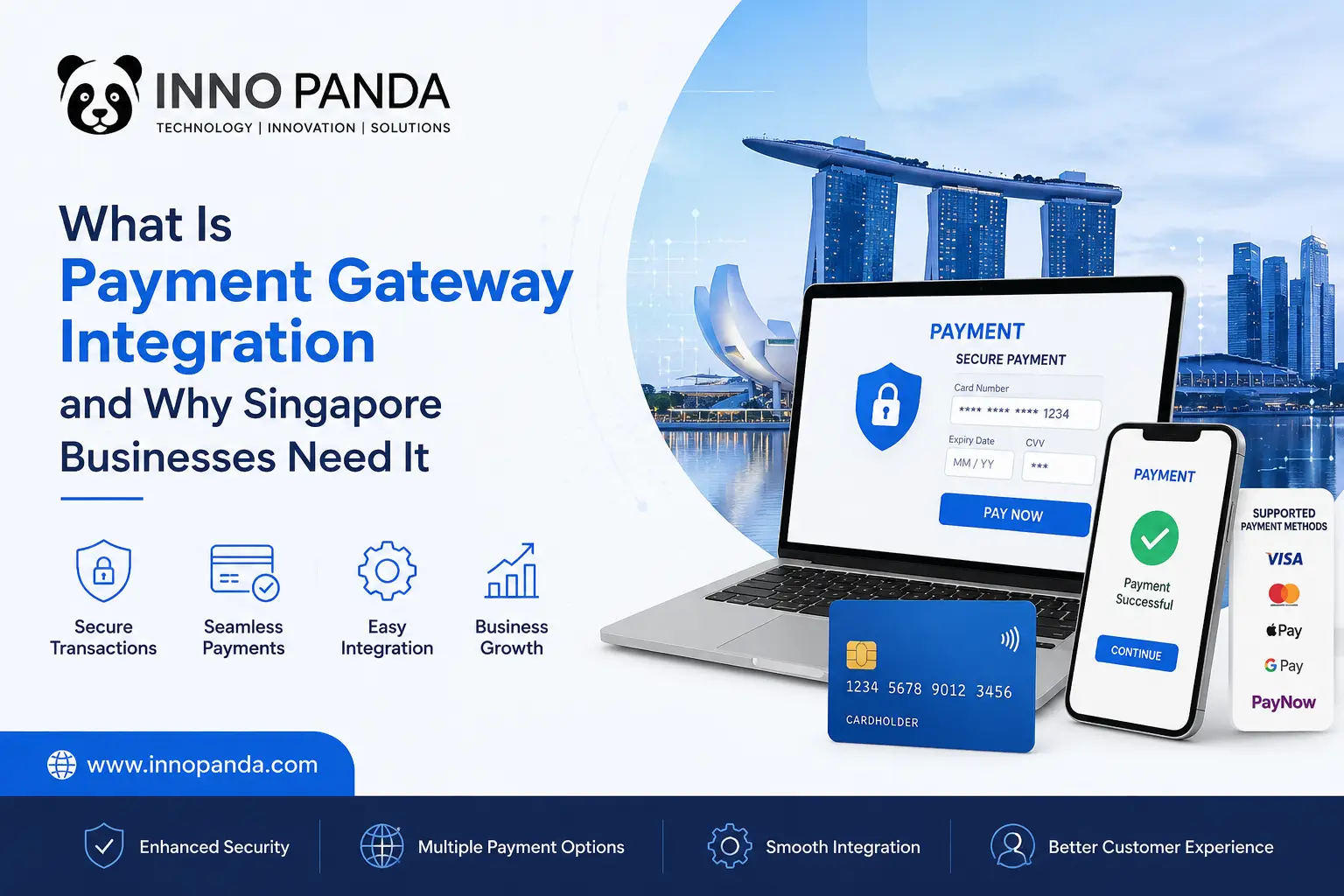
Open any successful Singapore e-commerce store today and you will find at least five ways to pay. PayNow QR. GrabPay. Visa. Atome. Probably Apple Pay too. Behind all of it — quietly handling billions of dollars in transactions every month — is payment gateway integration. It is one of the most business-critical pieces of technology a Singapore company can deploy, and one of the least understood.
Most guides on this topic read like vendor marketing: a list of providers, a fee comparison table, a call to action. This one is different. What follows is a proper explanation of what payment gateway integration actually is, what payment API integration involves at a technical level, how to evaluate payment gateway providers in Singapore honestly, and what compliance requirements your business is responsible for — regardless of which provider you choose.
Singapore's digital payment infrastructure is genuinely world-class. Over 92% of residents use PayNow daily. Transaction fees have hit historic lows. And the combination of MAS licensing requirements and PDPA obligations means the stakes for getting integration right — or wrong — are higher than they have ever been.
What Is Payment Gateway Integration in Singapore? A Plain-Language Explanation
Payment gateway integration in Singapore is the technical process of connecting a payment gateway — the licensed service that authorises, encrypts, and routes payment transactions — to your business's digital infrastructure. That infrastructure might be a website, a mobile app, a POS terminal, a subscription billing system, or an API-driven backend. The integration is what bridges your customer's tap, click, or card swipe to your merchant account.
A payment gateway on its own is just a service that exists somewhere on the internet. Payment gateway integration is the work that makes it usable inside your specific product — configuring it for your business logic, connecting it to your order management system, handling webhooks, managing error states, and presenting a payment experience that your customers actually trust. Done well, it is invisible. Done poorly, it is the thing that makes customers abandon their cart at the final step.
Payment Processing in Singapore: How the Money Actually Moves
Understanding how payment processing in Singapore works end-to-end helps you make better decisions about integration architecture. The journey of a single transaction involves more steps than most people realise — and each step is a place where a poorly implemented integration can fail.
Payment initiation
Your customer selects a payment method — PayNow QR, GrabPay, Visa, Atome — and submits their payment details. If your integration uses hosted payment fields or an embedded SDK (which it should), this data is captured directly inside the gateway's secure environment. Your own servers never see raw card numbers.
Encryption and tokenisation
The gateway encrypts the payment data via TLS and replaces sensitive card details with a token — a randomised reference string that has no usable value outside the gateway's own system. This tokenised request travels to the card network (Visa, Mastercard) or Singapore's FAST rail (PayNow) for authorisation.
The acquiring bank checks funds availability, applies 3DS2 authentication for card transactions, and runs the transaction through fraud scoring models. The gateway receives a real-time approval or decline and passes that response back to your checkout — typically within two to four seconds. This is where misconfigured integrations surface as mysterious failures: a webhook that never fires, a timeout that returns a blank page, a 3DS redirect that loses the session.
Settlement to your merchant account
Approved transactions are batched by the gateway and settled to your merchant account on the provider's settlement cycle. For PayNow transactions with most Singapore gateways, settlement is next business day. Card transactions typically settle in two to three business days. The gateway deducts its transaction fee before remittance — which is why understanding the full fee structure upfront matters.
Payment Gateway Setup in Singapore: The Five Steps Every Business Must Complete
Payment gateway setup in Singapore follows a predictable path regardless of which provider you choose. The timeline varies — a self-service plugin on HitPay can be live in under a day, while a custom payment API integration for an enterprise system can take eight to twelve weeks — but the underlying sequence is consistent.
Payment API Integration and Payment Gateway Development: When You Need a Custom Build
For businesses using off-the-shelf platforms — Shopify, WooCommerce, Wix — plugin-based payment gateway integration is usually sufficient. You install the plugin, enter your API keys, select your payment methods, and you are live. But there is a large and growing category of Singapore businesses where that approach simply does not work: those with custom mobile apps, bespoke web platforms, enterprise backend systems, or checkout flows that require logic that no pre-built plugin can handle.
That is where payment API integration and payment gateway development come in. A payment API integration connects your system directly to the gateway's API layer — giving you full control over what happens at every step of the transaction flow. You control the checkout UI. You control the data that flows through your system. You control the webhook handling, the retry logic, the error messaging, and the reconciliation architecture. That flexibility comes with a cost: higher development time, more surface area for bugs, and an ongoing maintenance responsibility that plugin users do not have.
You need a custom build if you are building a mobile app from scratch, if your checkout flow involves business logic that cannot be expressed as a simple hosted form (subscription tiers, split payments, marketplace payouts, dynamic pricing), if you are integrating payments into an ERP or CRM, or if you need multi-gateway routing — sending transactions to different providers based on payment method, geography, or risk score.
Payment Gateway Development Singapore: What the Build Actually Involves
A proper payment gateway development engagement for a Singapore business typically involves four distinct bodies of work. Each one matters. Skimping on any of them is where hidden costs accumulate.
🔗 API architecture and authentication Core Build
Setting up secure API key management, OAuth flows where required, and webhook endpoint infrastructure. This includes deciding which payment events your system needs to subscribe to — payment.succeeded, payment.failed, refund.created — and building the handlers that keep your own database in sync with the gateway's state.
💳 Checkout UI and UX implementation Core Build
Building the payment form using the gateway's embedded components or hosted fields — never by collecting raw card data in your own input fields. For Singapore businesses this includes PayNow QR generation and display, GrabPay redirect handling, 3DS2 challenge flow management, and mobile-optimised card entry that works reliably across the iOS and Android ecosystems your customers actually use.
🔒 Security and PCI DSS compliance Non-Negotiable
Even when you use hosted fields, your integration architecture must meet PCI DSS requirements — specifically around how you handle tokenised data, how you transmit payment events between your server and the gateway, and how you log and audit transaction activity. A secure online payment gateway is only as secure as the integration built around it.
🧾 Reconciliation and reporting integration Often Missed
The part most development engagements underscope. Building automated reconciliation between your gateway's settlement reports and your accounting system — handling partial refunds, chargebacks, multi-currency settlements, and gateway fee deductions — is often more complex than the checkout build itself. Getting this wrong creates accounting debt that compounds daily.
Payment Gateway Provider Singapore: Honest Comparison for 2026
Choosing a payment gateway provider in Singapore is not just a fee comparison exercise. The right provider depends on your business model, your customer base, your technical resources, and your growth plans. Here is an honest assessment of the major providers — not ranked by who pays for visibility, but by which genuinely serves which type of Singapore business.
| Provider | Card Rate (Local) | PayNow Rate | Monthly Fee | API Quality | Best For |
|---|---|---|---|---|---|
| HitPay | 2.2% + $0.30 | 0.8% + $0.15 | None | Simple / SME-friendly | Singapore SMEs, F&B, retail — local payment breadth |
| Stripe | 3.4% + $0.50 | 0.8% | None | Best-in-class | Custom builds, developer teams, SEA expansion |
| Airwallex | From 1.0% + $0.20 | Contact for rates | None | Good | Cost-sensitive, FX-heavy, SGD $50K+ monthly volume |
| 2C2P | Custom pricing | Supported | Negotiated | Strong (SEA focus) | Multi-market integration across Southeast Asia |
| PayPal | 3.9% + fixed fee | Not native | None | Mature but rigid | International B2B invoicing, cross-border buyers |
| Adyen | Interchange++ model | Supported | Min. invoice | Enterprise-grade | High-volume, omnichannel, enterprise Singapore brands |
The cost most businesses forget to model: A gateway that charges 1.0% per transaction but requires three developers and two months of integration time costs more in year one than a 2.5% gateway that takes a day to set up. Total cost of ownership — fees plus integration cost plus maintenance overhead plus workaround labour — is the number that actually matters.
Singapore Online Payment Solutions: What Digital Payment Solutions Your Customers Actually Expect
Singapore online payment solutions have evolved faster in the past two years than in the preceding decade. What was a differentiator in 2023 is a baseline expectation in 2026. A Singapore business that cannot accept PayNow, GrabPay, and major credit cards in a single seamless checkout is not just missing features — it is losing revenue to competitors who have already solved this.
Understanding which digital payment solutions belong in your checkout — and which are genuinely optional versus commercially essential — is one of the most practical decisions in this guide.
✅ Commercially Essential in Singapore 2026
- PayNow QR — the dominant domestic payment method, used by over 92% of residents. Not supporting PayNow means turning away a large portion of your local market
- Visa and Mastercard — still required for international customers, tourist traffic, and B2B payments
- GrabPay — deeply embedded in Singapore consumer behaviour across food, retail, and services. High adoption particularly among the 18–45 demographic
- BNPL (Atome, Rely) — increasingly expected for retail, fashion, electronics, and higher-value purchases. Checkout conversion lifts of 15–30% reported by merchants who added BNPL
⚡ Situational — Add When Your Audience Needs It
- Alipay / WeChat Pay — essential if your customer base includes Chinese tourists or cross-border buyers. Less relevant for purely domestic Singapore businesses
- Apple Pay / Google Pay — growing adoption, particularly on mobile. Worth adding if your mobile conversion rates are below desktop — it is usually the checkout experience causing the gap
- Bank transfer / direct debit — relevant for B2B and subscription billing, less so for consumer e-commerce
- Multi payment gateway integration — routing transactions across two or more gateways based on method, volume, or geography — justified for high-volume merchants managing cost and redundancy, not for most SMEs starting out
Payment Gateway for Ecommerce Websites in Singapore: Platform-Specific Guidance
The right payment gateway for an ecommerce website in Singapore depends heavily on which platform your store runs on. The integration complexity, available payment methods, and fee structures differ meaningfully between platforms — and a decision that looks identical on paper can have very different operational outcomes.
🛍️ Shopify Payment Gateway Singapore Plugin
Shopify's native payment gateway (Shopify Payments) is not available in Singapore — which means every Singapore Shopify merchant is on a third-party gateway. Stripe and HitPay are the most commonly used, both with official Shopify apps. The critical point: Shopify charges an additional 0.5–2% transaction fee if you use a third-party gateway instead of Shopify Payments. That fee applies on top of the gateway's own rate and changes the fee comparison significantly.
🔧 WooCommerce Payment Gateway Singapore Plugin + Custom
WooCommerce gives Singapore businesses more flexibility than Shopify — official plugins for Stripe, HitPay, PayPal, and Airwallex are all available, and WooCommerce does not add a transaction surcharge for third-party gateways. The trade-off is that WooCommerce plugin integrations require more technical oversight. PayNow reconciliation, webhook reliability under high load, and PDPA consent capture often need additional development work beyond what the base plugin provides.
📱 Custom Mobile App Payment Integration API
Mobile apps require payment API integration rather than plugins. Stripe's iOS and Android SDKs are the most mature in the Singapore market, with comprehensive documentation and a strong local developer community. HitPay offers a simpler API suited to businesses that do not need deep customisation. The key mobile-specific considerations are in-app PayNow QR generation (polling for payment confirmation rather than redirect), GrabPay deep-link handling, and Apple Pay / Google Pay native flows.
🌏 Multi Payment Gateway Integration Singapore Enterprise
Larger Singapore businesses — particularly those expanding across Southeast Asia — sometimes implement multi payment gateway integration: routing different transaction types to different providers. PayNow via HitPay for domestic transactions (lower fees), Stripe for international cards (better fraud tools), 2C2P for cross-border SEA payments. This architecture adds resilience and cost optimisation but requires a proper payment orchestration layer and significantly more integration development effort.
Secure Online Payment Gateway Singapore: PDPA Compliance and What It Actually Requires
A secure online payment gateway in Singapore means two things that are often conflated but are actually distinct: technical security (encryption, tokenisation, PCI DSS) and regulatory compliance (PDPA, MAS). Most conversations about payment security focus on the former and underestimate the latter. For Singapore businesses, both matter — and PDPA creates specific obligations that sit squarely with you, regardless of which gateway you use.
Payment System Integration in Singapore: Getting It Right From the Start
Payment gateway integration is the infrastructure that determines whether your Singapore business collects the revenue it earns. Every failed transaction, every abandoned cart at checkout, every compliance gap in how payment data is handled — these are direct costs, and most of them are preventable with the right integration approach from day one.
The good news is that Singapore's payment gateway provider landscape in 2026 is genuinely excellent. MAS-licensed options cover every business size and use case. Fees have fallen. Integration tooling has matured. And the combination of PayNow's near-zero friction, GrabPay's consumer penetration, and the growing BNPL adoption means there has never been a better time to build a checkout experience that converts.
What separates businesses that get this right from those that do not is not the gateway they choose — most major providers are technically capable. It is the quality of the integration: the webhook reliability, the consent management architecture, the reconciliation automation, the mobile payment flows, and the PDPA compliance posture built in from the start rather than retrofitted after a problem. That is where an experienced Singapore development partner genuinely earns its place in the process.
Frequently Asked Questions: Payment Gateway Integration in Singapore
The questions below reflect what Singapore business owners and developers search for most when researching payment gateway integration — answered directly, without jargon.
What is payment gateway integration in Singapore?
Payment gateway integration in Singapore is the technical process of connecting a licensed payment gateway — the service that authorises and processes customer transactions — to your website, mobile app, or business system. Once integrated, your customers can pay via PayNow, GrabPay, credit cards, BNPL, and other digital payment methods directly within your checkout experience, with funds settling automatically to your merchant account.
The integration can take different forms depending on your platform: a pre-built plugin for Shopify or WooCommerce, an embedded SDK that adds a hosted payment form to a custom website, or a full payment API integration for businesses building custom mobile apps or complex backend payment systems from scratch.
How do I set up a payment gateway in Singapore?
Setting up a payment gateway in Singapore involves five core steps:
- Choose a MAS-licensed provider — HitPay, Stripe, and Airwallex are the most practical starting points for most Singapore businesses
- Apply for a merchant account and complete KYC verification using your ACRA registration and business bank account details
- Choose your integration method — plugin for Shopify or WooCommerce, embedded SDK for custom sites, or full payment API integration for custom apps
- Test every payment method, error state, and webhook flow in sandbox mode before going live
- Launch in production with real-time monitoring on transaction success rates and settlement timing
Most Singapore SMEs using self-service platforms like HitPay or Stripe complete basic setup within one to three business days. Custom payment API integrations take significantly longer — typically four to twelve weeks depending on complexity.
What is the best payment gateway provider in Singapore?
There is no single best payment gateway provider in Singapore — the right choice depends on your business size, technical resources, volume, and customer base. That said, for most situations in 2026:
HitPay is the strongest option for Singapore SMEs that need breadth of local payment methods (PayNow, GrabPay, ShopeePay, Atome) with zero monthly fees and fast self-service setup. Stripe is the best choice for businesses with developer resources, custom checkout requirements, or plans to expand across Southeast Asia. Airwallex offers the most competitive domestic card processing rates and is worth evaluating once your monthly volume exceeds SGD $50,000.
What is payment API integration and when do I need it?
Payment API integration means connecting your website, app, or backend system directly to a payment gateway's API — rather than using a pre-built plugin. It gives you full control over checkout design, business logic, webhook handling, and integration architecture.
You need payment API integration when: you are building a custom mobile app; your checkout requires logic that no plugin can handle (subscription tiers, split payments, marketplace payouts); you need to integrate payments into an ERP or CRM system; or you require multi-gateway routing to send different transaction types to different providers. Plugin integrations cannot support these use cases reliably.
Is payment gateway integration PDPA-compliant in Singapore?
Not automatically. Using a MAS-licensed gateway gives you a regulatory baseline for the payment processing itself, but PDPA compliance for your overall checkout depends on how your specific integration is architectured.
The key requirements are: use hosted payment fields or an embedded SDK so raw card data never touches your servers; confirm your gateway stores data in Singapore or an equivalent jurisdiction; build explicit consent capture into checkout for any marketing use of transaction data; and have a documented data deletion workflow for personal data collected during payment. These are your responsibilities as the data controller — not the gateway provider's.
How much does payment gateway integration cost in Singapore?
Payment gateway integration costs in Singapore vary significantly by integration type. A plugin install on Shopify or WooCommerce costs SGD $0 in development time if you do it yourself, or under SGD $2,000 if you engage a developer. An embedded SDK integration for a custom website typically runs SGD $2,000–$8,000 in development costs. A full custom payment API integration — for a mobile app or complex backend system — typically costs SGD $8,000–$30,000+ depending on scope and complexity.
Transaction fees in Singapore range from 1.0% + SGD $0.20 (Airwallex domestic cards) to 3.9% + a fixed fee (PayPal international transactions). There are no MAS licensing fees for merchants — only for the gateway providers themselves.
What is multi payment gateway integration and does my business need it?
Multi payment gateway integration means routing transactions across two or more payment gateways based on criteria like payment method, transaction value, geography, or provider availability. For example: routing PayNow transactions through HitPay (lower fees), international card transactions through Stripe (better fraud tools), and cross-border SEA transactions through 2C2P.
Most Singapore SMEs do not need multi-gateway integration. The added architectural complexity and maintenance overhead is only justified once you are processing high volumes, operating across multiple Southeast Asian markets, or have specific redundancy requirements where a single provider going down would materially impact your business. If you are asking whether you need it, you probably do not yet — but it is worth designing your initial integration architecture to accommodate it as a future capability.
Need a Payment Gateway Integration That Actually Works for Your Singapore Business?
Whether you need a simple PayNow and GrabPay setup for a new ecommerce store, a custom payment API integration for a mobile app, or a full payment system integration with PDPA-compliant data architecture — the Inno Panda team has built it for Singapore businesses across retail, F&B, fintech, healthcare, and SaaS. We offer a free, no-commitment strategy session where we look at your current setup, recommend the right integration approach, and give you honest timelines and costs. If a plugin solves your problem, we will tell you that. If you need a custom build, we will scope it properly — including EDG grant eligibility if applicable.