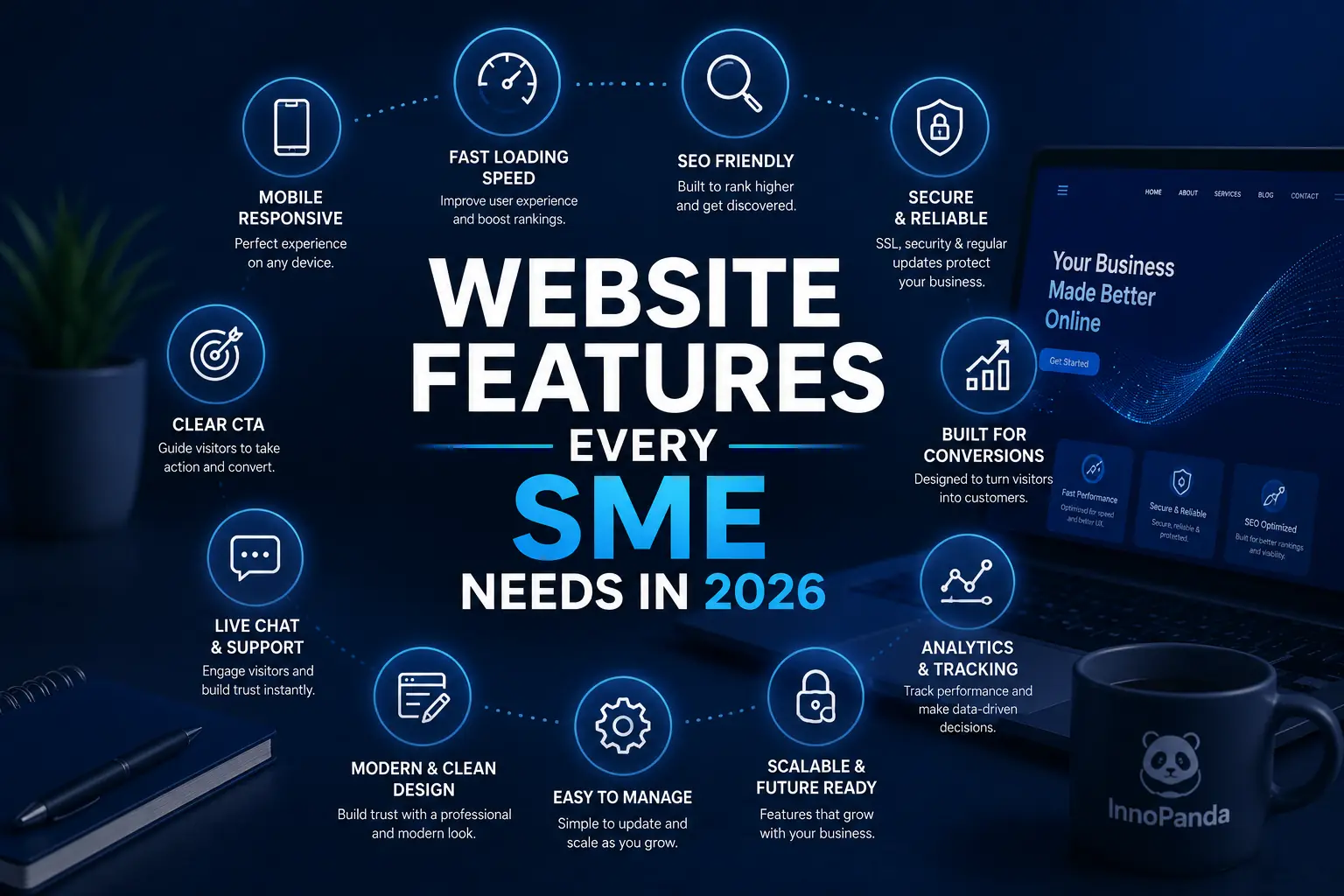
Most small business websites in Singapore are not failing because they look bad. They are failing because they are missing the features that turn visitors into enquiries. This is the complete checklist — every essential website feature your SME needs to compete and convert in 2026.
Why Your Website Is Your Most Important Business Asset in 2026
A website used to be a digital brochure — something you built once, published, and largely forgot about. In 2026, that approach will cost you customers you never even know you are losing. Your website is now the first sales conversation your business has with almost every prospect, often before any human ever speaks to them. It answers questions, builds trust, handles objections, and either convinces someone to reach out or sends them straight to a competitor.
Most Singapore SMEs are not being outcompeted by businesses with bigger budgets. They are being outcompeted by businesses with better-functioning websites. Fix the right features, and you level the playing field immediately. Here is exactly what your SME website needs in 2026 — and why each feature matters more now than it did two years ago.
83%
of consumers research a business online before making first contact — even after a referral
7%
drop in conversions for every one-second delay in page load time across all industries
72%
of Singapore web traffic now comes from mobile devices — up from 58% in 2022
1. Mobile-Friendly Website Design — The Feature Most SMEs Still Get Wrong
More than 72% of web traffic in Singapore comes from mobile devices. If your website is not genuinely optimised for mobile — not just technically "responsive" but genuinely fast and smooth on a phone — you are creating a poor first impression for the majority of people who visit you. And a poor first impression, in most cases, is the only impression you get.
A truly mobile-friendly website for small business means more than a layout that resizes. It means buttons large enough to tap without frustration, forms that work cleanly on a phone keyboard, images that load within two seconds on a 4G connection, and text that is readable without zooming. Google also uses mobile performance as a direct ranking signal — so a poor mobile experience does not just frustrate visitors, it pushes your site down the search results at the same time.
What a Truly Mobile-Optimised SME Website Includes in 2026
📱Core Requirement
Responsive layout that actually works
Every section — navigation, hero, service cards, forms, footers — must reflow cleanly at every screen size. Test on real devices, not just a browser resize tool. The difference is significant.
⚡Core Requirement
Sub-2-second load on mobile
Mobile users are often on 4G or 5G, not broadband. Your pages should load within two seconds. Anything slower and the majority of visitors leave before reading a single word about your business.
👆Core Requirement
Tap-friendly navigation and CTAs
Links and buttons need to be large enough to tap accurately without pinching. A call-to-action that is hard to hit on mobile is a conversion you are losing silently — and it costs nothing to fix.
2. Small Business Website SEO Features — How to Get Found Without Paying for Every Click
SEO is not a separate activity you bolt onto a finished website. It is built into how your site is structured, written, and coded from day one. An SME website without solid SEO foundations is invisible to the customers actively searching for exactly what you offer — and those are the highest-quality leads your business can get.
The good news is that local SEO website features are achievable without a massive budget. You do not need thousands of backlinks to rank for the terms your customers actually use in Singapore. What you do need is a technically clean site with clear page structure, proper meta data, fast loading, and schema markup that tells Google exactly what your business does and where you operate.
Core SEO Features Every Small Business Website Needs
Structured page titles and meta descriptions On-Page SEO
Every page needs a unique, keyword-relevant title tag and meta description. These are what Google displays in search results — they determine whether someone clicks your result or the one below it. Most SME websites have either missing meta descriptions or generic ones that say nothing useful to a searcher.
Schema markup and structured data Technical SEO
Schema markup helps Google understand your business — name, address, services, opening hours — without guessing. For local businesses in Singapore, adding LocalBusiness and Service schema is one of the highest-impact, lowest-effort SEO improvements available. It directly improves how you appear in local search results and Google Maps.
Google Maps-ready local SEO features Local SEO
Near-me searches — "web developer near me", "digital agency Singapore" — are growing every year. Your website supports local SEO when it includes a consistent NAP (Name, Address, Phone number), an embedded map, location-specific landing pages, and content that references the areas you serve.
Page speed and Core Web Vitals Ranking Signal
Google officially uses LCP, CLS, and INP as ranking factors. Businesses with pages that pass these thresholds outrank those that do not — regardless of content quality. If your site is slow, you are paying an invisible SEO penalty every day. Our website optimisation service fixes all three at the source.
💡 Not sure how your site scores on Google's technical signals?
3. Lead Generation and Contact Features That Actually Convert
Attracting traffic to your website is only half the job. The other half is converting that traffic into enquiries, bookings, or sales. Many SME websites are genuinely good at generating clicks — but then the website fails to turn those visits into business. These are the features that close that gap.
Contact Form Best Practices for Small Business Websites
Your contact form is one of the most important pages on your site and almost never receives enough attention. A well-designed SME contact form is short — name, email, phone, and one message field is usually enough. It should confirm submission clearly, send an automatic acknowledgement email to the enquirer, and notify your team immediately. Every day without those basics is leads falling silently into a gap you cannot see.
Small Business Website with Online Booking — Why It Matters
If your business takes appointments — consultations, salon visits, fitness sessions, inspections, demos — an integrated online booking system is one of the highest-ROI features you can add in 2026. A small business website with online booking reduces phone tag, captures enquiries outside office hours, and removes the friction that causes potential clients to give up and try someone else. Businesses that add booking functionality typically see a 20 to 35% increase in appointment volume within the first few months.
How to Add Testimonials to a Small Business Website Effectively
Trust is the invisible currency of every website conversion. Testimonials, reviews, and case studies are the fastest way to build it with someone who has never met you. Do not just drop a text quote block at the bottom of your homepage. Place testimonials on the pages where they do the most conversion work — near service descriptions, beside pricing, and directly above your contact form. A genuine five-star review from a recognisable Singapore business name outperforms any copywriting technique.
💬High ROI Feature
Small business website with live chat
Live chat converts visitors who are not yet ready to fill in a form. It catches the hesitant buyer at the exact moment they are evaluating you — and gives you the chance to answer the question that was about to send them to a competitor. Even a simple chatbot that collects a name and email after hours is worth having.
🎯Conversion Fundamental
Clear, specific calls to action
Every page needs one clear primary action. Not "click here" — something specific: "Get a Quote", "Talk to Our Team", "Start Your Project". Generic CTAs produce generic results. Tell visitors exactly what the next step is and make it impossible to miss on both desktop and mobile.
🏆Trust Building
Trust signals placed throughout
Client logos, years in business, certifications, media mentions, and team photographs all reduce the "who are these people?" hesitation that kills conversions. Distribute these throughout your site — not just on an About page that most visitors never reach.
4. Ecommerce Features for Small Business Websites — Selling Online Without Overcomplicating It
Not every SME needs a full ecommerce store. But if you sell products — even occasionally — having the right ecommerce features for small business websites is the difference between a smooth purchase and a lost sale. The good news is that you do not need to build something complex to sell effectively online in 2026. The core requirements are fewer than most business owners think.
Mobile-optimised checkout with multiple payment options
Cart abandonment on mobile is 20% higher than on desktop — and most of that gap comes from checkout flows that are fiddly to complete on a phone. Your checkout needs to be single-page where possible, offer PayNow, credit card, and buy-now-pay-later options, and autofill address fields. Each extra step adds friction; each friction point costs you sales.
Product pages that sell, not just display
A product page is not a data sheet. It is a sales conversation in writing. Strong SME product pages include multiple high-quality images, benefit-led descriptions (not just specs), real buyer reviews, and an obvious add-to-cart button that does not require scrolling to find. The investment in good product content pays back in conversion rate every week.
Inventory management and fulfilment integration
For businesses selling across multiple channels — Shopify, Lazada, Shopee, and your own website — inventory synchronisation is non-negotiable. Manual stock management causes overselling, refunds, and the kind of customer experience damage that is hard to recover from. Our ecommerce automation service connects all your channels automatically.
20–35%
Average increase in appointment volume after adding online booking to an SME website
8–12%
Conversion rate increase from a one-second improvement in mobile load time (ecommerce)
68%
of cart abandonments on mobile are caused by a slow or complicated checkout flow
5. Technical, Security, and Analytics Features Your SME Cannot Skip
These are the features no visitor ever notices — until they are missing. Technical foundations do not generate excitement the way a redesign does, but everything else on your website depends on them. A beautifully designed site on a shaky technical base is exactly like a great shop in a building with no electricity.
Website Security Features Every Small Business Needs
SSL (HTTPS) is non-negotiable — any site without it is flagged as "Not Secure" by Chrome and penalised by Google. Beyond SSL, SME websites need daily automated backups, a web application firewall, and bot protection. Small businesses are targeted by automated attacks constantly because they are statistically less likely to have proper security configured. A hacked website does not just cost downtime — it costs you search rankings and customer trust, both of which take months to rebuild.
Small Business Website Analytics Setup — Know What Is Working
You cannot improve what you cannot measure. A proper small business website analytics setup means Google Analytics 4 installed and configured, Google Search Console connected, and goal tracking set up for form submissions, phone clicks, and purchase completions. Without this, you are spending money on marketing and genuinely guessing whether it is working. Analytics setup takes less than a day and pays for itself immediately in smarter decisions.
✓
SSL certificate active on all pages: HTTPS is a Google ranking factor and a basic trust signal. Any site still serving HTTP in 2026 is losing rankings and customers simultaneously.
✓
Daily automated backups: A single update or plugin conflict can take your site down. Automated daily backups mean recovery takes minutes, not days — and you never lose content.
✓
Google Analytics 4 + Search Console: The foundation of every smart marketing decision. Without these, you have no reliable data on which pages perform, where visitors come from, or what converts.
✓
Goal tracking for forms, calls, purchases: Traffic data without conversion tracking is vanity data. Set up goals for every meaningful action a visitor can take — form submissions, clicks to call, purchases — so you know what is actually generating business.
✓
XML sitemap submitted to Google: A sitemap tells Google which pages exist and how recently they were updated. Essential for ensuring all your service and product pages are indexed and appearing in search results.
✓
404 error pages with redirects: Broken links kill both user experience and SEO. Every 404 is a visitor who hit a dead end and likely left — and a signal to Google that your site is poorly maintained.
Common mistake we see constantly: Over 60% of SME websites we audit have either no analytics installed, misconfigured tracking, or goals that were never set up after the initial build. Most business owners assume their web developer handled it. Most web developers assume someone else did. Check yours at analytics.google.com right now — before reading the next section.
6. Website Copywriting and Content — The Features That Build Trust and Drive Traffic
The words on your website matter more than most SME owners realise. Good website copywriting for small businesses is not about sounding impressive or using industry jargon. It is about answering the questions your customers actually have, in the order they have them, in language they actually use when they search.
Your homepage should answer three questions in the first ten seconds: What do you do? Who do you do it for? Why should I choose you over everyone else? If a visitor cannot answer those three questions within a single scroll, you are losing them — not to a slow website, but to unclear communication. Every word and every page structure decision is a conversion decision.
Do You Need a Blog on Your Small Business Website?
A blog helps your SEO significantly when maintained consistently — it gives Google fresh content to index, builds topical authority in your industry, and drives organic traffic from informational searches. If you can commit to one quality article per month on topics your customers actually search for, a blog is worth building into your site from day one. If you genuinely cannot commit to that, focus on making your core service pages exceptional first. One outstanding service page consistently outperforms twelve thin, outdated blog posts.
Social Media Integration for Your SME Website
Connecting your Instagram, Facebook, or LinkedIn to your website is not just an aesthetic choice — it keeps your site feeling current and active. A live social feed on your homepage or portfolio page signals to first-time visitors that your business is real and operating. More importantly, it gives new visitors a way to follow you before they are ready to buy — keeping your brand visible until the moment they are.
Website copywriting principles that convert Content Strategy
Lead with what you do, not who you are. Use the language your customers use — not your internal terminology. Every page should have one primary action you want visitors to take. Lead with benefits, follow with features. Short sentences and paragraphs work better on mobile — where the majority of your visitors are reading.
Content features that support long-term SEO SEO Growth
Location-specific landing pages for local search. Service pages with FAQ sections targeting People Also Ask. Case studies and portfolio pages that earn trust and build keyword coverage simultaneously. Testimonials with client names and industries named. Internal links connecting related services, blog content, and product pages.
7. Choosing the Right Platform — WordPress vs Shopify vs Custom Build for Singapore SMEs
The features you need matter — but so does the platform that delivers them. The platform decision affects everything from how fast your site loads to how easily your team can update it to how much your maintenance costs every month. Here is the honest breakdown for SMEs in Singapore in 2026.
Platform
Best For
SEO Capability
Ecommerce
Monthly Cost (est.)
WordPress
Service businesses, blogs, agencies, portfolios
Excellent — full control over all technical SEO
Good with WooCommerce
SGD 30–80 (hosting)
Shopify
Product-based ecommerce businesses
Good — limited control over URL structure
Best-in-class
SGD 45–120/month
Custom Build
SaaS, complex apps, unique workflows
Full control — depends on build quality
Built to spec
SGD 100–500+ (hosting)
Wix / Squarespace
Very small businesses, basic online presence
Limited — restricted technical access
Basic only
SGD 20–50/month
Our recommendation for most Singapore SMEs:
WordPress gives you the best combination of flexibility, SEO capability, and long-term scalability for service and content-driven businesses. Shopify is the right choice if your primary business model is selling products online. Custom builds make sense when you have specific technical requirements that no off-the-shelf platform can accommodate. If you are unsure which fits your situation, talk to our team — we assess your requirements honestly before recommending a direction.
⚠️ Plugin overload on WordPress
Every plugin adds loading time and security risk. Most WordPress SME sites we audit are running 15–20+ plugins — several of which are duplicated or unused. Lean plugins, proper caching, and a quality hosting plan are the difference between a fast WordPress site and a frustratingly slow one.
⚠️ Ignoring site speed post-launch
Performance degrades naturally as you add pages, images, and features over time. A site that loaded in 1.8 seconds at launch can be loading in 4+ seconds eighteen months later without anyone noticing. Schedule a performance review every six months — or use our ongoing optimisation service.
⚠️ Building for aesthetics over conversion
A beautiful website with no clear calls to action, no testimonials near the contact form, and no mobile optimisation is an expensive brochure. Prioritise conversion architecture first — then invest in visual polish on a site that already works.
1
Audit your current website against this checklist
Go through every feature in this guide and mark what your current site has, what it is missing, and what is present but not working properly. Be honest. Most SME website audits reveal 5–8 high-impact gaps that are straightforward to fix. Our website optimisation service covers this as the first step of every engagement.
2
Prioritise by business impact, not technical complexity
Fix the features that cost you the most business first. If you are getting traffic but no enquiries, lead generation and conversion features come before a visual redesign. If you are not getting found at all, SEO foundations and Google indexing come before anything else. Our SEO packages for Singapore businesses are designed around exactly this prioritisation.
3
Decide: optimise what you have, or build fresh
Many slow, poorly converting websites can be fixed without a full rebuild — faster, cheaper, and with less disruption than starting again. Others have structural problems that make targeted fixes impractical. We always assess this honestly before recommending either direction. See our web development service for full builds and our optimisation service for targeted improvements.
4
Connect your website to your full digital strategy
A website that works in isolation still underperforms. Connect it to your SEO strategy, your social media content plan, your lead generation funnels, and your paid campaigns. Every channel you run should flow traffic to a website optimised to convert it. Our lead generation funnel service builds this connection from the ground up.
Website features for small businessSmall business website must havesMobile-friendly website SingaporeLocal SEO website featuresWordPress for small businessWebsite speed optimisation SingaporeSmall business website with live chatOnline booking integrationWebsite analytics setup SMEEcommerce features small business
Frequently Asked Questions — Website Features for Small Business
What should a small business website include?
A small business website should include a clear homepage with a strong value proposition, dedicated service or product pages, an About page, a Contact page with a working form, and trust signals such as testimonials, client logos, and reviews. In 2026, mobile-friendly design, fast page speed, SSL security, and basic on-page SEO are the minimum standard — not optional extras.
Beyond the essentials, features like online booking, live chat, a blog, social proof near CTAs, and a proper analytics setup are the difference between a website that looks credible and one that actively generates business.
How many pages should a small business website have?
Most small businesses need between 5 and 7 core pages to start: Homepage, About, Services (or individual service pages for better SEO), Blog or Resources, and Contact. A Testimonials or Case Studies page adds significant trust value once you have genuine material to fill it with.
More pages are not always better — clarity and quality matter far more than volume when you are starting out. A five-page website that loads in 1.5 seconds and converts 3% of visitors is commercially more valuable than a 30-page website that loads in 5 seconds and converts 0.5%.
Do small businesses need a website in 2026?
Absolutely. Over 83% of consumers now research a business online before making contact — even when they discovered that business through a personal referral or a social media post. Without a website, you are invisible to this majority. No matter how good your product or service is, if people cannot find professional information about your business online, they will default to a competitor who has it.
A professional website in 2026 is not a competitive advantage — it is the baseline expectation your customers have before they will trust you with their money. Instagram, Facebook, or Google Business Profile alone are not substitutes; they are channels that should point back to a website you own and control.
Is WordPress good for small business websites in Singapore?
Yes — WordPress is one of the best platforms for small business websites when set up and maintained properly. It gives you full flexibility over design and functionality, strong SEO capability, and a wide ecosystem of plugins for booking, ecommerce, forms, and lead capture. It powers over 40% of all websites globally for good reason.
The key for SMEs is keeping plugins lean, updating everything regularly, using quality hosting (not budget shared hosting), and having someone manage performance actively. A poorly set-up WordPress site is slow and vulnerable; a well-built one is fast, flexible, and fully capable of scaling with your business. Our WordPress development service builds performance-first sites from day one.
How much does a small business website cost in Singapore?
A professionally designed and built small business website in Singapore typically costs between SGD 2,500 and SGD 8,000 depending on the number of pages, platform, and functionality required. Ecommerce sites with payment integration and product catalogues sit between SGD 5,000 and SGD 15,000. Custom-built applications with unique functionality start from SGD 15,000 and upward.
Most businesses find that a well-built site in the SGD 4,000 to SGD 6,000 range produces a measurable return within the first three months of proper use — particularly when paired with a basic SEO strategy and a properly configured lead generation setup. The cost of not having a well-functioning website is typically far higher than the investment to build one.
Do I need a blog on my small business website?
A blog helps your SEO significantly when it is maintained consistently. It gives Google fresh content to index, builds topical authority in your specific industry, and drives organic traffic from the informational searches your customers make before they are ready to buy. Businesses that publish one quality article per month for twelve months typically see meaningful organic traffic growth by month eight or nine.
If you genuinely cannot commit to at least one quality article per month, focus on making your core service and product pages exceptional first. A strong set of optimised service pages will always outperform a neglected, outdated blog — and a neglected blog can actually signal to Google that your site is not actively maintained.
What is the most important website feature for lead generation?
For most service businesses in Singapore, a well-placed, properly designed contact form is the highest-impact lead generation feature available. Pair it with a clear headline, a brief description of what happens after submission, and at least one nearby testimonial — and your form completion rate will significantly outperform sites that treat their contact page as an afterthought.
For businesses where response speed is a competitive differentiator — law firms, clinics, financial advisers — adding live chat alongside the form captures visitors who are not yet ready to commit to a form submission but are actively evaluating you. The combination of a strong contact form and live chat typically increases enquiry volume by 25–40% compared to a contact page alone.
How do website speed and Core Web Vitals affect Google rankings?
Page speed and Core Web Vitals — specifically Largest Contentful Paint (LCP), Cumulative Layout Shift (CLS), and Interaction to Next Paint (INP) — are confirmed Google ranking signals as part of the Page Experience update. Businesses with pages that pass these thresholds are ranked above those that do not, all other factors being equal.
In practice, this means a slow website is paying an invisible penalty in search rankings every day — regardless of how strong its content or backlink profile is. For most SMEs, fixing Core Web Vitals is one of the fastest routes to visible ranking improvements, because competitors in their space typically have the same unfixed performance issues. Our website optimisation service specifically addresses Core Web Vitals failures with before-and-after data to prove the improvement.
The Websites Winning in 2026 Are Not the Most Beautiful — They Are the Most Functional
Every feature in this guide exists for the same reason: to help your website do its job. The job is not to impress the people who built it. The job is to be found by the right people, communicate what you do clearly and quickly, build enough trust for them to take action, and make that action as easy as possible. That is it. Every decision — design, copy, speed, SEO, analytics — should be measured against how well it serves that purpose.
The good news for Singapore SMEs is that most competitors have not yet applied this thinking consistently to their own websites. The businesses that do — right now, in 2026 — build a compounding advantage that gets harder to close the longer they hold it. At Inno Panda, we build and optimise websites across Singapore with exactly this framework. Whether you want to know what your current site is missing or you are ready to build something that works properly from day one, we are the right team to do it with. See what we have done for our clients — then let us build the same results for you.
Want to Know Which Website Features You Are Missing?
We review SME websites across Singapore every week — checking for the features, performance gaps, and quick wins that make the biggest difference to leads and rankings. Tell us your URL and we will give you a straight, honest assessment of where your site stands and exactly what to prioritise first. No lengthy proposals, no obligation.