Skip to content

    API Integration Before You Lose More Customers in 2026

    Why Legacy API Integrations Are Costing You Customers — And How to Fix It | Inno Panda
    API Development & System Integration 2026 Guide

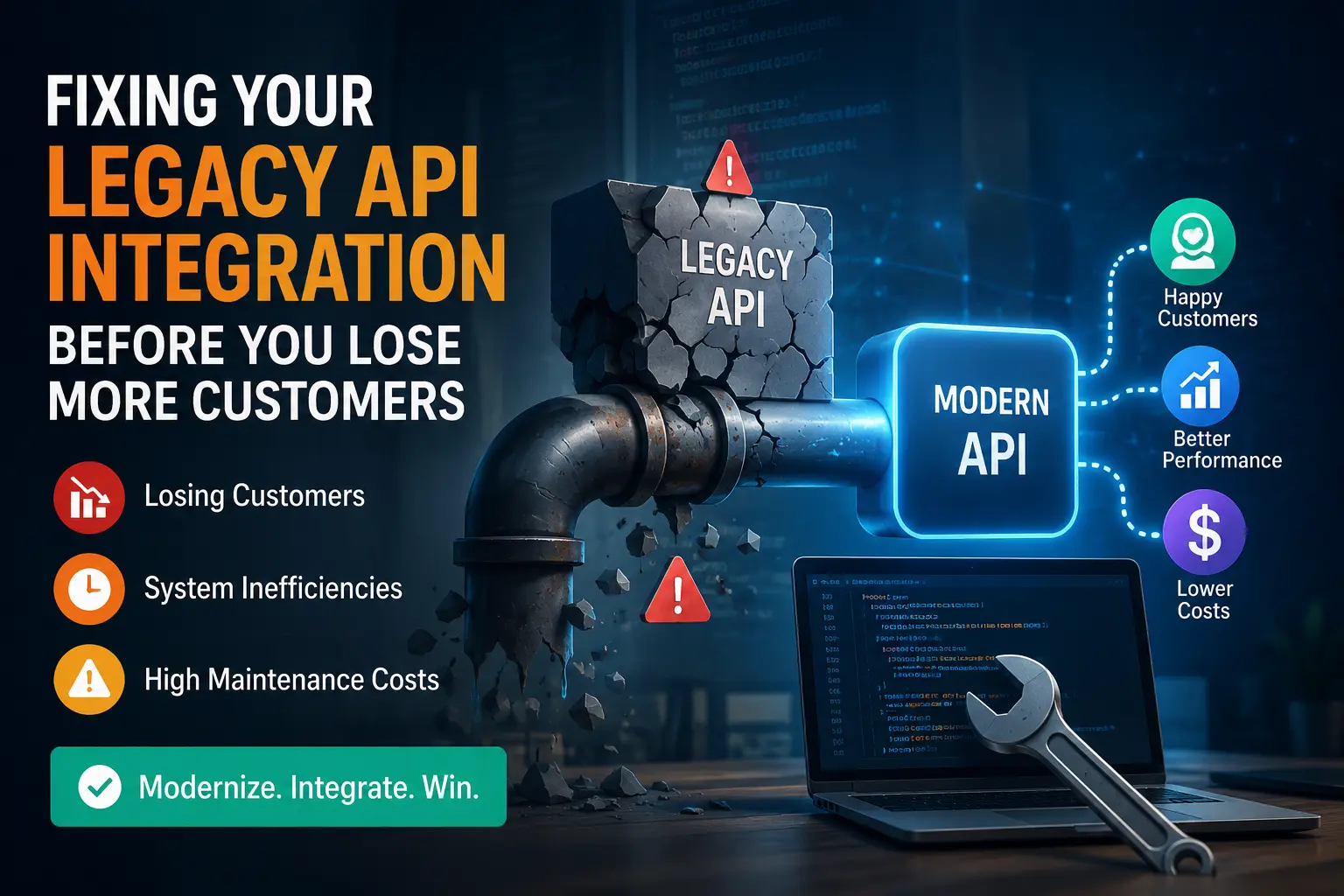
    Fixing Your Legacy API Integration Before You Lose More Customers

    Contents hide

    Your payment gateway just timed out. Your inventory shows a product as in stock across three marketplaces, but your warehouse ran out two days ago. A customer's order status hasn't updated in 48 hours. If any of this sounds familiar, this is not a staffing problem — it is a legacy API integration problem. And it is silently costing you customers, revenue, and reputation every single day.

    Why legacy API integrations are costing you customers and how to fix them — guide for Singapore and Southeast Asia businesses

    Legacy API integrations are outdated data connections between your business software (store, ERP, payment gateway, logistics provider) that fail silently, sync data unreliably, and lack the security and scalability modern operations require. They cost businesses in Singapore, Indonesia, Malaysia, and the Philippines through failed transactions, oversold inventory, slow customer experiences, and compounding manual workarounds. The fix is a phased migration to modern, well-monitored API architecture — typically using the strangler fig pattern to replace old endpoints without any operational downtime. This guide gives you the diagnostic framework, industry-specific context, and implementation roadmap to do exactly that.

    🐼
    Inno Panda Engineering Team
    Custom API Development & System Integration Specialists · Singapore

    This guide is written by the team at Inno Panda, a Singapore-based technology studio specialising in custom API development, system integration, and SaaS infrastructure for businesses across Southeast Asia. We have migrated legacy integration systems for eCommerce brands, logistics operators, SaaS platforms, and healthcare providers across Singapore, Malaysia, Indonesia, and the Philippines. The patterns, cost figures, and failure modes described here are drawn from real projects — not vendor marketing copy.

    83%
    of digital transformation failures in SMEs trace back to poor or outdated integration architecture — not frontend or product issues
    4.2×
    higher customer abandonment rate when checkout or order confirmation fails — even once — compared to a smooth transaction
    SGD 14K
    estimated annual cost of manual workarounds for a 50-order/day business managing broken API connections across 3 systems

    What Is a Legacy API Integration — And Why Does It Fail in 2026?

    A legacy API integration is any connection between two software systems built on outdated protocols, undocumented endpoints, or architectures that lack the error handling, security standards, and monitoring capabilities that modern operations require. The word "legacy" does not mean old — an integration built just three years ago without proper versioning, rate-limit management, or webhook support qualifies as legacy. What matters is whether it was built to handle the scale, security expectations, and platform diversity of your business today.

    Here is the insidious part: legacy API integrations rarely fail catastrophically all at once. They fail gradually and silently. A sync that runs correctly 98% of the time produces thousands of data inconsistencies per month across a multi-channel eCommerce operation. A payment gateway integration that has no retry logic fails 1–2% of valid transactions — transactions your customer attributes to your store, not to a technical failure they cannot see.

    The Anatomy of a Legacy API Failure

    Understanding why legacy integrations fail helps you diagnose what is actually happening in your systems. The failure modes are consistent across industries and geographies:

    No error handling or retry logic. When a request fails, the integration gives up silently. No retry, no alert, no fallback. Data is lost and neither system knows it.
    Polling instead of webhooks. Legacy systems check for updates on a schedule (every 15 minutes, every hour) rather than receiving instant event notifications. Data is always stale.
    Hardcoded credentials. API keys stored directly in code rather than environment variables — a security risk and a maintenance nightmare when keys expire or need rotation.
    No rate limit handling. Under load, requests hit platform rate limits and fail without exponential backoff logic. Spikes in order volume cause integration failures at precisely the wrong moment.
    No versioning or change management. When your vendor updates their API, your integration breaks immediately — with no fallback to a stable version and no warning that a change was coming.
    No monitoring or alerting. There is no visibility into whether the integration is running correctly. Problems surface only when a customer complains — not when they first occur.

    The compound effect: Each of these failure modes is manageable in isolation. The problem is that legacy integrations typically combine three to five of them simultaneously. The result is a system that looks like it is working — until your order volume doubles, a vendor updates their API, or you add a new sales channel. Then the cumulative technical debt surfaces all at once, usually during a promotional period or peak trading moment when the impact is greatest.

    6 Warning Signs Your API Integrations Are Already Hurting Your Business

    Legacy API integration failures do not always look like technical errors. Many of them look like operational problems, customer service problems, or team performance problems. Here is how to identify them accurately.

    1

    Your team has "daily manual fixes" for data mismatches

    If someone on your team manually updates inventory counts across platforms each morning, manually reconciles order data between your store and your ERP, or manually re-sends tracking notifications that "didn't go through" — that is not a workflow. That is a manual workaround for a broken integration. Count the hours. Multiply by your fully loaded staffing cost. That is the minimum annual cost of the problem.

    2

    Customers report payment failures that your gateway shows as successful

    This is a classic symptom of a legacy payment gateway integration with no idempotency key handling — meaning the same payment can appear as both succeeded and failed depending on which system you look at, usually because a network timeout interrupted the confirmation callback. In Singapore and Southeast Asia, where multi-payment gateway setups (Stripe + GrabPay + PayNow) are standard, this creates reconciliation nightmares and customer trust damage.

    3

    Overselling happens even though you check stock regularly

    If you are selling on two or more channels and occasionally fulfil orders for products you do not have, your inventory sync is running on a polling schedule rather than real-time webhooks. There is a window — anywhere from 5 minutes to several hours — between a sale on one channel and the stock update on another. That window is where oversells happen. The longer the polling interval, the more frequently it occurs at scale.

    4

    Integrations work fine normally but break during promotions or traffic spikes

    This is the clearest indicator of missing rate limit handling and no load testing in the original integration. Your 11.11 sale or Harbolnas campaign pushes transaction volume to 10× normal, your payment or inventory API hits rate limits, requests start failing silently, and your operations team is firefighting on the highest-revenue day of your quarter. Legacy integrations are built for average load — not peak load.

    5

    A vendor update broke your integration and you did not know until customers complained

    If your logistics provider, payment gateway, or marketplace updated their API and your connection failed — and you found out from a customer message rather than an automated alert — you have no monitoring, no versioning fallback, and no observability in your integration layer. This is both a technical risk and a customer experience risk.

    6

    Order status updates are delayed by hours rather than seconds

    If your customers receive "order confirmed" notifications 2 to 4 hours after payment — or receive them in a batch once per day — your integration is polling for order status rather than receiving instant webhook notifications. In a market where competitors are delivering real-time order and tracking communication, a delayed confirmation creates unnecessary support volume ("did my order go through?") and reduces customer confidence in your brand.

    Recognising one or more of these warning signs in your operation? Our team audits your current integration architecture, maps the failure points, and gives you a prioritised fix plan — no pressure, no obligation.

    Talk to Our Team →

    Why Inno Panda Is Singapore's Trusted Custom API Development Agency

    There is no shortage of software agencies in Singapore who will write API code. What separates a vendor who delivers a working integration from one who delivers a production-grade system is the depth of experience with the platforms you actually depend on, and the discipline to build integrations that perform reliably at scale — not just on launch day.

    Inno Panda is a Singapore-based custom API development agency that has built and migrated integration systems for eCommerce brands, logistics operators, SaaS platforms, and healthcare providers across Singapore, Malaysia, Indonesia, and the Philippines. Our work includes the SyncingAbout multi-channel inventory platform, payment gateway integrations for fintech clients, and enterprise ERP-to-storefront connections for brands processing thousands of transactions daily.

    🏆 Inno Panda · Singapore API Development

    What Makes Our API Development Different

    We build integrations designed for production reality — not demo environments. Every integration we deliver includes error handling, monitoring, retry logic, rate limit management, and versioning strategy from day one. We also bring direct experience with the Southeast Asian platforms — Shopee, Lazada, TikTok Shop, NinjaVan, GrabPay, PayNow — that generic Western agencies consistently underestimate.

    🔄
    Seamless migration from legacy systems with zero operational downtime

    We use the strangler fig migration pattern as standard — deploying new endpoints in parallel with your existing integration so your operations never stop while the migration happens. Legacy systems are only decommissioned after the new architecture has been validated under full production load. No big-bang cutovers. No "planned maintenance windows" that cost you sales.

    🔒
    Robust security and compliance for sensitive payment gateway integrations

    All payment gateway integrations we build include OAuth 2.0 or JWT authentication, idempotency key handling to prevent duplicate charges, TLS enforcement, and PCI DSS-aligned data handling practices. We integrate across the full Southeast Asian payment stack — Stripe, PayNow, GrabPay, GoPay, GCash, FPX, Maya, Atome — with the reconciliation logic to match transactions accurately across multiple gateways and currencies.

    🏢
    Local, hands-on support for complex enterprise system integrations

    ERP-to-storefront integrations, multi-warehouse order management connections, and custom accounting reconciliation workflows all have context-specific complexity that remote, ticket-based support handles poorly. Our team is Singapore-based and works directly with your operations and finance teams during design, build, and go-live — not through an offshore support queue that responds to issues two days after they surface.

    📐
    Scalable, custom architecture designed to grow with your user base

    We design integration architectures that handle 10× your current transaction volume without requiring rebuilds. That means event-driven architecture with message queuing (not synchronous polling), horizontal scaling capability built in from the first deployment, and monitoring infrastructure that gives you visibility before problems become customer-facing. The cost of building scalability in from the start is a fraction of the cost of retrofitting it under load.

    Our approach to honesty: We will tell you when an off-the-shelf integration tool — Zapier, Make, or a SaaS connector — is the right answer for your stage and scale. Not every integration problem requires custom development. What every integration problem requires is an honest assessment of what will actually work at your volume, on your platforms, with your data requirements. That is what we provide. Start a conversation with our team and we will give you a direct read on your specific situation.

    Which Industries Benefit Most from Modern System Integration Services?

    Legacy API integrations cause damage across every industry that depends on connected software — which in 2026 means virtually every growing business. But certain sectors face disproportionate consequences when integrations fail, because their business models are built on real-time data accuracy and automated fulfilment. These are the five areas where modern system integration services deliver the clearest and most immediate return.

    E-Commerce and Retail Brands Requiring Multi-Channel Inventory Sync APIs

    For a multi-channel retailer selling on Shopify, Lazada, Shopee, and TikTok Shop simultaneously, real-time inventory sync is not a nice-to-have — it is the operational foundation that prevents overselling, marketplace penalties, and the customer trust damage that follows a cancelled order. Legacy inventory integrations running on polling schedules create a window of inconsistency after every sale, where the same unit is technically available on multiple channels until the next sync cycle completes.

    What Multi-Channel Inventory Sync APIs Actually Do

    A modern multi-channel inventory sync API uses webhook-based event architecture — the moment a sale occurs on any channel, an event fires instantly to all connected platforms, reducing available stock in under five seconds. There is no polling window, no inconsistency period, and no manual reconciliation. Combined with a unified order queue and automated label generation, this architecture eliminates the most common operational failure mode for growing eCommerce brands in Southeast Asia. Our SyncingAbout platform and custom API development service both address this requirement.

    Logistics and Delivery Operations Needing Real-Time Tracking Integration

    For logistics providers, last-mile delivery companies, and any business managing fulfilment across multiple courier partners, real-time tracking integration between your OMS (order management system), WMS (warehouse management system), and logistics APIs is the difference between operational visibility and firefighting. Legacy tracking integrations typically provide batch updates — your system learns a parcel has been delivered at the end of the day, not the moment it was scanned at the customer's door.

    The downstream effect is significant: customer support volume spikes because people cannot see their order's current status; dispatch decisions are made on stale data; and SLA reporting is always lagging reality. Modern real-time tracking integration uses webhook event streams from logistics APIs (NinjaVan, J&T Express, Lalamove, Grab Express) that push status updates the instant they occur — feeding your customer notification system and your operations dashboard simultaneously.

    Growing SaaS Platforms Connecting to Third-Party CRM and Accounting Software

    As a SaaS platform grows its user base, the connections between your product and the tools your customers rely on — CRM platforms (Salesforce, HubSpot), accounting software (Xero, QuickBooks), and communication tools (Slack, Intercom) — become critical infrastructure. Legacy integration approaches to these connections — typically basic REST calls with no queue, no retry logic, and no monitoring — fail predictably as user counts and event volumes scale.

    What CRM and Accounting Integration Failure Looks Like at Scale

    When a SaaS platform grows from 200 to 2,000 users, the number of integration events (new user registrations, subscription changes, payment events, feature triggers) grows from hundreds to tens of thousands per day. Legacy integration architectures built for 200 users fail under this load — requests time out, webhooks are dropped, and customer data becomes inconsistent between systems. The fix is event-driven architecture with proper message queuing, idempotency guarantees, and dedicated monitoring — not simply increasing server capacity behind the old approach.

    Healthcare and Telehealth Providers Requiring Secure, Compliant Data Routing

    In healthcare and telehealth, the consequences of legacy API integration failures extend beyond operational inefficiency to patient safety and regulatory compliance. Secure, compliant data routing between EMR systems, appointment scheduling platforms, telehealth video providers, and pharmacy fulfilment systems requires not just technical correctness but data sovereignty compliance, access control auditing, and encryption at rest and in transit — standards that legacy integrations built before PDPA strengthening and regional healthcare data regulations frequently do not meet.

    For telehealth providers operating across Singapore, Malaysia, Indonesia, and the Philippines, this means integration architectures must account for different national data residency requirements, varying consent frameworks, and the security audit trail requirements of healthcare-specific certifications. Building on top of legacy connections that lack these capabilities is an active compliance risk — and one that regulators in the region are increasingly examining.

    Brick-and-Mortar Gyms Automating Memberships with Custom App Integrations

    For gym operators and fitness businesses transitioning from manual membership management to app-based operations, the integration between a member-facing mobile app, payment gateway, access control system, and class scheduling software determines whether the member experience is seamless or broken. Legacy approaches — often a combination of a point-of-sale system, spreadsheet-managed attendance, and a WhatsApp broadcast list for class bookings — create disconnected data silos that make scaling to multiple locations operationally unmanageable.

    Custom app integrations for fitness businesses connect membership status to access control in real time (so a cancelled membership disables gym entry automatically), push class bookings and cancellations to the scheduling system instantly, and trigger automated renewal reminders through the right channels at the right time. Our PT Buddy white-label gym management platform demonstrates exactly what this integrated architecture looks like in production — serving gym operators across Southeast Asia.

    🛒

    eCommerce & Retail

    Real-time multi-channel inventory sync, automated order fulfilment, and unified marketplace management. The operational foundation for multi-channel growth without manual reconciliation.

    🚚

    Logistics & Delivery

    Real-time tracking integration across courier partners, automated dispatch routing, and live operational dashboards. Eliminates the data latency that drives customer support volume.

    💻

    SaaS Platforms

    Scalable event-driven integrations with CRM, accounting, and communication tools. Architectures that handle 10× user growth without rebuilds or integration failures under load.

    🏥

    Healthcare & Telehealth

    Secure, compliant data routing between clinical, scheduling, and payment systems. Built to meet PDPA requirements and healthcare data sovereignty rules across SEA jurisdictions.

    🏋️

    Fitness & Gyms

    Custom app integrations connecting membership, access control, scheduling, and payments. Real-time status sync that makes multi-location management genuinely manageable.

    💰

    Fintech & Payments

    Multi-gateway payment integrations with full reconciliation logic, fraud detection hooks, and multi-currency handling across the full Southeast Asian payment ecosystem.

    How to Fix Legacy API Integrations Without Disrupting Your Operations

    The most common mistake businesses make when approaching API modernisation is treating it like a replatforming project — a high-risk, all-or-nothing migration that requires taking systems offline and hoping everything works when they come back up. This approach is unnecessary, unnecessarily risky, and exactly what causes organisations to delay integration modernisation far longer than they should.

    The professional standard for migration from legacy systems is the strangler fig pattern — a phased, parallel-deployment approach that replaces legacy integration logic incrementally, with a rollback path available at every stage. Here is how it works in practice.

    🔍
    Audit & Map
    Document every integration, dependency, and failure mode
    🏗️
    Build Parallel
    New endpoints deploy alongside legacy — both running
    🔀
    Migrate Traffic
    Route low-risk flows first, validate, then scale
    Validate & Monitor
    Production load testing before full cutover
    🗑️
    Retire Legacy
    Decommission only after 100% traffic validated
    1

    Phase 1 — Integration Audit and Dependency Mapping (Week 1–2)

    Before changing a single line of code, document every integration your business relies on — what systems it connects, what data it transfers, how frequently it runs, and what happens when it fails. Map the failure modes you are currently experiencing back to specific integration components. Identify which integrations are most business-critical (payment processing, inventory sync) versus lower-risk (reporting feeds, marketing automation). This audit becomes the prioritisation framework for everything that follows. Most businesses find they have more undocumented integration dependencies than they realised — and that some "minor" integrations are actually load-bearing infrastructure.

    2

    Phase 2 — Modern Architecture Design and Security Baseline (Week 2–3)

    Design the new integration architecture before building anything. This means defining the authentication model (OAuth 2.0, JWT, or API key management through a secrets vault), event delivery approach (webhooks with delivery confirmation versus polling where webhooks are unavailable), queue and retry strategy (exponential backoff with dead-letter queues for failed events), and the monitoring infrastructure (request logging, error rate alerting, latency tracking). For payment gateway integrations, define the idempotency key strategy to prevent duplicate transaction processing. This design phase prevents the most expensive class of integration errors — the ones caused by architectural decisions that cannot be changed later without a rebuild.

    3

    Phase 3 — Build New Endpoints in Parallel (Week 3–8, depending on scope)

    Deploy new integration endpoints alongside your existing legacy connections — not as replacements, but as parallel systems. Both old and new endpoints are live simultaneously. At this stage, new endpoints handle a small percentage of real traffic (typically 1–5%), while the legacy system continues handling the full load. This allows real-world validation of the new architecture without any risk to your operations. Edge cases that were invisible in testing surface under real production conditions — and they can be addressed while the legacy system remains available as a fallback.

    4

    Phase 4 — Incremental Traffic Migration and Validation

    Gradually route more traffic to the new endpoints — starting with the lowest-criticality integration flows and incrementally migrating toward high-volume and high-value flows as each is validated. At each step, compare error rates, response times, and data accuracy between old and new endpoints. For multi-channel inventory sync, this means validating stock accuracy across all channels during the migration period. For payment integrations, this means reconciling transaction outcomes between old and new endpoints before full cutover. The rollback path is available at every step — if any issue is detected, traffic routes back to the legacy endpoint while the issue is resolved.

    5

    Phase 5 — Full Cutover, Monitoring, and Legacy Retirement

    Once 100% of traffic has been running through the new endpoints for a validation period — typically 7 to 14 days under full production load including any scheduled peak periods — the legacy integration is decommissioned. Monitoring infrastructure continues actively for 30 days post-cutover with escalation paths defined for any anomalies. Documentation is updated to reflect the new architecture. The legacy system's credentials, scheduled tasks, and server resources are cleaned up in a final verification pass. At this point, your integration is running on modern, monitored, scalable architecture — with full visibility into its performance and health.

    ApproachBest ForDowntime RiskTimeline
    Strangler Fig (Parallel Migration)Production systems, payment and inventory integrations, enterprise connectionsZero — rollback available at every stage4–16 weeks
    Big Bang CutoverNon-critical, low-traffic integrations with clear data boundariesHigh — single point of failure, no rollback1–3 weeks
    No-Code Connector (Zapier/Make)Low volume, non-critical workflows, early-stage businessesLow — but performance degrades at volumeDays
    SaaS Platform (e.g. SyncingAbout)Multi-channel inventory sync for SEA marketplacesMinimal — managed platform handles uptime1–2 weeks setup

    API Modernisation Readiness Checklist

    • Integration audit completed: Every integration documented with failure modes, dependencies, and criticality ratings
    • Authentication modernised: OAuth 2.0 or JWT replacing plain API key or basic auth on all customer-facing integrations
    • Webhooks replacing polling: Event-driven delivery for inventory, order, and payment events — no more scheduled sync windows
    • Idempotency keys on payment flows: Every payment request carries a unique key preventing duplicate charges on network retries
    • Rate limit handling: All integrations handle 429 responses gracefully with backoff — no silent failures under load
    • Monitoring and alerting active: Error rate, latency, and throughput alerts with defined escalation paths
    • API versioning strategy defined: Vendor API version pinned with a migration path for future updates

    The Business Case: ROI of API Modernisation for Growing SEA Businesses

    The argument for modernising legacy API integrations is sometimes treated as a purely technical conversation. It is not. It is a financial one — and the numbers are consistently more compelling than most business owners expect when they run them carefully.

    💰

    Recovered Staff Time: SGD 8,000 – SGD 20,000/year

    For a business doing 50+ orders per day across multiple channels, the manual workarounds for broken integrations — daily stock reconciliation, manual tracking re-sends, payment mismatch investigations — typically consume 10 to 20 hours of staff time per week. At Singapore operational staffing costs, that is SGD 8,000 to SGD 20,000 annually in pure operational overhead, on top of the morale cost of your team spending their time on avoidable admin.

    🔁

    Recovered Failed Transactions: 1–3% of Revenue

    A payment gateway integration without proper retry logic and idempotency handling fails 1 to 3% of valid transactions — presenting customers with payment errors for purchases they were prepared to complete. At SGD 500,000 in annual GMV, that is SGD 5,000 to SGD 15,000 in lost revenue from fixable technical failures. Higher GMV businesses see proportionally larger losses — and higher abandonment rates as customers who hit one payment error rarely try again.

    Marketplace Ranking Protection: Immeasurable but Real

    Shopee and Lazada both use seller performance metrics — fulfilment speed, cancellation rate, on-time delivery — in their search and recommendation algorithms. Oversell-driven cancellations from failed inventory sync directly damage these metrics, reducing organic visibility in exactly the marketplace where your prospective customers are searching. The revenue impact of reduced marketplace ranking compounds over months and is difficult to recover.

    📈

    Scalability Without Proportional Headcount Growth

    The most significant business case for modern integration architecture is the one that has not happened yet: your next phase of growth. A well-built integration layer handles 10× your current transaction volume without rebuilds. A legacy layer does not — and the cost of emergency rearchitecting under operational pressure is three to five times higher than building it right the first time.

    🚩 Indicators That Inaction Is Costing You Now

    • Daily manual stock reconciliation across channels
    • Customer support tickets for order status queries you cannot resolve instantly
    • Oversells and cancellations affecting marketplace ratings
    • Finance team reconciliation backlog exceeding 5 days
    • Integration failures during promotional periods
    • Staff time spent on API error investigation weekly

    ✅ What Modern Integration Architecture Delivers

    • Real-time inventory accuracy across all channels — zero manual reconciliation
    • Order status and tracking updates in seconds, not hours or days
    • Zero payment failures from retry or idempotency gaps
    • Finance books current at all times — no reconciliation backlog
    • Integration performance stable under 10× load spikes
    • Full observability — issues caught by monitoring before customers see them

    Want a realistic cost estimate for modernising your specific integration stack? Our team assesses your current architecture, quantifies your manual overhead costs, and gives you a concrete proposal with timeline and ROI projections.

    Start Your Project →

    Systems and Platforms We Integrate With

    Our custom API development and system integration work covers the full platform ecosystem used by businesses across Singapore, Malaysia, Indonesia, and the Philippines — including the regional marketplaces, payment gateways, and logistics providers that Western-focused integration vendors routinely underserve.

    eCommerce & Store Platforms

    Shopify WooCommerce Magento BigCommerce Custom Storefronts

    Southeast Asian Marketplaces

    Shopee Lazada TikTok Shop Tokopedia Zalora Qoo10 Bukalapak Carousell

    Payment Gateways

    Stripe PayNow GrabPay GoPay GCash Maya OVO FPX Atome PayPal

    Logistics & Fulfilment

    NinjaVan J&T Express Lalamove Singpost Grab Express DHL Pos Laju JNE

    CRM, ERP & Accounting

    Salesforce HubSpot Xero QuickBooks SAP Autocount Accurate Zoho CRM

    Frequently Asked Questions About Legacy API Integrations

    These are the questions we hear most from founders, operations leads, and CTOs across Singapore, Malaysia, Indonesia, and the Philippines when they start assessing their integration infrastructure.

    What is a legacy API integration and how do I know if I have one?

    A legacy API integration is any connection between two business systems built on outdated protocols, undocumented endpoints, or architectures lacking modern error handling, security standards, and monitoring capabilities. The tell-tale signs: your team performs daily manual fixes for data mismatches between systems; your integrations fail intermittently without sending any alerts; your payment confirmations are sometimes delayed or lost; your inventory sync runs on a schedule rather than in real time.

    In Southeast Asia, the most common legacy integrations we encounter are: SOAP-based ERP connections from implementations five or more years old; basic REST integrations with no retry logic or webhook support; payment gateway connections built without idempotency key handling; and inventory sync systems running on 15-minute polling cycles rather than event-driven webhooks. If any of these describe your setup, your integrations are costing you operationally — and will cost you more as your business grows. Talk to our team for an assessment of your specific situation.

    How much does it cost to modernise legacy API integrations in Singapore?

    For most SMEs in Singapore, Malaysia, Indonesia, and the Philippines, professional API modernisation costs SGD 8,000 to SGD 45,000 depending on the number of integrations, complexity of data flows, and whether incremental migration or a full rebuild is required. A single high-priority integration (a broken payment gateway or inventory sync) typically costs SGD 3,000 to SGD 12,000 to properly rebuild.

    The more useful framing is what inaction costs. For a business doing 50+ orders per day across multiple channels, manual workarounds for broken integrations typically represent SGD 8,000 to SGD 20,000 annually in staff time alone — before accounting for failed transaction revenue, oversell-driven marketplace penalties, and the cost of emergency fixes when a legacy integration fails at peak trading. Most businesses recover their modernisation investment within 12 to 18 months through operational savings and recovered revenue. Ask our team for an estimate specific to your integration stack.

    How long does it take to migrate from legacy systems without downtime?

    Using the strangler fig migration pattern — where new API endpoints run in parallel with legacy ones until traffic is fully validated — most integrations can be modernised in 4 to 12 weeks without any operational downtime. A single integration typically takes 2 to 4 weeks. Complex multi-system migrations involving ERP, payment gateway, logistics, and CRM connections simultaneously take 8 to 16 weeks using a phased approach.

    The key principle is never decommissioning a legacy endpoint until the new one has been validated under real production load — not just test environments. This guarantees that if any issue surfaces during the migration, traffic can route back to the legacy system while the problem is resolved. Inno Panda uses this pattern as standard for all migration from legacy systems projects across Singapore and Southeast Asia.

    What is the difference between a legacy SOAP API and a modern REST API?

    SOAP (Simple Object Access Protocol) is an older, XML-based messaging standard that was dominant in enterprise integrations from the late 1990s through early 2010s. SOAP messages are verbose, structurally rigid, and require WSDL (Web Services Description Language) schema files to interpret — making them slow to build against and difficult to debug. REST APIs use lightweight JSON payloads, are stateless, and use standard HTTP verbs — they are faster, more readable, and directly supported by every modern development tool and framework.

    For businesses in Singapore and Southeast Asia integrating with Shopee, Lazada, Stripe, NinjaVan, or any modern SaaS platform, every current API is REST-based. If your ERP or legacy business system still exposes SOAP endpoints, you are building every new integration against a standard that no modern platform speaks natively — adding translation overhead, increasing failure risk, and working against every technology investment you make in your stack. Our API development service handles SOAP-to-REST migration as a specific service offering.

    Can I fix a broken API integration without disrupting my current operations?

    Yes — and this is the professional standard for any well-executed API migration. The strangler fig pattern deploys new integration logic in parallel with your existing setup so both run simultaneously. Traffic routes gradually from the legacy to the modern endpoint, with validation at each stage. The legacy system remains fully operational and available as a fallback throughout the entire migration process.

    This means there is no maintenance window, no "planned downtime," and no operational disruption for your team or your customers. The only moment where a legacy system is turned off is after the new endpoint has been running at 100% traffic volume, under full production load, for a validation period — typically 7 to 14 days. Inno Panda applies this approach to every legacy API migration we undertake. Get in touch to discuss your specific integration challenge.

    Which businesses in Singapore and Southeast Asia need modern system integration services most urgently?

    The businesses where legacy API integrations cause the most acute damage are those where real-time data accuracy is directly tied to revenue and customer trust. Multi-channel eCommerce retailers where inventory sync failures cause overselling and marketplace penalties; logistics and delivery companies where tracking data latency creates customer support volume; SaaS platforms with growing user bases where third-party CRM and accounting connections break under load; healthcare and telehealth providers where data routing errors carry compliance risk; and fitness businesses where fragmented membership and payment systems prevent scalable multi-location operations.

    In all these cases, the cost of inaction compounds as transaction volume grows — making the business case for modernisation stronger, not weaker, as the business scales. Our system integration services cover all these verticals with direct platform experience across Southeast Asian marketplaces, payment providers, and logistics networks.

    What security risks come with legacy API integrations?

    Legacy API integrations present three primary security risks that are particularly relevant for businesses handling payment data and personal customer information. First, outdated authentication — many legacy APIs use API keys passed as plain URL parameters or HTTP basic auth, rather than OAuth 2.0 or JWT token-based authentication, making credentials vulnerable to interception and difficult to rotate when compromised. Second, missing input validation — legacy endpoints often lack protection against injection attacks, data scraping, and abuse patterns that modern security standards address. Third, unencrypted data in transit — older integrations sometimes transmit sensitive customer and transaction data without enforced TLS, particularly over internal network segments.

    For businesses operating payment gateway integrations or handling personal health or financial data in Singapore and the region, these vulnerabilities represent both customer trust exposure and regulatory compliance risk under PDPA and sector-specific data regulations. Modernising your integration architecture is not optional from a security standpoint — it is increasingly a compliance requirement. Our API development team builds all integrations to modern authentication and encryption standards from the ground up.

    What is the strangler fig pattern for API migration?

    The strangler fig pattern is a software migration methodology where new functionality is built alongside the existing system rather than replacing it in a single high-risk cutover. The name comes from the strangler fig tree, which grows around an existing tree, gradually replacing it as the host decays — the host tree is never abruptly removed, it is incrementally replaced over time.

    In API migration, this means deploying modernised endpoints that run in parallel with legacy ones. Traffic routes incrementally — starting with low-risk, low-volume requests and progressively moving toward high-volume and high-criticality flows as each is validated in production. The legacy system is only decommissioned once the new endpoints have been confirmed stable under full production load. This approach eliminates the "big bang" migration risk — the scenario where a hard cutover fails and there is no rollback path available. Inno Panda applies the strangler fig pattern as standard across all legacy API migration projects. Talk to our team about applying this approach to your integration stack.

    How do I choose the right custom API development agency in Singapore?

    Four criteria separate agencies that deliver production-grade integration work from those that deliver demo-quality code: firstly, direct experience with the platforms you actually use — a Singapore-based API development agency should understand Shopee, Lazada, PayNow, GrabPay, NinjaVan, and regional ERP systems natively, not in theory. Secondly, a documented migration methodology — any credible agency should have a clear approach to zero-downtime migration that does not require taking your systems offline. Thirdly, post-go-live monitoring commitments — integrations fail after launch, often in ways not visible during UAT, and the agency should have a defined approach to production monitoring and incident response. Fourthly, honesty about build versus buy — a trustworthy agency tells you when a no-code connector or SaaS platform is the right answer, rather than defaulting to custom development for every problem.

    Inno Panda is a Singapore-based custom API development agency with direct experience across Southeast Asian platforms and a consistent approach to zero-downtime migration. We also operate SyncingAbout — our own multi-channel inventory platform — which means we understand eCommerce integration requirements from the product side as well as the engineering side. Get in touch and we will give you a direct assessment of what your specific integration situation actually requires.

    The Bottom Line: Your Legacy Integrations Are a Ticking Cost — Not a Technical Curiosity

    Every business in Singapore and Southeast Asia running on legacy API connections is managing a compound problem. The manual workarounds get heavier. The failure rate climbs as volume grows. The security exposure widens as your data footprint expands. And the cost of fixing it all at once — under operational pressure — rises with every month of inaction.

    The businesses that compete effectively over the next two to three years in this region will be the ones whose systems are connected, accurate, and reliable — where an order placed at 2am is fulfilled the same way as one placed at 2pm, where stock is accurate across all channels without anyone manually checking, and where customers receive instant, correct information without a support ticket being raised.

    That infrastructure is not complicated to build — but it has to be built properly, with the right architecture, the right platform knowledge, and a migration methodology that protects your operations throughout. Whether you need a single integration fixed, a full legacy system migration, or the multi-channel inventory infrastructure that SyncingAbout provides — the starting point is an honest assessment of what is actually happening in your systems right now.

    Related reading from Inno Panda: If your legacy integration challenges involve multi-channel inventory management specifically, read our complete guide — How to Automate eCommerce Operations in 2026 — which covers the full automation stack for growing online stores across Singapore and Southeast Asia.

    Ready to Replace Legacy API Integrations With Systems That Actually Scale?

    Our team audits your current integration architecture, identifies every failure point and manual workaround costing you time and revenue, and gives you a prioritised modernisation roadmap with realistic cost and timeline estimates. We use zero-downtime migration methodology as standard — your operations keep running throughout. Whether you need a single integration rebuilt, a full legacy system migration, or a multi-channel inventory platform, we give you an honest assessment of the right solution for your stage.