Skip to content

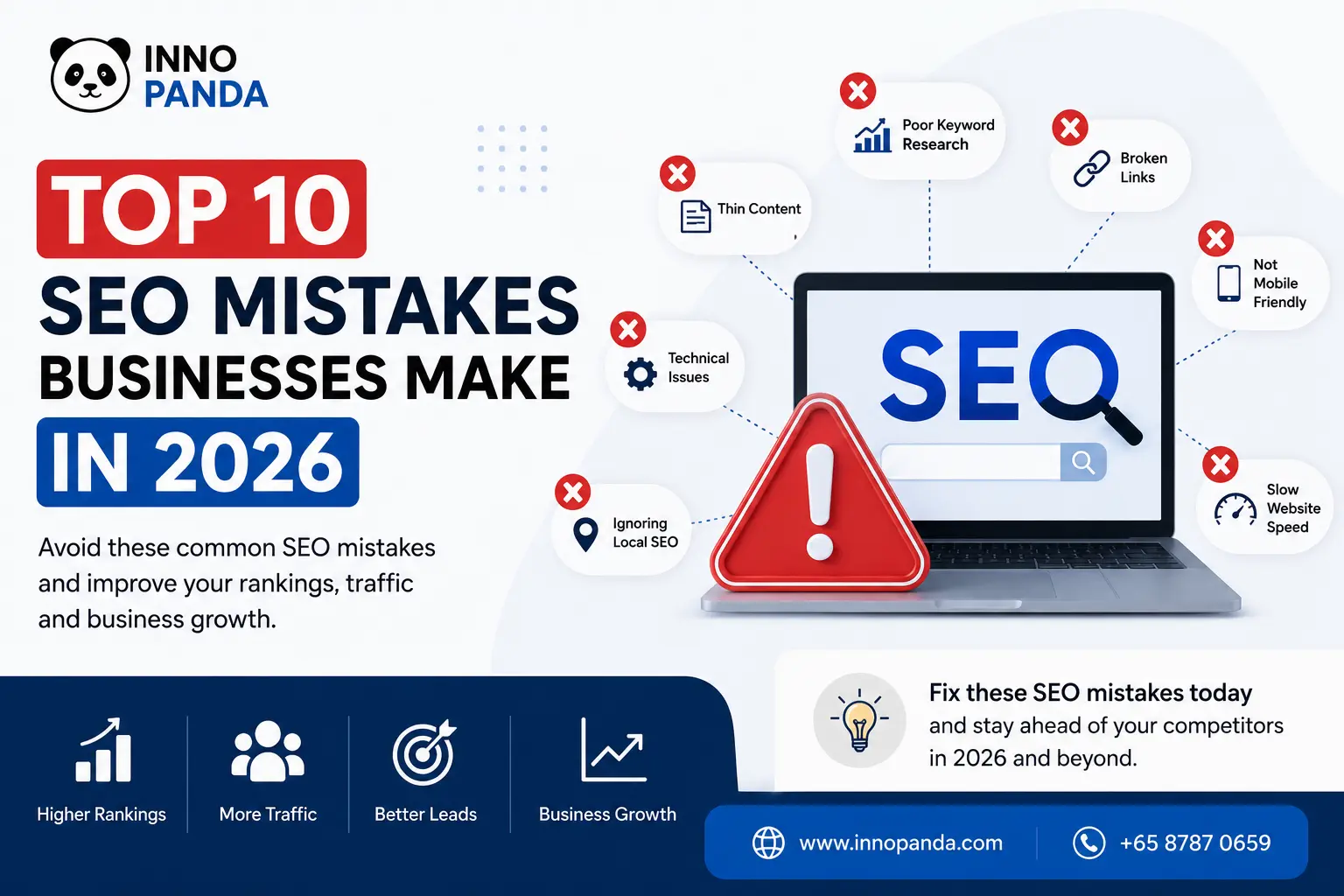
    Top 10 SEO Mistakes Businesses Make in 2026

    Top 10 SEO Mistakes Businesses Make in 2026 (And How to Fix Them) | Inno Panda
    SEO Strategy Guide 2026

    Top 10 SEO Mistakes Businesses Make in 2026 — And How to Fix Every Single One

    Contents hide

    Your competitors are getting the leads your website should be generating. The reason almost always comes down to the same avoidable SEO mistakes — and this guide covers all ten of them with clear, actionable fixes for businesses across Singapore, Malaysia, Indonesia, and the Philippines.

    Top 10 SEO Mistakes Businesses Make in 2026 — Inno Panda Singapore

    Here is something that surprises most business owners: you can have a genuinely great product, a professionally designed website, and an active social media presence — and still get almost no traffic from Google. The problem is not your business. The problem is SEO mistakes that are quietly killing your rankings, one algorithm update at a time.

    In 2026, SEO is more important than ever. Google processes over 8.5 billion searches every day, and AI-powered search is changing the rules around what good content looks like and how results are ranked. Businesses in Singapore, Malaysia, Indonesia, and the Philippines are competing harder for top-of-page visibility — and the gap between businesses that get SEO right and those that get it wrong is growing wider every month.

    This guide breaks down the ten most common SEO mistakes businesses make in 2026 — with a clear explanation of why each one hurts your rankings, and practical fixes you can act on immediately. Whether you are a startup founder, an SME owner, or a marketer responsible for your company's digital presence, this guide is written specifically for you.

    68%
    of all online experiences begin with a search engine — your SEO strategy is your first impression
    75%
    of users never scroll past the first page of Google results — if you are not on page one, you are effectively invisible
    53%
    of all website traffic globally comes from organic search — making SEO the highest-ROI digital marketing channel available

    Why SEO Still Matters More Than Ever in 2026

    There is a recurring myth that SEO is dying — usually spread by people who have not looked at their Google Analytics data recently. The reality is exactly the opposite. Organic search continues to be the single largest driver of website traffic globally, and in markets like Singapore, Malaysia, Indonesia, and the Philippines, the percentage of purchase decisions that begin with a Google search is still growing year-on-year.

    What has changed in 2026 is how Google ranks content. Three major shifts define the current SEO landscape:

    AI-powered search results — Google's Search Generative Experience (SGE) and AI Overviews now surface direct answers at the top of results. To appear in these results, your content needs genuine depth, authority, and E-E-A-T signals — not just keyword density.
    Frequent algorithm updates — Google rolled out multiple major core updates in 2025–2026 targeting low-quality AI content, unhelpful pages, and sites with poor user experience. Businesses that were coasting on old SEO are being hit hardest.
    Local SEO importance — "Near me" searches have grown by over 150% in the past three years. For businesses in Singapore, KL, Jakarta, and Manila, local SEO is not optional — it is your most direct route to foot traffic and local leads.
    Organic traffic quality — Visitors from organic search still convert at higher rates than paid traffic in most industries, because they are actively searching for what you offer. SEO is not just about traffic volume — it is about qualified intent.

    The takeaway: A solid SEO strategy in 2026 is not about gaming algorithms — it is about building a website that genuinely serves your audience, loads fast, answers real questions, and earns trust from both Google and real users. The ten mistakes below are what stand between most businesses and that goal.

    1

    Ignoring Technical SEO — The Foundation That Everything Else Depends On

    🔴 HIGH IMPACT — Affects all pages and all rankings

    Technical SEO is the infrastructure of your website — the behind-the-scenes elements that determine whether Google can even find, crawl, and index your pages properly. You can have the most brilliantly written content in your industry, but if your site is slow, broken, or inaccessible to search engine crawlers, none of it will rank.

    Common Technical SEO Mistakes Affecting Traffic in 2026

    The most frequent technical SEO mistakes we see when auditing client websites include page load speeds that fail Core Web Vitals benchmarks (particularly Largest Contentful Paint above 2.5 seconds), broken internal and external links returning 404 errors, pages blocked from crawling by incorrect robots.txt or noindex tags, missing XML sitemaps or sitemaps containing error pages, and duplicate content across HTTP and HTTPS versions of the same URL.

    Core Web Vitals: Google measures LCP (load speed), CLS (layout stability), and INP (interactivity). Pages that fail these benchmarks rank below pages that pass them — full stop.
    Crawl errors: If Google's bots cannot access your pages, those pages cannot rank. Check Google Search Console regularly for coverage errors and fix them immediately.
    Broken links: Every broken link on your site is a dead end for both users and crawlers. A site with hundreds of 404 errors signals low maintenance quality to Google's quality systems.
    Indexing issues: Pages that are not indexed are invisible to Google. Duplicate canonicals, orphaned pages, and incorrect sitemap submissions are the most common culprits.

    ✅ Quick Win: Run your site through Google Search Console's URL Inspection tool and PageSpeed Insights (pagespeed.web.dev) right now. Both are free, and the issues they surface are the highest-priority technical fixes you can make this week.

    2

    Poor Keyword Research — Targeting the Wrong Terms for the Wrong Reasons

    🔴 HIGH IMPACT — Misdirects all content and traffic strategy

    Bad keyword research is one of the most expensive SEO mistakes businesses make — not because it costs money directly, but because it costs months of content effort pointed in entirely the wrong direction. Ranking on page one for a keyword nobody searches, or a keyword whose searchers never buy anything, is worse than not ranking at all. It gives you false confidence while your actual target customers are finding competitors.

    The Search Intent Problem Most Businesses Miss

    In 2026, Google's ability to understand search intent — what a user actually wants when they type a query — has become exceptionally sophisticated. A business that optimises a product page for an informational keyword ("what is CRM software") will consistently lose to a competitor who correctly targets a transactional keyword ("best CRM for small businesses Singapore") with a page designed to convert that intent.

    Keyword stuffing ❌ Low-intent keywords ❌ Ignoring search volume ❌ Semantic SEO ✓ NLP keywords ✓ Buyer-intent targeting ✓ Search intent matching ✓

    How to Approach Keyword Research Correctly in 2026

    Start by mapping your keywords to buyer intent stages: awareness, consideration, and decision. Each stage requires different content and different landing pages. Use tools like Google Keyword Planner, Ahrefs, or SEMrush to identify search volume and keyword difficulty — but do not chase volume alone. A keyword with 200 monthly searches and high buyer intent will often outperform a keyword with 10,000 monthly searches from users who are only researching.

    Semantic SEO — building topical authority around a subject area rather than targeting isolated keywords — is what consistently outperforms keyword-by-keyword optimisation in 2026. Create content clusters around your core services and let Google understand that your website is a genuine authority on that topic, not just a page that mentions a keyword several times.

    ✅ Quick Win: Before writing any piece of content, search for your target keyword in Google's Incognito mode and look at the top 5 results. What type of content ranks? What questions does it answer? What format does it use? That tells you exactly what Google considers the best match for that search intent — and your content should do all of that, and more.

    3

    Not Optimising for Local SEO — The Most Direct Route to Regional Customers

    🔴 HIGH IMPACT — Critical for businesses serving Singapore, Malaysia, Indonesia & Philippines

    If your business serves customers in a specific city or country — and the vast majority of SMEs and startups in Southeast Asia do — then local SEO is not a secondary consideration. It is your primary battleground. Local SEO determines whether your business appears when someone in Singapore searches for "web development company near me" or a restaurant owner in Kuala Lumpur searches for "POS software for restaurants KL."

    Local SEO Mistakes for Small Businesses That Are Costing You Customers Right Now

    Unclaimed or unoptimised Google Business Profile: This is the single most impactful local SEO asset available — and a shocking number of businesses have either not claimed it or left it incomplete. A fully optimised profile with accurate hours, photos, services, and regular posts dramatically increases your local pack visibility.
    Missing local citations: Consistent Name, Address, and Phone Number (NAP) information across directories like Yelp, Yellow Pages, and local business directories builds local authority signals. Inconsistent NAP information actively harms your local rankings.
    No review strategy: Google reviews are a direct local ranking factor. Businesses with more frequent, higher-rated reviews consistently outrank competitors in the local pack. Ask happy customers to leave a Google review — it is the fastest return on effort in local SEO.
    No location-specific content: Generic website copy that never mentions your city or region misses the opportunity to rank for local keywords. Create dedicated location pages for each market you serve, with content that addresses local context, local customers, and local competitors.
    Local SEO Singapore Google Business optimisation Local citations Malaysia NAP consistency Location pages Philippines Local keywords Indonesia

    Our SEO services at Inno Panda include full local SEO setup and management — from Google Business Profile optimisation to local citation building and review generation strategies — for businesses across Singapore, Malaysia, Indonesia, and the Philippines.

    4

    Thin or AI-Looking Content — Why Generic Pages Are Getting Penalised in 2026

    🔴 HIGH IMPACT — Directly targeted by Google's Helpful Content system

    The content problem on the web in 2026 is not a shortage of words — it is a shortage of genuine insight. AI writing tools have made it trivially easy to produce thousands of words on any topic in minutes. The result is that Google's search index is flooded with content that sounds plausible, covers the obvious points, and adds absolutely nothing to the existing body of knowledge on a subject.

    What Google's Helpful Content System Actually Penalises

    Google's Helpful Content updates have been explicit about what they target: content written primarily for search engines rather than for people. This includes content that covers a topic at surface level without any unique insight, pages that aggregate information available elsewhere without synthesis or perspective, and content that shows no evidence of first-hand experience or genuine subject matter expertise.

    Building E-E-A-T Signals That Google Rewards

    E-E-A-T — Experience, Expertise, Authoritativeness, and Trustworthiness — is the framework Google uses to evaluate content quality at scale. Building it is not about ticking boxes in a checklist. It is about demonstrating, through every piece of content you publish, that real people with genuine knowledge wrote it, that you have direct experience with the subjects you cover, and that other credible sources recognise your authority.

    Author credentials: Add author bio pages with verifiable credentials. Content attributed to a named expert with a LinkedIn profile and industry background outperforms anonymous content every time.
    First-hand case studies: Replace generic examples with real project stories, actual client results, and lessons learned from your own experience. This is the content that AI tools cannot generate — and that Google increasingly rewards.
    Original research and data: Commission a survey, analyse your own data, or publish original insights from your industry experience. Unique data attracts backlinks naturally and positions your brand as an authority.
    Depth over volume: One comprehensive, well-researched 3,000-word article that fully addresses a topic will consistently outperform ten 300-word pages that skim the surface. Quality concentration beats quantity distribution.

    ⚠️ Important: Using AI to write content is not inherently wrong — but publishing AI-generated content without human editing, fact-checking, and enrichment with real expertise is. Google's algorithms are now sophisticated enough to recognise content patterns that indicate low human involvement, and the penalties for sites that rely on this approach are significant.

    5

    Ignoring Mobile Optimisation — A Non-Negotiable in Southeast Asia

    🔴 HIGH IMPACT — Google ranks the mobile version of your site first

    Mobile-first indexing is not a future consideration — it has been Google's default since 2021. This means Google crawls and indexes your website based on its mobile version, not its desktop version. If your mobile experience is broken, slow, or difficult to navigate, your rankings suffer across all devices — including desktop searches from office computers.

    This is especially critical in Southeast Asia, where mobile internet penetration exceeds desktop in every major market. In Indonesia and the Philippines, over 90% of internet users primarily access the web via mobile. If your website provides a poor mobile experience, you are effectively turning away the majority of your potential audience before they have read a single word about your business.

    Mobile SEO Issues That Are Quietly Destroying Your Rankings

    Non-responsive design: Pages that do not adapt to different screen sizes force users to pinch-and-zoom, increasing bounce rate and telling Google that your site provides a poor user experience.
    Touch targets too small: Buttons and links that are too small to tap accurately on a mobile screen frustrate users and reduce time-on-site — both signals that Google uses to evaluate page quality.
    Interstitial pop-ups: Large pop-ups that cover content on mobile pages are specifically penalised by Google. If your site shows aggressive pop-ups on mobile, your mobile rankings are paying the price.
    Slow mobile load times: Mobile networks are slower than desktop broadband. Images that are not compressed and optimised for mobile, or scripts that are not deferred, create page load times that drive users away within three seconds.

    Our mobile development team at Inno Panda builds mobile-first products and websites from the ground up — and our SEO team ensures that every site we work with passes Google's Mobile-Friendly Test and Core Web Vitals benchmarks on mobile before it goes live.

    6

    Weak Internal Linking — The Invisible SEO Lever Most Businesses Never Pull

    🟡 MEDIUM-HIGH IMPACT — Critical for topical authority and crawl efficiency

    Internal linking is one of the most underrated SEO techniques available — and one of the most commonly neglected. Every internal link you create between pages on your website does two things: it helps Google understand the structure and hierarchy of your content, and it passes link equity from high-authority pages to the pages that need a ranking boost.

    Why Topical Authority Depends on Internal Link Architecture

    Google evaluates websites as authorities on topics — not just as collections of individual pages. A website with a well-structured internal linking strategy, where pillar pages link to supporting cluster content and cluster content links back to pillar pages, signals deep topical authority. A website where pages exist in isolation — connected only by the navigation menu — signals the opposite.

    For a software development company, for example, a pillar page on custom software development should link to supporting pages on mobile app development, SaaS development, and AI automation. Each of those pages should link back to the pillar and to each other where relevant. This creates a web of topical authority that Google rewards with broader ranking visibility.

    Use descriptive anchor text: Never link with "click here" or "read more." Use keyword-rich descriptive anchor text that tells Google what the linked page is about. This is free SEO value that most businesses leave on the table.
    Link from high-traffic pages: Identify your most visited blog posts and pages using Google Analytics. Add contextually relevant internal links from these pages to your service and product pages — this directly boosts conversion opportunity.
    Create content clusters: Build a blog strategy around topic clusters — one comprehensive pillar page supported by 5–10 related articles that link back to it. This is the most reliable way to build domain authority in a focused topic area.
    Audit orphaned pages: Pages with no internal links pointing to them are effectively invisible to Google's crawlers beyond initial discovery. Run a site audit to identify orphaned pages and connect them to relevant hub content.
    7

    Missing or Poorly Written Meta Titles & Descriptions — Your SERP First Impression

    🟡 MEDIUM-HIGH IMPACT — Directly affects click-through rate from search results

    Your meta title and description are your advertisement in the Google search results. They are the first and often only impression you make on someone who has just typed in a query. A compelling, well-written meta title and description can double your click-through rate from the same ranking position — and a poor one can make a page one ranking feel like a page two result in practice.

    SERP Optimisation — What Good Meta Tags Look Like in 2026

    A strong meta title does three things: it includes the primary keyword near the front, it speaks directly to the search intent behind the query, and it gives the user a clear reason to click on your result over the others on the page. It should be between 50 and 60 characters — short enough to display fully in most browsers, compelling enough to earn the click.

    Meta descriptions do not directly influence rankings — but they dramatically influence click-through rates, which do. A good meta description (under 155 characters) reads like a pitch: it expands on the title, includes a supporting keyword naturally, and ends with an implicit or explicit call to action that tells the user what they will get by clicking through to your page.

    ElementCommon MistakeBest Practice in 2026
    Meta TitleGeneric: "Home | Company Name"Keyword-led + benefit: "Custom Software Development Singapore | Inno Panda"
    Meta DescriptionLeft blank or auto-generated from first paragraphWritten manually: clear value proposition + relevant keyword + implicit CTA under 155 characters
    Keyword PlacementPrimary keyword at the end or not at allPrimary keyword within the first 50 characters of the title tag
    Duplicate TagsSame title/description used across multiple pagesUnique, page-specific title and description for every indexable page on the site
    LengthTitles over 70 characters that get truncated mid-messageTitles 50–60 characters; descriptions 130–155 characters — fully visible in SERPs
    8

    No Conversion Strategy — Getting Traffic Without Getting Leads

    🔴 HIGH IMPACT — Traffic without conversions is a vanity metric

    This is the SEO mistake that hurts the most — because by the time a business realises it, they have often spent months building traffic that generates almost no business results. Getting to page one of Google is worth nothing if the people who land on your site immediately leave, or browse for a while and then leave without taking any action.

    SEO and conversion rate optimisation (CRO) are two sides of the same coin. Organic traffic is the raw material — your conversion strategy is what turns that raw material into actual business revenue. Without it, you are essentially running a library that gets plenty of visitors but no paying customers.

    On-Page SEO Mistakes Businesses Make Around Conversion

    No clear CTA above the fold: Every landing page should have a single, clear call-to-action visible without scrolling. "Book a Free Consultation," "Get a Quote," or "Start Your Free Trial" — the specific action matters less than its clarity and prominence.
    Overcomplicated lead forms: Every additional field in a contact form reduces completion rate by approximately 10%. Ask only for what you genuinely need to take the next step — name, email, and a brief description of the enquiry is almost always enough to start a conversation.
    Missing trust signals: Client logos, testimonials, review scores, case studies, and certifications all reduce the psychological friction that prevents first-time visitors from enquiring. Trust signals are not decoration — they are conversion infrastructure.
    Misaligned landing pages: Sending search traffic to your homepage when they searched for a specific service is one of the most common conversion killers. Build dedicated landing pages for each major keyword cluster with content and CTAs matched to that specific intent.

    Our lead generation funnel service at Inno Panda is specifically designed to turn your existing organic traffic into a predictable stream of qualified enquiries — through landing page design, CTA optimisation, and conversion-focused content strategy.

    9

    Ignoring AI & Voice Search Optimisation — The Fastest-Growing Search Channel in 2026

    🟡 MEDIUM IMPACT — Rapidly increasing significance in Southeast Asian markets

    Voice search and AI-powered search assistants have crossed from novelty to mainstream. In 2026, a significant proportion of searches — particularly on mobile devices — are conducted via voice. "Hey Google, find me a software developer in Singapore" or "Which SEO agency is best in Kuala Lumpur" are real queries that real customers are asking, and the businesses that have optimised for conversational search are the ones appearing in those results.

    How AI SEO and Conversational Search Change Your Optimisation Strategy

    Voice search queries are fundamentally different from typed queries in one important way: they are conversational. Someone who types "SEO agency Singapore" might say "What is the best SEO agency for small businesses in Singapore?" These longer, more naturally phrased queries are called long-tail conversational keywords — and content that directly answers them tends to rank for voice search results and AI Overviews alike.

    Google's Search Generative Experience surfaces direct answer snippets — short, clear, authoritative responses to specific questions — at the very top of search results. Content that wins these featured positions does not need to rank #1 for the traditional blue-link result. It needs to directly and concisely answer the exact question being asked, using the phrasing and structure that Google's NLP algorithms recognise as a high-quality answer.

    Target question-format keywords: "How do I...," "What is the best...," "Which is better..." — these conversational queries are how voice and AI search works. Build your FAQ sections, headers, and content around the actual questions your customers ask.
    Use structured data markup: FAQ schema, HowTo schema, and Article schema help Google understand your content's structure and surface it in rich results — including AI-generated answer panels at the top of search pages.
    Optimise for local voice queries: "Near me" and location-specific voice queries have grown dramatically. Ensure your Google Business Profile is fully optimised and your website mentions your service locations naturally throughout the content.
    Write at a conversational reading level: Voice search results favour content written in clear, direct, conversational language — not dense corporate prose. Short sentences, active voice, and direct answers to specific questions perform best.
    10

    Not Tracking SEO Performance — Flying Blind in a Data-Rich Environment

    🔴 HIGH IMPACT — Prevents identification of what is working and what needs fixing

    This is the mistake that makes all the others worse — because without proper tracking, you cannot tell which of your SEO efforts are generating results, which pages are declining in rankings, which keywords are driving qualified traffic, or which technical issues need urgent attention. Many businesses invest months in SEO and then cannot tell you whether their organic traffic increased, decreased, or stayed flat.

    SEO Problems Reducing Website Traffic That Only Data Can Reveal

    Google Analytics 4 and Google Search Console are both free, and together they provide all the data a small business needs to make informed SEO decisions. Google Search Console shows you which queries are driving impressions and clicks, which pages have indexing issues, and how your Core Web Vitals are performing. Google Analytics 4 shows you how visitors from organic search behave on your site — which pages they visit, how long they stay, and whether they convert into leads or customers.

    Google Search Console: Track impressions, clicks, average position, and CTR for every page and keyword on your site. Review it weekly. Set up email alerts for coverage errors and manual actions.
    Google Analytics 4: Monitor organic traffic trends, session duration, bounce rate, and goal completions from search traffic. Set up conversion events for contact form submissions, phone calls, and any other lead-generating action on your site.
    Rank tracking tools: Tools like Ahrefs, SEMrush, or SERPWatcher let you track specific keyword positions over time — so you can see whether your optimisation efforts are moving rankings in the right direction and catch drops before they become problems.
    Monthly reporting cadence: Create a simple monthly SEO report covering organic traffic change, ranking position changes for target keywords, top-performing pages, pages with declining traffic, and any technical issues identified. This makes your SEO work accountable and improvable over time.

    ✅ Quick Win: If you do not already have Google Search Console set up and your sitemap submitted, do it today. It is free, takes 15 minutes, and the data it provides is irreplaceable. Go to search.google.com/search-console and follow the verification steps for your domain.

    How Businesses Can Fix These SEO Mistakes: A Practical Action Plan

    Knowing what you are doing wrong is only half the battle. Here is a structured action plan that prioritises the highest-impact fixes first — designed for businesses with limited internal resources who need to make meaningful progress without overwhelming their team.

    1

    Run a Full Technical SEO Audit (Week 1–2)

    Start with Google Search Console to identify crawl errors, indexing issues, and Core Web Vitals failures. Use PageSpeed Insights to measure mobile and desktop load performance. Use a tool like Screaming Frog (free for up to 500 URLs) to identify broken links, missing meta tags, and duplicate content. Create a prioritised fix list sorted by impact and effort — technical fixes that affect your entire site (site speed, crawl errors) come first.

    2

    Rebuild Your Keyword Strategy Around Buyer Intent (Week 2–3)

    Map every service and product page to a primary target keyword with clear transactional or commercial intent. Identify 3–5 supporting long-tail keywords for each primary keyword and build your content and on-page optimisation around the full cluster. Use Google's "People Also Ask" boxes and "Related Searches" at the bottom of results pages to find the exact questions your audience is searching for — these become your FAQ content and supporting H3 headings.

    3

    Set Up and Fully Optimise Your Google Business Profile (Week 2)

    Claim your Google Business Profile if you have not already. Complete every field — business description, categories, services, photos, hours, and website link. Add a keyword-rich business description that naturally includes your primary service category and location. Start posting weekly Google Business updates and actively request reviews from recent clients. This is the fastest way to improve your local search visibility with no content writing required.

    4

    Audit and Rewrite Your Highest-Priority Pages (Weeks 3–6)

    Identify your top 5–10 most commercially important pages (service pages, landing pages, and your homepage). Rewrite them from scratch with a focus on genuine E-E-A-T signals — specific client outcomes, real project examples, expert author attribution, and in-depth answers to the questions your ideal customers actually have. Ensure each page has a unique meta title and description, clear internal links to related pages, and a prominent conversion-focused CTA.

    5

    Build Your Internal Linking Architecture (Weeks 4–6)

    Map your website's current internal link structure and identify your pillar pages and content clusters. Add contextually relevant internal links from blog posts to service pages, and from service pages to supporting case studies and FAQs. Ensure every important page on your site is reachable within two or three clicks from your homepage and has at least 3–5 internal links pointing to it from other pages on your domain.

    6

    Implement Tracking and Set Up Monthly Reporting (Week 1 — ongoing)

    Ensure Google Analytics 4 and Google Search Console are both properly configured and connected to each other. Set up conversion tracking for all lead-generating actions on your site. Create a monthly SEO dashboard in Google Looker Studio (free) that pulls data from both tools automatically. Review it at the start of each month and use the data to prioritise the next round of improvements.

    🚀 Not sure where to start? Get a free SEO audit from Inno Panda — no obligation, no sales pressure.

    Claim Your Free Audit

    Why Growing Businesses Choose Inno Panda for SEO and Digital Growth

    There is no shortage of SEO agencies in Singapore, Kuala Lumpur, Jakarta, or Manila. What is rare is finding a partner that combines genuine technical SEO capability with the software development expertise to fix the underlying issues that hold your rankings back — and the digital marketing experience to turn improved rankings into real business growth. That is what Inno Panda provides.

    1

    SEO That Starts with Technical Foundations

    Unlike many SEO agencies that focus only on content and backlinks, our SEO process starts with a comprehensive technical audit. We fix the infrastructure issues that are quietly suppressing your rankings before building on top of them.

    2

    Software Development Capability In-House

    When your site needs a faster mobile experience, a new landing page architecture, or structured data markup implemented correctly — we do not send you to another vendor. Our software development team handles it directly, which means faster execution and zero briefing gap.

    3

    Local SEO Expertise Across Southeast Asia

    We understand the search landscape in Singapore, Malaysia, Indonesia, and the Philippines — the local directories that matter, the language nuances that affect keyword strategy, and the competitive dynamics in each market. Our local SEO is not a generic template; it is built for your specific geography.

    4

    AI-Driven Content Strategy

    We use AI tools to accelerate research, identify content gaps, and analyse competitor content at scale — but every piece of content we produce is written, edited, and approved by human experts before it goes live. The result is content that passes Google's quality thresholds and actually serves your audience.

    5

    Transparent Reporting and Real Accountability

    Every Inno Panda SEO client receives a monthly performance report covering ranking changes, traffic trends, and lead volume from organic search. We set clear targets at the start of every engagement and measure ourselves against them every month — not just when the numbers look good.

    6

    Beyond SEO: Full Digital Growth Services

    Inno Panda offers a genuinely integrated service portfolio — SEO, social media marketing, lead generation funnels, and mobile app development under one roof. For businesses that want a single accountable partner for their entire digital growth strategy, this is what makes us different.

    Inno Panda Digital Growth Services

    📈

    SEO Services Singapore

    Technical SEO, keyword strategy, on-page optimisation, link building, and local SEO for businesses across Singapore and Southeast Asia.

    📱

    Mobile App Development

    iOS, Android, React Native, and Flutter apps — built mobile-first for performance and search discoverability from day one.

    💻

    Custom Software Development

    Bespoke web applications and enterprise platforms with SEO-optimised architecture built into the development process from the start.

    🤖

    AI & Automation

    AI-driven content workflows, automated reporting dashboards, and intelligent SEO monitoring systems that scale your optimisation efforts.

    📣

    Social Media Marketing

    Content strategy and social media management that supports and amplifies your SEO efforts through consistent brand visibility across channels.

    🎯

    Lead Generation Funnels

    Conversion-optimised landing pages, lead capture systems, and funnel architecture that turns your organic traffic into qualified business enquiries.

    Frequently Asked Questions About SEO Mistakes Businesses Make in 2026

    These are the questions we hear most often from founders, SME owners, and marketing managers across Singapore, Malaysia, Indonesia, and the Philippines — answered directly and practically.

    What are the most common SEO mistakes businesses make in 2026?

    The most common SEO mistakes in 2026 include ignoring technical SEO foundations (slow site speed, crawl errors, broken links), poor keyword research targeting low-intent terms or using keyword stuffing, neglecting local SEO and Google Business Profile optimisation, publishing thin or AI-generated content without E-E-A-T signals, and failing to optimise for mobile-first indexing.

    Beyond these, businesses frequently miss the impact of weak internal linking, poorly written or missing meta titles and descriptions, having no conversion strategy on landing pages despite receiving organic traffic, ignoring the growing influence of AI and voice search, and not tracking SEO performance with tools like Google Analytics 4 and Google Search Console.

    Why is my website not ranking on Google in 2026?

    Your website may not be ranking on Google due to one or more of the following: poor technical SEO health (slow page speed, crawl errors, indexing issues), weak or misaligned keyword targeting, thin content without clear E-E-A-T signals, lack of quality backlinks, poor mobile experience, missing local SEO setup, or failure to align with Google's latest algorithm updates including Helpful Content requirements and Core Web Vitals.

    Conducting a comprehensive SEO audit using Google Search Console and PageSpeed Insights is the first step to identifying the specific issues affecting your site. If you would like Inno Panda to conduct a free audit for your business, book a consultation here.

    How important is local SEO for businesses in Singapore, Malaysia, Indonesia, and the Philippines?

    Local SEO is extremely important for businesses operating in these markets. A fully optimised Google Business Profile, consistent local citations (Name, Address, Phone Number across directories), positive customer reviews, and location-specific content directly impact your visibility in local search results and Google Maps. For businesses targeting customers in Singapore, KL, Jakarta, or Manila, local SEO is typically one of the highest-ROI digital marketing activities available — particularly for service businesses where customers search by location before selecting a provider.

    What is E-E-A-T and why does it matter for SEO in 2026?

    E-E-A-T stands for Experience, Expertise, Authoritativeness, and Trustworthiness — a framework Google uses to evaluate content quality. In 2026, with AI-generated content flooding the web, Google places even greater weight on these signals. This includes author credentials, first-hand experience demonstrated in content, external citations from credible sources, accurate information, and secure, well-maintained websites.

    Businesses that build genuine authority through expert content and credible online presence consistently outperform those relying on thin or AI-generated material. The practical implication is that every piece of content you publish should demonstrate that a real expert wrote it, based on real experience — not just scraped and rephrased information from other sources.

    How do I fix technical SEO mistakes on my website?

    To fix technical SEO mistakes: start with a site audit using Google Search Console, Screaming Frog (free up to 500 URLs), or Ahrefs. Address slow page speed by compressing images, enabling browser caching, deferring non-critical JavaScript, and using a content delivery network (CDN). Fix broken links and redirect errors with 301 redirects. Ensure your XML sitemap is submitted to Google Search Console and contains only properly indexable pages.

    Improve Core Web Vitals scores — particularly Largest Contentful Paint (LCP, target under 2.5 seconds), Cumulative Layout Shift (CLS, target under 0.1), and Interaction to Next Paint (INP, target under 200 milliseconds). Ensure full mobile responsiveness across all device sizes using Google's Mobile-Friendly Test tool.

    What is the difference between on-page SEO and technical SEO?

    On-page SEO refers to the optimisation of visible page elements — including title tags, meta descriptions, headings, content structure, images, and internal links — to improve relevance and click-through rates. Technical SEO refers to the backend infrastructure of your website — site speed, crawlability, indexing, site architecture, structured data markup, canonical tags, and mobile performance.

    Both are essential for ranking success in 2026. Neglecting either will limit your organic traffic potential regardless of how strong the other is. The most effective SEO strategy addresses both simultaneously, which is why Inno Panda's SEO services always begin with a technical audit before any content work begins.

    Does AI content hurt my Google rankings in 2026?

    AI-generated content does not automatically hurt your Google rankings — but low-quality, generic, or unedited AI content that lacks original insights, factual accuracy, and genuine E-E-A-T signals will perform poorly. Google's algorithms in 2026 are sophisticated enough to identify content that adds no unique value to a topic area.

    The safest and most effective approach is to use AI as a writing assistant while ensuring all published content is reviewed, enriched with real expertise and first-hand experience, and fully aligned with the actual search intent of your target audience. Content that reads as genuinely helpful — regardless of the tools used to produce it — is what Google consistently rewards.

    How can Inno Panda help my business fix these SEO mistakes?

    Inno Panda offers professional SEO services for businesses in Singapore, Malaysia, Indonesia, and the Philippines. This includes comprehensive technical SEO audits and implementation, keyword strategy and content planning, local SEO and Google Business Profile optimisation, on-page optimisation, internal linking architecture, and monthly performance tracking and reporting.

    Our unique advantage is that our SEO team works directly with our in-house software development team — meaning technical SEO fixes that require code changes are implemented immediately rather than waiting for a third-party developer. To get started with a free SEO consultation, book a call here.

    The Right SEO Strategy in 2026 Is the Difference Between Being Found and Being Invisible

    The ten SEO mistakes covered in this guide are not exotic edge cases — they are the everyday reality of most business websites in Singapore, Malaysia, Indonesia, and the Philippines. Technical foundations left unaddressed, keyword strategies that miss buyer intent, local SEO profiles left unclaimed, content that adds nothing new to the conversation, mobile experiences that frustrate users, and analytics setups that tell you nothing useful.

    The good news is that every single one of these mistakes is fixable. And fixing them does not require a six-figure marketing budget — it requires a systematic approach, the right tools, and either the in-house expertise or the right external partner to execute the work properly.

    For businesses that want to improve their Google rankings, grow their organic traffic, and turn that traffic into real business leads — the path forward is clear. Start with your technical foundations. Build a keyword strategy around buyer intent. Get your local SEO properly set up. Publish content that demonstrates genuine expertise. Make your site work properly on mobile. Link your content intelligently. Optimise every SERP touchpoint. Build conversion infrastructure into every landing page. Prepare for AI and voice search. And measure everything.

    If that sounds like a lot to manage alongside running a business — that is exactly what Inno Panda is here for. See what we have built for our clients — and let us bring the same quality of results to your business.

    Ready to Fix Your SEO and Start Getting the Rankings Your Business Deserves?

    Whether you need a technical SEO audit, a complete keyword strategy overhaul, local SEO setup for Singapore or Southeast Asia, or an honest conversation about why your website is not generating leads — the Inno Panda team is ready to help. Book a free, no-obligation consultation and get a clear picture of where your SEO stands and exactly what needs to change.