How to Automate eCommerce Operations in 2026: A Complete Guide for Growing Online Stores
- 1 How to Automate eCommerce Operations in 2026: A Complete Guide for Growing Online Stores
- 1.1 What Is eCommerce Automation?
- 1.2 Why eCommerce Businesses Need Automation in 2026
- 1.3 7 Areas You Should Automate in Your eCommerce Business
- 1.3.1 1. Automated Order Processing — Start Here for Maximum ROI
- 1.3.2 2. Inventory Automation Software — Prevent Overselling Before It Costs You
- 1.3.3 3. Multichannel eCommerce Automation — One Source of Truth for Everything
- 1.3.4 4. Automate Customer Support for eCommerce — Turn Your Biggest Cost Into an Advantage
- 1.3.5 5. Warehouse Automation for eCommerce — Scale Fulfilment Without Scaling Headcount
- 1.3.6 6. Accounting and Payment Reconciliation — Close Your Books Without the Backlog
- 1.3.7 7. Marketing Automation Triggers — Recover Revenue That Would Otherwise Disappear
- 1.4 Our eCommerce Automation Tool: SyncingAbout
- 1.5 How to Start Automating Your eCommerce Operations
- 1.5.1 eCommerce Process Automation for Small Businesses: Choose the Right Tool for Your Stage
- 1.5.2 Best eCommerce Automation Tools in 2026: A Prioritised Implementation Roadmap
- 1.5.3 Audit Your Most Expensive Manual Processes First
- 1.5.4 Phase 1: Automate Order Fulfilment and Customer Notifications (Month 1–2)
- 1.5.5 Phase 2: Implement Multi-Channel Inventory Sync and Accounting Reconciliation (Month 2–3)
- 1.5.6 Phase 3: Automate Customer Support and Replenishment Alerts (Month 3–5)
- 1.5.7 Phase 4: Add AI Intelligence and Marketing Automation (Month 5+)
- 1.6 AI for eCommerce Business: Where Artificial Intelligence Actually Delivers Value
- 1.6.1 1. AI Automation for eCommerce Customer Support — Highest ROI, Start Here
- 1.6.2 2. AI Demand Forecasting for Inventory Management
- 1.6.3 3. AI Personalisation and Product Recommendation Engines
- 1.6.4 4. AI Dynamic Pricing
- 1.6.5 5. AI Fraud Detection
- 1.6.6 AI Customer Support
- 1.6.7 Demand Forecasting
- 1.6.8 Product Recommendations
- 1.7 eCommerce Platforms and Marketplaces We Integrate With
- 1.8 Frequently Asked Questions About eCommerce Automation
- 1.9 The Bottom Line: eCommerce Automation Is Not Optional in 2026 — It Is the Infrastructure for Scale
- 1.10 Ready to Automate Your eCommerce Operations and Build a Store That Actually Scales?
Your competitors are already fulfilling orders while you sleep. If your team is still manually updating stock, copy-pasting tracking numbers, and answering the same "where is my order?" message fifty times a day — this guide is for you. Here is the exact playbook for how to automate eCommerce operations in 2026, written for online store owners across Singapore, Malaysia, Indonesia, and the Philippines.
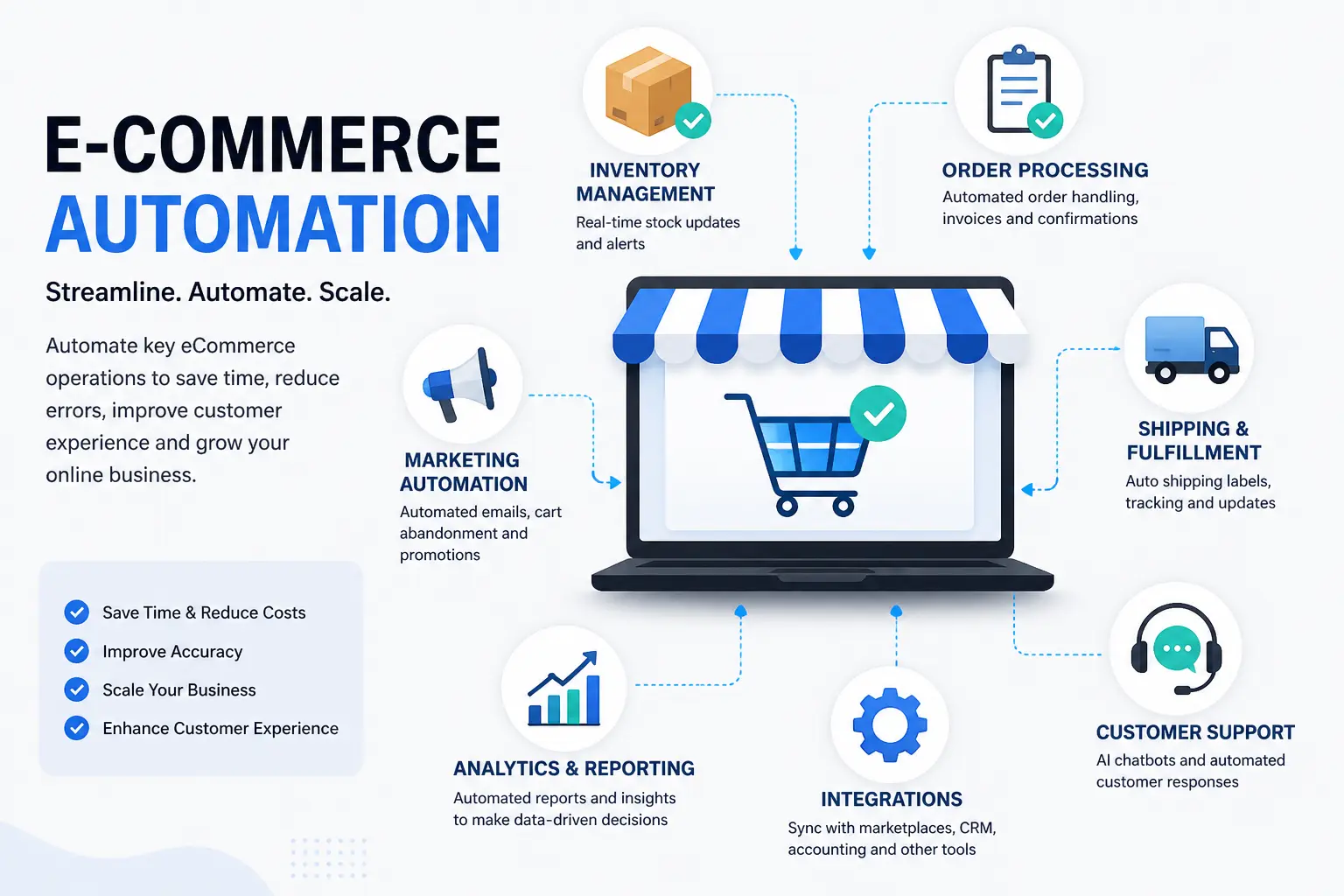
Who this guide is for: You are running an online store in Singapore, Malaysia, Indonesia, or the Philippines. Orders are growing, your team is stretched, and manual processes that used to work are starting to break. This guide gives you a practical, jargon-free roadmap for eCommerce business automation — what to automate first, which tools actually work in Southeast Asia, and what realistic results look like at your scale.
Here is the uncomfortable truth about running a growing eCommerce business in 2026: the bottleneck is almost never your product or your marketing. It is your operations. It is the hours lost manually updating inventory across three marketplaces. The customer who left a one-star review because nobody told them their order had shipped. The finance team two weeks behind on reconciliation because payment data from five gateways does not talk to each other. These are not small problems. They are the exact problems that cap your growth.
eCommerce workflow automation solves them — not by replacing your team, but by giving them back the time and attention that repetitive tasks steal every single day. At Inno Panda, we have designed and built automation systems for online stores across Southeast Asia — from solo founders handling 30 orders a day to multi-warehouse brands processing thousands. This guide captures everything we know about doing it right.
What Is eCommerce Automation?
eCommerce automation is the use of software integrations, API connections, and workflow logic to replace manual, repetitive tasks in your online store's day-to-day operations with automatic processes that run without human involvement. Think of it as building a set of rules that your systems follow automatically — so your business keeps moving even when your team is offline.
The simplest way to understand it: every time something happens in your store (an order is placed, a payment is confirmed, stock falls below a threshold), a sequence of actions needs to follow. Without automation, a person handles every step in that sequence. With automation, software handles those steps — and a person only gets involved when something genuinely requires human judgement.
How to Automate eCommerce Business Operations — The Core Mechanics
The technical foundation of eCommerce automation is API integration — building direct connections between your separate systems so they can share data and trigger actions automatically. When your Shopify store, your logistics provider, your inventory system, and your accounting software are all connected through well-built APIs, you have the infrastructure for genuine eCommerce process automation.
Here is a simple example of what that looks like in practice. A customer places an order on Shopee at 11pm:
That entire sequence — from order to accounting entry — takes a person 8 to 12 minutes to handle manually, per order. Automated, it completes in under 60 seconds. For a store processing 100 orders per day, that is 13 to 20 staff-hours recovered every single day without reducing order quality or customer experience.
Important distinction: eCommerce automation is not about replacing your team. It is about stopping your team from spending their working hours on tasks that software can do faster and more accurately. The goal is freeing your people to focus on the work that actually requires human creativity, relationship-building, and judgement — while automation handles the rest.
Why eCommerce Businesses Need Automation in 2026
The eCommerce landscape in Southeast Asia has changed dramatically. In 2020, running a Shopee store manually was manageable. In 2026, most growing brands are selling on four to six channels simultaneously — their own Shopify store, Lazada, Shopee, TikTok Shop, maybe Tokopedia or Zalora on top. The complexity of managing that manually has grown faster than team sizes have.
This is the core reason eCommerce business automation has shifted from a nice-to-have to essential infrastructure: the operations that work at 30 orders per day collapse at 300. Not because the business changed — but because manual processes have a ceiling, and growing online stores hit it faster than they expect.
eCommerce Operations Management: The Cost of Staying Manual
Let us be specific about what "not automating" actually costs. These are the recurring costs we see in manual eCommerce operations across Singapore and Southeast Asia:
Staff Time: SGD 5,000 – SGD 15,000/year
The cost of manually updating stock, processing orders, generating labels, and reconciling payments across multiple platforms — even at moderate order volumes. This scales linearly with growth.
Overselling and Stockouts: Lost Sales + Negative Reviews
One oversell on Shopee = a cancellation, a one-star review, and a marketplace penalty score. Manual stock updates across three channels create this risk every single day.
Delayed Fulfilment: Customer Experience Damage
Manual label generation and notification sending means orders placed outside business hours sit unfulfilled until someone comes online. Customers notice — and marketplaces track your fulfilment speed in their ranking algorithms.
Accounting Backlog: Cash Flow Blindness
When payment reconciliation is manual, your finance view is always 1–2 weeks behind reality. That is decisions being made on stale numbers — inventory purchases, promotions, hiring — all operating on incomplete data.
The scaling trap: Most online stores do not feel the pain of manual processes until they are already overwhelmed. Building automation infrastructure when your operation is already at capacity is far more expensive and disruptive than building it while you still have breathing room. The time to automate is before you hit the wall — not after.
7 Areas You Should Automate in Your eCommerce Business
Not everything needs to be automated at once — and not everything should be. The art of eCommerce operations management is knowing which workflows deliver the highest return when automated, and in what sequence to tackle them. Here are the seven areas where eCommerce automation delivers the most consistent value, in rough priority order for most Southeast Asian online stores.
1. Automated Order Processing — Start Here for Maximum ROI
Automated order processing is the single highest-ROI automation for most eCommerce businesses, because it addresses the highest-frequency workflow in your operation. Every order you receive triggers the same sequence of tasks. Automating that sequence is the fastest path to recovering significant staff time.
A fully automated order fulfilment workflow covers: payment validation, inventory deduction across all channels, shipping label generation via your logistics API, customer notification with tracking details, and transaction logging in your accounting system. All of this happens within 60 seconds of order confirmation — without any manual intervention, regardless of whether the order was placed at 2pm or 2am.
For businesses selling across multiple channels, the automation layer normalises incoming order data from Shopify, Lazada, Shopee, and TikTok Shop into a single unified queue — so your fulfilment team sees one clear list of orders to pick, pack, and dispatch, not four separate platform dashboards to log in and check.
How to automate order fulfilment in eCommerce: Connect your store platform to your logistics provider (NinjaVan, J&T, Lalamove) via API integration so confirmed orders auto-generate labels and tracking numbers without anyone logging into the courier portal. Add an inventory sync layer so stock deducts automatically across all channels at the same moment. This two-step integration alone recovers 8 to 15 staff-hours per day for stores doing 50+ orders.
2. Inventory Automation Software — Prevent Overselling Before It Costs You
Inventory automation is arguably the most consequential area to automate — because the cost of getting it wrong is not just staff time, it is customer trust and marketplace rankings. When your stock data is accurate across all channels in real time, you eliminate overselling. When it is not, you invite the cascade: cancellation, negative review, penalty score, reduced marketplace visibility.
Inventory automation software connects your stock levels to every sales channel simultaneously. The moment any sale occurs on any platform, available stock reduces across all others. A sale on Shopee immediately updates Lazada and your Shopify storefront — in seconds, not hours. This single capability eliminates the most common and costly error in multi-channel eCommerce operations.
Beyond real-time sync, automate inventory management for your online store with: automated reorder point alerts (so you stop running out of bestsellers), multi-location routing (fulfilment goes to the warehouse closest to the customer), and returns restocking (items that pass quality inspection go back into available inventory automatically).
3. Multichannel eCommerce Automation — One Source of Truth for Everything
Multichannel eCommerce automation creates a centralised system that all your sales channels feed into and draw from — so product data, inventory, orders, and customer records exist in one authoritative place rather than fragmented across six separate platform dashboards.
| Operation | Manual (Without Automation) | Automated (With Multichannel Sync) |
|---|---|---|
| Inventory After Each Sale | Manual update on every platform — 5–10 min per sale, error-prone | Auto-syncs across all channels in under 5 seconds |
| Product Listing Updates | Edit price/description separately on each marketplace | Update once centrally — pushes to all channels at once |
| Order Processing | Log into each platform dashboard to collect orders | Single unified fulfilment queue regardless of channel source |
| Oversell Risk | High — time lag between sale and manual stock update | Eliminated — real-time sync prevents double-selling |
| Flash Sale Execution | Update each platform individually — slow and error-prone | Schedule price changes centrally, fire across all channels at once |
| Performance Reporting | Pull separately from each platform and manually consolidate | Unified dashboard with all-channel performance in one view |
4. Automate Customer Support for eCommerce — Turn Your Biggest Cost Into an Advantage
Customer support is where most growing eCommerce businesses feel the most operational pain as they scale — and where automation delivers some of the most immediate, measurable savings. The reason is simple: the majority of eCommerce support queries follow completely predictable patterns.
In our experience working with Southeast Asian online stores, the support ticket breakdown looks remarkably consistent: roughly 40% are order status enquiries, 20% are return and refund requests, 15% are product questions, 10% are shipping and logistics issues, and 15% are genuinely complex cases requiring human judgement. That means 85% of your support volume is, in principle, automatable. In practice, well-built automation captures 60 to 70% — because some queries arrive with incomplete information.
✅ What Support Automation Handles
- Real-time order status — pulled directly from your fulfilment system
- Tracking link delivery — sent automatically with every status update
- Return initiation — collecting info and generating return authorisation
- Standard product questions — from your knowledge base or product catalogue
- Delivery timeframe estimates — based on shipping zone and carrier SLAs
- Complex case escalation — routed to the right agent with context already populated
🧑💼 What Still Needs a Human
- Complex disputes requiring individual case assessment
- Escalated complaints involving policy exceptions or significant compensation
- High-value B2B enquiries where relationship management matters
- Product feedback that should inform merchandising decisions
- Situations where automation has failed and trust recovery is needed
- Ambiguous edge cases outside your defined automation logic
5. Warehouse Automation for eCommerce — Scale Fulfilment Without Scaling Headcount
For businesses with physical warehouse operations, warehouse automation eCommerce tools connect your picking, packing, and dispatch workflows to your order management system — so every order that enters your system automatically generates a pick list, routes to the correct picker, tracks through packing, and triggers dispatch without manual coordination at each step.
At the simpler end, this means barcode scanning systems that update order status automatically as items are picked and packed. At the more sophisticated end, it means automated routing logic that directs multi-item orders to the optimal pick sequence, flagging potential errors before they leave the warehouse. For most growing Southeast Asian eCommerce businesses, the highest-value starting point in warehouse operations is connecting your WMS (or even basic scanning tools) to your order management system so status updates flow automatically — eliminating the manual "update the system" step at each stage of the fulfilment process.
6. Accounting and Payment Reconciliation — Close Your Books Without the Backlog
Automating the connection between your payment gateways — Stripe, PayNow, GrabPay, GoPay, Maya, GCash — and your accounting system (Xero or QuickBooks) means every transaction is logged automatically with the correct revenue account, tax treatment, and cost allocation applied. Payment gateway fees are deducted automatically. Multi-currency transactions convert at the correct exchange rate. Your finance team starts every day with accurate, current data rather than a backlog of manual entries.
For businesses processing orders across multiple channels and payment methods — which describes most growing eCommerce brands in Singapore and Southeast Asia — this automation alone recovers 5 to 10 hours of finance team time per week and reduces reconciliation errors that can cause material problems at audit or tax filing time.
7. Marketing Automation Triggers — Recover Revenue That Would Otherwise Disappear
eCommerce marketing automation connects your store behaviour data to automated communication sequences — so the right message reaches the right customer at the right moment, without anyone manually deciding to send it. Cart abandonment recovery sequences (sent 1 hour, 24 hours, and 72 hours after abandonment) typically recover 5 to 15% of abandoned carts that would otherwise be lost revenue. Post-purchase review request sequences, sent 7 days after confirmed delivery, improve marketplace review scores without anyone manually tracking fulfilment dates. Win-back sequences triggered by 60 or 90 days of purchase inactivity reactivate dormant customers at a fraction of the cost of new customer acquisition.
Not sure which of these 7 areas to tackle first for your specific operation? Our team maps your current workflows, quantifies the cost of each manual process, and gives you a prioritised roadmap — no obligation, no hard sell.
Talk to Our Team →Our eCommerce Automation Tool: SyncingAbout
We built SyncingAbout because we kept running into the same problem with our clients: the generic multi-channel inventory tools were built for Western markets. They supported Amazon and eBay beautifully. Shopee? Lazada? TikTok Shop? Patchy support, constant sync failures, and no understanding of how Southeast Asian marketplace operations actually work.
SyncingAbout is purpose-built for online stores operating across Southeast Asian marketplaces — with native integrations for the platforms your business actually runs on, and the business logic to handle the nuances of how those platforms behave.
Multi-Channel Inventory & Order Management, Built for Southeast Asia
SyncingAbout connects your Shopify store, Lazada, Shopee, WooCommerce, and TikTok Shop to a single source of truth — synchronising inventory in real time, centralising your order queue, and automating your fulfilment routing. No more manual platform-switching. No more overselling the last unit because two channels showed it as available.
Real-Time Inventory Sync
Stock updates across all connected channels in seconds — the moment any sale occurs on any platform.
Unified Order Queue
All orders from all channels in a single fulfilment dashboard. One place to pick, pack, and dispatch — regardless of source.
Automated Label Generation
Shipping labels generated automatically for every confirmed order — connected to NinjaVan, J&T, and other SEA logistics providers.
Cross-Channel Analytics
Unified performance reporting across all your channels — so you can see which platforms drive the best margins, not just the most volume.
Central Product Catalogue
Update product details, prices, and listings once — changes push to all connected channels simultaneously.
Smart Reorder Alerts
Automated low-stock notifications when any SKU hits your defined reorder threshold — before you run out, not after.
SyncingAbout vs Generic Multi-Channel Tools: Why SEA-Specific Matters
Most global inventory management tools are built with Western marketplaces as the primary use case. When you try to connect them to Shopee or Lazada, you run into partial integrations, sync delays, and missing marketplace-specific logic — like Shopee's reserved stock mechanics or Lazada's campaign pricing requirements.
SyncingAbout is built from the ground up for Southeast Asian marketplace operations. The integrations are native, not bolted-on. The sync logic accounts for how these platforms actually handle stock reservations, flash sales, and fulfilment SLAs. For growing online stores in Singapore, Malaysia, Indonesia, and the Philippines, this specificity makes a meaningful operational difference.
Selling on Shopee, Lazada, or TikTok Shop and still managing inventory manually? See exactly how SyncingAbout handles multi-channel sync for your specific marketplace combination.
Try SyncingAbout →How to Start Automating Your eCommerce Operations
The most common mistake online store owners make when starting eCommerce automation is trying to automate everything at once. This leads to over-engineered systems, long timelines, and the operational chaos that comes from changing multiple workflows simultaneously. The right approach is sequential — one high-impact workflow at a time, proven before moving to the next.
eCommerce Process Automation for Small Businesses: Choose the Right Tool for Your Stage
Before selecting tools, be honest about your current order volume, the channels you operate on, and the complexity of your fulfilment logic. Here is how the three main approaches compare for growing online stores in Southeast Asia:
Best eCommerce Automation Tools in 2026: A Prioritised Implementation Roadmap
Here is the exact sequence we recommend for most growing online stores in Singapore and Southeast Asia — based on where the earliest and largest returns are consistently found:
Audit Your Most Expensive Manual Processes First
Before building anything, map every manual step in your operation and estimate the time it costs per week. Most businesses find that order-to-fulfilment processing and inventory updates across channels account for 60 to 70% of their manual operational burden. That is where you start. Do not automate the nice-to-haves first. Automate the processes that hurt most right now.
Phase 1: Automate Order Fulfilment and Customer Notifications (Month 1–2)
Connect your store platform to your logistics provider API so every confirmed order automatically generates a label and tracking number. Connect your customer notification system so order confirmations and tracking messages fire automatically at each fulfilment milestone. This single phase typically recovers 8 to 15 staff-hours per day for stores doing 50+ orders, and immediately improves customer experience with faster, more consistent communication.
Phase 2: Implement Multi-Channel Inventory Sync and Accounting Reconciliation (Month 2–3)
Connect all your sales channels to a single inventory source through a platform like SyncingAbout or custom API integration. Simultaneously, connect your payment gateways to your accounting software so every transaction logs automatically. By the end of this phase, your stock is accurate across all channels in real time and your finance team has current books without manual reconciliation.
Phase 3: Automate Customer Support and Replenishment Alerts (Month 3–5)
Deploy an AI chatbot integrated with your order management system to handle order status, tracking, and return queries automatically. Set up automated low-stock alerts that fire when any SKU reaches your reorder threshold. By this phase, your operation is handling the most repetitive customer communication and inventory management without manual involvement at each step.
Phase 4: Add AI Intelligence and Marketing Automation (Month 5+)
Layer AI demand forecasting onto your inventory system to optimise reorder quantities and timing based on sales velocity and seasonal patterns. Build marketing automation triggers — cart abandonment recovery, post-purchase review requests, win-back sequences. At this stage, your eCommerce operation is running largely on autopilot for the repetitive work, and your team is focused almost entirely on strategic and relationship-based tasks.
eCommerce Automation Implementation Checklist
- Store-to-logistics API connection: Confirmed orders auto-generate labels and tracking numbers without courier portal login
- Automatic customer notifications: Order confirmation and tracking messages fire at each fulfilment milestone without manual sending
- Multi-channel inventory sync: All sales channels connected to a single stock source — real-time updates on every sale
- Payment-to-accounting reconciliation: All payment gateways feed automatically into Xero or QuickBooks with correct categorisation
- AI customer support integration: Chatbot connected to live order data handles 60–70% of queries without human involvement
- Reorder point alerts: Automated notifications when any SKU hits threshold — before you run out, not after
- Returns restocking automation: Items passing quality inspection automatically re-enter available inventory across all channels
- Marketing trigger sequences: Cart abandonment, post-purchase review requests, and win-back sequences active and running
The right starting question: Do not ask "what should I automate?" Ask "what is the most expensive manual process in my operation right now?" That answer — in terms of staff time, error cost, or customer experience impact — tells you exactly where to start. Our team helps eCommerce businesses answer this question with real operational data before any development work begins.
AI for eCommerce Business: Where Artificial Intelligence Actually Delivers Value
Every software vendor in 2026 claims their product uses AI. Most of what passes for "AI for eCommerce" is either basic rule-based automation with a trendy label, or genuinely sophisticated technology applied to the wrong problems. Here is an honest breakdown of where AI actually moves the needle for growing online stores in Southeast Asia — ranked by the returns we have seen in practice.
1. AI Automation for eCommerce Customer Support — Highest ROI, Start Here
An AI chatbot integrated with your live order data can resolve 60 to 70% of customer queries automatically — order status, tracking updates, return initiation, delivery timeframe estimates. The key word is "integrated": an AI that cannot pull real-time order information gives generic, unhelpful answers. An AI connected to your actual fulfilment data gives customers accurate, immediate answers to the questions they actually ask. For most online stores in Singapore and Southeast Asia processing more than 50 orders per day, this automation recovers 3 to 6 hours of support team time daily and cuts average response time from hours to seconds. Our AI automation service builds these integrated support systems for eCommerce businesses.
2. AI Demand Forecasting for Inventory Management
Traditional inventory management relies on manually-set reorder points based on gut feel or historical averages. AI demand forecasting analyses your actual sales velocity by SKU, identifies seasonal patterns and trend signals, and generates rolling reorder recommendations that account for supplier lead times and upcoming promotional events. For businesses with more than 200 active SKUs, AI-driven inventory planning typically reduces stockout incidents by 40 to 60% while simultaneously reducing average inventory holding — improving both customer experience and working capital efficiency.
3. AI Personalisation and Product Recommendation Engines
Product recommendation engines that surface relevant results based on genuine purchase pattern analysis — rather than generic cross-sells — increase average order value by 10 to 25% for most online stores. The difference between a useful recommendation and a generic one is the quality of the behavioural data behind it. For Shopify stores, several AI recommendation apps deliver solid results as plug-ins. For stores with custom storefronts or those wanting cross-channel recommendation consistency, a custom recommendation engine delivers better results — built through our custom development service.
4. AI Dynamic Pricing
Dynamic pricing engines monitor competitor prices, your own stock levels and sales velocity, and demand signals to recommend or automatically adjust prices within guardrails you define. For categories where price sensitivity is high and competitor pricing shifts frequently — consumer electronics, fashion accessories, commodity products — dynamic pricing keeps your offers competitive without someone manually monitoring competitor prices every day. The key is setting appropriate floor and ceiling constraints so the AI operates entirely within your margin requirements.
5. AI Fraud Detection
For high-value products or businesses with a history of chargebacks and fraudulent orders, AI fraud detection analyses order patterns, device fingerprints, shipping address anomalies, and purchase behaviour to flag suspicious orders for review before fulfilment. This prevents the operational cost of shipping and then disputing fraudulent transactions, and reduces chargeback rates that can affect your payment processor relationship and pricing.
AI Customer Support
60–70% of queries resolved automatically. Integrated with live order data. Escalates complex cases to agents with full context already populated. Highest ROI for most SEA stores.
Demand Forecasting
Reduces stockouts 40–60% while lowering inventory holding. Analyses sales velocity, seasonality, and supplier lead times to generate rolling reorder recommendations.
Product Recommendations
Increases average order value 10–25% through purchase pattern analysis. Surfaces genuinely relevant products rather than generic cross-sells.
eCommerce Platforms and Marketplaces We Integrate With
Our eCommerce automation work — through SyncingAbout and custom API development — covers the full ecosystem of platforms used by online stores across Singapore, Malaysia, Indonesia, and the Philippines. Including the regional marketplaces and payment methods that generic automation tools consistently miss.
Store Platforms
Southeast Asian Marketplaces
Logistics and Fulfilment
Payment Gateways
Accounting and Finance
Frequently Asked Questions About eCommerce Automation
These are the questions we hear most from online store owners and founders across Singapore, Malaysia, Indonesia, and the Philippines who are evaluating eCommerce automation for their operations.
How do I automate my eCommerce business operations?
Start by identifying the manual process that costs you the most — in time, errors, or customer experience impact. For most online stores in Southeast Asia, this is the order-to-fulfilment workflow: manually generating labels, updating stock across platforms, and sending tracking information. Automating this single workflow through API connections between your store, logistics provider, inventory system, and notification tool typically saves 8 to 15 hours of staff time per day for stores doing 50+ orders.
From there, expand to inventory synchronisation across channels, payment reconciliation, and customer support automation. The key is proving ROI from each phase before investing in the next. SyncingAbout and our API development service handle these integrations for eCommerce businesses across the region.
What are the best eCommerce automation tools in 2026?
The best tool depends on what you are automating and at what scale. For multi-channel inventory management across Southeast Asian marketplaces, SyncingAbout is built specifically for Shopify, Lazada, and Shopee operations. For low-volume workflow automation between mainstream tools, Zapier and Make work well as starting points. For AI-powered customer support, Gorgias (for Shopify) and Freshdesk are strong options at SME scale.
For businesses with high order volumes, complex fulfilment logic, or SEA-specific platform integrations that generic tools do not support natively, custom API integration delivers better results and lower ongoing cost. Our team helps businesses assess which approach is right for their specific operation — and we are direct when an off-the-shelf tool is the better answer. Talk to our team to discuss your requirements.
What is eCommerce automation and why does it matter?
eCommerce automation is the use of software integrations and API connections to replace manual, repetitive tasks — order processing, inventory updates, customer notifications, accounting reconciliation — with automatic workflows that run without human involvement. It matters because manual processes have a capacity ceiling. The operations that work at 30 orders per day collapse at 300.
In 2026, most growing online stores in Southeast Asia are operating across multiple channels simultaneously — Shopify, Lazada, Shopee, TikTok Shop. Managing that manually requires a team size that does not scale economically. Automation is the infrastructure that allows your business to grow without proportionally growing your operational headcount. Start with SyncingAbout for multi-channel sync, or speak to our team about a full automation assessment.
How does automated order processing work for eCommerce?
Automated order processing connects your storefront, inventory system, payment gateway, and logistics provider through API integrations so that each confirmed order triggers a predefined sequence of actions automatically. When a customer pays, the system validates payment, deducts inventory across all channels, generates a shipping label through your logistics API, sends the customer a tracking notification, and logs the transaction in your accounting software — all within seconds, with no manual involvement.
For businesses selling across multiple channels (Shopify, Lazada, Shopee), the automation layer normalises incoming order data from all sources and processes them through the same fulfilment workflow regardless of channel. Our API development service builds these workflows for online stores across Singapore and Southeast Asia.
What is inventory automation software and do small businesses need it?
Inventory automation software connects your stock levels to your sales channels so inventory updates automatically as orders are placed, fulfilled, and returned. For businesses selling on a single channel with low volume, basic inventory tracking within Shopify or WooCommerce may be sufficient. But for businesses selling across multiple channels simultaneously — which describes most growing online stores in Southeast Asia — real-time multi-channel inventory sync is essential infrastructure, not optional.
Selling the same item on three channels without real-time synchronisation means one sale can create oversell situations on the others — resulting in cancellations, negative reviews, and marketplace penalties. SyncingAbout solves exactly this problem for stores operating across Shopee, Lazada, and Shopify simultaneously.
How can AI improve eCommerce business operations?
AI delivers the most value in eCommerce through five practical applications: customer support automation (handling 60–70% of repetitive queries without human involvement), demand forecasting for inventory (reducing stockouts and overstock simultaneously), product recommendation engines (increasing average order value by 10–25%), dynamic pricing (maintaining competitive positioning without constant manual monitoring), and fraud detection (flagging suspicious orders before fulfilment).
For most growing online stores in Singapore and Southeast Asia, AI-powered customer support is the highest-ROI starting point — given the high volume of repetitive queries and the staffing cost of handling them manually. Our AI automation service builds these systems integrated directly with your order and inventory data.
What is multichannel eCommerce automation and how does it work?
Multichannel eCommerce automation connects all your sales channels — your own website, Lazada, Shopee, TikTok Shop, and any other marketplace — to a centralised system that synchronises inventory, orders, and product data across all of them automatically. A sale on any channel immediately reduces available stock on all others, all orders flow into a single fulfilment queue, and product updates propagate from one central catalogue to all channels at once.
For eCommerce businesses in Southeast Asia where operating across three to six channels simultaneously is standard, multichannel automation is the infrastructure that makes this manageable. SyncingAbout is purpose-built for exactly this — handling Shopify, Lazada, Shopee, and other SEA marketplaces in a single centralised system.
How much does eCommerce automation cost for a small business?
The cost varies by approach. No-code tools like Zapier cost SGD 30 to SGD 200 per month for low volumes, but escalate quickly as transaction volume grows. Purpose-built eCommerce automation platforms cost SGD 100 to SGD 500 per month depending on SKU count and channel volume. Custom API integration typically costs SGD 8,000 to SGD 40,000 to build, with low ongoing maintenance — and typically delivers better economics than subscription tools for businesses processing over 100 orders per day.
The more useful question is what manual operations are costing you right now. For businesses manually managing multi-channel inventory and order processing, the ongoing cost is usually SGD 5,000 to SGD 15,000 per year in staff time — before accounting for the revenue impact of errors, stockouts, and delayed fulfilment. Talk to our team for a realistic estimate specific to your operation.
Can I automate customer support for my eCommerce store?
Yes — and for most eCommerce businesses in Singapore and Southeast Asia, it is one of the highest-ROI automation investments available. A well-built customer support automation system can handle 60 to 70 percent of incoming queries automatically — order status, tracking updates, return initiation, standard product questions — deflecting tickets and only escalating genuinely complex cases to your support team.
The key to making it work is connecting your support automation to your real-time order and inventory data, so the AI can pull accurate, current information rather than giving generic responses. Our AI automation service builds these integrated support systems for eCommerce businesses. The result is faster resolution for customers, lower support costs, and a team that spends its time on cases that actually require human judgement.
How do I start automating my eCommerce operations?
Start by auditing your most expensive manual processes — map every manual step and estimate the time each costs per week. For most online stores in Southeast Asia, the order-to-fulfilment workflow and multi-channel inventory management account for the majority of manual operational burden. These are your starting points.
Phase 1: Connect your store to your logistics API for automatic label generation and tracking notifications (Month 1–2). Phase 2: Implement multi-channel inventory sync and payment reconciliation (Month 2–3). Phase 3: Add AI customer support and reorder alerts (Month 3–5). Phase 4: Layer in AI demand forecasting and marketing automation triggers (Month 5+). For a personalised roadmap based on your specific operation, get in touch with our team — we map your workflows and quantify the cost of each manual process before recommending any automation investment.
The Bottom Line: eCommerce Automation Is Not Optional in 2026 — It Is the Infrastructure for Scale
The online stores that will grow efficiently over the next two to three years in Singapore and Southeast Asia are not the ones with the biggest teams or the most aggressive marketing budgets. They are the ones whose operations can absorb growth without breaking — where every new order is processed as reliably as the first, where stock stays accurate across all channels regardless of volume, and where customers get consistent, fast communication without anyone manually sending each notification.
Automation is not a transformation you make all at once. It is a sequence of targeted investments — each one eliminating a specific bottleneck and proving a specific return before the next phase is built. The businesses that win are the ones that start this sequence now, before manual bottlenecks become hard growth ceilings.
Whether you need multi-channel inventory sync through SyncingAbout, custom API integrations for complex workflows, or AI-powered automation for customer support and inventory intelligence — the right starting point is understanding exactly what your operation costs to run manually right now. See what we have built for eCommerce businesses across Southeast Asia and let us look at what your operation specifically needs.
Ready to Automate Your eCommerce Operations and Build a Store That Actually Scales?
Our team maps your current order, inventory, and fulfilment workflows — identifies the specific manual processes costing you the most — and gives you a prioritised automation roadmap with realistic cost and timeline estimates. Whether you need a multi-channel inventory platform, a custom API integration, or an AI-powered support system, we will tell you honestly what the right solution is for your stage and your operation. No obligation. No hard sell.
Get in Touch with Our Team →