

Google AdSense Requirements 2026: How to Get Approved and What You Can Earn
- 1 Google AdSense Requirements 2026: How to Get Approved and What You Can Earn
- 1.1 Key Takeaways
- 1.2 Google AdSense Still Worth It in 2026?
- 1.3 Google AdSense Official 2026: How the Program Works and How You Get Paid
- 1.4 Google AdSense Eligibility Requirements Official 2026: What's Real and What's a Myth
- 1.5 Google AdSense Approval Requirements 2026: What Google Checks Before Approving Your Site
- 1.6 Google AdSense Requirements for New Websites in 2026
- 1.7 Is Google AdSense Available in Your Country? Myanmar and Other Locations
- 1.8 How to Get Google AdSense Approval: A Step-by-Step Checklist
- 1.9 Why Was Your Google AdSense Application Rejected?
- 1.10 How Much Does Google AdSense Pay in 2026?
- 1.11 Google AdSense Revenue Share and Payment Threshold (Official 2026)
- 1.12 How to Increase Google AdSense RPM
- 1.13 How AI Is Changing Google AdSense and the Future of Google Monetization
- 1.14 Google AdSense AI-Generated Content Policy in 2026
- 1.15 Google AdSense Policy Changes in 2026: What to Watch
- 1.16 Google AdSense RPM Benchmarks by Niche: Which Topics Have Higher Advertiser Demand?
- 1.17 SEO Strategy and Technical Checklist for AdSense Websites
- 1.18 Google AdSense vs Other Ad Networks
- 1.19 How Google Search Console Can Improve Your AdSense SEO
- 1.20 Quick AdSense Glossary
- 1.21 Frequently Asked Questions About Google AdSense in 2026
- 1.22 Final Takeaway
- 1.23 Want a Second Opinion on Your AdSense Site?
What Google actually requires, which "rules" are just forum myths, why applications get rejected, and what AdSense really pays.
If you're here, you probably want to know what Google actually requires for AdSense approval, which "rules" are just forum myths, why applications get rejected, or what AdSense really pays. This guide covers all four, using Google's own published rules rather than the approval myths that float around forums.
Key Takeaways
- Google's official bar is short: be 18 or older, own the site, publish original content and follow the program policies.
- Google has never published a minimum article count, traffic level or domain age. The "15 to 20 articles" advice is a myth.
- Reviewers still look at practical things like navigation, a privacy policy, mobile usability, HTTPS and indexing.
- AdSense isn't open in every country, so check Google's list of supported regions before you build a plan around it.
- Earnings depend on niche, traffic country, advertiser demand and content quality, so no single RPM figure fits every site.
- Publishers generally keep about 68% of revenue from ads bought through Google Ads, and Google pays once you reach the payment threshold.
- AI-assisted content isn't the problem. Mass-produced content with no human oversight is.
Google AdSense Still Worth It in 2026?
Short answer: yes for most publishers, but don't count on it alone. AdSense still has no traffic minimum, and it pays on time once you're approved. It's also one of the easiest ways to put ads on a site. What's changed is how little slack you get. Thin pages are filtered out harder than they used to be, and AI Overviews have cut clicks on some informational searches. Sites with solid, well-organised content are still doing fine. Sites that bet on volume over quality are having a rough year. Use AdSense as one income stream, not the only one.
Not sure how the program works yet? The next section covers that.
Google AdSense Official 2026: How the Program Works and How You Get Paid
What is Google AdSense? It's Google's free publisher program. You apply, Google reviews your site against its publisher policies, and once approved you add a small code snippet to your pages. Google then matches ads to your content, validates clicks and pays you monthly once your balance passes the payment threshold, which is around US$100 and varies by currency.
Your part is building an audience with useful content and SEO. Google handles the rest, from matching ads to paying you.
Google AdSense Eligibility Requirements Official 2026: What's Real and What's a Myth
Google's site eligibility requirements for content, traffic and policies come down to a short list on its eligibility page. Most of the stricter rules people quote come from forums, not from Google.
| Rule | Is it official? | What it means |
|---|---|---|
| You must be 18 or older | Yes | If you're younger, a parent or guardian can apply with their own Google Account |
| You must own and control the site | Yes | You need the right to place ads on the pages you submit |
| Content must be original and useful | Yes | Content that adds real value for readers, not copied or filler pages |
| You must follow AdSense policies | Yes | Read the publisher policies before you apply |
| You need 15 to 20 articles | No | Google has never published a minimum article count |
| Your domain must be 6 months old | No | There is no domain age rule in Google's requirements |
| You need a set amount of traffic | No | There is no published traffic minimum for applying |
| Every post needs 1,000+ words | No | Google sets no word count. Length should match what the topic needs |
| You need Google Analytics or Search Console first | No | Neither is required to apply, although Search Console helps you check indexing |
| One rejection means you're banned | No | You can fix the issues and apply again |
Why this matters: chasing a made-up article count wastes weeks. Use that time to improve the pages you already have.
Google AdSense Minimum Requirements for Content, Traffic and Pages
So what is the real minimum? On Google's side, it's the four official requirements in the table. There's no minimum visitor count, no minimum number of posts and no minimum word count per page. If a guide gives you exact numbers, such as 30 posts of 1,000 words each, it's sharing someone's experience, not Google's rule.
Still, a reviewer needs something to look at. Three short posts give them very little to judge. Aim for enough to show value, not enough to hit a number.
Where the Forum Myths Come From
Most myths start with one person's approval story. Someone gets approved with 20 posts, shares the number, and it turns into a rule. It works the other way too. A publisher with 50 posts gets rejected and blames the count, when the real problem was thin pages. Either way, the count wasn't the cause. The quality of the pages was.
Google AdSense Approval Requirements 2026: What Google Checks Before Approving Your Site
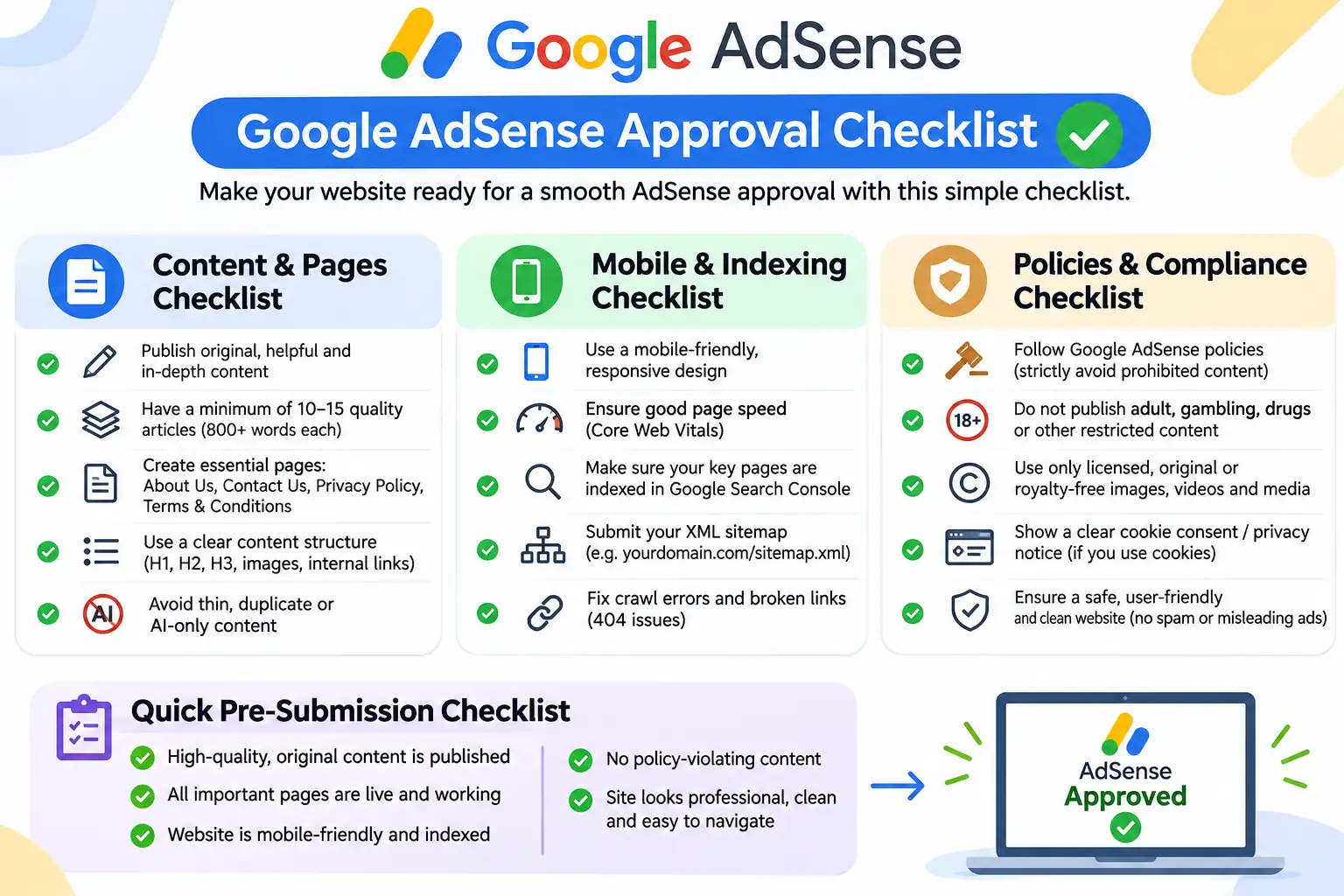
Meeting the official rules makes you eligible. Approval depends on what a reviewer sees when they open your site. These eight things come up most.
1Original, helpful content
Show that your site answers real questions. No article count is required, so aim for enough original material to prove the site is worth reading.
Visitors and reviewers should find your main content, categories and key pages without hunting.
3About, Contact and Privacy Policy pages
They show who runs the site and what happens to visitor data. If you run ads or analytics that collect data, you need a privacy policy, in practice. About and Contact pages make the site look more credible.
4A mobile-friendly site
Most visitors are on phones. If your site is hard to read on a small screen, you'll lose readers, and it won't help your application either.
5HTTPS and technical access
Pages should load securely and be readable by Google, with no broken pages or blocked scripts.
6Policy compliance
No adult content, no copyrighted material you don't have rights to, and nothing designed to encourage invalid clicks. Read the policies yourself rather than relying on summaries.
7Google indexing
If your pages aren't showing in Google at all, fix that before you apply, not after a rejection.
A named author and consistent, accurate details show that a real person stands behind the site.
Google AdSense Requirements for New Websites in 2026
Yes, a brand-new site can apply, because Google sets no minimum site age. What new sites usually lack is substance, not age. Run through this list before you submit.
Before a new site applies
- Publish enough original pages that the site feels finished, not like a placeholder
- Make sure each page is useful on its own and answers a real question
- Link your About, Contact and Privacy Policy pages in the menu or footer
- Check in Search Console that your pages are indexed
- Read the publisher policies against your own pages
Blogger AdSense Approval Requirements in 2026
Google applies the same program policies to every site, whatever platform it runs on. A Blogger blog has to meet the same four requirements as a WordPress site: you own and control it, the content is original and useful, and it follows the policies. So the checklist in this guide works for both. Blogger doesn't give you a shortcut, and it doesn't hold you back.
Is Google AdSense Available in Your Country? Myanmar and Other Locations
People often ask whether Google AdSense is available in Myanmar, and the same question comes up for plenty of other countries. AdSense isn't open everywhere. Google keeps a list of regions where you can apply, and a separate policy covers places it can't serve because of sanctions. When we checked the list, Myanmar wasn't on it. That's only a snapshot, since Google updates the list, so check the current page before you plan around AdSense.
If your country isn't listed, don't try to get around it with false details. Accurate account information is part of the rules, and a workaround can cost you the account later. Affiliate links, sponsorships and selling your own products don't depend on this list. Other ad networks have their own country rules, so check each one.
How to Get Google AdSense Approval: A Step-by-Step Checklist
Prepare the site
Make sure it's live, loads quickly and works on mobile.
Publish helpful content
Write pages that answer real questions, not pages made to fill space.
Add the essential pages
About, Contact and Privacy Policy, clearly linked in your menu or footer.
Check indexing
Use the URL Inspection tool in Search Console to confirm your pages are indexed.
Read the policies
Check your site against them directly instead of assuming it complies.
Apply
Submit through your AdSense account and wait for Google's review.
Fix and reapply if needed
Address the exact reason Google gives before applying again.
Why Was Your Google AdSense Application Rejected?
Most rejections trace back to a small set of problems.
- Thin content: pages that say little or don't fully cover the topic
- Low-value content: pages that exist mainly to catch search traffic
- Poor navigation: your main content is hard to find
- Policy problems: content that breaches the publisher policies
- Technical access issues: Google can't read your site properly
- Missing information: no privacy policy or unclear ownership
- Poor user experience: slow loading, intrusive layouts or broken pages
- Too little original value: content that closely mirrors what already exists
What to Fix Before You Reapply
Start with the exact reason Google gave you, not a full site overhaul. If it flagged content quality, work on that before touching design. Give your changes time to take effect and confirm the updated pages are re-indexed before you apply again.
How Much Does Google AdSense Pay in 2026?
Anyone giving you one universal figure is guessing. Your earnings come from a mix of factors:
What shapes your earnings
- Traffic volume and which country it comes from
- Niche and advertiser demand
- Search intent behind the visits
- Device and seasonality
- Ad placement on the page
RPM, CPC and CPM Explained
| Term | What it means |
|---|---|
| RPM | Estimated earnings per 1,000 page views, after Google's share is taken out. The most useful number in your dashboard. |
| CPC | What an advertiser pays each time someone clicks their ad. It varies hugely by niche. |
| CPM | What advertisers pay per 1,000 ad impressions, before Google's share. The advertiser-side version of RPM. |
Why Do Two Sites With the Same Traffic Earn Different Amounts?
Because traffic alone doesn't set the value. A finance or B2B software site with 10,000 monthly visitors can out-earn a lifestyle site with 60,000, because advertisers in high-value industries bid more for the same space. Content depth, page experience and how well your content matches search intent move the number further, up or down.
What Is the Average Google AdSense RPM in 2026?
Google doesn't publish an official average RPM, and the numbers you see online mix very different sites. A site read mostly by people in countries with strong advertiser spending will usually see a higher RPM than the same content read elsewhere. Device, season and page layout also move it. Your own dashboard is the best benchmark, so give it a few weeks of real traffic before you judge it.
Two numbers decide how much of your earnings reach your bank: the revenue share and the payment threshold. Here's what Google publishes for each.
| Item | Official figure | What to know |
|---|---|---|
| Revenue share | About 68% to you | Applies to ads bought through Google Ads on your content. Other ad products can use a different share |
| Payment threshold | US$100 | Varies by currency. Google lists, for example, EUR 70, GBP 60 and CAD 100 |
| Payment method threshold | US$10 | You pick your payment method once your balance reaches this lower amount |
| Payment timing | Monthly, once the threshold is met | Your account must follow the program policies and have no payment holds |
The full list of currencies is on Google's payment threshold page. Until your balance passes the threshold, it simply carries over from month to month.
How to Increase Google AdSense RPM
What actually helps
- Target higher-intent topics your audience is trying to solve
- Improve the quality of your organic traffic, not just the volume
- Deepen content so pages fully answer the query
- Improve page experience and Core Web Vitals
- Test ad placement instead of assuming Auto Ads alone is best
- Strengthen internal links so visitors read more pages
- Refresh declining pages instead of only publishing new ones
- Read your Search Console and AdSense data together
How AI Is Changing Google AdSense and the Future of Google Monetization
AI now runs underneath most of AdSense. Four things matter in practice.
Ad targeting
Ads are increasingly matched to what's on the page, which rewards specific, well-targeted content.
Auto Ads
Machine learning places ads where they're likely to perform. Many publishers do best with Auto Ads plus a couple of manual units.
Contextual relevance
The better your content fits a specific topic, the more relevant, and often better paid, the ads can be.
Invalid traffic protection
Google filters fraudulent and accidental clicks automatically. You don't manage this directly.
Looking ahead, the bigger change for publishers isn't the ad format. AI Overviews now answer many simple questions on the results page, so fewer people click through. Pages that give readers something an overview can't, like original data, hands-on experience, a tool or a clear recommendation, tend to hold their traffic better. That's why this guide keeps coming back to content quality.
Google AdSense AI-Generated Content Policy in 2026
A lot of people search for the AdSense AI-generated content policy, so here's the short version. Using AI to help draft a page isn't a problem in itself. What gets judged is the finished page. Google's AdSense policies and its Search spam policies both go after low-value content, and the spam policies call mass-producing thin pages "scaled content abuse". Our August 2026 spam update article covers how that played out in search.
What usually reads as fine
- AI used for an outline or first draft, then edited by someone who knows the topic
- Facts checked against reliable sources before publishing
- Real examples, experience or data added that a generic draft wouldn't have
- A named author and clear site information
- Bulk publishing: dozens of near-identical pages released at once
- No review: text nobody has read or fact-checked
- No added value: pages that repeat what ten other sites already say
In short: it's the quality and the editing that count, not the tool behind the first draft.
Google AdSense Policy Changes in 2026: What to Watch
Plenty of publishers search for the latest AdSense policy changes. Google updates its policies from time to time, and the details can move faster than any article can keep up with. So instead of chasing headlines, build around what stays the same: original and useful content, accurate site information, a good reading experience and ads that don't mislead.
Habits that protect your account
- Re-read the publisher policies before you apply, and again every few months
- Keep a simple log of big site changes, so you can trace a problem if one appears
- Act quickly on anything flagged in your AdSense policy centre
Google AdSense RPM Benchmarks by Niche: Which Topics Have Higher Advertiser Demand?
Advertisers don't compete equally for every topic, which is why RPM varies so much between niches. Treat this as a rough guide, not a promise of earnings. There's no reliable public benchmark for any niche.
| Niche | Advertiser demand | SEO competition |
|---|---|---|
| Finance | High | Very high |
| SaaS | High | High |
| Legal | High | Very high |
| Digital marketing | High | High |
| Education | Medium to high | Medium |
| Engineering and technical content | Varies by topic | Medium to high |
| Lifestyle | Lower | High |
Engineering and technical content sits in the middle and varies a lot. Pages that attract buyers of software, cloud tools or B2B services tend to draw stronger bids than general explainers aimed at students. High-demand niches are harder to rank in because more publishers are chasing the same advertisers. That's not a reason to avoid them, but expect a longer runway before traffic and RPM mature.
SEO Strategy and Technical Checklist for AdSense Websites
AdSense income follows organic traffic, so the practical way to grow it is to build the signals Google already rewards in search: experience, expertise, authority and trust.
Content signals to build
- Show who wrote it. A visible byline tells readers and Google a real person stands behind the content.
- Add author credentials. A short bio explains why this person is worth trusting on the topic.
- Cite reliable sources. Link to credible sources instead of stating numbers without backup.
- Use first-hand experience. Where you have it, say so and add specifics a generic article wouldn't have.
- Bring original examples or data. They're much harder to copy than a rewritten summary.
- Keep pages current. A visible update date backed by a real update is a small but real trust signal.
Technical basics to check
- Core Web Vitals (LCP, INP and CLS)
- Mobile layout and image optimisation
- Caching and fast hosting
- HTTPS and clean indexing
Watch layout shift in particular. Ads that push content around as they load make for a worse reading experience, and that shows up in engagement over time. If your site needs a technical health check, our technical SEO services cover this list.
AdSense Loading Method: Keep the Ad Code From Slowing Your Pages
How your ads load affects both speed and layout, so it pays to set them up carefully.
Loading basics
- The AdSense script loads asynchronously, so it shouldn't block your page by itself. Add it the way Google instructs
- Reserve space for each ad slot with a set height, so text doesn't jump when the ad appears
- Test Auto Ads against a few manual units on real pages instead of guessing
- Check Core Web Vitals in Search Console after every change to your ad setup
- Don't edit the ad code beyond what Google's instructions allow
Google AdSense vs Other Ad Networks
AdSense isn't the only option, and for high-traffic sites it may not stay the best one. Entry rules and thresholds change, so check each network's current requirements before you plan around them.
| Network | Entry requirements | Approach | Best for |
|---|---|---|---|
| Google AdSense | No traffic minimum | Automated, contextual ad matching | New and growing sites of any size |
| Ezoic | No fixed minimum | AI-driven layout and ad testing | Sites ready to experiment with layouts |
| Mediavine | Session threshold applies | Managed ad operations | Established lifestyle, food and parenting sites |
| Raptive | Pageview threshold applies | Premium managed ad operations | High-traffic sites wanting a fuller service |
For most publishers starting out, AdSense is still the sensible first step. Build real traffic first, and higher-tier networks become an option later.
How Google Search Console Can Improve Your AdSense SEO
Search Console is one of the most underused tools among AdSense publishers. Here's how to read it.
| What you see | What it usually means | What to do |
|---|---|---|
| High impressions, low CTR | The title or description isn't earning the click | Test a rewritten title and meta description |
| High impressions, position 8 to 15 | Google sees the page as relevant but not the best answer | Strengthen the content itself |
| High clicks, falling impressions | A page that used to perform is losing relevance | Refresh it with current information |
| New queries appearing | Searchers want something you only half cover | Create dedicated content for that intent |
A page ranking well with poor CTR is usually a title problem. A page with low impressions is usually a content or indexing problem. They need different fixes.
Quick AdSense Glossary
- RPM (revenue per mille)
- Your estimated earnings per 1,000 page views, after Google's share is taken out.
- CPC (cost per click)
- What an advertiser pays each time someone clicks their ad.
- CPM (cost per mille)
- What advertisers pay per 1,000 ad impressions.
- Auto Ads
- AdSense's machine-learning ad placement, which finds where ads are likely to perform.
- Publisher policies
- Google's official rules for what content and behaviour are allowed on an AdSense site.
- Core Web Vitals
- Google's page experience metrics for loading speed, interactivity and visual stability.
Frequently Asked Questions About Google AdSense in 2026
Is Google AdSense still worth it in 2026?
For most publishers, yes, but it isn't guaranteed income. AdSense has no traffic minimum and pays reliably once you're approved. The catch is that 2026 has been bumpy, with AI Overviews cutting clicks on some informational content. AdSense works best as one part of your monetisation plan, not all of it.
What are the Google AdSense approval requirements in 2026?
Google asks that you're 18 or older, own and control the site, publish original and useful content, and follow its program policies. In practice, reviewers also look at navigation, a privacy policy, mobile usability, HTTPS and whether your pages are indexed. Google doesn't publish a minimum article count.
What are the official Google AdSense eligibility requirements?
The official bar is short: be at least 18 (or have a parent or guardian apply), own and control the site you submit, publish original content, and comply with AdSense policies. Google doesn't set a traffic, domain age or post count requirement.
How do I get AdSense approval?
Get your site live and mobile-friendly, publish useful content, add About, Contact and Privacy Policy pages, confirm your pages are indexed, read the program policies, then apply. If you're rejected, fix the specific reason Google gives before reapplying.
Why was my AdSense application rejected?
Common reasons are thin or low-value content, confusing navigation, missing policy pages, technical access problems, or content that doesn't add enough original value. Google's email usually names the policy area to review.
How long does AdSense approval take?
Most applications get a decision within a few days to a few weeks. Google doesn't publish a fixed timeframe, and it can vary with the review queue.
Do I need a minimum number of articles or visitors?
No. Google doesn't publish a minimum article count or traffic requirement. The advice about 15 or 20 articles comes from forums, not from Google. What matters is whether your site already has enough useful, original content to judge.
How much does Google AdSense pay?
It depends on niche, country of traffic, advertiser demand and content quality, so no single number is reliable. Publishers generally keep about 68% of revenue when ads are bought through Google Ads, according to Google's revenue share documentation. Payments are made monthly once you reach the payment threshold, which is around US$100 and varies by currency.
What is the AdSense payment threshold?
The threshold is US$100, and it varies by currency (for example, 70 euros or 60 pounds). Google pays once your outstanding earnings reach the threshold and your account has no holds. You also choose a payment method once your balance reaches a lower selection threshold of US$10.
What is AdSense RPM?
RPM (revenue per mille) is your estimated earnings per 1,000 page views, after Google's share has been taken out. It's the figure in your dashboard that best shows what your traffic is worth.
What is the average AdSense RPM?
Google doesn't publish an official average RPM, and figures you see online mix very different sites. Your RPM depends on niche, traffic country, device and content quality, so your own dashboard is the best benchmark.
How can I increase AdSense RPM?
Target higher-intent topics, improve the quality of your organic traffic, deepen your content, improve page experience and Core Web Vitals, test ad placement, strengthen internal links, and refresh pages that are losing traffic.
Can a new website get AdSense approval?
Yes. Google doesn't set a minimum site age or traffic level. What matters is that the site has enough real content and the basic pages in place when you apply.
Is Google AdSense available in Myanmar?
AdSense isn't open in every country. When we checked Google's list of regions where you can apply, Myanmar didn't appear on it. Google updates the list, so check the current page before you plan around AdSense.
Does AI-generated content affect AdSense approval?
Using AI to help write isn't automatically a problem. Google's concern is low-quality, mass-produced content with no real editorial oversight. Content that a person has reviewed, fact-checked and made genuinely useful is treated very differently from unreviewed bulk output.
Final Takeaway
Approval and earnings both come down to the same thing: build a site that's useful to the people reading it, and Google has reasons to trust it. Chasing an article count, a magic RPM range or an approval trick misses the point of the review.
If you're building or growing an AdSense site and want a second pair of eyes on content quality, technical setup or approval readiness, our team can help. Our SEO packages and technical SEO services cover the fundamentals this guide is built on.
Preparing for approval or trying to lift your RPM? We'll review your content and setup and tell you what's worth fixing first.
Want a Second Opinion on Your AdSense Site?
Whether you're getting ready to apply or trying to grow your RPM, we can review your content, technical setup and SEO foundation and tell you straight what to fix first.
Talk to Our Team View SEO Packages