How to Build a SaaS Platform in 2026: Step-by-Step Guide for Startups & Businesses
- 1 How to Build a SaaS Platform in 2026: Step-by-Step Guide for Startups & Businesses
- 1.1 What Is a SaaS Platform and Why Build One in 2026?
- 1.2 How to Build a SaaS Platform Step by Step: The 2026 Process
- 1.2.1 Define and validate your SaaS idea before building anything
- 1.2.2 Scope your MVP — and cut it in half
- 1.2.3 Choose your SaaS technology stack carefully
- 1.2.4 Design the user experience before writing a single line of code
- 1.2.5 Build your SaaS MVP with the right team structure
- 1.2.6 Integrate subscription billing from day one
- 1.2.7 Launch to a focused early adopter group — not the public
- 1.2.8 Iterate aggressively before scaling marketing
- 1.3 SaaS Technology Stack 2026: What to Build With and Why
- 1.4 SaaS Platform Development Cost in 2026: What to Actually Budget
- 1.5 Common SaaS Development Mistakes Startups Make (and How to Avoid Them)
- 1.6 How Inno Panda Builds SaaS Platforms for Startups and Businesses Across Southeast Asia
- 1.7 Frequently Asked Questions About Building a SaaS Platform in 2026
- 1.8 Building a SaaS Platform in 2026 Is Achievable — With the Right Process and the Right Partner
- 1.9 Ready to Build Your SaaS Platform?
Building a SaaS platform has never been more accessible — or more competitive. Whether you are a founder validating your first idea or an established business looking to productise an internal tool, this guide walks you through every stage of building a SaaS product in 2026: from idea to architecture, MVP to launch, and growth to scale.
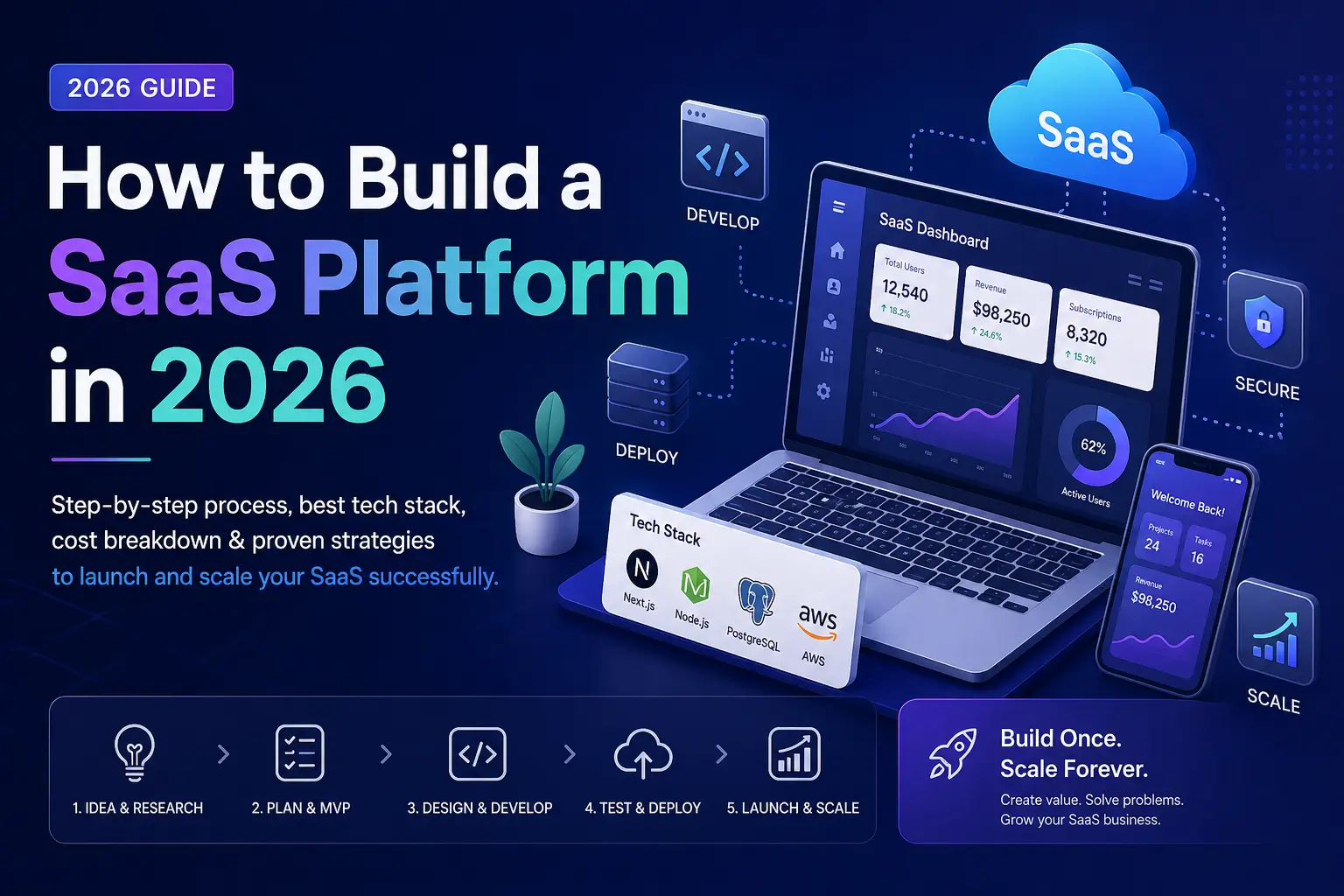
The SaaS industry continues to grow at a pace that shows no signs of slowing. But the landscape has also matured significantly — which means the bar for building a SaaS product that wins in the market has risen. In 2026, buyers are more sophisticated, the technical baseline is higher, and the competition in most categories is real. What has also changed is that the tools, frameworks, and development partners available to founders have never been better. If you know what you are building and why, getting it built is more achievable than at any point in history.
This guide gives you the honest, practical breakdown of how to build a SaaS platform in 2026 — including the parts that most guides skip over, like what actually belongs in an MVP, how to structure your technology choices so they do not become a bottleneck at scale, and how to find and work with a development partner who can actually execute.
What Is a SaaS Platform and Why Build One in 2026?
A SaaS (Software as a Service) platform is a cloud-hosted software product that users access via a web browser or mobile app, typically on a subscription basis. Unlike traditional software that is installed locally, SaaS products are maintained centrally by the provider — meaning users always access the latest version, and the provider manages all infrastructure, security, and updates.
The case for building a SaaS product in 2026 is strong across multiple dimensions. Subscription revenue compounds over time and creates predictable cashflow. Cloud infrastructure makes scaling a product to thousands of users far less capital-intensive than it was a decade ago. And the global shift toward digital-first business operations has created genuine demand for specialised SaaS tools across every industry.
SaaS product development for startups: why the model works at early stage
For startups, the SaaS model has a specific advantage that is often underappreciated: it aligns the business model with product quality in a direct way. Unlike a one-time software sale, subscription revenue requires ongoing delivery of value — customers stay when the product keeps working well for them, and leave when it does not. That accountability loop forces founders to stay close to the product and the customer, which is exactly the discipline that builds great software businesses.
How to Build a SaaS Platform Step by Step: The 2026 Process
The steps below represent the process that consistently works for SaaS founders in 2026 — whether they are building their first product or their fifth. Each step is sequenced deliberately. Skipping ahead — particularly the validation and architecture stages — is the most common reason SaaS builds fail or require costly rewrites.
Define and validate your SaaS idea before building anything
The most expensive mistake in SaaS development is building a product for a problem that is not painful enough, or for an audience that will not pay for a solution. Before any design or code begins, you need evidence that your target customers have the problem you think they have, experience it regularly, and would pay a subscription fee to solve it. Talk to twenty potential customers. Review competitor reviews on G2 and Capterra for consistent complaints. Look at what people are searching for — and what existing tools are failing to deliver. This stage should take two to four weeks and requires no budget. It saves months of expensive misdirection.
Scope your MVP — and cut it in half
Most founders scope their first MVP with too many features. An MVP is not a smaller version of your final product — it is the minimum set of functionality required to deliver the core value to a real user and validate that they will pay for it. For most SaaS products, that means one core workflow, user authentication, subscription billing, and a basic admin dashboard. Every other feature belongs on a post-validation roadmap. The goal of an MVP is not to impress — it is to learn, fast, with real paying users. Treat every feature on your initial list as guilty until proven necessary.
Choose your SaaS technology stack carefully
Your technology choices at this stage will either support or constrain your product for years. The right stack for a SaaS platform in 2026 depends on your product requirements, your team's expertise, and the type of users you are serving. For most early-stage SaaS products, a modern JavaScript frontend (React or Next.js), a Python or Node.js backend, PostgreSQL as the primary database, Stripe for billing, and AWS or GCP for cloud hosting is a well-proven and flexible foundation. The key principle is to use managed services wherever possible — do not build what you can buy, particularly at MVP stage.
Design the user experience before writing a single line of code
SaaS products live or die on their user experience — not just aesthetics, but the core workflow logic that determines how quickly a new user reaches their first "this is genuinely useful" moment. Before development begins, your team should produce wireframes and a clickable prototype that walks through the end-to-end user journey. This is where you identify friction points, confusing navigation, and workflow assumptions that need to be stress-tested before they are built into the codebase. One week spent on design review saves four weeks of development rework.
Build your SaaS MVP with the right team structure
For a focused SaaS MVP, the right team structure is typically: one or two full-stack developers, a UI/UX designer (who may also handle front-end development), and a QA engineer or testing resource. A project manager becomes essential at larger scope. Working with a specialist SaaS development company like Inno Panda means this team comes pre-assembled, with relevant SaaS development experience, established communication processes, and no hiring lag. Most clients have their MVP development team productive within two weeks of signing an engagement agreement.
Integrate subscription billing from day one
Billing is not a feature you add later — it is foundational infrastructure that shapes your pricing model, trial logic, upgrade flows, and revenue reporting from the first user onward. Stripe is the default choice for SaaS billing in 2026 and for good reason: it handles subscription logic, prorations, failed payment recovery, invoicing, and tax compliance in a way that would take months to rebuild from scratch. Use Stripe Billing (or Paddle as an alternative for simplified global tax compliance) and connect it to your product from the start. The two weeks it takes to integrate properly saves six months of billing chaos later.
Launch to a focused early adopter group — not the public
The first version of your SaaS product should go to a small, engaged, pre-qualified group of users who agreed to test it in exchange for early access pricing or the opportunity to shape the product. This is not a public launch — it is a structured learning exercise. Give these users direct access to your team. Watch how they use the product. Ask them what is confusing, what is missing, and what would make them recommend it to a colleague. The insights from 20 engaged early adopters are worth more than the analytics from 2,000 passive trial signups.
Iterate aggressively before scaling marketing
The biggest mistake SaaS founders make after initial launch is investing heavily in marketing before the product is retention-ready. If your 30-day churn rate is above 10%, spending money to acquire new users is pouring water into a leaking bucket. Get your core workflow to a state where most new users successfully reach their first value moment, stay active through their first billing cycle, and can clearly articulate why they would not cancel. Then scale marketing. The sequence matters more than the speed.
SaaS Technology Stack 2026: What to Build With and Why
One of the most consequential decisions in building a SaaS platform is technology selection. The choices you make here determine how fast you can build, how well the product performs at scale, and how easy it is to maintain and extend the codebase over time. Here is the stack that our team at Inno Panda recommends and uses for most SaaS builds in 2026.
| Layer | Recommended Technology | Why It Works for SaaS |
|---|---|---|
| Frontend | React / Next.js | Component-based architecture, SSR for SEO, large ecosystem, excellent developer tooling and hiring pool |
| Backend / API | Node.js (Express/Fastify) or Python (FastAPI/Django) | Fast API development, excellent library ecosystems, strong AI/ML integration support (particularly Python) |
| Database | PostgreSQL (primary) + Redis (caching/sessions) | PostgreSQL handles complex relational data; Redis eliminates database bottlenecks at scale |
| Cloud Infrastructure | AWS / GCP (managed services) | Managed databases, serverless compute, CDN, auto-scaling — infrastructure that grows with you without manual ops |
| Subscription Billing | Stripe Billing / Paddle | Complete subscription lifecycle management — trials, upgrades, dunning, tax — without custom billing logic |
| Authentication | Auth0 / Supabase Auth / NextAuth | Battle-tested auth infrastructure with SSO, MFA, and social login — build it once and never touch it again |
| Email / Notifications | Resend / SendGrid / Postmark | Transactional email infrastructure with deliverability monitoring and template management |
| AI Features | OpenAI API / Anthropic API / LangChain | Accessible AI capabilities via API — no model training required at MVP stage |
How to build a cloud-based SaaS application that scales without costly rewrites
The architectural decisions that prevent costly rewrites at scale come down to two principles: use managed cloud services wherever possible, and design your data model correctly from the start. Multi-tenancy — the way your SaaS isolates each customer's data from every other customer's data — is the most common architectural decision that founders get wrong at MVP stage and pay for heavily at growth stage. Getting the tenant isolation model right early, even if it adds a week to the initial build, is one of the highest-return investments you can make in a SaaS platform.
SaaS Platform Development Cost in 2026: What to Actually Budget
The cost to build a SaaS platform varies significantly depending on scope, team location, and the complexity of the features required. Here is a realistic breakdown based on actual project experience — not theoretical estimates.
Focused SaaS MVP
$10,000 – $15,000
One core workflow, user authentication, Stripe billing, basic admin dashboard, and onboarding. No AI integration or complex third-party APIs. Timeline: 8–14 weeks.
Mid-Complexity SaaS Platform
$15,000 – $40,000
Multiple user roles, third-party API integrations, advanced reporting, AI-assisted features, and a polished onboarding experience. Timeline: 16–24 weeks.
Enterprise-Grade SaaS Product
$40,000+
Full multi-tenancy, custom AI pipelines, enterprise SSO, compliance features, advanced analytics, and a mature UX built for complex B2B workflows. Timeline: 28–48 weeks.
What drives SaaS development costs: The biggest cost drivers are feature scope, AI integration complexity, third-party API work, and the number of user roles and permission levels required. The most effective cost-control strategy is keeping the MVP scope ruthlessly tight and using managed services (Stripe, Auth0, cloud databases) instead of building infrastructure from scratch. Get in touch and our team will scope your specific product and give you a realistic cost and timeline estimate.
Common SaaS Development Mistakes Startups Make (and How to Avoid Them)
Most of the painful, expensive mistakes in SaaS development are not technical — they are strategic and sequencing errors. Here are the ones we see most often working with founders across Singapore, Malaysia, Indonesia, and beyond.
How Inno Panda Builds SaaS Platforms for Startups and Businesses Across Southeast Asia
At Inno Panda, SaaS development is not a sideline — it is one of our core specialisms. We have designed, built, and launched SaaS products including our own platforms (PT Buddy, SyncingAbout, and CashFlow SaaS), and we bring that founder-level perspective to every client project. Here is specifically what we provide.
🏗️ End-to-end SaaS product development
From product scoping and architecture design through to front-end, back-end, billing integration, testing, and cloud deployment — we manage the full development lifecycle so you can focus on customers and product strategy.
🤖 AI integration for SaaS platforms
We integrate OpenAI, Anthropic, and custom AI pipelines into SaaS products — from intelligent automation workflows to LLM-powered features and predictive analytics. Our AI automation service handles this as a standalone capability.
🚀 Rapid SaaS MVP development
We build MVPs with deliberate scope discipline. Most Inno Panda SaaS MVPs are in user testing within 10 to 14 weeks. We focus on validating your core value proposition with real users — not building a complete product before you have proof of demand.
📦 Multi-tenant cloud architecture
Our SaaS builds use scalable, cloud-native architecture designed for multi-tenancy from the start. The technical choices we make at MVP stage do not create bottlenecks when you scale to 1,000 or 10,000 customers.
🔄 Ongoing development and product iteration
We do not build and hand over. Our dedicated team model means your development partner stays engaged through launch, iteration, and scaling — adjusting team composition up or down as your product and revenue stage requires.
📈 Growth services to acquire SaaS customers
Unlike pure dev shops, Inno Panda also offers SEO, lead generation funnels, and digital marketing — so we can help you grow the subscriber base after the product is built, not just hand you a codebase and wish you luck.
Frequently Asked Questions About Building a SaaS Platform in 2026
These are the questions we hear most consistently from founders, product managers, and business owners planning their first or next SaaS build.
How much does it cost to build a SaaS platform?
The cost to build a SaaS platform depends on scope, feature complexity, technology stack, and development team location. A focused SaaS MVP typically costs between $15,000 and $40,000 when built with a Southeast Asian development partner like Inno Panda. Mid-complexity platforms — with AI features, multiple user roles, and third-party integrations — typically range from $40,000 to $100,000. Enterprise-grade SaaS products start at $100,000+.
The most effective way to manage development cost is to scope the MVP tightly and build the full feature roadmap in phases as revenue validates the direction. Get in touch for a scoped estimate based on your specific product requirements.
How long does it take to build a SaaS product?
A well-scoped SaaS MVP typically takes 12 to 20 weeks from initial design through to launch-ready product. Simple, focused tools can be delivered in 8 to 12 weeks. More complex platforms — with multi-tenancy, AI integration, and custom billing logic — typically take 20 to 32 weeks for a first version.
Working with a specialist SaaS development company like Inno Panda reduces this timeline compared to assembling an in-house team from scratch, because our developers come pre-assembled with relevant SaaS experience and can start work within two weeks of a signed engagement.
What technology stack should I use to build a SaaS platform?
The most common and well-proven SaaS stack in 2026 is React or Next.js for the frontend, Node.js or Python for the backend, PostgreSQL for the database, Stripe for subscription billing, and AWS or GCP for cloud infrastructure. For AI-integrated products, OpenAI APIs, LangChain, and Python data pipelines are increasingly standard.
The key principle is to use proven, well-supported technologies rather than the newest frameworks — and to use managed services wherever possible rather than building infrastructure from scratch. The right stack is the one your team can execute well, not the most technically impressive one on paper.
What is the difference between a SaaS MVP and a full SaaS product?
A SaaS MVP is the smallest version of your product that delivers the core value proposition and allows you to validate demand and generate initial revenue. It includes essential features only — the core workflow, subscription billing, basic user management, and onboarding.
A full SaaS product adds everything beyond that: advanced analytics, integrations, enterprise features, custom roles and permissions, and a mature UX refined through iterative customer feedback. Most successful SaaS companies launched a deliberately narrow MVP first and expanded the product based on paying customer input — not internal assumptions about what the market needed.
Do I need a technical co-founder to build a SaaS platform?
No. Many successful SaaS founders have launched and grown profitable platforms without a technical co-founder by working with a specialist SaaS development partner. Inno Panda can manage the full technical build — architecture, development, testing, and deployment — while you focus on customer development, sales, and product strategy.
This is a well-established and pragmatic path, particularly for founders with deep domain expertise in their target market but limited technical background. The key is choosing a development partner with a genuine SaaS track record, not just general web development experience. See our portfolio for examples of what this looks like in practice.
What are the most important features to build in a SaaS MVP?
The essential features for a SaaS MVP are: user authentication and account management, the core product workflow that solves your target customer's primary problem, subscription billing (via Stripe), a basic admin dashboard for monitoring and managing users, and an onboarding flow that gets new users to their first value moment as quickly as possible.
Everything else — advanced reporting, third-party integrations, team collaboration features, custom roles — belongs on the post-launch roadmap. Adding features to an MVP before you have validated the core is one of the most common and expensive mistakes in early-stage SaaS development.
How do I choose the right SaaS development company?
Look for a SaaS development company with a verifiable track record of shipping live SaaS products, not just general web or app development. Key indicators include: case studies or portfolio examples of live SaaS products, demonstrated experience with subscription billing, multi-tenancy, and cloud-native architecture, transparent pricing and project scoping, and clear communication processes.
Inno Panda is a Singapore-based SaaS development company with direct experience building multi-tenant SaaS platforms across fintech, healthcare, e-commerce, and professional services. Book a free consultation to discuss your project — we will give you an honest assessment of scope and timeline with no obligation.
Should I build or buy the infrastructure for my SaaS platform?
At MVP and early-growth stage, buy as much as you can. Use managed cloud services (AWS RDS, GCP Cloud SQL) instead of self-managed databases. Use Stripe instead of building billing logic. Use Auth0 or Supabase instead of building your own authentication system.
The cost of buying these services is trivial compared to the engineering time saved — and it keeps your development team focused on the core product that differentiates your SaaS, not infrastructure that has already been solved at industrial scale. The right time to build custom infrastructure is when you have a specific, validated reason that off-the-shelf solutions genuinely cannot meet.
Building a SaaS Platform in 2026 Is Achievable — With the Right Process and the Right Partner
The SaaS landscape in 2026 is more competitive than it has ever been — and also more accessible than it has ever been. The tools, frameworks, managed services, and development talent available to founders today have lowered the cost and timeline of getting a production-grade SaaS product to market significantly. What has not changed is the importance of doing the fundamentals well: validating before building, scoping the MVP tightly, making sensible architecture decisions early, and choosing a development partner who has actually done this before.
Whether you are a non-technical founder building your first product, an established business looking to productise an internal tool, or a startup ready to scale beyond an initial MVP — Inno Panda has the experience, the team, and the processes to help you execute it well. Review our portfolio to see the type of products we have built — and then get in touch to discuss yours.
Ready to Build Your SaaS Platform?
Whether you have a validated product idea and need an experienced development team, or you are still working through the right scope for your MVP — the Inno Panda team is here to help. We work with founders and businesses across Singapore, Malaysia, Indonesia, the Philippines, USA, and UK to design, build, and launch SaaS products that generate real, recurring revenue.
Get in touch for a no-pressure conversation about your SaaS idea. We will give you an honest assessment of scope, timeline, and investment — and a clear path forward with no obligation.