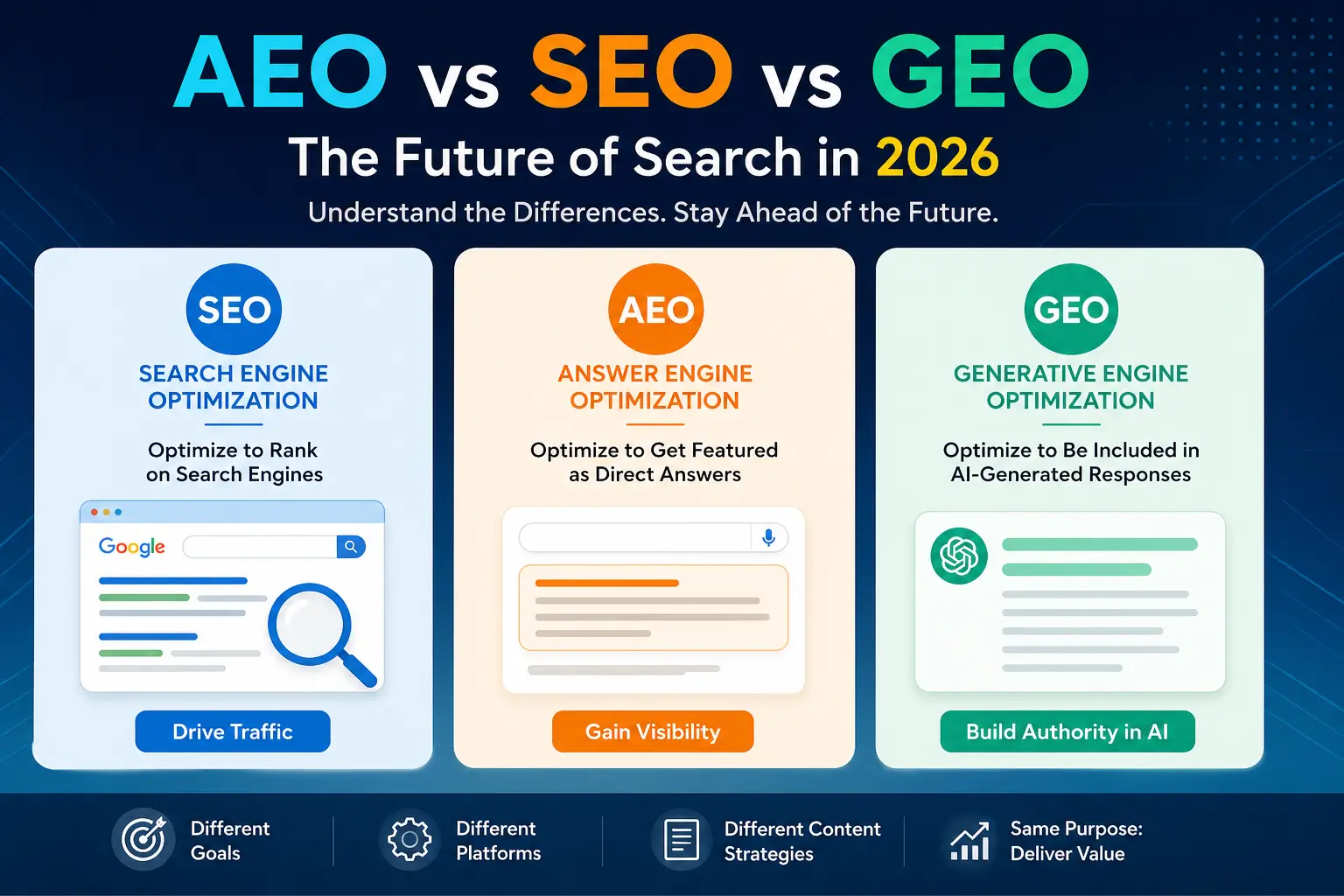
AEO vs SEO vs GEO: The Future of Search in 2026 Explained
- 1 AEO vs SEO vs GEO: The Future of Search in 2026 Explained
- 1.1 Why the Future of Search Engines Is Changing Faster Than Most Businesses Realise
- 1.2 What is SEO? Search Engine Optimization in 2026 Still the Foundation
- 1.3 What is AEO? Answer Engine Optimization and Featured Snippets Explained
- 1.4 What is GEO? Generative Engine Optimization The Newest Frontier
- 1.4.1 GEO Strategy for Beginners: How to Start Building AI-Citation Authority
- 1.4.2 Build your brand entity across the web consistently
- 1.4.3 Create genuinely citable, data-rich content
- 1.4.4 Implement schema markup comprehensively
- 1.4.5 Earn mentions on high-authority external sites
- 1.4.6 Keep your content current and updated regularly
- 1.5 AEO vs SEO vs GEO: The Complete Side-by-Side Comparison
- 1.6 Using AI for SEO: How to Build a Strategy That Works Across All Three Disciplines
- 1.7 Building Your Integrated AEO + SEO + GEO Strategy With Inno Panda
- 1.8 What an SEO Expert Actually Does in 2026 and Why It Looks Different Than Before
- 1.9 Frequently Asked Questions: AEO, SEO, GEO, and AI Search in 2026
- 1.10 The Future of Search Is Here — Build Your Strategy Before Your Competitors Do
- 1.11 Ready to Build a Search Strategy That Works in 2026 and Beyond?
Search is no longer one thing. In 2026, your content needs to work in three completely different environments traditional Google rankings, AI-generated answer boxes, and generative AI tools like ChatGPT. Understanding AEO, SEO, and GEO is not optional anymore. It is the new baseline for any business that wants to be found.

A few years ago, the entire conversation around search was simple: rank on Google, get traffic, grow your business. Today, that conversation has fractured into three distinct disciplines each targeting a different type of search environment, a different type of user behaviour, and a different type of AI system.
If you have heard terms like Answer Engine Optimization, Generative Engine Optimization, or AI search optimization and felt mildly confused about what they actually mean and how they differ from traditional SEO this guide is for you. We are going to break all three down clearly, show you exactly how they compare, and give you a practical roadmap for building a strategy that works across all of them.
At Inno Panda, we are already helping businesses build content and technical strategies that perform in all three search environments. The businesses that adapt now will have a compounding advantage that grows every quarter. The ones that wait will find themselves increasingly invisible as AI search continues its rapid expansion. Let us make sure you are in the first group.
Why the Future of Search Engines Is Changing Faster Than Most Businesses Realise
Before we get into the mechanics of each discipline, it is worth pausing to understand just how dramatically the search landscape has shifted and how fast it is still moving. These are not incremental changes. They represent a genuine structural shift in how people find information and how businesses get found.
The bottom line is this: if your only search strategy is traditional SEO, you are already missing a significant and growing share of the attention economy. That does not mean SEO is dead far from it. But it does mean that SEO alone, without AEO and GEO layered on top, is a strategy built for a search landscape that is rapidly becoming the past.
The good news? The fundamentals that make great SEO quality content, technical excellence, genuine authority — are the same fundamentals that underpin both AEO and GEO. You are not starting from scratch. You are building on what you already have, and extending it into new search environments. This is exactly how we approach the work at Inno Panda's SEO services.
What is SEO? Search Engine Optimization in 2026 Still the Foundation
Let us start with what most people know — or think they know. Search Engine Optimization (SEO) is the practice of improving your website and content so that search engines primarily Google and Bing rank your pages higher in their results. When someone types a query and clicks a blue link, that click is the outcome SEO is designed to generate.
But SEO in 2026 is considerably more sophisticated than SEO even five years ago. Modern SEO is built on three interconnected pillars:
On-Page SEO: What Lives On Your Website
On-page SEO covers everything you directly control on your website your content, your keywords, your heading structure, your meta titles and descriptions, your internal linking, your image alt text, and your URL structure. The goal of on-page SEO is to make it crystal clear to search engines exactly what each page is about, why it is relevant to specific search queries, and why it deserves to rank.
Good on-page SEO is not about keyword stuffing that approach has been penalised for years. It is about creating content that genuinely answers what your target audience is searching for, structured in a way that both humans and search engines can understand. Our SEO services and SEO packages treat on-page optimisation as the starting point for every new engagement.
Off-Page SEO: Authority Built Outside Your Website
Off-page SEO is primarily about backlinks links from other websites pointing to yours. Backlinks work like votes of confidence: when a high-authority website links to your content, it signals to Google that your page is credible and worth ranking. The quality of backlinks matters enormously — a single link from a respected industry publication can outweigh hundreds of low-quality directory links.
Beyond backlinks, off-page SEO also includes brand mentions, social signals, PR coverage, and partnerships that build your domain's authority in Google's eyes. In 2026, these same off-page signals are also critical for GEO because they are exactly the kind of third-party endorsements that AI systems look for when deciding which brands to cite.
Technical SEO: The Infrastructure That Makes Everything Else Work
Technical SEO is the layer most businesses underinvest in and the one that most frequently explains why strong content simply does not rank. It covers site speed, mobile-friendliness, crawlability, Core Web Vitals, schema markup, XML sitemaps, canonical tags, and URL structure.
If search engine bots cannot efficiently crawl your site, or if your pages load slowly and fail Core Web Vitals benchmarks, even excellent content will underperform. Our dedicated technical SEO service conducts a full infrastructure audit before recommending any content or link changes because fixing the foundation always comes first. We pair this directly with our website speed optimisation service for maximum impact.
The simple version of what is SEO: It is the practice of making your website easy to find, easy to understand, and easy to trust for both search engine algorithms and the humans using them. In 2026, SEO is still the largest driver of organic traffic for most websites — but it increasingly needs to work alongside AEO and GEO to capture the full picture of how people search today.
What is AEO? Answer Engine Optimization and Featured Snippets Explained
Here is where things get more interesting. Answer Engine Optimization (AEO) is the practice of structuring your content so that AI-powered answer engines can extract and present your content as a direct answer to a user's question — without requiring the user to click through to your site.
You have seen AEO results even if you did not know the name for them. They are the featured snippets at the top of Google results the paragraph, list, or table that answers the question right there on the results page. They are also the answers Siri reads out, what Google Assistant says when you ask it something, and what Google's AI Overviews present at the top of search results in 2026.
AEO Optimization Techniques for Featured Snippets That Actually Work
Winning featured snippets and AI answer boxes is not luck it is a specific set of content and technical practices that consistently produce results:
The relationship between AEO and traditional SEO is important to understand: you generally need to rank in the top five for a query before Google will consider your content for a featured snippet. AEO is not a shortcut around SEO — it is a layer built on top of it. This is exactly why our SEO packages now incorporate AEO-ready content structuring as a standard component.
What is GEO? Generative Engine Optimization The Newest Frontier
Now for the newest discipline and arguably the most significant shift in the long-term trajectory of how businesses will be discovered online. Generative Engine Optimization (GEO) is the practice of optimising your content and online presence so that AI generative tools ChatGPT, Perplexity, Google Gemini, Microsoft Copilot are more likely to cite, reference, or recommend your brand when generating responses.
The key difference between AEO and GEO is the environment. AEO targets answer boxes within a traditional search interface the user still started with a Google search. GEO targets generative AI conversations the user may never have opened a search engine at all. They asked ChatGPT a question, and your brand either appeared in the answer or it did not.
GEO Strategy for Beginners: How to Start Building AI-Citation Authority
If GEO feels overwhelming, here is the practical reality: much of what builds GEO authority is the same as what builds SEO and off-page authority done more deliberately and with AI citation specifically in mind. Here is where to start:
Build your brand entity across the web consistently
AI systems recognise your brand as a trusted entity when you appear consistently across multiple authoritative platforms. This means a complete Google Business Profile, an active LinkedIn company page, consistent Name/Address/Phone information across directories, and accurate information on Wikidata where relevant. Our local SEO service builds many of these entity signals as standard — and they translate directly into GEO authority.
Create genuinely citable, data-rich content
AI models are trained on content that other sites reference and link to. Original research, proprietary data, statistics, expert opinions, and detailed how-to guides are the types of content that earn citations — from humans and AI systems alike. Every piece of content you create should ask: "Is this specific enough and valuable enough that another site would want to link to it?" If the answer is no, it needs to be better.
Implement schema markup comprehensively
Structured data is the clearest signal you can send to AI systems about what your content is, who created it, and why it should be trusted. FAQ schema, Article schema, Organisation schema, HowTo schema, and LocalBusiness schema all contribute to GEO authority. Our technical SEO team implements schema markup as standard — and it pays dividends in both traditional and AI search simultaneously.
Earn mentions on high-authority external sites
LLM training data is heavily weighted toward authoritative publications, industry forums, Wikipedia, Reddit, and credible news sources. Getting mentioned, quoted, or featured in these environments is one of the most powerful GEO levers available. This requires genuine PR strategy, thought leadership, and sometimes content partnerships — but the returns compound over time.
Keep your content current and updated regularly
AI systems that use real-time retrieval like Perplexity and Google AI Overviews strongly prefer recently updated content. A comprehensive guide last updated in 2022 will consistently lose to a well-maintained guide updated in 2026. Build content refresh cycles into your ongoing strategy. Check out the Inno Panda SEO & Digital Growth blog for ongoing updates on best practices as AI search evolves.
AEO vs SEO vs GEO: The Complete Side-by-Side Comparison
Now that we have defined all three disciplines individually, here is the most useful thing you can have: a clear, honest side-by-side comparison that shows exactly where they overlap, where they diverge, and what each one prioritises.
| Factor | SEO — Search Engine Optimization | AEO — Answer Engine Optimization | GEO — Generative Engine Optimization |
|---|---|---|---|
| Primary Target | Google & Bing ranked search results | Featured snippets, AI Overviews, voice search | ChatGPT, Perplexity, Gemini, Copilot responses |
| User Journey | User searches → clicks blue link → reads page | User searches → answer shown on results page → may or may not click | User asks AI → AI generates answer → may cite sources or not |
| Success Metric | Rankings, organic traffic, click-through rate | Featured snippet wins, voice answer appearances, zero-click visibility | Brand citation frequency in AI outputs, AI-assisted discovery |
| Content Format | Comprehensive, keyword-optimised pages | Concise, direct answers; FAQ sections; numbered lists | Authoritative, citable, data-rich; consistent across web |
| Backlinks | Critical ranking signal | Important for underlying page rankings | Important high-authority citations improve LLM inclusion |
| Schema Markup | Helpful supports rich results | Very important — FAQ, HowTo schema improves snippet eligibility | Important — helps AI parse and trust content structure |
| Technical Foundation | Critical — speed, crawlability, Core Web Vitals | Important — underlying page must rank and load fast | Moderately important — primarily affects retrieval-based AI tools |
| Entity Building | Helpful — brand signals and E-E-A-T | Helpful — establishes content authority | Critical — AI systems recognise and cite known entities |
| Content Freshness | Important for time-sensitive topics | Important — stale answers lose snippet positions | Very important — retrieval AI systems prioritise current content |
| Time to Results | Months to years — long-term compound growth | Weeks to months — faster than traditional ranking gains | Months to years — builds with brand authority over time |
| Requires SEO Foundation | Is the foundation | Yes — must rank first before winning snippets | Partially — off-page and technical signals matter |
The most important thing this table makes clear is that these three are not competing strategies they are complementary layers of a complete modern search strategy. Traditional SEO is the foundation. AEO is the layer that captures zero-click and voice search users. GEO is the layer that positions your brand in the AI-generated conversations that are increasingly replacing traditional search for many query types.
Using AI for SEO: How to Build a Strategy That Works Across All Three Disciplines
The businesses that will look back on 2026 as a breakthrough year for search visibility are not the ones picking one discipline and ignoring the others. They are the ones building an integrated system where SEO, AEO, and GEO work in concert. Here is what that looks like in practice.
How to Rank in AI Search Results in 2026
Ranking in AI search results whether that means Google's AI Overviews, ChatGPT's browsing results, or Perplexity's cited answers comes down to five core disciplines applied simultaneously:
Structure your content for extraction
Clear H1/H2/H3 hierarchy, short paragraphs, direct question-answer pairs, and FAQ sections all make it easy for AI systems to extract and use your content accurately.
Build genuine authority signals
E-E-A-T signals — Experience, Expertise, Authoritativeness, Trustworthiness are weighted by both traditional Google and AI retrieval systems. Author credentials, real reviews, and transparent business information all contribute.
Optimise technical performance
Fast page speed, mobile-first design, clean crawlability, and comprehensive schema markup create the technical foundation that every other optimisation layer depends on.
Earn quality backlinks and citations
High-authority backlinks remain the single strongest authority signal across SEO, AEO, and GEO. Quality always wins over quantity. One editorial link from a respected publication beats a hundred directory submissions.
Keep content current
Regular content audits and updates signal freshness to both traditional search algorithms and AI retrieval systems. Content that is never updated gradually loses visibility in all three environments.
Build brand entity consistency
Your brand name, description, and key facts should be consistent across every platform where it appears. Inconsistency confuses AI systems and reduces the likelihood of accurate citation.
How to Optimise Content for ChatGPT and Google SGE
These two AI platforms require slightly different approaches because they work differently under the hood. Here is a practical breakdown for each:
For Google AI Overviews (SGE): The clearest path is combining strong traditional SEO rankings with content that answers questions directly in the first paragraph, proper schema markup via our technical SEO service, and excellent page speed through our website speed optimisation service. Google's AI Overviews predominantly pull from the pages that already rank organically — so your baseline SEO foundation is non-negotiable.
For ChatGPT: ChatGPT's browsing tool uses Bing's index, so Bing optimisation matters alongside Google. For training data influence, focus on earning mentions across high-authority sources Wikipedia edits, major publication coverage, industry forum authority, and credible third-party reviews. Our lead generation and content strategy work increasingly incorporates this kind of authority-building as a deliberate GEO investment.
SEO vs AI Search Optimization: A Practical Guide for 2026
The question we hear most often is: "Should I focus on traditional SEO or AI search optimization?" The honest answer is both — and here is why the question itself reveals a misunderstanding.
Traditional SEO is not being replaced by AI search optimization. It is being extended by it. Google's AI Overviews pull from pages that rank well in traditional search. Featured snippets come from pages that rank in the top positions. Even ChatGPT's browsing tool respects traditional authority signals through Bing's index.
What is changing is that ranking alone is no longer enough. A page that ranks fifth but is structured to answer questions directly may win the AI Overview over the page that ranks first but buries its answer in paragraph seven. This is why working with an SEO expert in 2026 means working with someone who understands all three disciplines — not just someone who knows how to build backlinks and write meta titles.
AEO Optimization Techniques for Featured Snippets: The Practical Checklist
If you want to start winning more featured snippets immediately, this is the checklist that matters:
Building Your Integrated AEO + SEO + GEO Strategy With Inno Panda
Now that you understand all three disciplines, the most important question is: how do you build a strategy that serves all three simultaneously without doubling or tripling your workload? The answer is an integrated content and technical system — one where the work done for traditional SEO also benefits AEO and GEO.
Here is what that system looks like in practice — and how Inno Panda's services cover each layer:
The technical foundation — fast site speed, clean crawlability, comprehensive schema markup — serves all three disciplines simultaneously. This is handled by our technical SEO and website optimisation services working together.
The content layer authoritative, well-structured, direct-answer content with FAQ sections built in — is designed to rank in traditional search, win featured snippets, and be citable by AI systems. This is the core of how we approach every blog post, service page, and landing page we create.
The authority layer backlinks, brand mentions, PR, third-party citations builds the off-page credibility that all three disciplines rely on. Our SEO packages include ongoing off-page work as a standard component, not an optional add-on.
And the conversion layer making sure all the traffic driven by SEO, AEO, and GEO clicks actually converts into leads and customers — is handled by our conversion rate optimisation service, landing page design, and lead generation funnels. There is no point driving more search visibility if your website is not converting the visitors it already receives.
The businesses that build this integrated system now will compound their advantage quarter by quarter. Those that wait will find themselves chasing a gap that grows wider every month. Book a free consultation to see exactly where your current strategy stands across SEO, AEO, and GEO — and what would make the biggest difference fastest.
What an SEO Expert Actually Does in 2026 and Why It Looks Different Than Before
The role of a genuine SEO expert has expanded significantly in the last two years. In 2022, a strong SEO specialist needed to understand keyword research, on-page optimisation, link building, and technical auditing. In 2026, that same specialist also needs to understand AI search behaviour, AEO content structuring, GEO entity optimisation, and how large language models evaluate content authority.
This means that working with a team that only understands traditional SEO is no longer sufficient for businesses that want to build search visibility across all three environments. At Inno Panda, our team bridges all three disciplines — combining deep technical SEO expertise with content strategy, AI-search optimisation, and the full digital marketing stack needed to convert the traffic that search visibility generates.
Whether you need a full SEO strategy built from scratch, a technical SEO audit to fix what is holding you back, or an SEO package that covers the full picture — our team works with you as a genuine partner, not a vendor who delivers reports and moves on. See what that looks like in practice.
Frequently Asked Questions: AEO, SEO, GEO, and AI Search in 2026
These are the questions we get asked most often by businesses trying to navigate the new search landscape — answered clearly and practically, without jargon.
What is AEO (Answer Engine Optimization)?
Answer Engine Optimization (AEO) is the practice of structuring and formatting your content so that AI-powered answer engines — such as Google's AI Overviews, Siri, Alexa, and voice search assistants — can extract and present your content as a direct answer to a user's question, without requiring the user to click through to your website.
Unlike traditional SEO which targets a ranked list of clickable links, AEO targets the answer box itself — the response the user receives right on the results page. Winning featured snippets, People Also Ask boxes, and voice search answers all fall under the AEO umbrella.
To win at AEO, you need content that answers questions directly and concisely, proper schema markup (especially FAQ and HowTo schema), and a strong underlying SEO ranking — because Google only pulls featured snippets from pages already ranking in the top positions. Our technical SEO service covers schema implementation as standard.
What is SEO (Search Engine Optimization) in 2026?
Search Engine Optimization (SEO) is the process of improving your website and content so that search engines — primarily Google and Bing — rank your pages higher in their results, driving organic traffic to your site. In 2026, SEO remains the largest driver of organic traffic for most websites and serves as the foundation for both AEO and GEO.
Modern SEO is built on three pillars: on-page SEO (content, keywords, heading structure, internal linking), off-page SEO (backlinks, brand mentions, authority building), and technical SEO (site speed, crawlability, Core Web Vitals, schema markup).
Our SEO services, SEO packages, technical SEO service, and local SEO in Singapore cover all three pillars comprehensively — treated as an integrated system rather than isolated tactics.
What is GEO (Generative Engine Optimization)?
Generative Engine Optimization (GEO) is the practice of optimising your content and online presence so that AI generative tools — like ChatGPT, Perplexity, Google Gemini, and Microsoft Copilot — are more likely to cite, reference, or recommend your brand when generating responses to user queries.
Unlike SEO which targets ranked links and AEO which targets answer boxes within search interfaces, GEO targets the generative AI conversation itself — environments where the user may never open a traditional search engine at all.
GEO success is built on: genuine content authority, consistent brand entity signals across the web, comprehensive schema markup, high-quality backlinks and third-party citations, and content that is regularly updated to stay current. Explore our SEO & Digital Growth blog for ongoing GEO updates and best practices.
What is the difference between AEO, SEO, and GEO?
The three disciplines target different search environments and different user journeys:
SEO targets traditional search rankings in Google and Bing. The goal is a blue clickable link in the results. Success is measured in rankings, organic traffic, and click-through rates.
AEO targets AI answer boxes and featured snippets — the response shown at the top of the results page without requiring a click. Success is measured in snippet wins, voice search appearances, and zero-click visibility.
GEO targets generative AI tools like ChatGPT and Perplexity. The goal is for your brand to be cited or recommended in AI-generated responses. Success is measured by how often your brand appears in AI outputs — regardless of whether a search engine is involved at all.
All three share the same foundation: high-quality, authoritative, well-structured content. They are complementary layers of a complete modern search strategy — not competing alternatives.
How do I rank in AI search results in 2026?
Ranking in AI search results in 2026 requires five core practices applied simultaneously:
1. Structure content for extraction — Answer questions directly in the first paragraph, use clear heading hierarchies, implement FAQ sections, and use numbered lists for process content.
2. Build genuine authority — E-E-A-T signals (Experience, Expertise, Authoritativeness, Trustworthiness) are evaluated by both traditional Google and AI retrieval systems. Author credentials, transparent business information, and real customer reviews all contribute.
3. Implement comprehensive schema markup — FAQ schema, Article schema, Organisation schema, and HowTo schema help AI systems accurately parse and trust your content. Our technical SEO team handles this as standard.
4. Earn citations from high-authority sources — Backlinks, press mentions, and third-party citations signal to AI systems that your brand is credible and worth referencing.
5. Keep content current — AI retrieval systems strongly prefer recently updated content. Build regular content refresh cycles into your strategy.
How do I optimize content for ChatGPT and Google SGE?
The two platforms require slightly different approaches because they work differently under the hood:
For Google AI Overviews (SGE): Combine strong traditional SEO rankings with content that answers questions directly in the opening paragraph, comprehensive schema markup, excellent page speed, and clear heading structure. Google's AI Overviews overwhelmingly pull from pages that already rank well in traditional organic results.
For ChatGPT: ChatGPT's browsing tool uses Bing's index — so Bing optimisation is important alongside Google. For training data influence, focus on earning mentions across Wikipedia, major publications, credible industry forums, and high-authority directories. Creating genuinely data-rich, citable content that other sites link to is the most reliable long-term strategy for ChatGPT visibility.
Both environments share the same underlying need for genuine authority, structured content, and consistent brand entity signals across the web. Our SEO packages are now built with both environments in mind simultaneously.
Is SEO still relevant in 2026 with the rise of AI search?
Yes — traditional SEO remains highly relevant in 2026 and is the foundation on which both AEO and GEO success are built. Google AI Overviews predominantly pull from pages that already rank well in traditional search. Featured snippets come from pages ranking in the top positions. Even ChatGPT's browsing tool respects traditional authority signals through Bing's index.
What has changed is that SEO alone is no longer sufficient for businesses that want to capture the full picture of how people search in 2026. A complete strategy combines traditional SEO (rankings and traffic), AEO (answer box visibility and zero-click presence), and GEO (AI citation and generative search presence).
At Inno Panda, we build strategies that serve all three environments — starting with the SEO foundation and extending it into AEO and GEO. Book a free consultation to see exactly where your current strategy stands.
What are backlinks and why do they still matter in AI search?
Backlinks are links from external websites pointing to your content — and they remain one of the most important authority signals across all three search disciplines in 2026.
For traditional SEO, backlinks tell Google that other sites consider your content credible and valuable — directly influencing where your pages rank. For AEO, the underlying page rankings that enable featured snippets are partly determined by the same backlink authority. For GEO, high-quality backlinks and third-party citations signal to LLM training data curators and AI retrieval systems that your brand is trusted by credible sources — increasing the likelihood of AI citation.
Quality always matters more than quantity. A single editorial mention from a respected industry publication creates more authority across all three disciplines than hundreds of low-quality directory links. Building genuine, earned backlinks through exceptional content and real relationships is the only reliable long-term backlink strategy — and it is a core component of how our SEO packages are structured.
The Future of Search Is Here — Build Your Strategy Before Your Competitors Do
AEO, SEO, and GEO are not three separate departments that need three separate budgets and three separate agencies. They are three layers of a single, coherent search strategy — each one reinforcing the others when built correctly.
The businesses that will dominate search in the next three years are the ones that start building this integrated foundation now — not the ones who react to each change as it arrives and spend their energy catching up. The search landscape will keep evolving. Your strategy needs to be built for continuous adaptation, not for the snapshot of where things are today.
At Inno Panda, we build these integrated search strategies — from technical SEO foundations and speed optimisation through to content-led SEO, AEO content structuring, and GEO authority building. We also ensure the traffic generated actually converts — through conversion rate optimisation, landing page design, and lead generation funnels that make every visitor count.
See how we have built this for our clients — then let us build it for you.
Ready to Build a Search Strategy That Works in 2026 and Beyond?
Whether you are starting from scratch, auditing what you have, or ready to add AEO and GEO layers to an existing SEO strategy — the Inno Panda team builds search visibility systems that cover all three disciplines. Traditional rankings, AI answer boxes, and generative AI citations — all working together. No guesswork. Just compounding results.
Get a Free Consultation