- 1 How AI Is Changing Social Media Marketing in 2026
- 1.1 Key Takeaways
- 1.2 What Is AI in Social Media Marketing?
- 1.3 Why Businesses Are Using AI for Social Media in 2026
- 1.4 How AI Is Changing Content Creation, Targeting, and Ads
- 1.4.1 AI Content Creation Is Faster, Not Just Automatic
- 1.4.2 AI Ad Targeting Runs the Big Platforms by Default
- 1.4.3 AI Chatbots Handle the Repetitive Questions
- 1.4.4 Personalisation Happens Automatically
- 1.4.5 AI Video Tools Are Making Reels and TikTok Cheaper to Produce
- 1.4.6 AI Analytics Tell You What's Working Before You Spend More
- 1.4.7 AI Makes Influencer Research Faster
- 1.4.8 AI Social Listening Shows You What People Actually Think
- 1.5 The AI Content Saturation Problem: Why Authenticity Still Wins
- 1.6 Best AI Tools for Social Media Marketing in 2026
- 1.7 The Bottom Line on AI and Social Media Marketing
- 1.8 Benefits of Using AI in Your Social Media Strategy
- 1.9 Challenges to Watch Out For
- 1.10 How to Start Using AI in Your Social Media Strategy
- 1.11 How to Measure Whether AI Is Actually Working for You
- 1.12 What's Next: AI Trends Beyond 2026
- 1.13 Quick Glossary
- 1.14 Frequently Asked Questions
- 1.15 Related Reading from Inno Panda
- 1.16 Ready to Put AI to Work in Your Social Media Strategy?
If you're still writing every caption by hand, guessing the best time to post, and boosting posts and hoping for the best, you're already behind. Here's exactly how AI is changing social media marketing this year, and how a small business in Singapore or Southeast Asia can actually use it.
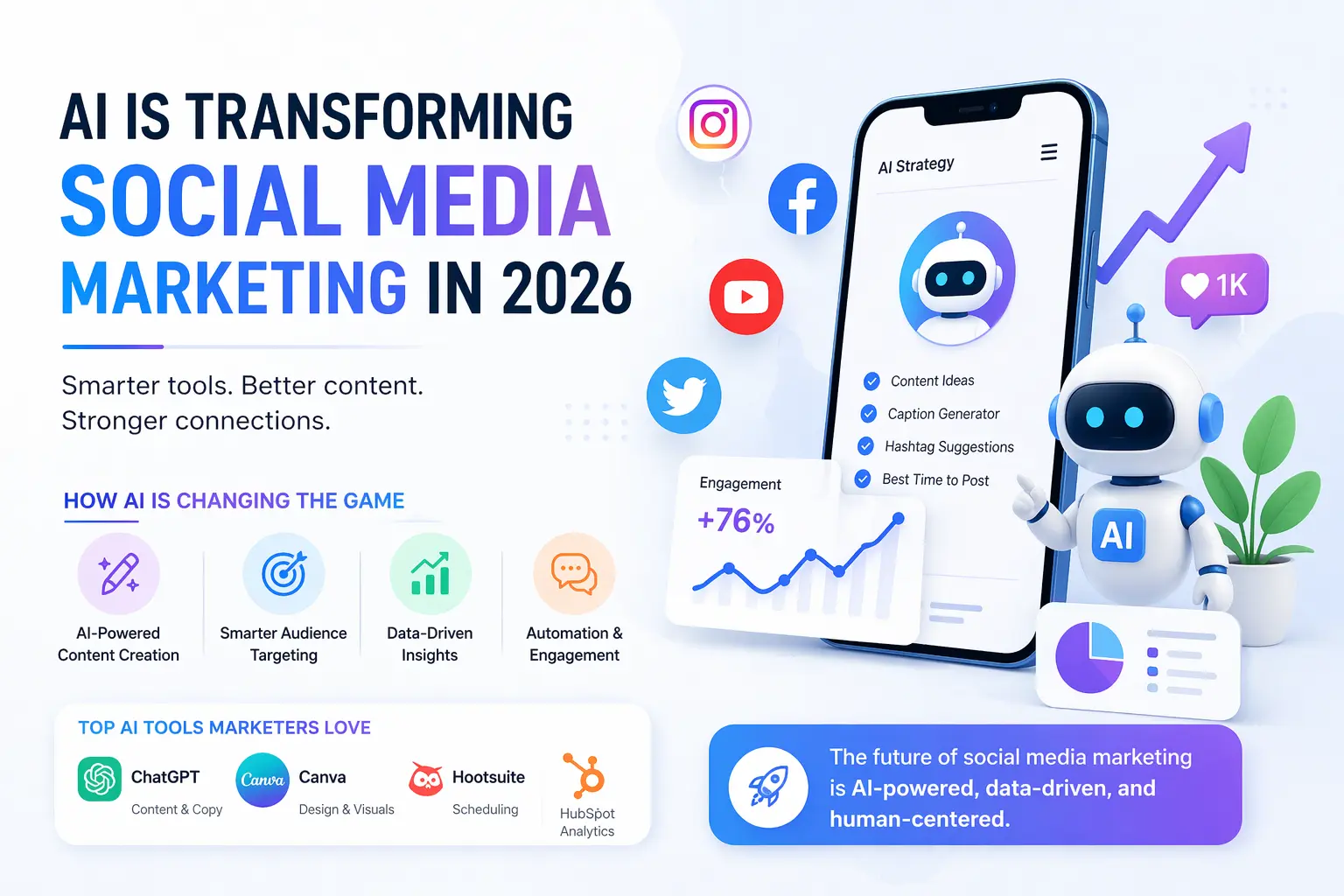
Quick answer: AI is changing social media marketing in 2026 by taking over the repetitive parts of the job, writing first-draft captions, generating visuals, scheduling at the best times, targeting ads automatically, and answering common customer questions, so a small team can run a strategy that used to need specialists for each task. The platforms themselves (Meta, TikTok, LinkedIn) now run on AI by default for ad delivery. The tradeoff: content is easier to produce but easier to make generic, so the businesses winning with AI in 2026 are the ones still adding a human layer of brand voice, local nuance, and judgment on top.
Key Takeaways
- AI is changing social media marketing across content creation, ad targeting, personalisation, and customer replies, not just one piece of it.
- The biggest shift is speed. What used to take a team days now takes hours, without losing quality if a human still reviews the output.
- Meta, TikTok, and LinkedIn now run their ad platforms on AI by default, so businesses using manual targeting are already at a disadvantage.
- The risk isn't using AI, it's over-relying on it for things that need a human touch, like community management and brand voice.
- Small businesses get the most value by automating one or two bottlenecks first, not overhauling everything at once.
AI in social media marketing means using machine learning and automation to make your social strategy smarter and faster, without needing a bigger team or budget to do it. A few years ago, "automation" mostly meant scheduling a post ahead of time. Today's AI tools do far more: they write drafts, pick the best time to post, decide who sees your ad, and even reply to common customer questions.
In practical terms, this covers the whole process. Coming up with content ideas, writing captions, designing graphics, choosing who to target, running the ad, and reporting on how it did, all of it can now involve AI at some stage, with a person still steering the direction.
The shift that matters most isn't any single tool, it's how much of the workflow now runs itself in the background. A few years ago, a small marketing team spent most of its week on production: writing, designing, scheduling, checking numbers. Today, AI handles the bulk of that groundwork, and the team's time shifts toward deciding what to say and reviewing what the AI produced, rather than producing everything from scratch.
Adoption isn't limited to big brands anymore. Small businesses across Singapore, Indonesia, Malaysia, and the Philippines are folding AI into their day-to-day marketing, mostly for three reasons. None of them require a technical background, and most businesses start with just one or two tools rather than a full overhaul.
How AI Is Changing Content Creation, Targeting, and Ads
This is the part that actually matters day to day. Here's where AI is making the biggest difference right now.
AI Content Creation Is Faster, Not Just Automatic
Tools like ChatGPT, Claude, and Jasper draft captions, repurpose blog posts into social content, and adapt tone across platforms. Canva AI and Adobe Firefly handle the visual side, producing on-brand graphics in seconds. The point isn't to replace creativity, it's to remove the blank-page problem so your team edits and refines instead of starting from zero every time.
AI Ad Targeting Runs the Big Platforms by Default
Meta's Advantage+, TikTok's Smart Performance Campaigns, and LinkedIn's Predictive Audiences all use AI to handle targeting, bidding, and creative testing automatically. For a small business without a dedicated media buyer, this means professional-level campaign management without the specialist cost.
AI Chatbots Handle the Repetitive Questions
AI chatbots running on Instagram DMs, Messenger, and WhatsApp Business now handle order status questions, booking requests, and basic product enquiries around the clock, and hand off the tricky ones to a real person. For businesses serving customers across different time zones in Southeast Asia, that's a real advantage.
Personalisation Happens Automatically
Different people now see different versions of the same ad, a new visitor sees an introduction, someone who's already engaged sees a direct offer, a past customer sees a loyalty message. This used to require manual audience segmentation. Now it's built into the ad platforms themselves.
What this means for you: if your competitors are already using AI-optimised ad formats and you're still running manual audiences, you're not just behind on tools, you're paying more per result than you need to.
AI Video Tools Are Making Reels and TikTok Cheaper to Produce
Short-form video is still the highest-reach format on almost every platform, and it used to be the most expensive to produce well. Tools like Runway, CapCut AI, and TikTok's own Symphony suite can now generate clips, captions, and even AI voiceovers from a simple prompt or raw footage. That doesn't replace genuine storytelling, but it removes a lot of the production cost that used to keep smaller businesses out of video entirely.
AI Analytics Tell You What's Working Before You Spend More
Instead of waiting until the end of a campaign to see what worked, predictive analytics tools now flag which content style, format, and timing are likely to perform well based on your account's own history. Tools like Supermetrics and the built-in insights in Meta Business Suite and TikTok Ads Manager pull all your platform data into one place, so you're not manually piecing numbers together from five different dashboards.
AI Makes Influencer Research Faster
Finding the right creator to partner with used to mean scrolling through hundreds of profiles by hand. Platforms like Modash and Heepsy now score creators on audience authenticity, engagement quality, and how well they match your product, cutting a research process that used to take days down to an afternoon. That matters most for smaller budgets, where picking the wrong influencer is a costly mistake.
Beyond likes and comments, AI-powered listening tools track brand mentions across platforms and read the sentiment behind them, positive, negative, or somewhere in between. That gives small businesses the same kind of real-time brand awareness that used to be an enterprise-only capability, and it's often the fastest way to catch a problem before it turns into a bigger one.
The AI Content Saturation Problem: Why Authenticity Still Wins
Here's the part most "AI is amazing" guides skip. When every business has access to the same content-generation tools, feeds fill up with posts that sound similar, same structure, same tone, same stock-photo energy. Audiences notice this faster than businesses do. Engagement on obviously AI-generated, unedited content is already starting to soften on several platforms, while accounts that keep a distinct voice continue to perform.
This isn't an argument against using AI. It's a reason to be deliberate about where you use it. Let AI handle the first draft, the scheduling, the targeting, the analysis. Keep a real person responsible for the final edit, the specific local references, the jokes that only make sense to your actual audience, and anything that touches a real customer conversation. That combination, not AI alone, is what's actually working for brands in Southeast Asia right now.
The right tools depend on where your time actually goes. Here's a quick honest breakdown by category.
| Category | Tool | Best For |
|---|---|---|
| Writing | ChatGPT / Claude | Captions, content ideas, repurposing long-form content |
| Design | Canva AI | Quick, on-brand graphics and Reels thumbnails |
| Scheduling | Hootsuite / Buffer | Posting time optimisation, multi-account management |
| Chatbots | ManyChat | Instagram DM and WhatsApp Business automation |
| Ads | Meta Advantage+ / TikTok Smart Performance | Automated targeting and bid optimisation |
A common mistake is trying to adopt several of these at once. Pick the tool that solves your biggest bottleneck first, get comfortable with it, then add the next. Businesses that try to overhaul writing, design, scheduling, and ads simultaneously usually end up using none of the tools properly.
AI hasn't replaced the need for a real strategy, a clear brand voice, or genuine understanding of your audience. What it's done is remove the ceiling on what a small team can produce and how precisely they can reach the right people. The businesses gaining ground in 2026 aren't the ones using the most AI tools, they're the ones using a few tools well, with a person still making the final call on tone, timing, and what actually gets published.
The case for AI here isn't abstract. It shows up in a few concrete, measurable ways once it's actually in place.
Challenges to Watch Out For
AI isn't risk-free, and being upfront about that makes for a stronger strategy, not a weaker one. Most of the mistakes businesses make here come from moving too fast rather than from the tools themselves.
Don't try to automate everything at once. Start with your biggest bottleneck and build from there. Most businesses that jump straight to a full AI-powered stack end up under-using most of it, while the ones that go step by step actually stick with what they build, because each phase proves its value before the next one starts.
Phase 1
Identify your biggest time drain, usually content writing or scheduling, and fix that first with one tool rather than five at once.
Phase 2
Move your paid campaigns to AI-optimised formats like Meta Advantage+ or TikTok Smart Performance, and compare results against your old manual setup.
Phase 3
Add a chatbot for common questions, connect your reporting into one dashboard, and revisit what's automated every few months as your business grows.
Our AI automation integration service helps businesses set up exactly this kind of workflow, and our social media marketing service handles the strategy and content side end to end for businesses across Singapore and the wider region.
How to Measure Whether AI Is Actually Working for You
Adopting a tool isn't the same as getting a return on it. Track these against your numbers from before you started, not against a generic benchmark:
If none of these move after a month or two, the tool isn't the problem, the setup probably is. Revisit your prompts, your targeting settings, or which tasks you've handed over before assuming AI "doesn't work" for your business.
What's Next: AI Trends Beyond 2026
A few shifts are worth watching, even if you're not ready to act on them yet. Conversational commerce, buying directly through a chat with a brand on WhatsApp or Instagram DMs, is growing fastest in the Philippines, Indonesia, and Malaysia, where messaging apps are already central to how people shop. Virtual, AI-generated influencers are moving from novelty to genuine brand partnerships in some categories. And personalisation is heading toward tailoring the entire customer journey, not just the ad creative, to each individual. None of this requires action today, but it's worth knowing where the ground is moving.
Quick Glossary
- AI ad optimisation
- Using AI to automatically choose who sees your ad, how much to bid, and which creative performs best.
- Predictive analytics
- AI that forecasts which content or campaigns are likely to perform well, based on past data.
- Conversational AI
- Chatbots that can hold a natural back-and-forth conversation with a customer, rather than just following a fixed script.
Frequently Asked Questions
How is AI changing social media marketing in 2026?
AI is changing social media marketing by speeding up content creation, improving ad targeting, personalising what each person sees, and automating routine tasks like scheduling and replying to common questions. The overall effect is that smaller teams can now run strategies that used to need a much bigger team and budget.
What is the best AI tool for social media marketing?
There's no single best tool, it depends on your bottleneck. ChatGPT or Claude work well for captions and content ideas, Canva AI for quick visuals, and Hootsuite or Buffer for scheduling. Most businesses get the best results using two or three tools together rather than one do-everything platform.
Will AI replace social media managers?
No. AI handles the repetitive, high-volume parts of the job, like drafting captions or scheduling posts, but strategy, brand voice, community management, and creative judgment still need a person. The role is shifting toward oversight and strategy rather than disappearing.
Is AI social media marketing worth it for small businesses?
Yes, especially for small teams. AI tools remove a lot of the manual work around content and scheduling, which means a small business can maintain a consistent, professional presence without hiring a full marketing team.
What are the risks of using AI in social media marketing?
The main risks are over-automating things that need a human touch, like community management or crisis responses, publishing unedited AI content that sounds generic, and mishandling customer data under privacy laws like Singapore's PDPA.
How much does AI social media marketing cost?
Many AI writing and scheduling tools start free or under SGD 30 a month for small teams. More advanced platforms with analytics and multi-account management run SGD 100 to 350 a month. Working with an agency to build and manage an AI-powered strategy typically starts from a few hundred dollars a month depending on scope.
How do I know if AI is actually improving my social media results?
Track time saved per week, cost per click or lead before and after switching to AI-optimised ads, engagement rate on AI-assisted content, and how fast customer questions get answered. Compare these against your own numbers from before you started, not a generic industry benchmark.
Does AI-generated content hurt engagement on social media?
Unedited, obviously AI-generated content is starting to underperform as feeds fill up with similar-sounding posts. Content that uses AI for the first draft but keeps a distinct brand voice, local references, and human editing continues to perform well.
Whether you need smarter ad targeting, a faster content workflow, or a chatbot handling your DMs, our team can show you exactly where AI would help most in your specific setup.