Build a Complete Uber Clone for Rides, Food Delivery and Business Operations for Southeast Asia
The ride hailing market across Singapore, Malaysia, Indonesia, and the Philippines is mature, competitive, and still growing. Winning in it requires more than a working app — it requires a platform that is faster, smarter, and better managed than what passengers and drivers are already used to.
At Inno Panda, we develop Uber clone apps and ride hailing platforms for transport startups, taxi operators, fleet companies, and on-demand delivery businesses that want a branded, fully owned platform — not a dependency on someone else's marketplace.
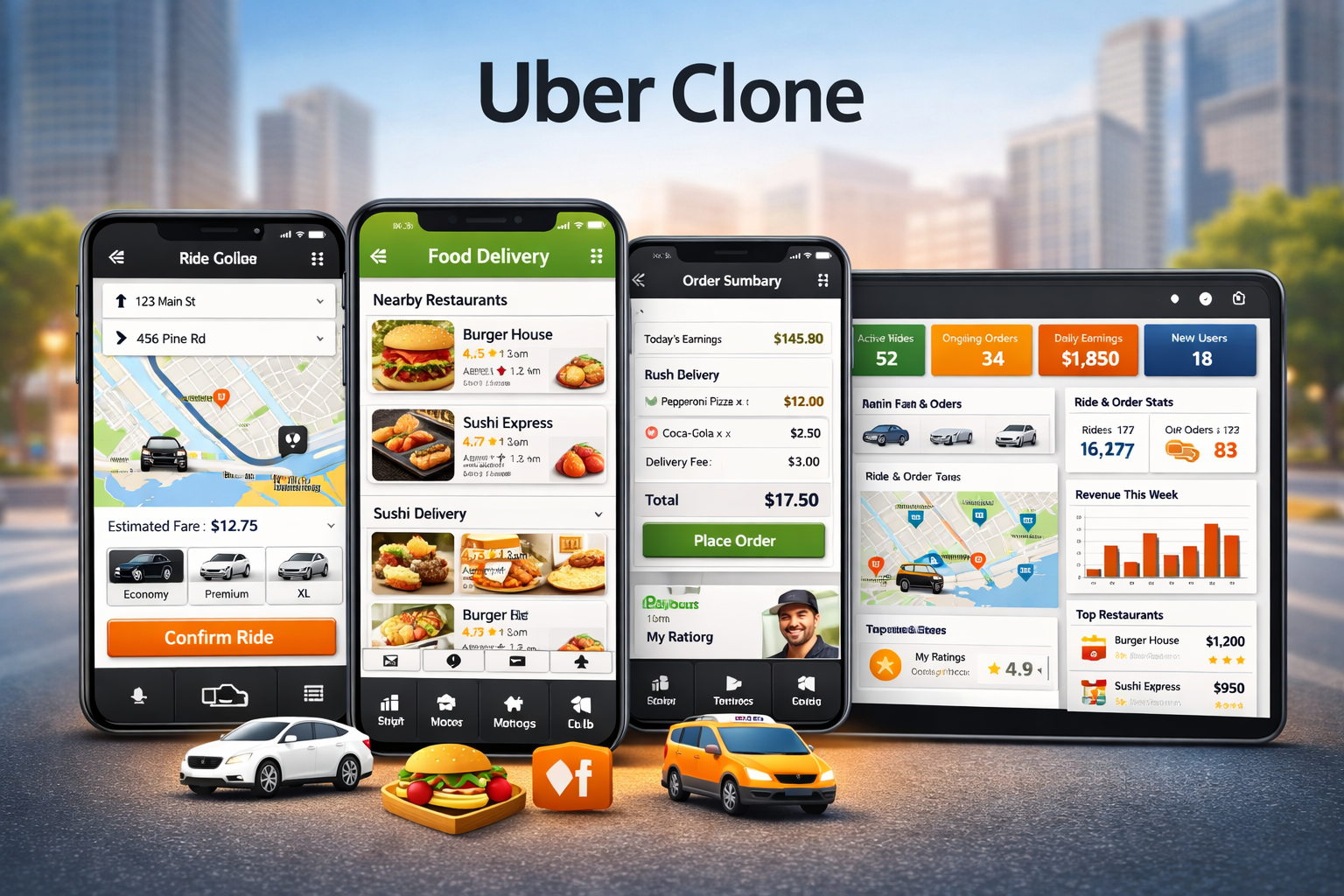
Uber Clone App Three Connected Platforms, One Complete Business
A successful Uber clone app is not a single application. It is three separate products — a passenger app, a driver app, and an admin dashboard — each built for a different user with completely different needs. All three have to work together seamlessly, because a failure in any one of them breaks the experience for everyone else.
Passenger App — Booking, Tracking, Payments
Passengers judge a ride hailing app in the first 30 seconds. If booking is slow, pricing is unclear, or the tracking is unreliable, they switch to a competitor. We design passenger apps that feel effortless from the moment someone opens them.
- Instant ride booking with GPS pickup and drop-off detection
- Multiple vehicle categories — economy, premium, XL, bike, EV
- Upfront fare estimate with surge pricing shown before confirmation
- Live driver tracking and accurate ETA updates
- Split fare, digital receipts, and full trip history
- Saved locations, favourite drivers, and schedule-ahead booking
Uber Eats Clone — Food Delivery Module
If you want to expand beyond rides into food delivery — or launch with food delivery as your primary model — we build the full Uber Eats clone experience with restaurant discovery, real-time order tracking, and delivery partner management integrated into the same platform.
- Restaurant and menu browsing with filters and categories
- Real-time order status from kitchen confirmation to doorstep
- Scheduled orders for later delivery slots
- Promo codes, loyalty rewards, ratings, and reviews
- Contactless delivery with photo proof
- Multi-restaurant ordering and group order support
Admin Dashboard — Full Operational Control
The admin panel is where your business actually runs. Driver verification, revenue reporting, dispute resolution, surge pricing configuration, and promotional campaign management — all in one backend built to scale with your operation, not against it.
- Live fleet map with all active trips and drivers
- Trip and order analytics with peak hour and zone insights
- Driver and restaurant partner onboarding and verification
- Revenue, commission, and payout reporting
- Promotion management and push notification centre
- Customer support tools and dispute resolution workflow
Build App Like Uber How the Passenger Journey Works in Practice
When you build an app like Uber, the product quality shows up in the smallest details — how fast the map loads, how clearly the pricing is shown, and how smoothly a booking moves from request to confirmed driver. We design every step of the passenger journey to remove friction and build confidence.
Book a Ride or Place an Order
Passengers enter their pickup and destination for rides, or browse restaurants and menus for food delivery. Fare estimates appear immediately no surprises after booking. Scheduled and instant options are both available from the same screen.
Confirm and Pay
The app shows a clear summary — vehicle type, estimated arrival, fare or order total, and selected payment method. Passengers can pay by card, e-wallet, PayNow, GrabPay, GoPay, or in-app wallet depending on their market and preference. One tap confirms the booking.
Track in Real Time and Rate
Live GPS tracking shows exactly where the driver or delivery partner is, with ETA updates that reflect actual traffic conditions. After the trip or delivery, passengers rate the experience — feeding the quality data your admin team uses to maintain driver standards.
Ride Hailing App Development Company Driver and Partner Features That Retain Good Drivers
The biggest operational challenge in ride hailing is driver supply. Great passengers find better alternatives when driver coverage is thin. We build driver apps that make working on your platform easier and more rewarding than the alternatives — because driver retention is as important as passenger acquisition.
Earnings Dashboard
Daily, weekly, and monthly earnings breakdowns with completed trips, incentive bonuses, tips, and deductions shown clearly. Drivers know exactly what they earned and why — no confusion, no disputes about pay.
Navigation and Route Tools
Google Maps and Waze integration with in-app navigation optimised for your operating city. Traffic-aware routing reduces trip time and increases the number of jobs a driver can complete per hour.
Job Management and Availability
Simple online and offline toggle, job acceptance with a visible countdown, and clear cancellation policies. Drivers control their availability without feeling trapped or pressured — which improves online hours and platform reliability.
Multi-Service Switching
In slow ride-hailing periods, drivers can switch to food delivery or parcel delivery from the same app — maximising their earning potential and keeping them active on the platform when passenger demand dips.
Taxi Booking App Development Services Complete Feature List
Every Uber clone platform we build is a complete, production-ready ecosystem — not a prototype with half the features working. Here is what is included in a full-scope taxi booking app development project.
Hire App Developers for Taxi App Built for Singapore, Malaysia, Indonesia, and the Philippines
When you hire app developers for a taxi app in Southeast Asia, you need a team that understands the specific market dynamics of each country — not just the technical requirements. Payment preferences, regulatory environments, and passenger expectations differ significantly across Singapore, Malaysia, Indonesia, and the Philippines. We build with those differences incorporated from the start.
Ride Hailing App Development Singapore
Singapore's ride hailing market is dominated by Grab, but there is genuine demand for alternatives — especially from corporate clients, specialised transport services, and EV-focused fleets. We build Singapore ride hailing apps with PayNow and GrabPay integration, PDPA compliance, and a UX benchmarked against the high standard Singapore passengers already expect. Corporate account management and GST invoicing are built in.
Taxi App Development Malaysia
Malaysia's transport app market has significant room for challengers, particularly outside Klang Valley. We build Malaysian ride hailing platforms with Touch 'n Go, Boost, and FPX bank transfer support, Malay and English localisation, and architecture that handles geographically distributed demand across Peninsular and East Malaysia. Local regulatory alignment with the Land Public Transport Authority requirements is included.
Ride Hailing App Indonesia
Indonesia is Gojek's home market — which means building a competitive ride hailing app here requires genuine product quality and strong local market understanding. GoPay, OVO, DANA, and bank transfer payment support are non-negotiable. Bahasa Indonesia localisation, a mobile-first UX designed for variable connectivity, and ojek (motorbike taxi) service category support are all part of how we build for Indonesia.
Taxi Booking App Philippines
The Philippines has strong ride hailing demand driven by urban congestion and limited public transport alternatives. GCash is the dominant payment method and must be integrated from day one. We build Philippines taxi booking apps with Filipino and English language support, jeepney and tricycle service categories if relevant to your model, and LTFRB compliance tools for driver and vehicle accreditation management.
Uber Like App Source Code Custom Build vs. White-Label vs. Script
When businesses first look at ride hailing app development, they often ask about Uber like app source code — pre-built scripts or white-label platforms that promise a faster, cheaper route to market. Here is an honest answer on what each approach actually delivers.
Pre-built source code scripts
Off-the-shelf source code is the fastest way to launch something functional — but the hidden costs are real. Most scripts require significant customisation before they are production-ready, they come with security vulnerabilities that are difficult to audit, and they have fixed architectures that make adding SEA-specific payment gateways, languages, or service categories expensive and slow. They work for demos. They struggle under real operational load.
White-label platforms
White-label platforms sit between scripts and custom builds. They offer more stability and some customisation, but you are still building on someone else's architecture. That means limitations on what you can change, ongoing licensing costs, and no control over your own technical roadmap. When the platform provider makes changes, your business is affected whether you like it or not.
Custom build (what we do)
A custom-built ride hailing platform takes longer and costs more upfront. But you own the code, you own the architecture, you can make any change you need, and you are not paying per-trip licensing fees to a platform provider. For a business that plans to operate at scale, the custom build almost always has a better total cost of ownership over three to five years.
See our SaaS development services for platform architecture planning and technical roadmap support.Taxi App Development Cost What You Should Actually Expect to Pay in 2025
Taxi app development cost varies enormously depending on scope, platform, team location, and how many of the features listed above you need at launch versus later. Here is a realistic breakdown for businesses evaluating this investment.
How to Build App Like Uber in 2026 — What the Build Actually Involves
Building an app like Uber requires three separate mobile applications (iOS and Android for passenger and driver apps — so four apps total), a backend API, an admin web dashboard, GPS and mapping integration, payment gateway connections, and push notification infrastructure. Each component has its own complexity and timeline. The passenger app alone is not the whole build — it is closer to a third of it.
The discovery phase — where we define your service model, pricing logic, payment flows, and market requirements — is where the majority of expensive mistakes are avoided. We treat it as a required investment, not a billable overhead.
Cost to Build Uber Clone App — Realistic SGD Figures
An MVP ride hailing app — passenger booking, driver acceptance, live GPS tracking, basic admin dashboard, and one payment gateway — typically starts from SGD 70,000 to SGD 130,000. A full-platform build with food delivery, multiple vehicle categories, corporate accounts, multi-market localisation, and advanced analytics runs significantly higher and is scoped individually.
We provide a detailed, fixed-price proposal after a free discovery session. You will know exactly what is included and what it costs before any development begins — no scope creep, no billing surprises at the end of the project.
Features of Ride Hailing App That Drive Cost
The features that add most to development cost are: real-time GPS tracking accuracy and map rendering, multi-payment gateway integration across different SEA markets, surge pricing algorithms, driver verification and document management workflows, and multi-language localisation done properly rather than machine-translated. We advise on which features are essential for your MVP and which can be added in a second release — keeping your launch timeline and budget realistic without cutting corners on what matters.
See our API development services for payment gateway and third-party integration architecture.Uber Clone App Development Company — Why Businesses Choose Inno Panda
There are a lot of development teams that will take a ride hailing project. The difference is in what you get after the project — an app that is running reliably in production, a team that understands your market, and a codebase you own and can build on without starting from scratch every time something needs to change.
We understand the SEA ride hailing market
We have built transport and delivery platforms for markets across Singapore, Malaysia, Indonesia, and the Philippines. We know what local payment gateways are non-negotiable in each country, what regulatory requirements affect driver verification, and how passenger behaviour differs across these markets. That knowledge is built into every platform we deliver.
We build for production load, not demos
Every platform we build is tested under realistic operational conditions before launch. We use load testing to verify that the GPS tracking, matching algorithm, and payment processing hold up when hundreds of simultaneous trips are active — because that is what your platform will need to handle within months of a successful launch.
We stay as your development partner after launch
A ride hailing platform is never finished. New service categories, new markets, improved matching logic, driver incentive changes, new payment methods — the platform needs to keep evolving. We offer ongoing development retainers so you always have the technical team to implement changes quickly and correctly as your business grows.
Connect with our AI automation services to automate driver onboarding, revenue reconciliation, and operational reporting.Taxi Booking App Development Guide — Frequently Asked Questions
How long does it take to build a ride hailing app?
An MVP ride hailing platform — passenger app, driver app, admin dashboard, GPS tracking, and core payments — typically takes four to six months from discovery to launch. A full-platform build with food delivery, multi-vehicle categories, multi-market localisation, and enterprise features takes eight to twelve months. We work in phased releases so you can launch your core service and start generating real operational data before the full platform is complete.
Do you build both iOS and Android apps?
Yes. We build native or cross-platform apps for both iOS and Android — for passenger and driver applications. The choice of native versus cross-platform depends on your budget, timeline, and performance requirements. We recommend the right approach for your specific situation during the discovery phase.
Can the platform support both rides and food delivery?
Yes. We build multi-service platforms where passengers can book rides and order food from the same app, and drivers can switch between ride hailing and food delivery based on demand. This is how Gojek and Grab operate — and it is a significant advantage for platform stickiness and driver earnings optimisation.
What payment gateways do you support?
We integrate market-specific payment gateways for each SEA country — PayNow and GrabPay for Singapore, Touch 'n Go and FPX for Malaysia, GoPay, OVO, and DANA for Indonesia, and GCash for the Philippines — alongside global options like Stripe and in-app wallets. See our API development services for the full integration scope.
Is this a pre-built script or a custom development?
Everything we build is custom development — not an off-the-shelf script or white-label platform. You own the code, you control the architecture, and you can make any change without depending on a third-party platform provider. For a business operating at scale, this is almost always the right approach.
Can you integrate with our existing systems?
Yes. We build API integrations with existing HR systems, accounting platforms, fleet management tools, and corporate travel management systems. If you are building a ride hailing platform alongside an existing transport or logistics operation, we design the integration architecture to connect them without duplicating work or data. See our API development services for more detail.
Ready to Build Your Own Ride Hailing Platform Across Southeast Asia?
Whether you are a transport startup ready to launch, a taxi operator looking to compete digitally, or a fleet company that wants to own its customer relationship instead of depending on aggregators — we can build the platform that makes it possible. Talk to our team and let us show you what a properly built ride hailing app looks like for your market and your business model.