What a web app really costs in Singapore, what you should get for the money, and why more local businesses are building their own software instead of renting it.
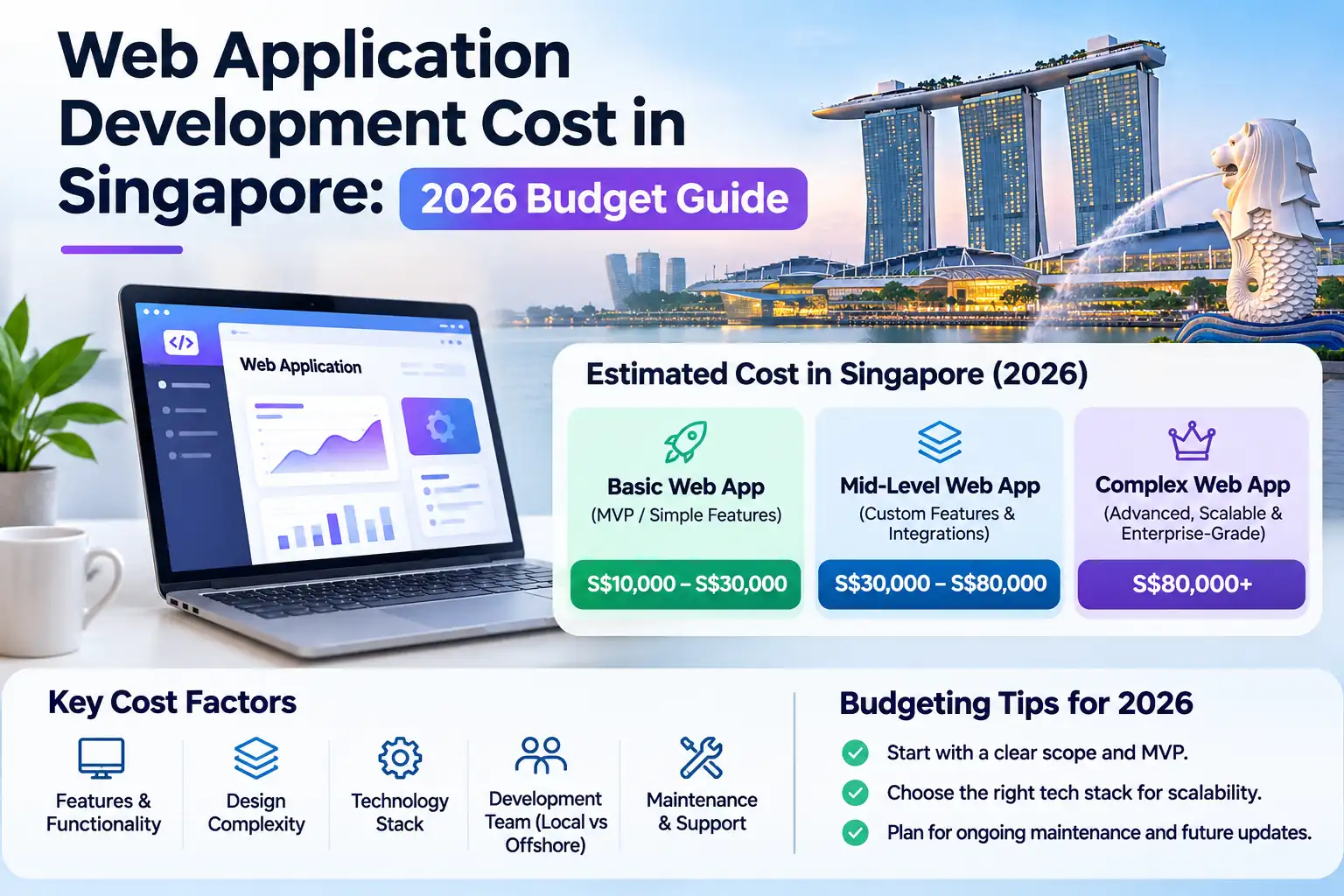
Most custom web applications in Singapore land somewhere between SGD 10,000 and SGD 200,000. Yes, that's a huge gap. This guide walks through what sits behind it, what web application development services should actually include, and how to read vendor quotes without getting lost.
A quick note on these numbers: they're indicative market ranges, not fixed prices. Quotes in Singapore vary a lot from one vendor to the next, and your final figure depends on your scope.
A web application is software that runs in the browser and does real work for your business: logins, dashboards, bookings, payments, approvals, data processing. A website mostly tells people things. That's the main reason web app development costs more than a brochure site.
If all you need is a set of pages, a WordPress or WooCommerce build may be plenty. But if your users need accounts, custom logic or a link into your internal systems, you're in web application territory. At that point you'll want a web application development company that's comfortable with both design and engineering.
Think about how your business runs today. Orders come in over WhatsApp, approvals happen by email, and the numbers live in three spreadsheets that never quite match. It works, until it doesn't. A web application product replaces that patchwork with one system that does exactly what your team needs.
Singapore is also a market where customers expect to book, pay and track things online at any hour. And if you sell into Malaysia, Indonesia or the Philippines, a web app travels with you without needing a new office in every country. Here's where it makes the biggest difference.
Approvals, invoices, reports and data entry move into one place. Fewer copy-paste errors, and more time for work that needs a human.
Self-service portals, online booking and live order tracking mean customers don't have to wait for office hours.
If your process or expertise can be packaged as software, a web app can turn into a new revenue line, like a SaaS subscription.
You collect first-party data and see what's working, instead of relying on whatever a third-party tool chooses to show you.
Off-the-shelf tools make you adapt. A custom application is built around how your business already runs.
An application designed with the Personal Data Protection Act in mind makes it easier to handle personal data responsibly.
So a web application product isn't really an IT project. It's a business asset that supports efficiency, customer loyalty and growth, which is why so many Singapore SMEs and larger companies invest in professional web application development services.
| Complexity | Typical cost (SGD) | Typical timeline | Example |
|---|---|---|---|
| Simple or MVP | 10,000 – 30,000 | 6 – 12 weeks | Internal tool, basic portal, validation prototype |
| Mid-complexity | 30,000 – 80,000 | 3 – 5 months | Customer portal, booking system, dashboard with integrations |
| Complex or enterprise | 80,000 – 200,000+ | 6 – 12+ months | SaaS platform, marketplace, system connected to ERP or CRM |
| Application type | Indicative cost (SGD) | What drives the price |
|---|---|---|
| Internal dashboard or admin tool | 10,000 – 35,000 | Number of user roles, reports and data sources |
| Customer portal | 25,000 – 70,000 | Authentication, account features, notifications |
| Booking or reservation system | 20,000 – 60,000 | Scheduling logic, payments, reminders |
| Custom ecommerce platform | 25,000 – 80,000 | Catalogue size, payments, inventory, shipping rules |
| SaaS MVP | 40,000 – 100,000 | Multi-tenancy, subscriptions, admin, analytics |
| Marketplace | 60,000 – 150,000 | Two-sided accounts, payouts, trust and moderation |
| Enterprise or ERP-integrated system | 100,000 – 250,000+ | Legacy integration, security, compliance, scale |
When you hire a web application development company, the price should buy you more than lines of code. Good web application development services in Singapore cover strategy, design, engineering and support, so the app launches well and keeps working afterwards. Ask every vendor which of the following are in the quote.
Front-end and back-end engineering built around your workflow, users and business rules.
User flows, wireframes and clickable prototypes, so people can use the app without a manual.
Multi-user platforms with subscriptions, roles and dashboards that can grow with you.
Connections to payment gateways, CRM, ERP, accounting tools and the other systems you already use.
Customer portals, booking systems and custom online stores with secure checkout.
Functional, performance and security testing, with PDPA-aware handling of personal data.
Reliable hosting, backups, monitoring and a release process that doesn't break on launch day.
Bug fixes, updates, security patches and new features once you're live.
Once the app is live, people still need to find it. Our SEO packages help new platforms and product pages reach the right customers.
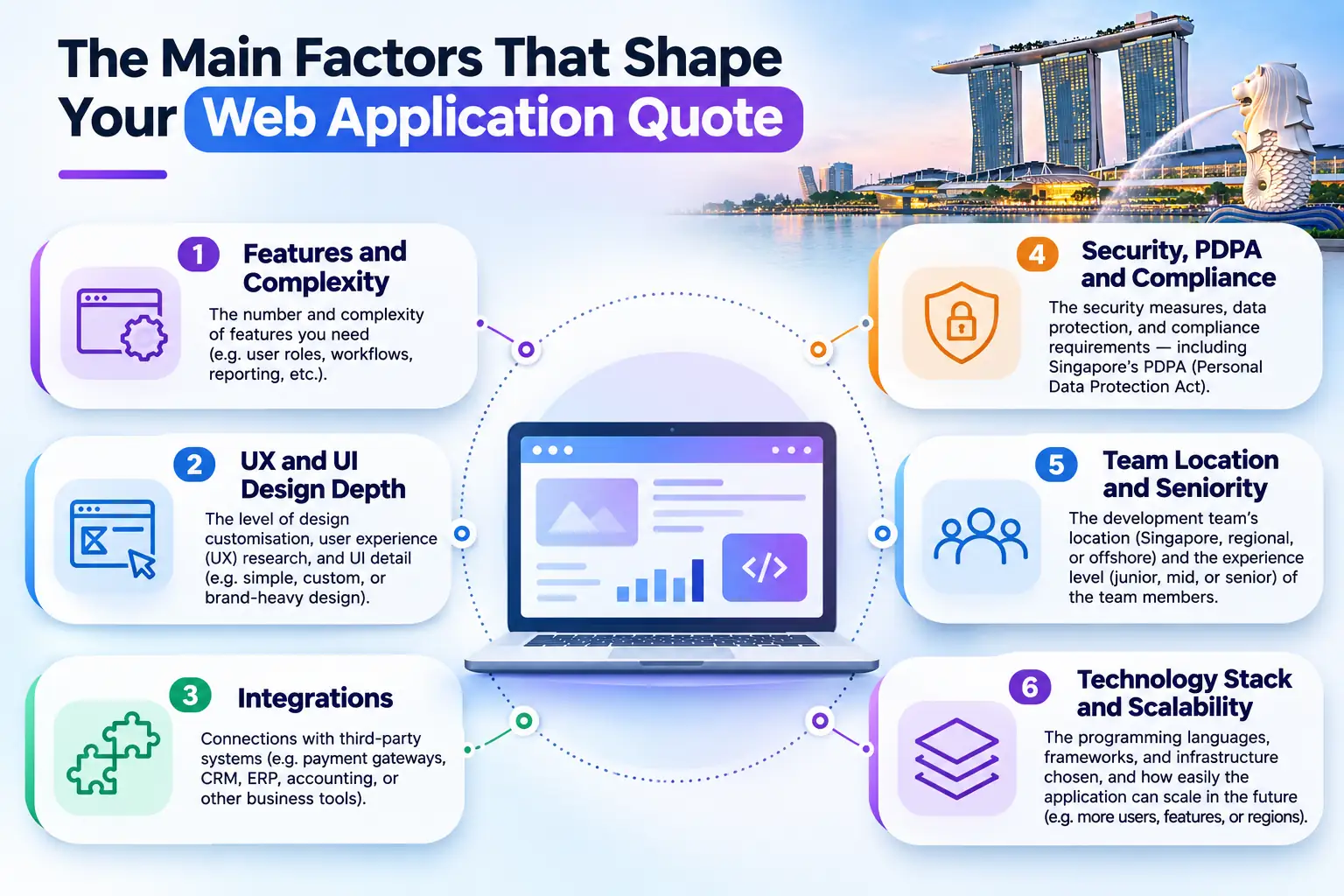
Every feature adds design, development and testing time. User roles, approval workflows, reporting and search each multiply the effort. Before you ask for quotes, sort your list into "must-have" and "nice-to-have".
A clean, tested interface costs more than a ready-made template. It also means less training, fewer mistakes and fewer people giving up halfway. Complex apps need user flows and prototypes before anyone writes code.
Payment gateways, PayNow, accounting tools, CRMs and government or identity services all add work. Each one needs building, testing and ongoing monitoring.
If your app holds personal data, it needs to respect Singapore's Personal Data Protection Act. Regulated sectors like finance and healthcare bring extra requirements, plus more security testing.
Singapore teams cost more per hour than offshore ones, but you get closer collaboration, local context and clear accountability. Senior engineers charge more, though they often save you rework later.
A simple app on a mainstream stack is cheaper to build and maintain. If you're planning for heavy traffic, real-time features or several regions, expect extra architecture work.
The build quote is rarely the whole story. Ask vendors to price the items below separately, so nothing catches you off guard after launch.
Monthly infrastructure, backups and monitoring grow as usage grows.
Security patches, bug fixes and updates keep the app safe and working.
Penetration tests and audits matter when the app holds sensitive data.
Maps, SMS, email, payments and analytics often come with usage fees.
Changing scope halfway through adds cost, so agree how changes are handled up front.
Check whether the quote includes GST, which is currently 9% in Singapore.
| Model | Best for | Watch out for |
|---|---|---|
| Fixed price | A well-defined scope with clear requirements | Any change becomes a paid change request |
| Time and materials | Evolving products and phased builds | Needs active budget tracking and regular reporting |
| Dedicated team | Long-term product development | Bigger commitment and more of your management time |
Cheaper and flexible, and a good fit for small, clear tasks. The risk grows with complexity, because one person ends up carrying design, security and continuity.
Costs more, but you get strategy, design, QA and someone accountable for delivery, plus local context and PDPA awareness. Best for business-critical apps.
Lower hourly rates, but time zones, communication and quality control need strong project management on your side.
Don't build what you can buy. If a standard SaaS tool already covers about 80% of your process, subscribing is cheaper and quicker. Go for custom web application development when the software is your product, your workflow is genuinely different, or you need integrations that existing tools just can't provide.
Government support can take some weight off your budget, but read the current rules carefully. Historically, the Productivity Solutions Grant has focused on pre-approved, off-the-shelf solutions, while the Enterprise Development Grant has supported custom, bespoke projects. Enterprise Singapore has announced that PSG, EDG and Market Readiness Assistance are being merged into a single scheme called EDGE from the second half of 2026.
Workshops pin down goals, users, features and priorities. You walk away with a scope and an estimate.
Wireframes and prototypes get tested with real users before development starts.
Features are built in short cycles, with regular demos so you can give feedback early.
Functional, performance and security testing catch problems before your customers do.
Deployment, training and documentation get your team ready to run the app.
Monitoring, fixes and new features, guided by how people actually use the app.
A good quote starts with a good brief. Before you contact any web application development services provider, get these four things down on paper:
The problem the app solves and how you'll know it's working.
Who will use it, and what each type of user can do.
A prioritised feature list, ideally with a few reference apps you like.
The systems it needs to talk to, such as payments, CRM or accounting.
And watch for these red flags when quotes come back:
The cheapest quote is rarely the cheapest project once rework, delays and maintenance are counted.
Most custom web applications in Singapore cost between SGD 10,000 and SGD 200,000 or more. A simple internal tool or MVP sits near the bottom, a customer portal or booking system lands in the middle, and a SaaS platform or enterprise system sits at the top. What decides it is your scope, your integrations and how much compliance work is involved.
A proper package covers discovery and scoping, UX and UI design, front-end and back-end development, integrations, testing and security checks, cloud deployment, and support after launch. Ask which of these are in the quote and which are charged separately.
It lets you automate manual work, serve customers at any hour and turn your own process into software you can scale. In a competitive, digital-first market like Singapore, it also gives you data, control and flexibility that off-the-shelf tools often can't match.
Because vendors are often pricing different things. One quote might include discovery, design, testing and support, while another covers coding only. Compare what's included, not just the headline number.
Usually, yes. A website mostly shows information. A web app handles logins, data, workflows and integrations, and all that backend logic, security and testing adds cost.
A simple MVP can take roughly 6 to 12 weeks, a mid-complexity app 3 to 5 months, and a complex platform 6 to 12 months or longer. A lot depends on how fast your team makes decisions and gives feedback.
Plan for cloud hosting, security updates, bug fixes, monitoring, third-party licences and new features. Many businesses set aside a meaningful share of the build cost each year for maintenance, so ask for a support quote alongside the build quote.
Possibly. The Productivity Solutions Grant has focused on pre-approved, off-the-shelf solutions, while the Enterprise Development Grant has backed custom projects. Enterprise Singapore has announced that these schemes are being merged into a new EDGE grant, so check the current rules on the official Enterprise Singapore and GoBusiness pages before you sign anything.
Freelancers suit small, well-defined jobs. A Singapore agency makes more sense when you need strategy, design, security and someone accountable for delivery. Offshore teams can lower hourly rates but need strong project management and clear communication. Choose based on risk and complexity, not price alone.
Off-the-shelf is cheaper and faster when your process is fairly standard. Custom development makes sense when the software is core to your business, your workflow is unique, or you need integrations that existing tools can't offer.
Got a project in mind? Tell us what you're trying to build and we'll help you scope it and set a realistic budget.
Tell us what you want to build. We'll look at your requirements, suggest the right scope and give you a straightforward estimate in SGD, with no obligation. Book a free consultation and know what your web application will cost before you commit.
Book a Free Consultation Request a Quote