Zero-Click Search in 2026: Why 68% of Google Searches Don't Reach a Website (And How to Win Anyway)
- 1 Zero-Click Search in 2026: Why 68% of Google Searches Don't Reach a Website (And How to Win Anyway)
- 1.1 Key Takeaways
- 1.2 What Is Zero-Click Search?
- 1.3 Zero-Click Search Statistics in 2026: What the Data Shows
- 1.4 Why Are Zero-Click Searches Increasing in 2026?
- 1.5 How Zero-Click Search Is Changing SEO in 2026
- 1.6 Does Zero-Click Search Mean SEO Is Dead?
- 1.7 Zero-Click Search vs AEO vs GEO: What's the Difference?
- 1.8 Zero-Click Search Is Spreading Beyond Google
- 1.9 Can AI Systems Even Reach Your Content? Crawler Access for GEO
- 1.10 How to Win Zero-Click Searches in 2026
- 1.10.1 1. Optimize for Search Intent
- 1.10.2 2. Answer Questions Directly
- 1.10.3 3. Optimize for Featured Snippets
- 1.10.4 4. Optimize for People Also Ask
- 1.10.5 5. Create Answer-First Content
- 1.10.6 6. Use Structured Data and Schema Markup
- 1.10.7 7. Strengthen E-E-A-T Signals
- 1.10.8 8. Build Topical Authority
- 1.10.9 9. Strengthen Brand and Entity Signals
- 1.10.10 10. Optimize for AI Overviews
- 1.10.11 11. Build Content That AI Systems Can Easily Understand and Cite
- 1.10.12 12. Optimize Local Search Visibility
- 1.11 Not Sure How Visible Your Business Already Is?
- 1.12 What Should You Optimize for If Users Don't Click?
- 1.13 How Zero-Click Search Impacts Businesses
- 1.14 Zero-Click Search Strategy for Singapore Businesses
- 1.15 Common Zero-Click SEO Mistakes to Avoid
- 1.16 How to Measure Zero-Click SEO Success
- 1.17 How Inno Panda Can Help Your Business Adapt to Zero-Click Search
- 1.18 Quick Glossary: Key Zero-Click Search Terms
- 1.19 Frequently Asked Questions About Zero-Click Search
- 1.20 The Future of SEO Is Bigger Than the Click
- 1.21 Ready to Build Visibility That Survives the Zero-Click Era?
- 1.22 Related Reading
More than two out of three Google searches now end without a click. Here's what the latest research actually shows, why AI Overviews are accelerating the shift, and a practical SEO, AEO, and GEO plan to stay visible even when nobody clicks through.
Key Takeaways
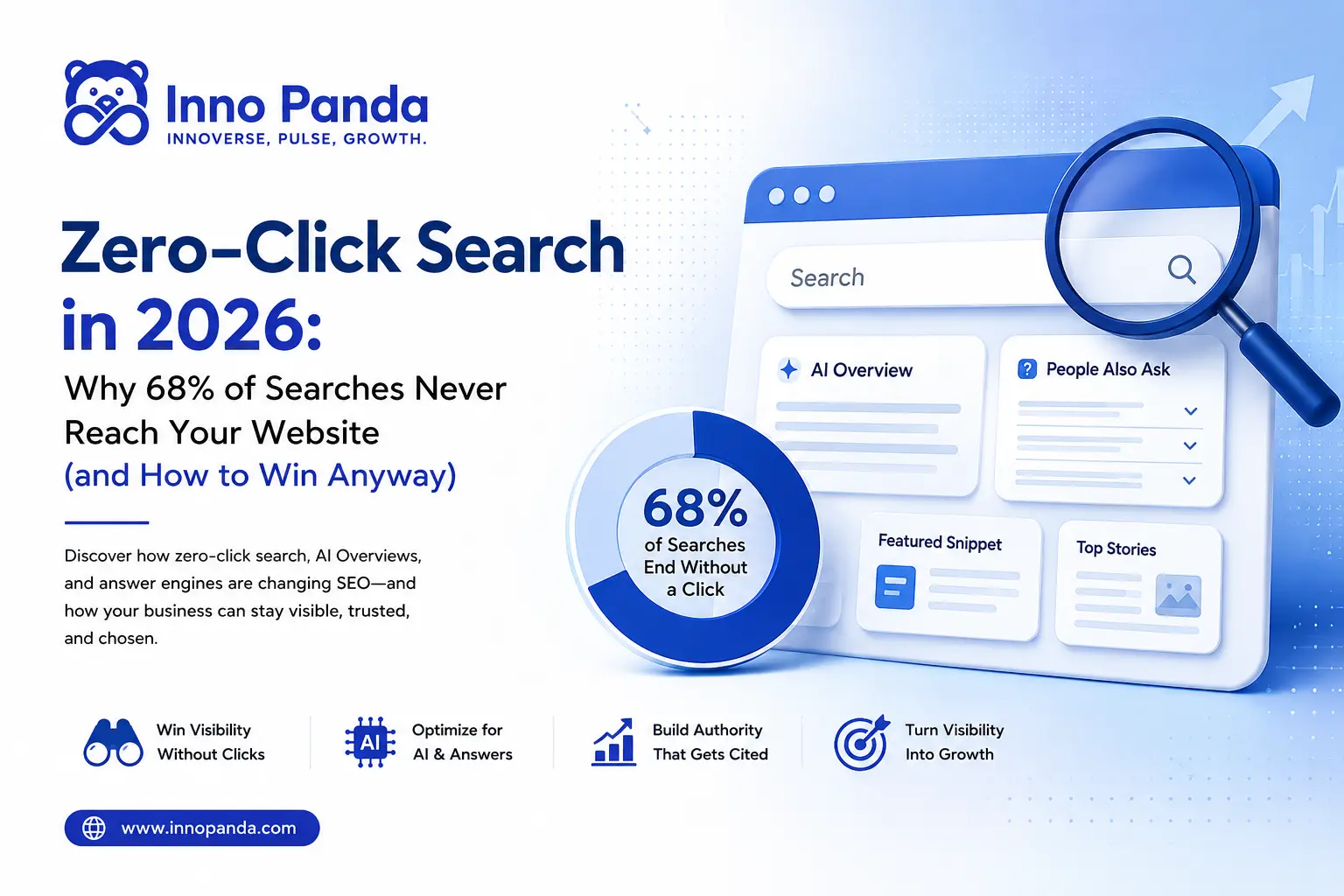
- 68.01% of U.S. Google searches ended without a click between January and April 2026, up from 60.45% two years earlier, according to SparkToro's analysis of Similarweb data.
- Google AI Overviews now appear on more than 20% of searches, and independent studies put the click-through hit anywhere from roughly 34% to 58%, depending on query type and methodology.
- Zero-click search doesn't mean SEO is dead. It means visibility, citations, and brand recognition now count alongside clicks.
- SEO, AEO (answer engine optimization), and GEO (generative engine optimization) work together, they aren't competing strategies.
- Informational queries take the biggest hit, while branded, transactional, and local searches hold up far better.
Open Google Search Console for almost any content-heavy website in 2026 and you'll probably notice the same pattern. Impressions are holding steady or climbing, but clicks are barely moving, or sliding backward. That isn't a tracking glitch. It's the new default shape of search, and it has a name: zero-click search. This guide walks through what the term actually means, what the 2026 data shows, why it's happening, and, more importantly, what your business can still do to win visibility, trust, and revenue when the click is no longer guaranteed.
What Is Zero-Click Search?
A zero-click search is a Google search that gets answered directly on the results page itself, so the person never clicks through to a website. The information they wanted, a definition, a fact, an address, a quick comparison, is delivered instantly, right there on the SERP, and their search journey ends before it ever reaches your site.
It's worth being clear about what this isn't. A zero-click search is not a failed search. The person got exactly what they needed. The only thing that's changed is where they got it from, and for any business that depends on organic traffic, that shift in "where" matters a great deal. It changes how visibility gets earned, how success gets measured, and how content needs to be structured to be useful in the first place.
Examples of Zero-Click Searches
Zero-click search results show up more often than most people realize, and chances are you've triggered several of them today without thinking about it. Common examples include weather forecasts and currency conversions, dictionary definitions and quick factual questions, business hours and addresses pulled from a local pack, product prices shown in a shopping carousel, and People Also Ask boxes that expand into a full answer the moment you tap them. Each of these queries gets resolved on the SERP itself, and each one is a small but real piece of visibility that businesses can either capture or lose entirely.
Zero-Click Search Statistics in 2026: What the Data Shows
There's a lot of "68%" being quoted online right now, often stripped of the context that makes it meaningful. Since this number is doing so much work in shaping how businesses think about SEO this year, it deserves a closer look at where it comes from, how it's changed over time, and what it does and doesn't actually tell us.
68.01% of U.S. Google Searches Ended Without a Click
SparkToro's review of Similarweb clickstream data found that the share of U.S. Google searches generating at least one click fell 9.51 percentage points between 2024 and 2026, a 22.9% relative decline. That pushed the zero-click rate to 68.01% during the January to April 2026 window. The study also found that AI Overviews now appear on more than 20% of searches, and that when they do, click-through rates drop by nearly 60% on that query.
How Zero-Click Search Has Changed Over Time
Zero-click behavior isn't new. It's been building for years through featured snippets and knowledge panels, long before AI Overviews existed. What's changed in the 2024-to-2026 window is the scale and the speed. SparkToro's own year-over-year comparison shows the zero-click rate climbing from 60.45% to 68.01% in just two years, and AI-generated answers are the clearest driver of that acceleration. For a huge share of informational queries, the "answer" a user sees now comes from an AI Overview sitting at the very top of the page, often before they scroll far enough to see the first traditional organic result at all.
What the 68% Figure Actually Means
This is the part that gets skipped in a lot of coverage, and it's important for reading the data honestly. The 68.01% figure comes from U.S. clickstream panel data, not from Google Search Console, and it isn't a global figure that applies identically everywhere. Different studies use different methodologies and different panels, which is exactly why the click-through decline attributed to AI Overviews ranges anywhere from roughly 34% to 58% depending on which research you're reading. Treat 68% as a strong directional signal about where search behavior is heading, not as a single precise number to quote as "68% of all searches worldwide."
| Study | What It Measured | Headline Finding |
|---|---|---|
| SparkToro (2026) | Overall U.S. click rate across all search types, 2024 vs. 2026 | 68.01% of searches ended in zero clicks, up from 60.45% |
| Pew Research | Actual browsing behavior, AI Overview present vs. absent | Click rate fell from ~15% to ~8%, a ~47% relative decline |
| Ahrefs (Feb 2026) | 150,000 keywords with an AI Overview vs. without, Dec 2023 vs. Dec 2025 | Roughly 34% to 58% lower CTR depending on the baseline used |
| Seer Interactive | 53 brands, 5.47 million queries, Jan 2025–Feb 2026 | AI Overview query CTR bottomed near 1.3%, recovered to about 2.4%, still trailing the ~3.3% non-AI-Overview baseline |
The takeaway isn't which number is "correct." It's that every study agrees on direction: AI Overviews reduce the odds of a click on a given search, even as the exact percentage moves depending on query type, industry, and how each researcher measured it. Publisher-level data adds one more useful nuance here too. Informational queries carry most of the click loss, while branded and transactional searches tend to hold up much better, and smaller, less-authoritative publishers have reported traffic drops well above what larger, established sites experience, since bigger brands absorb more of the loss through direct and branded search.
Why Are Zero-Click Searches Increasing in 2026?
Several overlapping SERP features are driving the rise in zero-click search, and most businesses are dealing with all of them at once rather than just one. Here's a closer look at each.
Google AI Overviews
Google AI Overviews generate a synthesized answer pulled from multiple sources at once and place it above the traditional organic results. When that summary fully satisfies what the user was asking, there's simply less reason to scroll further down the page, which is why AI Overviews are widely considered the single biggest driver behind the recent jump in zero-click search.
Featured Snippets
Featured snippets pull a short, direct answer, often a definition, list, or table, straight from a ranking page and display it prominently at the top of the results. It's still one of the highest-value zero-click formats to win, because your brand name and URL appear clearly even when the user doesn't click.
People Also Ask
PAA boxes expand into a full answer the moment a user taps them, often resolving the question without a single page visit. These boxes also tend to multiply, since answering one question usually reveals two or three more related ones directly underneath.
Knowledge Panels
For brands, places, and well-known entities, Google often builds a knowledge panel directly from structured data and other trusted sources, again reducing the need for a click to answer a simple factual question about that entity.
Local Packs and Google Maps
For "near me" and location-based searches, the local pack shows hours, ratings, directions, and contact details right on the results page. This is exactly why Google Business Profile management and local SEO matter more than ever for any business that depends on foot traffic or local enquiries.
Rich Results and Other SERP Features
Product carousels, review stars, event listings, and other rich results all chip away further at the traditional ten-blue-links format, giving users more ways to get an answer without ever leaving Google's own results page.
Users Are Becoming More Comfortable Getting Answers Directly From Search
Behavior matters as much as technology here. Years of exposure to snippets, panels, and now AI-generated summaries have trained users to expect a fast, direct answer on the SERP itself. That expectation is now reinforcing the trend: the more reliable these on-page answers become, the less habit users have of clicking through at all, even for queries where a click would once have felt automatic.
How Zero-Click Search Is Changing SEO in 2026
The old SEO model was straightforward: rank on page one, earn the click, drive the visitor to your website, convert them there. That funnel still exists, and it's still worth pursuing, but it's no longer the whole picture of what SEO success looks like.
The modern search visibility model looks different. Rank and appear across a wider range of SERP formats. Get seen or cited even when there's no click. Build trust and brand recognition right on the results page. Let that visibility generate demand that converts later, whether that's on your website, through a branded search next week, or through a phone call to your business. Organic click-through rate is genuinely declining for many informational queries. But impressions, SERP visibility, AI citations, brand mentions, and overall search demand are all becoming just as important to track as raw traffic.
Does Zero-Click Search Mean SEO Is Dead?
Quick answer: No. SEO is not becoming irrelevant, the definition of SEO success is expanding.
SEO increasingly supports a wider set of goals than it used to: search visibility, AI retrieval, brand authority, SERP feature ownership, AI citations, entity recognition, and general website discoverability. Most current commentary on AI search treats SEO as the underlying eligibility layer for AI visibility, rather than something search has simply outgrown. If your content isn't well-structured, technically sound, and easy to crawl, an AI Overview has nothing reliable to cite in the first place, and a featured snippet has nothing clean to extract. SEO is still the foundation everything else in this guide is built on top of.
Zero-Click Search vs AEO vs GEO: What's the Difference?
These three terms get used interchangeably online, but they actually describe different layers of the same overall visibility strategy, and understanding how they relate to each other is one of the more useful things a business can take away from this guide.
| Approach | Primary Goal |
|---|---|
| SEO | Rank pages in traditional search results |
| Zero-Click SEO | Gain visibility on the SERP without requiring a click |
| AEO (Answer Engine Optimization) | Become the trusted source for direct, extractable answers |
| GEO (Generative Engine Optimization) | Get cited inside AI-generated results like AI Overviews |
SEO Is the Foundation
Every other layer depends on solid technical SEO underneath it: crawlable pages, clean site structure, and genuinely relevant content. Nothing gets cited, snippet-featured, or trusted by an AI system if it can't be indexed and understood correctly in the first place.
AEO Targets Answers
Answer engine optimization is about formatting content so it can be lifted cleanly into featured snippets, People Also Ask boxes, and voice assistant answers. In practice, that usually means leading with a direct, short answer before you expand into detail.
GEO Targets Generative Search
Generative engine optimization is about becoming a source that large language models and AI Overviews actually pull from and cite. It leans heavily on clarity, factual accuracy, and strong E-E-A-T signals.
Zero-Click SEO Connects the SERP Experience
Zero-click SEO ties all three together. It's the practice of making sure your brand shows up, gets cited, and builds recognition across every SERP format available, whether or not the user ever actually clicks through to your website.
Zero-Click Search Is Spreading Beyond Google
Most of this guide has focused on Google. That's fair, since Google still handles the vast majority of searches. But GEO is bigger than Google alone. ChatGPT Search, Perplexity, Microsoft Copilot, and Google's own Gemini app now answer questions directly too. They give the user a short summary and a citation link, and most users never click it. If your GEO plan only covers Google AI Overviews, you're missing part of the picture.
The data here is mixed. Studies disagree on the exact numbers. That's worth knowing before you build a strategy around any single stat.
| Finding | What the Research Shows |
|---|---|
| Share of total site traffic | AI platforms combined still send a small slice of total website traffic, likely under 3%. That share is growing every quarter across most published studies. |
| Which platform sends the most | ChatGPT is the largest single source of AI referral traffic. Studies put its share anywhere from about three-quarters to over 90% of all AI traffic, depending on the study. |
| Fastest-growing platform | Google Gemini and Anthropic's Claude have posted the steepest year-over-year growth among major AI answer engines, even from a smaller starting point. |
| Citation behaviour | Perplexity tends to add inline citations by default. It also pulls from a wider mix of sources, including smaller sites, more than platforms that lean on a narrow set of large domains. |
Here's what that means in practice. Don't treat "Google AI Overview visibility" and "AI search visibility" as the same thing. A page built for GEO, with clear claims, strong sourcing, and plain language, tends to do well across all these engines at once. They're all solving the same problem in slightly different ways. You don't need a separate content plan for ChatGPT, Gemini, and Google. You need one clear content standard, applied consistently.
Can AI Systems Even Reach Your Content? Crawler Access for GEO
There's a technical layer under all of this that's easy to miss. An AI system can only cite your content if it's allowed to crawl it in the first place. Some sites block AI crawlers on purpose, often to keep content out of model training. The problem is that this same block can also stop your pages from ever being cited in an AI Overview, a ChatGPT answer, or a Perplexity summary.
Here's the good news. Training access and citation access are usually controlled by separate bots. You can block one and allow the other. That means you don't have to choose between "keep our content out of AI training" and "stay eligible to be cited."
| Crawler | Run By | What It's For |
|---|---|---|
| GPTBot | OpenAI | Collects content for model training. Blocking it does not remove you from ChatGPT Search citations. |
| OAI-SearchBot | OpenAI | Powers ChatGPT Search citations. Block this and OpenAI's own documentation confirms you won't appear in ChatGPT search answers. |
| Google-Extended | Controls use in AI training and Gemini responses, separate from standard Googlebot indexing for normal Search. | |
| PerplexityBot | Perplexity | Crawls and indexes pages for Perplexity's answer engine and citations. |
| ClaudeBot | Anthropic | Crawls content for Claude, covering both training and citation use. |
Check your robots.txt file for these names. If you want AI citations, make sure the search-facing bots, OAI-SearchBot, PerplexityBot, Google-Extended, and ClaudeBot, aren't disallowed. If you also want to opt out of AI training specifically, you can block GPTBot on its own without losing ChatGPT Search visibility.
One more thing worth doing: publish an llms.txt file alongside your robots.txt. It's a simple, plain-text file that points AI systems toward your most important pages. It isn't a universal standard yet, but it costs very little to add. It also signals that a site is actively managing its AI visibility instead of leaving it to chance.
How to Win Zero-Click Searches in 2026
This is the practical core of the guide. Winning zero-click search means breaking your strategy down into a set of concrete, ongoing practices rather than a single one-time fix.
1. Optimize for Search Intent
Informational, navigational, commercial, and transactional queries all need different content shapes. Answering an informational "what is" query with a sales pitch, or a commercial comparison query with a vague definition, is one of the fastest ways to lose both the click and the citation.
2. Answer Questions Directly
Use short, direct answers near the top of the page, followed by definitions, lists, tables, and step-by-step explanations underneath. Featured snippets and AI Overviews both reward content that gets to the point immediately rather than building up to it over several paragraphs.
3. Optimize for Featured Snippets
Structure your content in the exact formats Google tends to pull from: a concise definition in the first sentence, a numbered list for processes, or a clean table for comparisons. This structural clarity is often more important to winning a snippet than the writing quality itself.
4. Optimize for People Also Ask
Anticipate the related questions a reader is likely to have after your main answer, and address them directly under their own subheadings. This naturally increases your odds of appearing across multiple PAA boxes for the same core topic.
5. Create Answer-First Content
Lead with the answer, then support it. This single habit, restructuring content so the most useful sentence comes first rather than last, is one of the highest-leverage changes a content team can make for zero-click visibility.
6. Use Structured Data and Schema Markup
FAQPage, Article, Organization, and LocalBusiness schema give search engines and AI systems a clean, machine-readable version of your content to work from, rather than forcing them to interpret unstructured text.
7. Strengthen E-E-A-T Signals
Author bios, visible credentials, and original data all help. So does consistent brand information across the web. Together, these build the experience, expertise, authority, and trust signals that AI systems weigh before deciding whether to cite a source.
Covering a topic in real depth helps. So does linking related pages together, like our guide to SEO across Southeast Asia. Together, these help search engines and AI models see your site as a genuine authority on the subject, not just a single page that happens to rank.
9. Strengthen Brand and Entity Signals
Consistent naming, clear "About" and author pages, and mentions across other trusted sites all help search engines and AI systems recognize your brand as a distinct, real-world entity rather than just another URL in the index.
10. Optimize for AI Overviews
AI Overview optimization rewards clear structure and factual accuracy. It also rewards content that's easy to extract without ambiguity. Pages with vague claims, unclear sourcing, or contradictory information are far less likely to get pulled into a generated summary.
11. Build Content That AI Systems Can Easily Understand and Cite
Write in plain, unambiguous language, avoid burying key facts inside long paragraphs, and keep each section focused on one clear idea. This isn't just good practice for readers, it's exactly the format AI summarization systems parse most reliably.
12. Optimize Local Search Visibility
For local pack and "near me" visibility, an optimized Google Business Profile, consistent NAP data, and location-specific content matter as much as your website itself. This is where dedicated local SEO work tends to have an outsized, fairly quick impact.
Not Sure How Visible Your Business Already Is?
We'll show you exactly where you're winning, and losing, across Google, AI Overviews, and zero-click SERPs, then build a plan around it.
What Should You Optimize for If Users Don't Click?
Instead of focusing only on clicks, widen the scorecard. Track impressions, SERP visibility, featured snippet and PAA appearances, and AI Overview visibility. Add AI citations, brand mentions, branded searches, organic and assisted conversions, and overall lead quality. Clicks are still meaningful, but on their own they no longer capture the full value a page can generate.
The key idea to hold onto here: a zero-click impression can still influence what someone does next. Someone who sees your brand answer a question today may search your brand name directly next week, mention it to a colleague, or walk into your store without ever having "clicked" anything at all.
How Zero-Click Search Impacts Businesses
The scale and shape of this impact varies quite a bit depending on the kind of business you run, so it's worth looking at a few categories separately.
E-commerce Businesses
Product searches, shopping results, and commercial queries increasingly get answered through shopping carousels and rich snippets, not a standard organic listing. That makes structured product data, reviews, and pricing markup essential just to stay visible.
SaaS Businesses
Software comparisons, feature searches, and problem-based queries are exactly the kind of content AI Overviews now summarize directly. Clear, well-structured comparison content and honest feature breakdowns are what tend to get cited, ahead of vaguer marketing copy.
Local Businesses
Google Maps, the local pack, reviews, and "near me" searches often decide whether a local business gets contacted at all, long before anyone visits a website. For many local businesses, the local pack has effectively become the new homepage.
B2B Companies
Industry questions, research queries, and vendor comparisons are increasingly resolved through AI-generated summaries before a buyer ever reaches out. Thought leadership content that's clearly sourced and well structured has a real advantage in getting cited during this early research stage.
What we typically see: a client comes to us with a service page that ranks on page one but hasn't moved in traffic for months. The pattern is usually the same. The page reads well for humans, but it gives an AI Overview nothing clean to pull from. The answer sits three paragraphs deep. There's no schema markup. The headings don't match the questions people are actually asking. We move the direct answer to the first sentence, add FAQPage schema, and clean up the heading structure. That alone is often enough to start winning snippet and AI Overview appearances within a few weeks, well before rankings themselves shift.
Zero-Click Search Strategy for Singapore Businesses
Singapore's search landscape adds a genuinely local layer to everything covered so far. AI Overviews are increasingly active for Singapore-based queries. That makes schema markup and structured content real competitive differentiators in a small, dense market, not optional extras to get to eventually.
A practical zero-click strategy for Singapore businesses covers a few specific areas. Keep your Google Business Profile complete, accurate, and updated often. Build dedicated pages for local pack and service-area queries, not just one generic contact page. Publish Singapore-specific content that AI Overviews can confidently cite. Earn genuine reviews and local authority signals across trusted directories. Pair all of that with strong technical SEO foundations, so pages stay easy to crawl and extract in the first place. This works best as part of a fuller Southeast Asia SEO strategy, not a standalone local tactic.
Common Zero-Click SEO Mistakes to Avoid
Most businesses that struggle here aren't doing nothing. They're making one of a handful of avoidable mistakes. Here's what tends to hold pages back.
Burying the Answer
A long introduction before you get to the point is one of the most common reasons a well-ranked page never wins a snippet or an AI citation. Featured snippets and AI Overviews both favour content that answers the core question right away, not content that builds up to it.
Chasing Clicks Instead of Visibility
Writing purely to boost click-through rate, vague titles built for curiosity, thin pages made only to rank, tends to backfire in an AI-summarised world. These pages get skipped over. They simply don't give an AI system anything concrete to cite.
Skipping Schema Markup
Pages without FAQPage, Article, or LocalBusiness schema are harder for search engines and AI systems to read with confidence. That makes them less likely to land in a snippet, panel, or AI summary, even when the content itself is strong.
Letting FAQ Text and Schema Drift Apart
When the visible FAQ answer on a page doesn't match the FAQPage schema behind it, search engines and AI systems trust both less. Keeping visible text and structured data in sync isn't a nice-to-have. It's a basic trust signal.
Ignoring Branded and Assisted Conversions
Judging a page only on direct organic clicks misses the searches that convert later, through a branded search, a phone call, or a store visit. Reporting on clicks alone in a zero-click world will always undercount what a page is actually doing.
Treating GEO as a One-Time Project
AI Overviews and AI search engines re-crawl and re-summarise all the time. A page cited once isn't guaranteed to stay cited if a competitor publishes clearer, more current content on the same topic. Zero-click visibility needs the same ongoing attention as rankings do, not a single one-off fix.
How to Measure Zero-Click SEO Success
It helps to break this down into four categories. Each one captures a different part of the picture.
Traditional SEO Metrics
Organic clicks, organic traffic, keyword rankings, click-through rate, and conversions still matter and shouldn't be dropped from your reporting just because zero-click search is on the rise.
Zero-Click Visibility Metrics
Featured snippet wins, PAA appearances, knowledge panel presence, and local pack appearances all show how much SERP real estate you actually hold. That's true whether or not each appearance generates a click.
AI Search Metrics
AI citations matter here. So do brand mentions inside AI Overviews, your overall AI Overview appearance rate, and referral traffic from AI platforms. This is the newest category to monitor, and it's growing fast.
Business Metrics
Leads, branded searches, conversion rate, revenue, and assisted conversions ultimately tell you whether all that SERP and AI visibility is translating into real business results, which is the number that matters most at the end of the day.
How to Track AI Citations When Search Console Can't Show You
This is usually the first wall businesses hit. Google Search Console shows impressions and clicks for normal organic results. It does not show whether your page got cited inside an AI Overview, a ChatGPT answer, or a Perplexity summary. That gap is exactly why "we're probably getting cited somewhere" isn't a real strategy. Here's how to close it instead.
Practical ways to check: search your priority queries by hand and log which pages get cited in the AI Overview. Run the same queries inside ChatGPT, Perplexity, and Gemini, and note whether your brand shows up. Watch your analytics for referral traffic from chatgpt.com, perplexity.ai, or copilot.microsoft.com. Check your branded search volume in Search Console too. A rise in people searching your brand name directly is a strong sign that your AI visibility is working.
A growing set of dedicated AI-visibility tools now automate this work. They run your target keywords through several AI engines on a schedule and report which brands get cited. Once your GEO efforts move past the testing stage, this kind of tracking is worth the budget. Manual spot-checks don't scale well past a handful of priority keywords.
| Category | What to Track |
|---|---|
| Traditional SEO | Organic clicks, traffic, keyword rankings, CTR, conversions |
| Zero-Click Visibility | Featured snippet wins, PAA appearances, knowledge panel and local pack presence |
| AI Search Visibility | AI Overview citations, brand mentions inside AI answers, referral traffic from AI platforms |
| Business Impact | Leads, branded search volume, conversion rate, assisted conversions, revenue |
How Inno Panda Can Help Your Business Adapt to Zero-Click Search
Adapting to zero-click search doesn't mean starting over. It means building on solid SEO with the right structure, schema, and content strategy layered on top of it. Our team works across SEO services, technical SEO, local SEO, content SEO, and content built specifically for AI search visibility, so your business stays found no matter which format actually answers the query.
Want to know how visible your business is across Google, AI search, and zero-click SERPs right now? Start with a search visibility review, and we'll walk you through exactly where the gaps are.
Discuss Your ProjectQuick Glossary: Key Zero-Click Search Terms
Before the FAQs, here's a fast reference for the terms used throughout this guide.
- Zero-Click Search
- A search query answered directly on the results page, so the user never visits a website.
- AEO (Answer Engine Optimization)
- Optimizing content to be pulled into direct answers like featured snippets, PAA boxes, and voice responses.
- GEO (Generative Engine Optimization)
- Optimizing content to be cited by AI-generated results such as Google AI Overviews.
- E-E-A-T
- Experience, Expertise, Authoritativeness, and Trustworthiness, the trust signals search engines and AI systems evaluate before citing a source.
- Entity SEO
- Optimizing how search engines understand and connect your brand, people, and topics as recognized entities.
- SERP Features
- On-page result formats like snippets, knowledge panels, and local packs that appear alongside standard organic listings.
- Featured Snippet
- A short, direct answer pulled from a ranking page and displayed at the very top of the search results.
- Knowledge Panel
- An information box built from structured data and trusted sources, typically shown for well-known brands, people, or places.
Frequently Asked Questions About Zero-Click Search
What is a zero-click search?
A zero-click search is a Google search that gets fully answered on the results page itself, through a featured snippet, AI Overview, knowledge panel, or local pack, so the person never clicks through to a website.
What percentage of Google searches are zero-click in 2026?
SparkToro's analysis of Similarweb clickstream data found that 68.01% of U.S. Google searches ended without a click between January and April 2026, up from 60.45% two years earlier. This is a U.S. panel-based estimate, not a universal global figure.
Why are zero-click searches increasing in 2026?
Zero-click searches are rising mainly because of Google AI Overviews, which now appear on more than 20% of searches, alongside featured snippets, People Also Ask boxes, knowledge panels, and local packs that all answer queries directly on the results page.
Does an AI Overview really reduce clicks that much?
Yes, though the exact number depends on the study. Pew Research found click rates drop from about 15% to 8% when an AI Overview appears, close to a 47% relative decline, while Ahrefs and Seer Interactive have measured declines ranging from roughly 34% to 58% depending on query type and methodology.
Does zero-click search mean SEO is dead?
No. SEO is not dead. The definition of SEO success is expanding beyond clicks. It now includes SERP visibility, AI citations, brand mentions, and the assisted conversions that happen after a zero-click impression.
How can I optimize my content for zero-click search?
Match content to search intent, answer the core question in the first 40 to 60 words, use schema markup and structured data, strengthen E-E-A-T and entity signals, and format content in short, extractable blocks that featured snippets and AI Overviews can lift cleanly.
What is the difference between SEO, AEO, and GEO?
SEO ranks web pages in traditional search results. AEO, or answer engine optimization, focuses on becoming the source pulled into direct answers like snippets and voice responses. GEO, or generative engine optimization, focuses on getting cited inside AI-generated summaries such as AI Overviews. All three build on the same technical and content foundation.
What should I measure instead of just clicks?
Track impressions and organic search visibility. Watch featured snippet and PAA appearances, AI Overview citations, and branded search volume. Track assisted and offline conversions too, alongside your usual click and traffic numbers.
Are all industries affected by zero-click search equally?
No. Informational queries are hit hardest, while branded and transactional searches tend to hold up better. Publisher data shows smaller, less-authoritative sites losing more traffic share than larger, well-established ones.
How can Singapore businesses adapt to zero-click search?
Singapore businesses can adapt by strengthening their Google Business Profile and targeting local pack and near me searches. Add schema markup to service pages. Publish clearly structured, Singapore-specific content that AI Overviews and featured snippets can confidently cite.
Does zero-click search only apply to Google?
No. Google drives the majority of zero-click behaviour today, but ChatGPT Search, Perplexity, Microsoft Copilot, and Google Gemini all generate direct answers with citations too. A GEO strategy that only targets Google AI Overviews misses a growing share of AI-driven search.
How do I track AI Overview and AI search citations?
Google Search Console doesn't report AI Overview or LLM citations directly. Tracking usually means running manual query checks across Google, ChatGPT, and Perplexity, watching for referral traffic from AI platform domains in your analytics, and tracking branded search volume for growth. At scale, a dedicated AI-visibility tracking tool helps too.
Do I need to allow AI crawlers like GPTBot for my content to be cited?
Yes, for the crawlers that power citations specifically. Training crawlers like GPTBot and citation crawlers like OAI-SearchBot are usually separate bots, so you can block training while still allowing citation. Check your robots.txt for GPTBot, OAI-SearchBot, Google-Extended, PerplexityBot, and ClaudeBot, and make sure the citation-facing ones aren't disallowed.
The Future of SEO Is Bigger Than the Click
The goal was never to stop zero-click searches from happening. That's not something any single business can control, and trying to fight it is a losing battle. The real goal is making sure your business is visible, cited, and trusted when the click doesn't happen. That's the throughline connecting SEO, SERP visibility, AEO, AI visibility, brand authority, and, eventually, business results: SEO leads to SERP visibility, which leads to AEO and AI visibility, which builds brand authority, which drives real business outcomes, whether or not any individual search along the way ever turns into a click.
Ready to Build Visibility That Survives the Zero-Click Era?
Let's audit where your business stands across Google, AI Overviews, and local search, then build a plan around SEO, AEO, and GEO together, not as separate projects.