NRIC Authentication Singapore: PDPC 2026 Deadline and Compliance Guide
- 1 NRIC Authentication Singapore: PDPC 2026 Deadline and Compliance Guide
- 1.1 Key Takeaways
- 1.2 What Is the PDPC NRIC Authentication Requirement?
- 1.3 Why Is Singapore Phasing Out NRIC-Based Authentication?
- 1.4 What Is the NRIC Authentication Deadline?
- 1.5 Does the NRIC Rule Apply to Your Business?
- 1.6 Sector-Specific Guidance for Regulated Industries
- 1.7 What Counts as NRIC-Based Authentication?
- 1.8 NRIC Identification vs Authentication: What's the Difference?
- 1.9 PDPC Enforcement and Penalties for Non-Compliance
- 1.10 What Happens After 31 December 2026?
- 1.11 What Are the Alternatives to NRIC Authentication?
- 1.12 How to Replace NRIC Authentication in Your Business
- 1.12.1 Audit Existing Authentication Systems
- 1.12.2 Identify Every System Using NRIC Authentication
- 1.12.3 Assess Security and Compliance Risks
- 1.12.4 Select an Appropriate Authentication Method
- 1.12.5 Update the Login Architecture
- 1.12.6 Migrate Existing Users
- 1.12.7 Test the New Authentication Flow
- 1.12.8 Communicate the Change to Users
- 1.12.9 Remove Legacy NRIC Authentication
- 1.12.10 Monitor the New System
- 1.13 NRIC Authentication Compliance Checklist for Singapore Businesses
- 1.14 Common Mistakes Businesses Should Avoid
- 1.15 How Inno Panda Can Help With Secure Authentication
- 1.16 Quick Glossary
- 1.17 Frequently Asked Questions About NRIC Authentication in Singapore
- 1.17.1 When will NRIC authentication be banned in Singapore?
- 1.17.2 Can businesses still use NRIC numbers for authentication?
- 1.17.3 Can NRIC numbers be used as passwords in Singapore?
- 1.17.4 What is the NRIC authentication deadline?
- 1.17.5 What happens after 31 December 2026?
- 1.17.6 Does the requirement apply to all private organisations?
- 1.17.7 Can businesses still collect NRIC numbers?
- 1.17.8 What are the alternatives to NRIC authentication?
- 1.17.9 How can businesses replace NRIC-based login?
- 1.17.10 What authentication methods can Singapore businesses use instead?
- 1.18 Related Reading from Inno Panda
- 1.19 Need to Replace NRIC Authentication Before the Deadline?
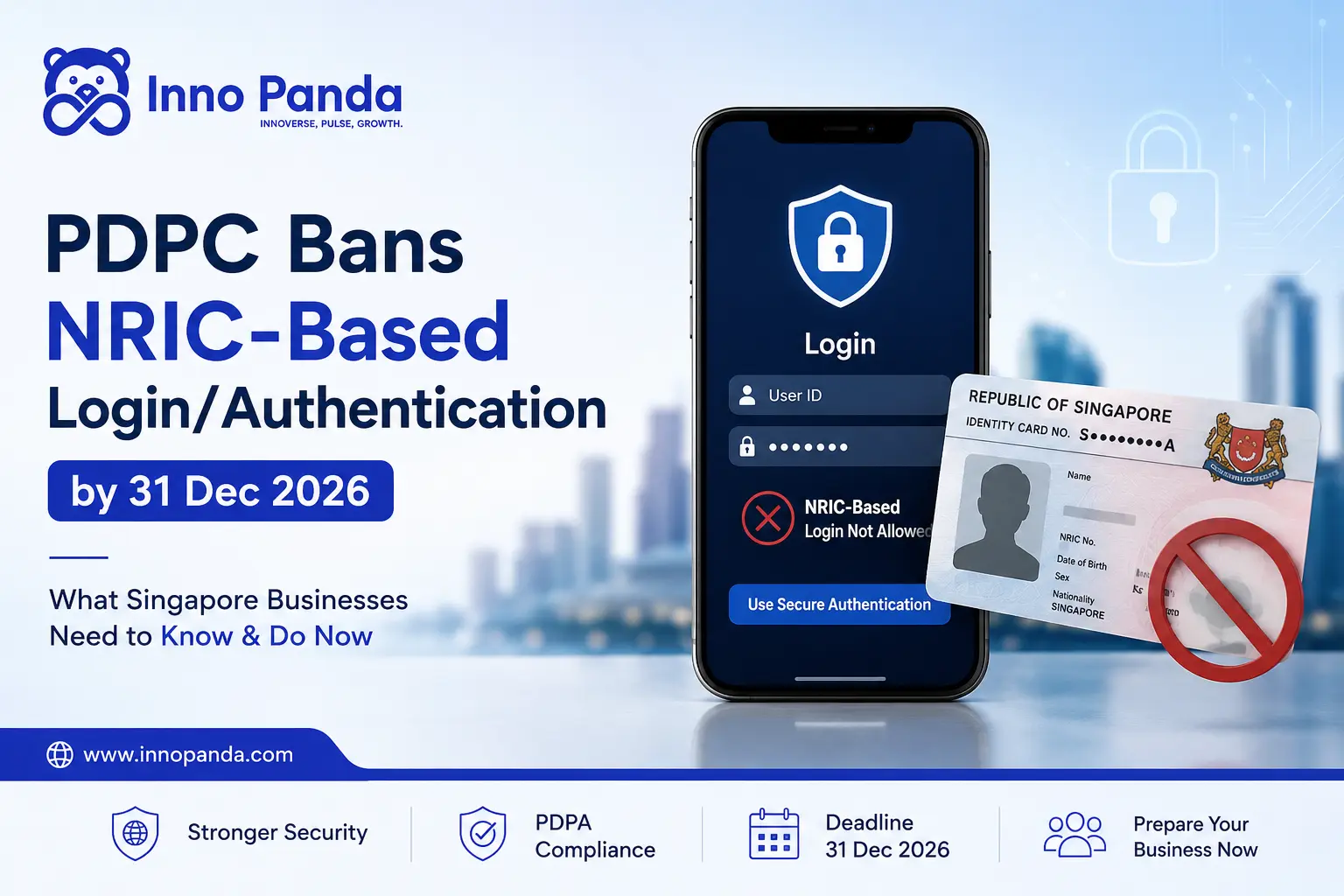
PDPC has set a hard deadline for NRIC authentication in Singapore. Private businesses must stop using NRIC numbers to log people in by 31 December 2026. Enforcement gets stricter from 1 January 2027. This guide explains the rule in plain terms: who it affects, what it could cost you, and how to switch to a safer login method before the deadline.
Key Takeaways
- PDPC's deadline for NRIC authentication in Singapore is 31 December 2026.
- Enforcement gets stricter from 1 January 2027. Don't wait until the deadline to start.
- The rule started with a June 2025 PDPC-CSA advisory and builds on PDPC's 2019 NRIC guidelines.
- Identifying someone and authenticating them are different things. Only authentication is being phased out.
- The same rule covers FIN and Work Permit numbers, not just NRIC numbers.
- IMDA, MAS, and MOH have added their own guidance for telecoms, finance, and healthcare.
- Missing the deadline can count as a PDPA breach, with financial penalties possible from 2027.
- MFA, 2FA, passwordless login, and Singpass are the main ways to replace NRIC login.
Here's the short version: PDPC has told private businesses to stop using NRIC numbers as a login credential. That's the headline. But there's more to it, a firm deadline, real fines if you miss it, a key difference between identifying someone and authenticating them, and a regulatory trail that goes back further than most articles on this topic mention.
Here's why this matters right now. Does your business ask customers or staff to log in with their NRIC number? If NRIC is used as the password, or the default password, your login system needs to change before 31 December 2026. This guide covers what PDPC announced, why the rule exists, who it applies to, what it could cost you to miss it, and how to build a safer login system in its place.
What Is the PDPC NRIC Authentication Requirement?
What PDPC Announced
PDPC has told private organisations to stop using NRIC numbers to authenticate users. The deadline is 31 December 2026. Enforcement gets stricter from 1 January 2027. Why? NRIC numbers are easy to find or guess, so they make a weak login credential.
Where the Rule Comes From
This rule didn't appear overnight. In June 2025, PDPC and the Cyber Security Agency of Singapore (CSA) warned businesses not to misuse NRIC numbers for authentication. That included using them as default passwords, or combining them with easy-to-find details like a name or birthdate. This advisory built on PDPC's 2019 NRIC guidelines, which already limited how businesses could collect, use, or share NRIC numbers. The February 2026 announcement turned that guidance into a firm compliance date.
What Does "Authentication" Mean?
Authentication is the step where a system proves you are who you say you are. A password does this. So does a one-time code sent to your phone. Typing your NRIC number doesn't count, because that number sits on a card in your wallet. It isn't a secret.
Why Is Singapore Phasing Out NRIC-Based Authentication?
PDPC and CSA have both warned against using NRIC numbers as passwords. Here's the security problem, in plain terms.
NRIC Numbers Are Not Secret
Your NRIC number sits on your ID card. It shows up on official letters and countless forms. A real login credential needs to be something only you know or hold. An NRIC number fails that test.
If an NRIC number alone can unlock an account, anyone who has seen your card, a form, or a leaked database could log in as you.
Risk of Identity Theft
NRIC-based login makes it easy for scammers to pretend to be a real customer or staff member. The "password" is public, not private.
Why Identification and Authentication Should Stay Separate
Identification is a claim about who you are. Authentication proves that claim is true. Using the same data for both breaks an important security rule. That's what this new guidance fixes.
What Is the NRIC Authentication Deadline?
31 December 2026: Compliance Deadline
Every private business using NRIC numbers to log people in needs a new system live by this date.
1 January 2027: Enforcement Increases
From this date, PDPC steps up enforcement. Businesses still using NRIC-based login face real compliance risk.
What to Do Before the Deadline
Start now, not in November 2026. Building, testing, and rolling out a new login system takes longer than most teams expect.
Does the NRIC Rule Apply to Your Business?
If your business touches any of the systems below, this rule applies to you.
Private Organisations
This covers private businesses of every size, not just big companies.
Customer-Facing Websites and Apps
Any login step on a public website or app counts.
Employee and Internal Systems
Internal HR or IT logins that use NRIC numbers are covered too.
Membership and Customer Portals
Loyalty programmes and account portals often use NRIC as a shortcut. They need the same fix.
E-Commerce Platforms
Online stores using NRIC numbers to verify accounts need to switch as well.
Mobile Applications
App login flows are covered too, not just websites.
Key point: this rule is about using NRIC numbers to log people in. It doesn't ban collecting or using NRIC numbers for other purposes. PDPC has separate rules covering legitimate use of NRIC numbers outside of login systems.
Sector-Specific Guidance for Regulated Industries
PDPC's deadline is the baseline rule for every private business. A few sectors have received extra guidance on top of it. If your business sits in one of these areas, check both the general PDPC rule and your regulator's own advisory.
Telecoms (IMDA)
IMDA has told telecom providers to stop using NRIC numbers for customer login and service checks.
Finance and Insurance (MAS)
MAS has told banks and insurers to move away from NRIC login for online banking and policy portals.
Healthcare (MOH)
MOH has guided clinics and hospitals on this, since NRIC-as-password logins have long been common in patient portals.
Other National ID Numbers
The same rule covers FIN and Work Permit numbers. If you log in foreign staff or pass holders this way, that needs to change too.
What Counts as NRIC-Based Authentication?
This is where most businesses get confused, so let's be specific.
Using NRIC as a Username and Password
Logging in with your NRIC number as both the ID and the proof is the clearest case PDPC wants stopped.
Using NRIC as a Default Password
Setting a new account's password to the user's NRIC number, even for a short time, breaks the same rule.
Using NRIC to Unlock Access
Asking someone to "confirm" their NRIC number as the only step before granting access counts as authentication.
Using NRIC as the Only Login Factor
If NRIC is the one thing standing between a visitor and your account, that's exactly what PDPC wants removed.
Real Examples of NRIC-Based Login
Common cases include clinic portals, membership sign-ins, insurance portals, and old HR systems built years ago.
What doesn't count: collecting an NRIC number for a real reason, like checking who qualifies for a service, is fine. The rule targets login use. Not every use of an NRIC number is a problem.
NRIC Identification vs Authentication: What's the Difference?
| Identification | Authentication | |
|---|---|---|
| What it does | Claims who a person is | Proves the person is who they claim to be |
| Example | Giving an identifier, like an NRIC number | Password, MFA, biometric check |
| PDPC's view | NRIC can have legitimate identification uses | NRIC should not be used to authenticate |
Why This Difference Matters
Businesses that confuse the two make one of two mistakes. Some remove every NRIC use case out of caution, even the legal ones. Others miss the systems that actually need to change. Get this right, and your compliance work stays focused on what matters.
PDPC Enforcement and Penalties for Non-Compliance
Missing this deadline isn't just a paperwork problem. Using NRIC numbers to log people in after the deadline can count as a failure to protect personal data. That's a breach of the Personal Data Protection Act (PDPA).
Financial Penalties
PDPC can issue directions or fines to businesses that keep using NRIC login after 1 January 2027.
Public Enforcement Decisions
PDPC often publishes its enforcement decisions. Cases tied to well-known brands tend to draw media coverage too.
We're keeping this section general on purpose. Exact penalty amounts sit with PDPC, so check PDPC's official guidance for the current rules before treating any figure as final.
What Happens After 31 December 2026?
Enforcement From 1 January 2027
PDPC steps up enforcement from this date, aimed at businesses still using NRIC-based login.
What Businesses Should Expect
Expect closer checks on login systems. This matters most for healthcare, finance, and membership services.
Wider PDPA Risk
This isn't only about the NRIC rule. Weak login security can trigger other PDPA problems too. Protecting personal data is a broad duty, not just a login-screen fix.
Why You Shouldn't Wait
System changes rarely work perfectly the first time. Start early, and you'll have time to fix issues before enforcement begins.
What Are the Alternatives to NRIC Authentication?
PDPC and CSA point businesses toward stronger login methods, matched to the level of risk. Here are the main options.
Strong Passwords
A real, private password beats an NRIC number anyone can look up. It's a basic fix, but a real one.
Multi-Factor Authentication (MFA)
Add a second factor, like a one-time code, to a password. This alone cuts the risk of unauthorised access a lot.
Two-Factor Authentication (2FA)
A common type of MFA. Usually a password plus an SMS or app code. Easy for most users to pick up.
Security Tokens
A physical or app-based token makes a one-time code. Good for high-risk systems, like admin panels.
Biometric Authentication
Fingerprint or face recognition is common on phones. It's fast and hard to fake.
Passwordless Authentication
Magic links, authenticator apps, or passkeys remove the password entirely. That closes off a major weak point.
The Singapore-specific option: Singpass and MyInfo check identity through Singapore's own digital ID system. No NRIC number needed. Building or updating a mobile app? Read our guide on Singpass MyInfo integration for mobile apps.
How to Replace NRIC Authentication in Your Business
Treat this as a ten-step project, not a single switch to flip. Each step builds on the one before it.
Audit Existing Authentication Systems
Map every website, app, and internal tool with a login step, so nothing gets missed.
Identify Every System Using NRIC Authentication
From your audit, flag which systems use NRIC numbers to log people in.
Assess Security and Compliance Risks
Rank systems by risk. Fix healthcare and financial portals first.
Select an Appropriate Authentication Method
Match the method to the risk. MFA or passwordless for customers, Singpass for strict identity checks.
Update the Login Architecture
Build the login flow around the new method, instead of bolting it onto the old one.
Migrate Existing Users
Plan how current users move over, including how you'll notify and re-verify them.
Test the New Authentication Flow
Run the new login start to finish. Test locked accounts and failed second factors too.
Communicate the Change to Users
Tell customers and staff what's changing, and why, well before the switch.
Remove Legacy NRIC Authentication
Once migration is done, shut off the old NRIC login path for good.
Monitor the New System
Watch login success rates and support tickets after launch, to catch what testing missed.
This is exactly the kind of secure login work we handle through our Custom Software Development service. Need your login to talk to Singpass, payment providers, or internal HR tools? Our API Integration Services team handles those connections.
NRIC Authentication Compliance Checklist for Singapore Businesses
- Identify systems using NRIC for authentication
- Review website login systems
- Review mobile applications
- Review customer portals
- Review employee systems
- Remove NRIC as a password
- Implement stronger authentication
- Test the new login process
- Communicate changes to users
- Complete migration before 31 December 2026
Common Mistakes Businesses Should Avoid
Treating NRIC as a Password
This is the exact habit the rule exists to stop.
Waiting Until December 2026
Migrations always take longer than planned.
Swapping NRIC for Another Guessable ID
Like a birthdate, which has the same weakness.
Setting Up MFA the Wrong Way
A second factor that's just as easy to guess defeats the point.
Forgetting Legacy Systems
Old internal tools are often the last checked, and the easiest to miss.
Skipping Migration Testing
A broken login on launch day creates a support nightmare.
Mixing Up Identification and Authentication
Leads to overcorrecting, or missing real risk.
How Inno Panda Can Help With Secure Authentication
We build and migrate login systems for Singapore businesses. That includes MFA, passwordless login, and Singpass or MyInfo setup. Replacing one login form, or every system you have? We can scope the work against the 31 December 2026 deadline.
Audit
We map every system still using NRIC-based login before anything gets rebuilt.
Build
We build MFA, passwordless, or Singpass-based login suited to your platform.
Migrate
We move your existing users safely, with testing before the old system switches off.
Quick Glossary
- PDPC
- Personal Data Protection Commission, Singapore's data protection regulator.
- NRIC
- National Registration Identity Card, Singapore's national ID document and number.
- FIN
- Foreign Identification Number, given to foreigners like work pass holders. Covered by the same rule as NRIC.
- Authentication
- Proving you are who you say you are, unlike identification, which just states a claim.
- MFA
- Multi-Factor Authentication. Needs two or more separate proofs of identity to log in.
- Singpass / MyInfo
- Singapore's national digital ID system. Lets businesses check identity without handling NRIC numbers directly.
- PDPA
- Personal Data Protection Act, Singapore's core data protection law. NRIC login misuse can breach this law.
Frequently Asked Questions About NRIC Authentication in Singapore
When will NRIC authentication be banned in Singapore?
By 31 December 2026. Private organisations must stop using NRIC numbers for login or account access by this date, whether the number is used in full or in part.
Can businesses still use NRIC numbers for authentication?
Only until 31 December 2026. After that, PDPC treats it as non-compliant, and enforcement action increases from 1 January 2027.
Can NRIC numbers be used as passwords in Singapore?
No. Using an NRIC number as a password or default password, alone or with easy-to-find details like a name or birthdate, is the exact practice PDPC wants stopped.
What is the NRIC authentication deadline?
31 December 2026. That is the date PDPC has set for private organisations to stop using NRIC numbers to verify who is logging in.
What happens after 31 December 2026?
PDPC steps up enforcement from 1 January 2027. Businesses still using NRIC numbers to log people in may be found in breach of the PDPA, which can lead to financial penalties.
Does the requirement apply to all private organisations?
Yes, it applies to private businesses of every size. A few sectors have extra rules too. IMDA covers telecoms. MAS covers finance and insurance. MOH covers healthcare.
Can businesses still collect NRIC numbers?
Yes, but only in limited cases. PDPC still allows businesses to collect or use NRIC numbers when the law requires it, or when it is needed for accurate identity checks. Using it to log people in is the separate issue.
What are the alternatives to NRIC authentication?
Good options include strong passwords, MFA, 2FA, security tokens, biometrics, and passwordless login. Singapore's Singpass or MyInfo system is another good fit.
How can businesses replace NRIC-based login?
Audit your systems, pick a stronger login method, rebuild the login flow, move your users over, test it, tell your users about the change, then switch off the old NRIC system and keep watching it.
What authentication methods can Singapore businesses use instead?
It depends on the risk. Customer logins often move to MFA or passwordless sign-in. Mobile apps can use device biometrics. Businesses that need strict identity checks can connect to Singpass or MyInfo instead of collecting NRIC numbers.
Need to Replace NRIC Authentication Before the Deadline?
We'll audit your login systems, map out what needs to change, and build a secure replacement, MFA, passwordless, or Singpass-based, well before 31 December 2026.