Singpass & Myinfo Integration for Mobile Apps: The FAPI 2.0 Deadline Singapore Businesses Can't Miss (2026)
- 1 Singpass & Myinfo Integration for Mobile Apps: The FAPI 2.0 Deadline Singapore Businesses Can't Miss (2026)
- 1.1 Key Takeaways
- 1.2 What Is Singpass Integration for Mobile Apps?
- 1.3 The FAPI 2.0 Deadline Explained: What Changes by 31 December 2026
- 1.4 What You Can Build With Singpass & Myinfo APIs
- 1.5 How Much Does Singpass & Myinfo Integration Cost in Singapore?
- 1.6 Industries Benefiting Most From Singpass Integration in 2026
- 1.7 Is Singpass Safe for Your Business to Integrate?
- 1.8 How to Integrate Singpass Into Your Mobile App: Step-by-Step
- 1.9 Common Mistakes Businesses Make With Singpass Integration
- 1.10 Why Businesses Choose Inno Panda for Singpass & Myinfo Integration
- 1.11 Quick Glossary: Key Singpass Terms Explained
- 1.12 Frequently Asked Questions
- 1.13 Need Your App Compliant Before 31 December 2026?
- 1.14 Related Reading
Every Singpass Login and Myinfo integration in Singapore has to be FAPI 2.0-compliant by 31 December 2026. Here's exactly what's changing, what it costs, and how to migrate or integrate without a last-minute scramble.
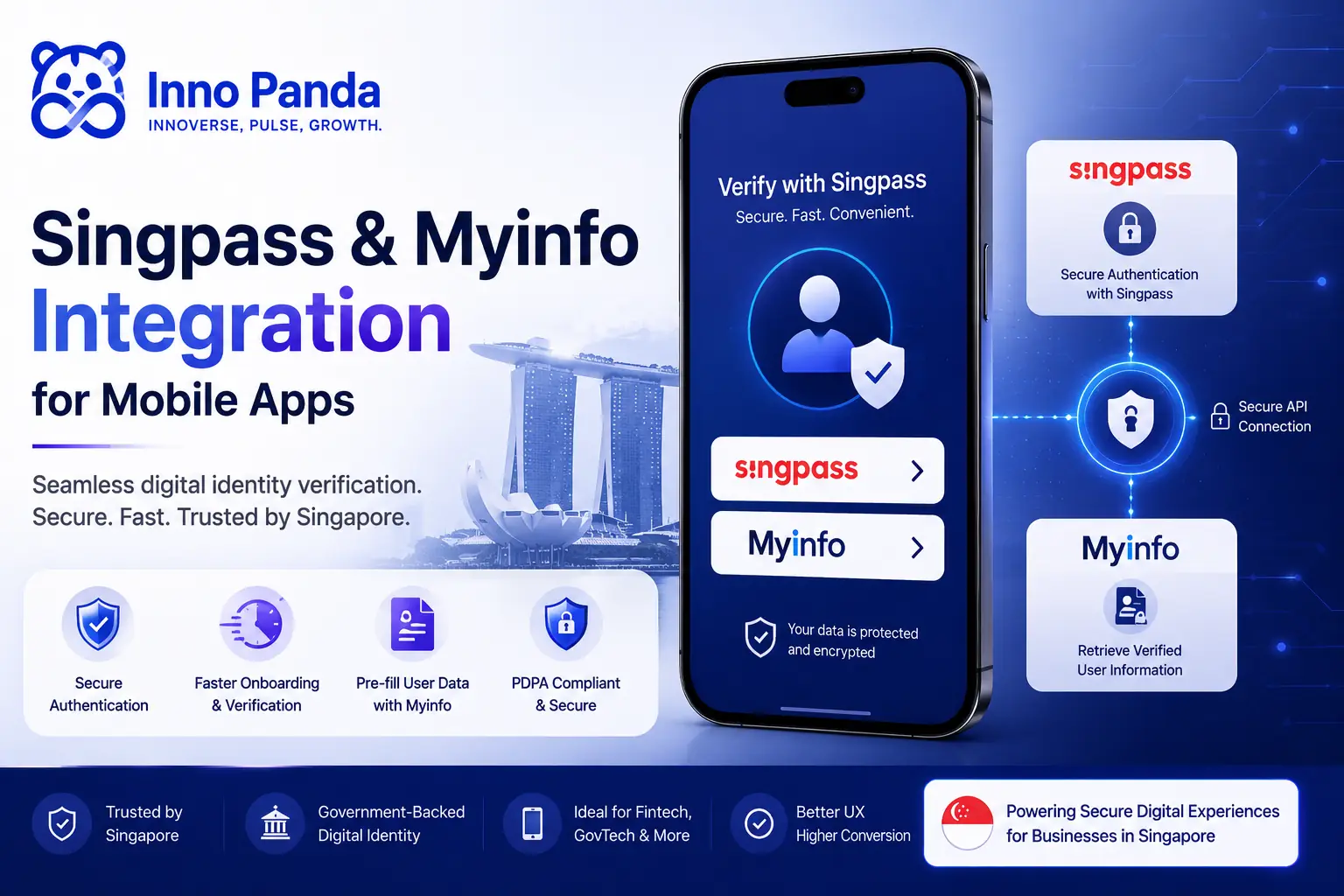
Key Takeaways
- All Singpass Login and Myinfo apps must be FAPI 2.0-compliant by 31 December 2026.
- Businesses still on Myinfo v3/v4 have an earlier cutoff: migrate to Myinfo v5 by 30 September 2026.
- Singpass handles authentication, Myinfo handles verified data. Most apps use both together.
- There are no setup fees, and generous free monthly tiers cover most SMEs before usage charges apply.
- New integrations should build on the FAPI 2.0-compliant flow directly, skipping a second migration later this year.
- Fintech, healthcare, and insurance apps see the fastest onboarding gains from Singpass and Myinfo together.
What Is Singpass Integration for Mobile Apps?
Quick answer: Singpass integration lets a mobile app authenticate users through Singapore's national digital identity system, so people can log in and share government-verified data with one tap instead of creating a new password and filling in forms manually.
Singpass is no longer just a government login tool. Over 5 million residents use it, and it now processes more than 41 million transactions every month across over 2,700 digital services, spanning both government agencies and private businesses. When an app integrates Singpass, it's plugging into infrastructure almost every adult in Singapore already trusts and already has installed on their phone.
For businesses, that trust is the real value. A new user doesn't need to invent another password or upload a photo of their NRIC. They authenticate with a fingerprint, face scan, or the Singpass app, and they're in.
Singpass vs Myinfo: What's the Difference
These two terms get used interchangeably, but they do different jobs, and understanding the split matters for planning an integration.
| System | What It Does | Example in an App |
|---|---|---|
| Singpass | Authenticates the user, confirms "this person is who they say they are" | One-tap login via QR code, biometrics, or the Singpass app |
| Myinfo | Shares the user's government-verified personal data, once they've consented | Auto-filled name, address, and date of birth on a signup form |
| Singpass Verify / Identiface | Adds biometric or QR-based step-up verification | Face scan before approving a large transaction |
| Singpass Sign | Issues cryptographically secure digital signatures | Signing a loan agreement or consent form in-app |
| SGFinDex | Consolidates financial data across banks and government schemes | A single dashboard showing bank accounts, insurance, and CPF |
Why Singapore Businesses Are Rushing to Integrate Singpass Now
The FAPI 2.0 Deadline Explained: What Changes by 31 December 2026
FAPI 2.0, short for Financial-grade API 2.0, is a stricter, more secure authentication standard. GovTech has confirmed that all Singpass Login and Myinfo apps must be FAPI 2.0-compliant by 31 December 2026. Existing apps aren't being asked to rebuild from scratch, they can migrate their current integration to the new authentication API, and both the old and new API can run side by side during the transition so teams can test safely before switching over in production.
The practical changes to plan for include moving to pushed authorization requests, adopting a proper in-app browser flow using ASWebAuthenticationSession on iOS instead of an older WebView-based approach, and updating scope configuration in the Singpass Developer Portal if the app relies on foreign ID data, since that now lives in a separate identity claim.
Myinfo v3/v4 to v5 Migration Deadline (30 September 2026)
There's an earlier checkpoint for apps still running Myinfo v3 or v4: end of September 2026 to migrate to Myinfo v5. That's roughly two months out from today, and a separate, earlier deadline from the FAPI 2.0 one. Any new Myinfo integration built from now onward should skip v4 entirely and onboard straight onto v5.
One nuance worth flagging: Myinfo v5 apps are meant to serve a single purpose. A v4 app currently handling multiple use cases inside one integration will likely need to be split into several v5 apps during migration, rather than a simple one-to-one swap.
| Milestone | Deadline | Who's Affected |
|---|---|---|
| Myinfo v3/v4 → v5 migration | 30 September 2026 | Apps still integrated on the older Myinfo protocol |
| FAPI 2.0 compliance | 31 December 2026 | All existing Login and Myinfo (v5) apps |
| New integrations | Ongoing | Build directly on the FAPI 2.0-compliant flow to avoid a second migration |
What Happens If You Miss the Deadline
GovTech hasn't published a dramatic public penalty structure, but the practical risk is straightforward: non-compliant Login and Myinfo integrations risk service disruption once the deadline passes. For a fintech onboarding flow, an insurance claims app, or a healthcare portal, even a short outage on the identity verification layer means users can't sign up, log in, or complete a claim. That's a direct hit to revenue and trust, and it's entirely avoidable with a bit of planning.
What You Can Build With Singpass & Myinfo APIs
Once an app is inside the Singpass ecosystem, there's a full suite of APIs available, and most businesses only ever use a fraction of what's on offer.
Singpass Login
One-tap sign-in via QR code or biometrics, no new password to create, with a built-in audit trail of verified authentication.
Myinfo Auto-Fill
Users consent to share verified profile data straight from government records, so forms pre-fill instead of being typed manually.
Verify & Identiface
QR-based identity checks for in-person acquisition, plus face verification for step-up authentication on higher-risk actions.
Singpass Sign
Tamper-proof digital signatures with an audit trail, supporting compliance with Singapore's Electronic Transactions Act.
SGFinDex
Consolidates bank accounts, insurance policies, and CPF into a single consented financial view for wealth and fintech apps.
Myinfo Business
Retrieves verified company information for B2B onboarding, reducing manual document checks for corporate customers.
How Much Does Singpass & Myinfo Integration Cost in Singapore?
Login and Myinfo Free Tiers
Singpass runs on a freemium pricing model per UEN. The first 50,000 completed Login transactions per month are free, and the first 5,000 completed Myinfo Standard transactions per month are free. For most SMEs and even mid-sized apps, that covers a significant chunk of monthly activity before any usage fees apply. There are also no setup or onboarding fees for integrating with Singpass APIs; charges only apply once production usage exceeds the free thresholds.
Myinfo Standard vs Myinfo Plus Pricing
| Tier | Covers | Free Monthly Tier |
|---|---|---|
| Singpass Login | Authentication only, no personal data retrieved | First 50,000 transactions free |
| Myinfo Standard | Non-financial profile data, e.g. name, address, marital status | First 5,000 transactions free |
| Myinfo Plus | Financial profile data, e.g. income; applies if any Plus scope is retrieved | No free tier, billed per transaction |
Pricing is determined by the highest-value data scope retrieved in a transaction, so requesting even one Myinfo Plus field bills the entire transaction at the Plus rate. It's worth being deliberate about which data scopes an app actually requests.
Development Cost to Integrate Singpass Into Your App
Government-side transaction fees are only part of the picture. The bigger cost variable is development effort: building the OIDC authentication flow, handling the in-app browser session correctly on both iOS and Android, managing token exchange securely, and going through GovTech's app approval and user journey review process. For a straightforward Login and Myinfo integration, most Singapore development teams budget a few weeks of dedicated engineering time. Adding Verify, Sign, or SGFinDex extends that timeline, since each API carries its own approval and testing requirements.
Industries Benefiting Most From Singpass Integration in 2026
Fintech & Banking
Faster KYC and fewer manual document checks. Paired with SGFinDex, apps can offer a genuinely consolidated financial view without users manually linking accounts.
Healthcare & Insurance
Singpass authentication paired with Myinfo makes patient and policyholder onboarding dramatically faster, especially when apps also sync wearable data or health declarations.
Logistics, HR & Government-Adjacent Services
Delivery platforms and HR onboarding tools use Singpass Verify and Myinfo to cut paperwork and reduce fraudulent signups.
Is Singpass Safe for Your Business to Integrate?
Quick answer: Yes. Singapore's government reports no confirmed cybersecurity breaches of the core Singpass system in the last five years. The real risk sits elsewhere, with phishing scams that trick individual users into handing over their own login details, not with the system itself.
This is a fair question to ask before you build on top of any identity system. In a written parliamentary reply, Singapore's Ministry of Digital Development and Information confirmed there were no cybersecurity breaches detected in the Singpass system over the past five years. Myinfo data isn't stored in one central vault either. It sits across multiple government systems, each protected with end-to-end encryption and layered security controls.
The Real Threat: Phishing, Not System Hacks
Most Singpass account compromises don't come from a break-in on the government side. They come from scams. A user gets tricked into sharing an OTP or approving a login they didn't request. Security researchers have found stolen Singpass credentials for sale on the dark web, almost always traced back to phishing or social engineering, not a flaw in Singpass itself. This matters for how you design your app: your own anti-fraud messaging and clear consent screens do real work here, even though the underlying identity system is solid.
Singpass Passkeys: What's Rolling Out in 2026
To cut phishing risk even further, GovTech began rolling out passkey login for Singpass on 1 July 2026, starting with iPhone users. Passkeys use a device-bound credential instead of a password or OTP, which makes it much harder for a scammer to remotely take over an account, even if they trick a user into giving up other details. If your app uses Singpass Login, your users benefit from this improvement automatically, with no extra work needed on your end.
MAS Compliance for Financial Institutions
If you're a bank, insurer, or fintech, there's good news on the compliance side too. The Monetary Authority of Singapore has confirmed that outsourcing arrangements which are wholly provided by GovTech, or by agents appointed by GovTech, are not subject to MAS's usual Outsourcing Guidelines. In plain terms: using official Singpass and Myinfo APIs doesn't trigger the same outsourcing risk review that a third-party vendor normally would.
Already trusted by Singapore's biggest banks: DBS and UOB have both built Myinfo into their core digital journeys, using it to speed up account opening, card applications, and loan approvals without manual document uploads. When major banks route regulated financial onboarding through Myinfo, it's a strong signal for any business still deciding whether to trust it with their own signup flow.
How to Integrate Singpass Into Your Mobile App: Step-by-Step
Step 1 — Register Your App on the Singpass Developer Portal
Every integration starts here. Register your business, define your app's purpose, and select the specific data scopes needed. GovTech reviews this to ensure only genuinely relevant data is being requested.
Step 2 — Choose Your Integration Type (OIDC, In-App Browser)
Singpass uses the OpenID Connect (OIDC) protocol for authentication. For mobile apps, GovTech requires a proper in-app browser implementation rather than a basic embedded WebView, using ASWebAuthenticationSession on iOS or the Android equivalent, to keep the authentication session secure and separate from the app's own storage.
Step 3 — Build and Test in the Singpass Sandbox
Once your app is registered, you get access to a staging environment. This is where you build and test safely, before anything touches real user data. GovTech provides ready-made test personas that simulate real Myinfo responses, so you can test your onboarding flow end to end without needing a live Singpass account. You'll also find OIDC libraries and sample code in several programming languages on GovTech's public GitHub, including working examples for the FAPI 2.0 flow, which saves your dev team from building the authentication layer from a blank page.
Step 4 — Build for FAPI 2.0 Compliance From Day One
For any integration starting in the second half of 2026, there's no reason to build on the older API and migrate later. Build directly on the FAPI 2.0-compliant flow with pushed authorization requests from the start, and avoid a second migration project entirely.
Step 5 — Submit for Approval and Go Live
Once your staging tests pass, you submit your app for production approval. GovTech typically takes up to two weeks to review a production app, so it's worth building this into your project timeline rather than assuming an instant turnaround. Once approved, the new integration can run alongside any legacy flow during a transition window, which makes for a much safer rollout than a hard cutover.
Common Mistakes Businesses Make With Singpass Integration
Data mistakeRequesting more Myinfo data scopes than actually used. Every unused field is a privacy liability and can push an otherwise-Standard transaction into the more expensive Myinfo Plus tier.
Timeline mistakeTreating the FAPI 2.0 migration as a "later" problem. With the deadline landing at the end of this year, rushed migrations under deadline pressure are where security mistakes happen.
Technical mistakeUsing a basic WebView instead of a proper in-app browser session. This common shortcut fails GovTech's security review and has to be redone anyway.
Planning mistakeSkipping the user journey review early in planning. GovTech assesses the consent flow and data justification before approval, and surprises here can delay a launch by weeks.
Structure mistakeNot separating Myinfo v5 apps by purpose. A single integration trying to serve multiple use cases tends to get flagged during review and needs to be restructured.
Why Businesses Choose Inno Panda for Singpass & Myinfo Integration
We build mobile apps and handle API integrations for Singapore businesses across fintech, healthcare, and insurance, including Singpass, Myinfo, and SGFinDex integrations built to current GovTech standards from day one. Whether it's a fresh integration or a migration ahead of the FAPI 2.0 deadline, the work is far more manageable when it's planned rather than rushed in December.
Building In-House vs Working With an Integration Partner
| In-House Build | Working With Inno Panda | |
|---|---|---|
| Speed to compliance | Depends on existing team bandwidth and GovTech familiarity | Structured rollout against known deadlines |
| Approval process | First-time submissions often face review delays | User journey and scope justification prepared in advance |
| Technical implementation | Risk of WebView shortcuts that fail security review | Built on the correct in-app browser flow from the start |
| Best for | Teams with existing Singpass integration experience | Businesses wanting it handled correctly the first time |
Quick Glossary: Key Singpass Terms Explained
Before the FAQs, here's a fast reference for the terms used throughout this guide.
- Singpass
- Singapore's national digital identity system, used to authenticate users across government and private-sector digital services.
- Myinfo
- The data-sharing layer built on top of Singpass, letting users consent to share government-verified personal data with a business.
- FAPI 2.0
- Financial-grade API 2.0, a stricter authentication security standard that all Singpass Login and Myinfo apps must comply with by 31 December 2026.
- OIDC (OpenID Connect)
- The authentication protocol Singpass uses to verify a user's identity and issue a signed ID token to the integrating app.
- Pushed Authorization Request (PAR)
- A more secure way of sending authorization request parameters, required as part of the FAPI 2.0-compliant flow.
- Myinfo Standard vs Myinfo Plus
- Standard covers non-financial profile data; Plus covers financial data such as income, and is billed at a higher rate.
- SGFinDex
- A service that consolidates a user's financial data, including bank accounts, insurance, and CPF, into a single consented view.
- UEN
- Unique Entity Number, Singapore's business registration identifier, used to track a business's free transaction tiers on Singpass APIs.
- Passkey
- A device-bound login credential that replaces passwords and OTPs. Singpass began rolling passkeys out on 1 July 2026, starting with iPhone users, to reduce phishing risk.
- Sandbox / Staging Environment
- A safe testing environment where a business can build and test its Singpass integration using test personas, before going live with real user data.
- MAS Outsourcing Guidelines
- Rules from the Monetary Authority of Singapore governing how financial institutions manage third-party vendor risk. Services provided directly by GovTech, including Singpass and Myinfo, are exempt from this review.
Frequently Asked Questions
What is FAPI 2.0 and why does Singpass require it?
FAPI 2.0 is a stricter, financial-grade authentication security standard. GovTech has adopted it to strengthen how identity tokens are issued and verified, reducing the risk of interception or misuse during the login process.
Is Singpass integration free for businesses?
There are no setup or onboarding fees. Singpass Login and Myinfo Standard both come with generous monthly free transaction tiers, and charges only apply once production usage exceeds those thresholds.
How long does it take to integrate Singpass into an app?
A standard Login and Myinfo integration typically takes a few weeks of development time, including GovTech's review process. Adding Verify, Sign, Identiface, or SGFinDex extends the timeline since each has its own approval requirements.
Can foreigners use Singpass and Myinfo?
Yes. Foreigners with a valid Singpass account, such as Foreign Identification Number holders, have a Myinfo profile and can use these services the same way citizens and permanent residents do.
Do I still need PDPA compliance if I use Singpass integration?
Yes. Singpass and Myinfo integration supports good data-handling practice, but it doesn't replace broader PDPA obligations around consent, storage, and data retention across the rest of the app.
What is the difference between Myinfo Standard and Myinfo Plus?
Myinfo Standard covers non-financial personal data such as name and address, while Myinfo Plus covers financial profile data such as income. Pricing is based on the highest-value data scope retrieved in a given transaction.
What happens if I don't migrate before the FAPI 2.0 deadline?
Integrations that aren't FAPI 2.0-compliant by 31 December 2026 risk disruption to their Login and Myinfo services, which for most apps means new users can't sign up and existing users can't authenticate until it's fixed.
Is Singpass safe for my business to integrate?
Yes. Singapore's government has confirmed no cybersecurity breaches of the core Singpass system in the last five years. The main risk comes from phishing scams targeting individual users, not weaknesses in the system itself.
What is the Singpass passkey feature?
Passkeys are a device-bound login method that replace passwords and OTPs, making accounts harder to take over remotely. GovTech began rolling this out for iPhone users on 1 July 2026, and apps using Singpass Login benefit automatically.
How do I test my Singpass integration before going live?
GovTech provides a staging environment with ready-made test personas that simulate real Myinfo responses, plus sample code and OIDC libraries on GitHub, so you can test your full onboarding flow safely before submitting for production approval.
Do financial institutions need special MAS approval to use Singpass APIs?
No additional outsourcing review is required. MAS has confirmed that services provided directly by GovTech, including Singpass and Myinfo, fall outside its usual Outsourcing Guidelines for financial institutions.
Need Your App Compliant Before 31 December 2026?
Inno Panda builds and migrates Singpass, Myinfo, and SGFinDex integrations for Singapore businesses, built to current GovTech standards from day one, not bolted on after a security review flags it.