Syncing About Case Study: How Multi-Channel Inventory Sync Stopped Overselling for a Singapore Retailer
- 1 Syncing About Case Study: How Multi-Channel Inventory Sync Stopped Overselling for a Singapore Retailer
- 1.1 Key Takeaways
- 1.2 What Is Multi-Channel Inventory Management Software?
- 1.3 Why Do Sellers Oversell Across Shopify, Shopee, and Lazada?
- 1.4 The Challenge: One Retailer's Manual Stock Problem
- 1.5 How Syncing About Solves Multi-Channel Overselling
- 1.6 Before and After: What Changed With Real-Time Sync
- 1.7 Every Channel Syncing About Connects To
- 1.8 How the Rollout Actually Happened
- 1.9 Who This Case Study Is Most Relevant To
- 1.10 Quick Glossary
- 1.11 Frequently Asked Questions
- 1.12 Related Reading from Inno Panda
- 1.13 Still Matching Stock by Hand Across Channels?
This retailer sold on Shopify, Shopee, and Lazada. Every night, staff checked stock by hand. The numbers never matched. Here's how real-time sync fixed it. The same fix works for any multi-channel seller.
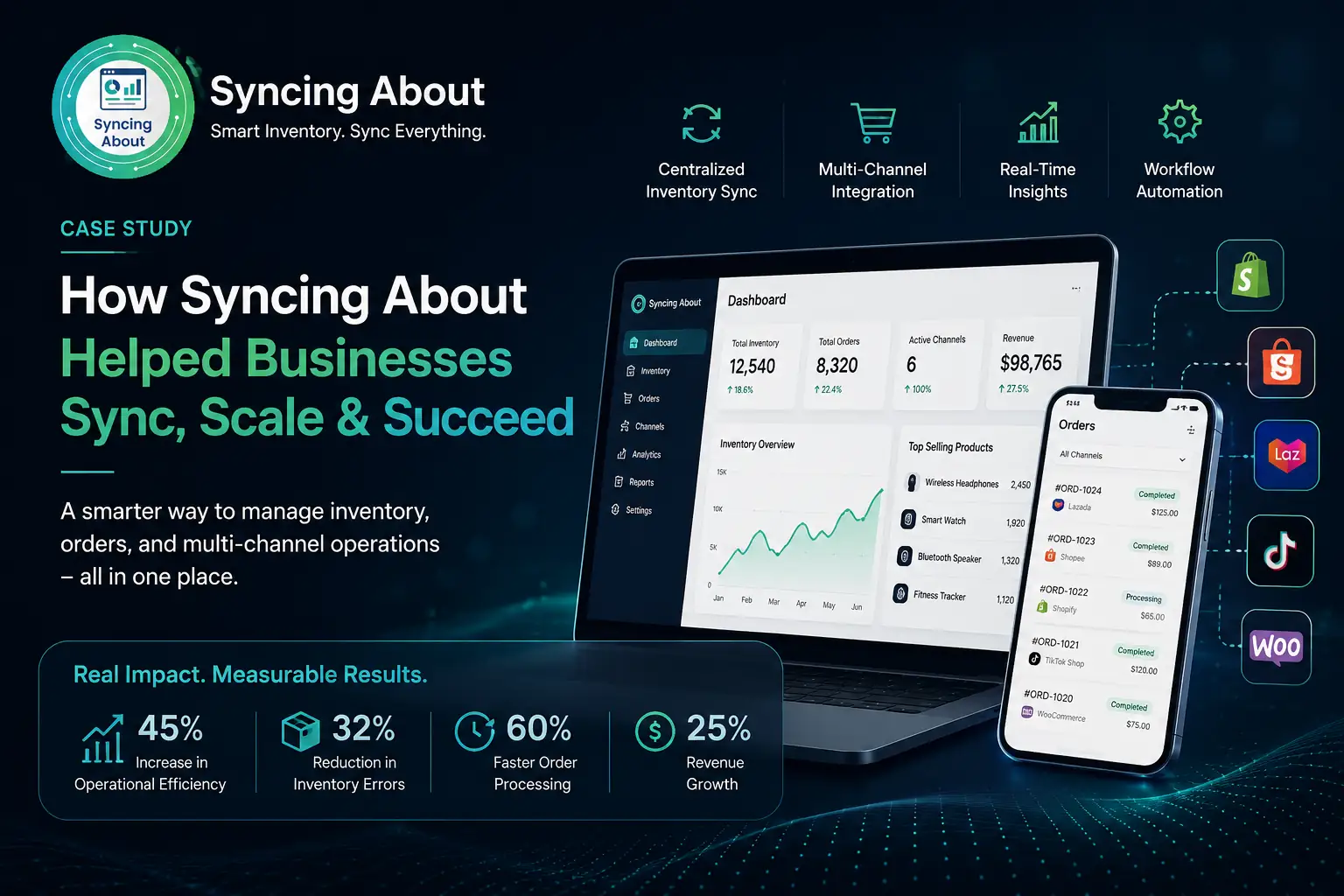
Quick answer: Multi-channel inventory software keeps stock the same on every channel. Syncing About, built by Inno Panda, syncs Shopify, WooCommerce, Shopee, Lazada, TikTok Shop, Amazon, and in-store POS. It works in real time. A sale on one channel updates stock everywhere else in seconds. This case study shows how one Singapore retailer made that switch. It also covers what changed after.
Key Takeaways
- The retailer sold the same products on Shopify, Shopee, and Lazada.
- Staff updated stock on each channel by hand.
- Manual updates caused overselling and refunds. Sale days were the worst.
- Syncing About now syncs stock, orders, and fulfilment in one dashboard, in real time, online and in-store.
- The team rolled it out one channel at a time, busiest first.
- Since going live, overselling has dropped, and daily manual stock checks are largely gone.
What Is Multi-Channel Inventory Management Software?
Multi-channel inventory software links every place you sell into one stock count. That includes online stores like Shopify. It includes marketplaces like Shopee and Lazada. It also includes physical shops. When something sells anywhere, the stock number updates everywhere else, right away.
Without it, sellers update each channel by hand. That works fine at low volume. Once a business sells on three or four channels, manual updates fall behind. A stock count that's a few hours old is enough to sell something that isn't there.
Why Do Sellers Oversell Across Shopify, Shopee, and Lazada?
Overselling happens when a product sells out on one channel. The other channels still show it as available. The seller has to cancel the order. Then they refund the buyer and explain what went wrong. This is common for any business on more than one platform. It gets worse during big sale events, when orders spike fastest.
Why it matters beyond the refund: Shopee and Lazada also track seller scores. Cancelled orders can pull those scores down. Lower scores mean listings show up less in search results.
The Challenge: One Retailer's Manual Stock Problem
Details below come from an anonymised composite of Inno Panda client work, to protect client privacy.
The client sells home and lifestyle products in Singapore. They sell on three channels: Shopify, Shopee, and Lazada. Each channel was added at a different time. Stock was never linked between them.
Every update meant logging into three dashboards. Staff changed the same number by hand, one at a time. When something sold out on one channel, the others didn't know yet. Sometimes the gap was a few hours. Sometimes it was a full day.
The breaking point came during a peak sale. Several products sold out on one channel. They stayed listed on the other two. Every order after that had to be cancelled and refunded by hand.
How Syncing About Solves Multi-Channel Overselling
What the Retailer Needed
A basic stock tool wasn't enough. The retailer needed something built for Singapore sellers. That means the local mix of channels, SGD pricing, and the shipping setup they already had. That's the gap Syncing About closes.
How It Works
Syncing About puts Shopify, Shopee, and Lazada on one dashboard. It syncs in real time. A sale on any channel updates stock on the others within seconds. There's no delay. Orders from all three flow into one screen. The team fulfils orders from one place, not three logins.
How the Rollout Was Planned
Channels went live one at a time, not all at once. The busiest channel came first. The team watched it closely for a few weeks. Then they added the rest. Live sales kept running smoothly the whole time.
What Changed Day to Day
Stock counts across all three channels now match, all the time. Nobody opens three dashboards each morning to check by hand. Overselling used to be routine. Now it's rare.
Before and After: What Changed With Real-Time Sync
| Process | Before Syncing About | After Syncing About |
|---|---|---|
| Stock updates | Updated by hand on each platform, once a day or when remembered | Synced automatically within seconds of any sale |
| Order handling | Three separate dashboards, checked one at a time | One dashboard for every channel |
| Overselling risk | High during peak sales, caused by sync lag | Low, stock shows the same number everywhere at once |
| Admin time | A few hours a week spent matching stock by hand | Mostly gone for routine stock checks |
| Adding a new channel | Avoided, it meant more manual work | Easy, added in phases |
Every Channel Syncing About Connects To
This retailer's rollout covered three channels. But Syncing About isn't limited to three. The same sync engine also connects WooCommerce, TikTok Shop, and Amazon. It includes a built-in POS too. A sale at a physical counter updates online stock. It works the same way an online sale updates every other channel.
Syncing About also includes AI demand forecasting. It looks at sales trends across every channel. Then it suggests safety stock levels. Sellers can plan ahead, instead of just reacting to sync alerts.
How the Rollout Actually Happened
Audit & First Connection
Mapped stock steps across all three platforms. Linked the busiest channel first. Checked that sync worked, without upsetting the others.
Stabilise, Then Expand
Watched the first channel for a few weeks to see how well it held up. Then linked the last two. This caught bugs early.
Full Rollout & Monitoring
All three channels now run on real-time sync. The team keeps an eye out for platform changes that could throw off stock counts.
Who This Case Study Is Most Relevant To
Quick Glossary
- Multi-Channel Selling
- Selling the same products on more than one platform. For example, a Shopify store plus Shopee and Lazada.
- Real-Time Inventory Sync
- Stock levels update on every channel within seconds of a sale. There's no scheduled delay.
- Overselling
- Selling something that's already out of stock, because one channel hadn't yet shown a sale made on another.
- Webhook-Based Sync
- A way a platform sends an instant update the moment something happens. The system doesn't have to check on its own.
- AI Demand Forecasting
- Using past sales to guess what will sell next. It suggests safe stock levels ahead of time.
Frequently Asked Questions
What is multi-channel inventory management software?
It's software that keeps stock the same across every channel you sell on. That includes Shopify, Shopee, Lazada, and physical stores. It updates stock in real time. A sale on one channel shows up everywhere else within seconds.
What platforms does Syncing About sync inventory across?
Syncing About connects Shopify, WooCommerce, Shopee, Lazada, TikTok Shop, and Amazon into one dashboard. It also connects in-store POS. Stock updates the moment a sale happens on any channel.
How does real-time inventory sync stop overselling?
Real-time sync updates stock the moment a sale happens. There's no delay. This closes the gap where a product looks available after it's already sold out elsewhere. That gap is the main cause of overselling.
How is Syncing About different from a generic inventory tool?
Syncing About is built for how Singapore sellers actually operate. That means the local marketplace mix, SGD pricing, and 3PL fulfilment. It also supports Shopify, WooCommerce, Amazon, and in-store POS. It isn't a global tool retrofitted for the region.
How long does it take to onboard onto Syncing About?
Most sellers connect their busiest channel first. That's usually stable within a couple of weeks. The rest are added in phases, not all at once.
Does Syncing About work for physical stores, not just online channels?
Yes. Syncing About includes a built-in POS. An in-store sale updates online stock, the same way an online sale updates every other channel. It also includes AI demand forecasting, to help sellers plan stock ahead of time.
Still Matching Stock by Hand Across Channels?
This is exactly the problem Syncing About solves. Overselling, sync failures, and hours lost to manual work are common. They're also fixable. Our team can walk you through a rollout plan for your channel mix.