Why Local SEO Still Matters for Businesses in 2026
- 1 Why Local SEO Still Matters for Businesses in 2026
- 1.1 Introduction
- 1.2 What Is Local SEO?
- 1.3 Why Local SEO Still Matters in 2026
- 1.4 Key Benefits of Local SEO for Businesses
- 1.5 How Google Determines Local Search Rankings
- 1.6 Essential Local SEO Ranking Factors in 2026
- 1.7 10 Proven Local SEO Strategies That Deliver Results in 2026
- 1.7.1 Claim and Fully Optimize Your Google Business Profile
- 1.7.2 Build a Steady Flow of Google Reviews
- 1.7.3 Fix NAP Consistency Across the Web
- 1.7.4 Build Local Citations on Relevant Directories
- 1.7.5 Create Location-Specific Landing Pages
- 1.7.6 Target Local Keywords With Real Search Intent
- 1.7.7 Add Local Business Schema Markup
- 1.7.8 Earn Local Backlinks and Press Mentions
- 1.7.9 Keep Your Website Mobile-Friendly and Fast
- 1.7.10 Post Regularly and Track Google Business Profile Insights
- 1.8 Common Local SEO Mistakes to Avoid
- 1.9 Local SEO Checklist for 2026
- 1.10 Which Businesses Benefit Most from Local SEO?
- 1.11 How to Measure the Success of Your Local SEO Strategy
- 1.12 Why Partner with a Professional Local SEO Agency?
- 1.13 Why Choose Inno Panda for Local SEO Services Across Southeast Asia (SEA)?
- 1.14 Frequently Asked Questions (FAQs)
- 1.15 Conclusion
- 1.16 Ready to Win Your Local Search Rankings?
Every year, someone predicts local SEO is "dying." Every year, near-me searches climb higher instead. Here's what's actually changed for local search in 2026, and why businesses that skip it are handing customers straight to competitors.
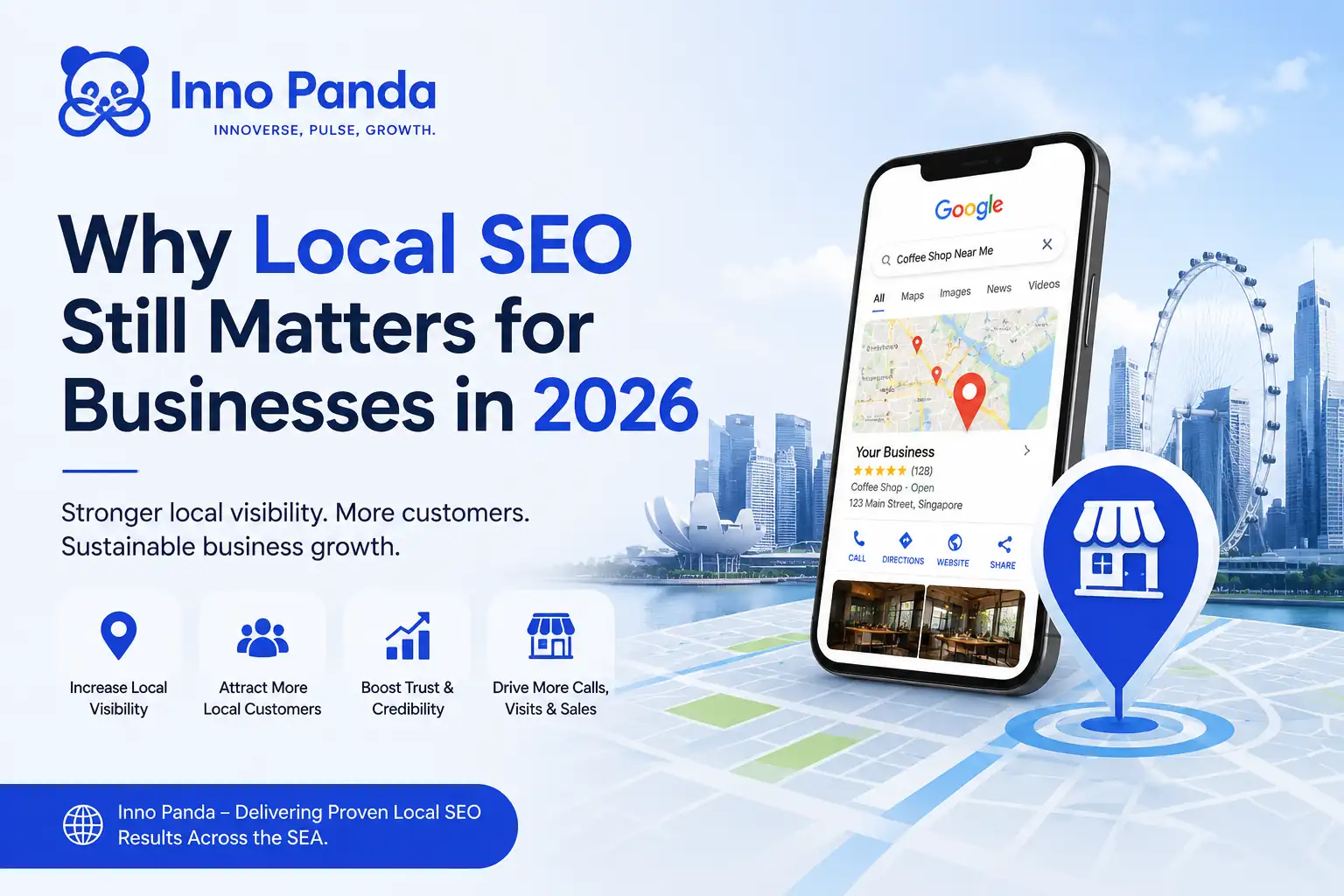
Introduction
If you've ever typed "coffee shop near me" or asked your phone to find a plumber tonight, you've already experienced local SEO at work, you just didn't see it happening. It's the reason one business shows up first and the other doesn't.
This channel keeps getting written off as an old tactic. But the data tells a different story. Near-me searches have grown at a pace few other search categories can match, and Google's local results now decide who gets the call, the visit, or the booking before a customer ever reaches your website. This guide breaks down why local SEO still matters in 2026, how Google actually ranks local businesses, and the exact strategies worth your time this year.
What Is Local SEO?
Local SEO is the process of optimizing your online presence so people searching nearby can find, choose, and contact your business. Unlike traditional SEO, which competes for visibility across an entire country or the whole web, it narrows the fight to a specific city, neighborhood, or service area.
It combines several moving parts working together: your Google Business Profile, your website's local pages, your customer reviews, your business citations across directories, and the consistency of your name, address, and phone number (NAP) everywhere your business appears online. Get these right, and Google has everything it needs to confidently show your business to the right nearby customer at the right moment.
Why Local SEO Still Matters in 2026
This isn't a relic from the early days of Google Maps. If anything, 2026 is the year local search matters most, because search behavior has shifted almost entirely toward instant, location-based decisions.
The Near-Me Search Boom Isn't Slowing Down
"Near me" style searches have grown at a remarkable pace over the past two years, and a large share of Google's daily search volume now carries local intent. Most people who search for something nearby take action within a day, whether that's visiting, calling, or making a purchase. That's not casual browsing, that's a customer standing at the door, and your local search visibility decides whether they knock on yours or the competitor's down the street.
AI Search Is Changing How People Find Local Businesses
AI Overviews, chat-based assistants, and voice search are reshaping how people discover businesses nearby, but they haven't replaced the fundamentals, they depend on them. These tools pull business details straight from your Google Business Profile, your website content, and your reviews. A business with weak or inconsistent local signals simply doesn't get mentioned, no matter how good its products or service actually are.
Multi-Platform Local Search: It's Not Just Google Anymore
Google Maps still drives most of the traffic, but Apple Maps, Bing Places, and AI assistants like ChatGPT and Perplexity now surface local recommendations too, often pulling from the same business data. A complete, well-structured profile on Google is no longer the finish line, it's the baseline. Businesses that keep their listings consistent across every platform show up more often, no matter where the customer starts their search.
Key Benefits of Local SEO for Businesses
Beyond visibility, this channel delivers a set of practical, measurable benefits that compound the longer you invest in it.
How Google Determines Local Search Rankings
Google's own documentation is direct about this: local rankings come down to three pillars, relevance, distance, and prominence. Every ranking factor you've ever read about feeds into one of these three.
Relevance, Distance, and Prominence Explained
Relevance measures how well your business matches what someone typed, pulled from your primary category, service descriptions, and website content. Distance is simply how close you are to the searcher, or to the location they specified, and it's the one factor you can't directly change. Prominence reflects how well-known and trusted your business appears online, built from review volume, backlinks, and citation consistency. You can't move your address, but you can out-optimize competitors on relevance and prominence, and that's usually enough to beat a closer rival with a weaker profile.
Essential Local SEO Ranking Factors in 2026
Local ranking factors group into a handful of signal categories. Here's roughly how much weight each one tends to carry, based on current industry benchmarking.
| Signal Group | Approx. Weight | What It Covers |
|---|---|---|
| Google Business Profile signals | 32% | Primary category, completeness, business description, posts |
| On-page & website signals | 19% | NAP consistency, local content, service area pages |
| Review signals | 16-20% | Review count, star rating, recency, owner responses |
| Link signals | 15% | Local backlinks, brand mentions, domain authority |
| Behavioral signals | 8% | Clicks, calls, and direction requests from your listing |
| Citation signals | 7% | Consistency of your business details across directories |
Notice how much weight sits inside your Google Business Profile alone. A half-finished profile is one of the fastest ways to lose a spot in the Local Pack, no matter how strong the rest of your strategy is.
Why E-E-A-T Now Shapes Local Rankings Too
E-E-A-T, experience, expertise, authoritativeness, and trustworthiness, isn't just a concept for blog content anymore. It shows up directly in how Google scores local businesses. Real customer photos instead of stock images demonstrate experience. Detailed service pages written by people who actually do the work demonstrate expertise. Consistent citations and quality backlinks build authority. Genuine, responded-to reviews build trust. Businesses that show real proof of their work in these four areas consistently outperform ones that just check the technical boxes.
10 Proven Local SEO Strategies That Deliver Results in 2026
Claim and Fully Optimize Your Google Business Profile
Complete every field, choose the most accurate primary category, and keep hours, services, and photos current. This single asset carries the most local ranking weight of anything you control.
Build a Steady Flow of Google Reviews
Ask happy customers to leave a review right after service, and respond to every review, good or bad. Recency and volume both matter more than a single high rating.
Fix NAP Consistency Across the Web
Your business name, address, and phone number should match exactly across your website, directories, and social profiles. Inconsistencies quietly erode Google's trust in your listing.
Build Local Citations on Relevant Directories
List your business on the directories that matter for your city and industry, not every directory that exists. Quality and consistency beat sheer quantity.
Create Location-Specific Landing Pages
If you serve multiple areas, build a dedicated page for each one instead of a single generic page. This gives Google far clearer relevance signals to match against local searches.
Target Local Keywords With Real Search Intent
Go beyond your city name. Include neighborhood names, landmarks, and service-specific phrases that match how people actually search when they're ready to act.
Add Local Business Schema Markup
Structured data helps Google, and increasingly AI search tools, read your address, hours, and services accurately, which reduces the chance of being left out of AI-generated answers.
Earn Local Backlinks and Press Mentions
Links from local news outlets, chambers of commerce, and community partners carry outsized weight in prominence, the ranking factor most businesses under-invest in.
Keep Your Website Mobile-Friendly and Fast
Most local searches happen on a phone. A slow or clunky mobile site loses the customer before they even reach your contact details.
Post Regularly and Track Google Business Profile Insights
Active profiles with recent posts and photos signal a real, operating business. Review your GBP insights monthly to see what's actually driving calls and direction requests.
Common Local SEO Mistakes to Avoid
Treating Google Business Profile as a One-Time Setup
A profile you claim and never touch again slowly loses ground to competitors who post updates, add photos, and respond to reviews weekly.
Ignoring Negative Reviews Instead of Responding
Unanswered negative reviews hurt trust more than the review itself. A calm, professional response often reassures future customers more than a wall of five-star ratings alone.
Inconsistent NAP Details Across Directories
An old phone number on one directory and a slightly different address on another sends mixed signals that quietly cap your rankings, even when everything else is strong.
Keyword-Stuffing the Google Business Profile Name
Adding extra keywords into your business name to game rankings now risks profile suspension. Google enforces this policy far more aggressively than it used to.
Skipping Local SEO for Service-Area Businesses
Businesses that travel to customers instead of operating from a storefront still need a complete profile, a defined service area, and location-relevant content, not just a website with no local signals at all.
Local SEO Checklist for 2026
Which Businesses Benefit Most from Local SEO?
This investment isn't equally urgent for every business, but it delivers the strongest returns for businesses with a physical presence, a defined service area, or repeat local demand.
| Business Type | Why It Matters |
|---|---|
| Retail stores & showrooms | Captures nearby shoppers searching before an in-store visit |
| Clinics & healthcare providers | Wins trust-driven, high-intent appointment searches |
| Restaurants & cafes | Dominates "open now near me" and reservation searches |
| Home services (plumbers, electricians) | Captures urgent, same-day service-area searches |
| Real estate agencies | Builds neighborhood-level authority and lead capture |
| Salons & wellness studios | Drives repeat bookings through reviews and proximity |
| Multi-location franchises | Needs consistent, location-by-location optimization |
How to Measure the Success of Your Local SEO Strategy
Results show up across a few clear metrics, and tracking them monthly tells you whether your local search strategy is actually working.
Why Partner with a Professional Local SEO Agency?
Local search rewards consistency, and consistency is exactly what most business owners run out of time for. A professional agency brings the tools to track rankings and citations properly, the experience to avoid Google Business Profile suspensions, and the bandwidth to manage reviews, content, and technical fixes at the pace Google actually rewards.
Local SEO for Multi-Location and Franchise Businesses
Managing multiple locations is a different job entirely from optimizing a single storefront. Each branch needs its own optimized Google Business Profile, its own location page, and its own review strategy, while still keeping brand messaging and NAP details consistent across every listing. Doing this manually across five, ten, or fifty locations quickly becomes a full-time role on its own, which is exactly where a dedicated team pays for itself.
Why Choose Inno Panda for Local SEO Services Across Southeast Asia (SEA)?
Inno Panda works with businesses across Singapore, Malaysia, Indonesia, and the Philippines, which means our team understands regional search behavior, not just generic templates. Our Local SEO services cover full Google Business Profile optimization, citation building, review management, and location-specific content, built around how customers in each SEA market actually search.
We pair local search optimization with our broader SEO services so your local visibility and overall organic growth move together instead of working in silos. If you're ready to see where your business currently stands, talk to our team for a straightforward look at your local search visibility.
Frequently Asked Questions (FAQs)
What is local SEO and how does it work?
Local SEO is the practice of optimizing your online presence so nearby customers can find, choose, and contact your business. It works by giving Google clear, consistent signals through your Google Business Profile, website, reviews, and citations, so the algorithm can confidently match you to local search queries.
Why is local SEO important for small businesses?
Small businesses depend on nearby customers finding them at the exact moment they're ready to buy. Local SEO puts a business directly in front of that high-intent traffic, often at a lower cost per lead than paid ads, and the visibility compounds over time instead of disappearing when a budget runs out.
How long does local SEO take to show results?
Most businesses start seeing movement in Google Business Profile visibility and Local Pack rankings within 2 to 4 months, with more competitive categories or cities taking 4 to 6 months. Reviews, citations, and content all build authority gradually, so early consistency matters more than any single quick fix.
Is local SEO still worth it in 2026 with AI search on the rise?
Yes. AI-powered search and chat assistants still pull local business information from the same sources local SEO strengthens, Google Business Profile, structured website content, and reviews. Businesses with strong local SEO foundations are the ones AI tools recommend, not the ones left out of the conversation.
How much does local SEO cost?
Costs vary by market and competition, but single-location businesses typically invest a modest monthly retainer for ongoing optimization, while multi-location or franchise businesses pay more due to the added complexity of managing multiple listings and location pages.
What is the difference between SEO and local SEO?
SEO aims to rank a website in general search results, often nationally or globally. Local SEO narrows that focus to a specific geography, optimizing for map-based results, near-me searches, and location-specific keywords so a physical or service-area business gets found by nearby customers.
How many Google reviews do I need to rank in the local map pack?
There's no fixed number, but a noticeable ranking shift tends to happen around 10 reviews, and industry research shows a large share of consumers hesitate to choose a business with fewer than 20. A steady flow of recent, responded-to reviews matters more than hitting one static number.
Can I do local SEO myself, or do I need an agency?
A single-location business with time to spare can handle the basics, claiming a Google Business Profile, requesting reviews, and keeping details consistent. Once you need citation building, technical fixes, content at scale, or multi-location management, a professional local SEO agency typically moves faster and avoids costly missteps.
Conclusion
Local SEO hasn't lost relevance in 2026, it's become the foundation everything else in local search gets built on, including how AI tools decide who to recommend. The businesses winning right now aren't doing anything exotic. They're keeping their Google Business Profile complete, earning reviews consistently, and making sure every local signal points the same direction. That's the whole game, done consistently, for long enough to compound.
Ready to Win Your Local Search Rankings?
Get a clear, honest look at where your business currently stands in local search, and exactly what it would take to move up. No generic audit, no guesswork.